You installed solar expecting to generate 400 to 500 units per month. Your monitoring app shows 280 units. Something is wrong, but what? Low solar generation is one of the most common complaints we hear from homeowners after installation, and the root cause is almost never what people first assume.
In our experience across 10,000+ installations, eight causes account for over 90% of underperformance cases. Some are simple fixes you can do yourself. Others require a professional inspection. All are diagnosable within 30 minutes with the right checklist.
Key takeaway. Low solar generation in India is most often caused by panel soiling, shading from new obstructions, inverter faults, or incorrect system monitoring, not panel degradation. Heaven Green Energy’s free performance audit can identify the cause and restore output in most cases within 24 to 48 hours. A properly maintained system should generate within 5% of its design output year-round.
The diagnostic process matters because blindly replacing components is expensive and often unnecessary. Start with the checklist below, then escalate to professional testing only if the simple checks don’t resolve the issue.
How to Establish Your Baseline Expected Generation
Before diagnosing a problem, you need to know what your system should be generating, otherwise you can’t tell if you have an actual issue.
The baseline formula:
Expected monthly kWh = System kW × Peak sun hours × 30 × System efficiency (%)
For a 3 kW system in Ahmedabad:
- 3 kW × 5.5 hr/day × 30 days × 0.80 efficiency = 396 kWh/month
If your app shows 280 kWh, you’re at 70% of baseline, a meaningful 30% shortfall that warrants investigation.
Peak sun hours by city:
| City | Annual Avg Peak Sun Hours/Day | Expected kWh/kW/month |
|---|---|---|
| Ahmedabad | 5.5 | 132 |
| Surat | 5.3 | 127 |
| Jaipur | 5.7 | 137 |
| Mumbai | 4.8 | 115 |
| Pune | 5.0 | 120 |
| Delhi | 5.2 | 125 |
| Chennai | 5.4 | 130 |
Approximate annual averages; your installer’s site simulation gives the exact figure for your roof.
A shortfall in monsoon months (June–September) is normal, reduced irradiance is expected; in Gujarat, July and August output can run 30 to 40% below the annual monthly average (PVGIS estimate for Ahmedabad). A 20 to 30%+ shortfall in November–March in Gujarat is abnormal and needs investigation.
Also check: are you comparing to the same month last year? Generation naturally varies ±15% across seasons. Use a full-year comparison for the most accurate baseline. The solar panel maintenance guide explains how to read your monitoring app and set seasonal expectations.
Cause 1, Panel Soiling and Dust Accumulation
Dust, bird droppings, and leaf debris on panels block sunlight from reaching the solar cells. In Gujarat and Rajasthan, where construction dust and sand are common, unclean panels can lose 15 to 30% of their output within 2 to 3 weeks, a well-documented soiling loss effect.
How to check: Walk up to the roof during daylight and visually inspect the panels. If you can write your name in the dust, they need cleaning.
How to fix: Clean panels with clean water (municipal supply or borewell) and a soft cloth or squeegee. Avoid abrasive materials, they scratch the anti-reflective coating and cause permanent output loss. Clean in the early morning when panels are cool to prevent thermal shock. Do not use detergent unless your installer specifically recommends a panel-safe surfactant.
How often to clean: In Gujarat’s dry season (October–May), monthly cleaning is standard. During monsoon (June–September), rain largely handles it. Across our installed base, customers who clean monthly maintain 97 to 99% of nameplate output; those who clean every 3 to 4 months average 85 to 90%.
💡 Fast tip
Clean your solar panels before 8 am or after 5 pm. Panels heated by midday sun can be damaged by cold water, and cleaning a hot panel dries the water before you wipe it, leaving mineral deposits that reduce output further.
Cause 2, New Shading: Trees, Buildings, Water Tanks
Shading is the single most destructive cause of solar underperformance. A panel that is only partly shaded can lose far more output than the shaded area suggests (shading loss) because of the series-string architecture of most solar arrays. One partially shaded panel drags down the entire string.
How to check: Observe your roof between 9 am and 4 pm. Has a tree grown taller since installation? Did a neighbour build a new floor? Was a new water tank or AC outdoor unit placed on your roof?
What happens technically: Most string inverters use a single maximum power point tracker (MPPT) for each string of 6 to 12 panels. One shaded panel can pull the entire string down towards the shaded panel’s reduced output; bypass diodes limit the damage by skipping the shaded section, at the cost of that section’s output. Even a coconut palm frond shadow on one panel at 11 am can noticeably cut your string output.
How to fix: Trim trees. Relocate obstacles if possible. If shading is permanent and unavoidable, consider upgrading to a microinverter or DC power optimiser setup, these give each panel individual MPPT tracking, so one shaded panel doesn’t drag down the rest. Ask your installer if a panel re-layout could reduce the shaded panels.
Cause 3, Inverter Fault or Partial Failure
The inverter is the brain of your solar system. When it underperforms or partially fails, your generation data will show a consistent shortfall across all weather conditions.
How to check: Most inverters have a fault code display or LED indicator. Log into your monitoring app (iSolarCloud for Sungrow, ShinePhone for Growatt, etc.) and check for error codes. Common fault codes include:
- Isolation fault (IF): Insulation resistance between DC cables and ground has dropped. Can be a loose junction box or moisture ingress. Needs professional inspection.
- Grid voltage out of range (Grid OV/UV): Your DISCOM’s grid voltage is fluctuating outside the inverter’s acceptable range. The inverter self-protects by reducing output or disconnecting temporarily.
- Over-temperature: Inverter installed in a poorly ventilated location, running too hot. Fix: improve ventilation, add a shade cover over the inverter, or relocate it.
Warning sign: If generation drops sharply on a sunny day with no clouds, an inverter fault is likely. Soiling and shading cause gradual or partial drops; an inverter fault causes near-total drops. For a deeper technical walkthrough of fault codes and step-by-step checks, QBits Energy’s solar inverter troubleshooting guide covers the same diagnostic logic in more depth.
Cause 4, String Configuration Error or MC4 Connector Fault
This cause is installation-specific, it usually appears soon after commissioning, not years later. A panel wired out of sequence in the string, a loose MC4 connector, or an incorrectly torqued junction box terminal can cause a consistent 10 to 25% shortfall.
How to check: Compare the open-circuit voltage (Voc) shown on your inverter display against the expected value. For a string of 8 × 400W panels in series, Voc should be approximately 8 × the panel’s datasheet Voc (for example, 8 × 41V = 328V) at standard test conditions (STC). A reading significantly below this suggests a panel is not contributing to the string.
This diagnosis requires a DC multimeter and should be done by a qualified solar technician, voltage at the DC terminals can be lethal. Contact your installer.
Cause 5, Incorrect Monitoring Setup (Generation vs. Export Confusion)
Many homeowners look at the wrong number. Your monitoring app shows three key figures:
- Solar generation (kWh): Total electricity produced by panels, the number you want for performance tracking.
- Export to grid (kWh): Surplus sent to DISCOM via net meter.
- Self-consumption (kWh): Solar power used directly by home appliances.
If you’re only looking at export (from your net meter), and your home consumption has increased (new AC, work from home), your export will drop, but solar generation may be perfectly fine.
How to check: Log into your inverter monitoring app and look specifically at the “generation” or “yield” figure, not the net meter export. If generation is normal but export is low, you have more self-consumption, that’s actually a good thing.
Cause 6, Temperature-Related Output Reduction
Solar panels produce less power at high temperatures. This is a fundamental physics property, not a defect. All panels have a temperature coefficient (Pmax) specification, typically about -0.30% to -0.40% per degree Celsius above 25°C (STC); Adani’s datasheets list -0.37%/°C for its PERC module and -0.32%/°C for its TOPCon module.
In Ahmedabad in May, panel surface temperatures can reach 65 to 75°C. At 70°C, output drops by:
- (70 - 25) × 0.37% ≈ 17% reduction from nameplate
This means a 400W panel may only deliver about 333W at peak summer temperature. This is normal and expected, and is factored into the 80% system efficiency used in baseline calculations.
What is not normal: If output remains low on cold, clear winter mornings (when panels are near 25°C), temperature is not the culprit. Winter clear-day performance should be within 3 to 5% of STC nameplate.
Cause 7, Panel Microcracks or Potential Induced Degradation (PID)
Microcracks in solar cells can develop from physical stress, rough handling during transport or installation, hailstorm damage, or thermal cycling over time. Potential Induced Degradation (PID) is an electrical phenomenon in some panels where voltage stress causes cell degradation, especially in humid coastal environments.
How to check: Microcracks are invisible to the naked eye. Diagnosis requires electroluminescence (EL) imaging, a specialised test where the panel is powered in reverse to illuminate cell damage. This is available from certified testing labs and from Heaven Green Energy’s service team.
Who is at risk: PID primarily affects panels without proper PID resistance treatment and older p-type cells. Most modern n-type TOPCon and HJT panels sold since 2023 are PID-resistant by design. If your system is 5+ years old and using older poly panels, PID inspection is worth scheduling as part of an annual maintenance visit.
The solar panel maintenance in Gujarat guide covers annual inspection protocols including EL testing options.
Cause 8, Wrong Tilt or Orientation After Roof Modification
This cause affects a small number of installations, but it’s worth checking if your roof has been modified. Solar panels in India should face true south at a tilt angle of 10 to 25° (matching the site’s latitude ± 5°). In Gujarat (latitude ~23°N), the optimal tilt is 20 to 23°.
If mounting structures were damaged or adjusted during roof waterproofing work or a storm, panels may now face southeast or east instead of south, or the tilt may have changed. In Gujarat a 15° deviation from true south costs only about 1% of annual generation and a 30° deviation about 2%, but a panel turned to face due east loses around 11% (PVGIS estimates for Ahmedabad at a 20° tilt); a changed tilt or new self-shading usually matters more.
How to check: Use a compass app on your phone (or a hardware compass) to verify your panels are facing within 15° of true south. Visually check that all mounting structures are secure, level, and at the original tilt angle. Report any changes to your installer for correction.
Book a free generation audit. Heaven Green Energy engineers inspect your system, identify the root cause, and provide a written performance restoration plan, no cost, no obligation. Get your free quote →
The Heaven Green 8-Point Diagnostic Protocol
When a customer reports low generation, our service team follows a structured eight-step diagnostic process, the Heaven Green Solar Output Audit Protocol: before recommending any component replacement.
- Pull three months of generation data from the monitoring platform
- Calculate expected generation using the city-specific peak sun hours baseline
- Calculate the shortfall percentage
- Visual roof inspection: soiling assessment, shading analysis, structural check
- Inverter fault code scan and DC string voltage check
- Net meter data pull to separate self-consumption from export confusion
- Infrared (IR) or EL panel testing if steps 1 to 6 are inconclusive
- Written diagnosis report with root cause and recommended corrective action
In our experience, steps 1 to 4 resolve 75% of cases. Steps 5 to 6 resolve another 15%. Only 10% of cases reach step 7.
Pros and Cons of Self-Diagnosis vs. Professional Audit
- Free, no service call cost
- Can resolve soiling and monitoring confusion immediately
- Builds your knowledge for future maintenance
- No specialist equipment needed for basic checks
- DC string voltage checks require qualified technician (shock hazard)
- Cannot diagnose microcracks, PID, or internal cell faults visually
- Inverter firmware diagnostics need service login access
- Risk of voiding warranty if you tamper with connections
How Heaven Green Energy Fixes Low Generation
Heaven Green Energy offers a post-installation performance audit for all systems, whether we installed them or not. Our service team covers Ahmedabad, Surat, Rajkot, Vadodara, and Morbi with 24-hour response for performance complaints.
We use digital performance monitoring tools and, where needed, IR thermography to identify cell-level hot spots without dismantling the system. All our maintenance contracts include an annual generation performance certificate backed by the actual data from your monitoring platform.
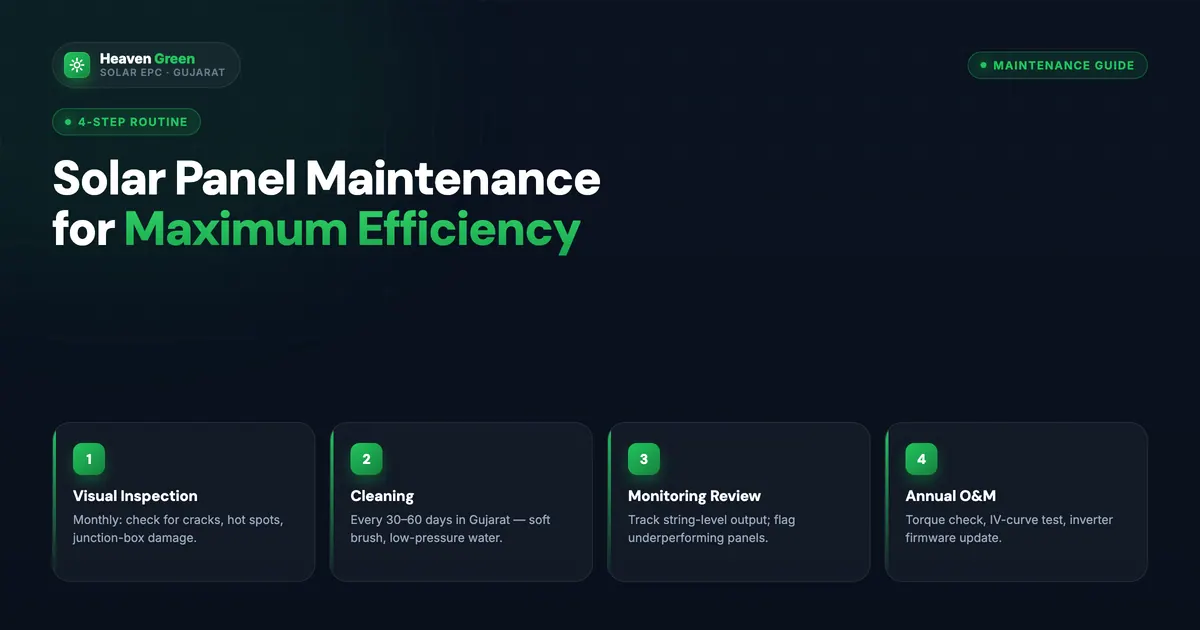
- Solar Panel Maintenance: annual AMC plans covering cleaning, inspection, and generation audit.
- Solar Calculator: verify whether your current generation matches expectations.
- Why AI Is the Future of Solar O&M: how AI monitoring tools catch faults before output drops.
- Contact our service team: book a performance audit within 24 hours.
Frequently Asked Questions
Why is my solar system generating less in winter?
Winter brings shorter days and lower sun angles, which reduces daily irradiance duration. However, cooler temperatures actually improve panel efficiency by reducing thermal losses. In India’s north and central regions, winter generation can be 10 to 20% lower than summer on a monthly basis due to shorter daylight hours, not lower efficiency. If winter generation drops more than 25% below your monsoon baseline, investigate shading or soiling.
How do I check if my solar inverter has a fault?
Open the monitoring app for your inverter brand (iSolarCloud for Sungrow, ShinePhone for Growatt, Sunny Portal for SMA). Go to the “Alarms” or “Events” tab and look for active faults. Common codes include ISO fault, grid fault, and over-temperature. If you don’t have app access, check the physical LED indicators on the inverter face, red LED or flashing amber typically indicates a fault condition.
How much generation loss is normal over 10 years?
Reputable monocrystalline panels are warranted to lose no more than 1 to 2% in the first year and 0.40 to 0.55% a year after that (Adani’s TOPCon and PERC datasheets). After 10 years, a panel at those limits is about 5 to 7% below nameplate. A 3 kW system generating 396 kWh/month when new should still generate roughly 368 to 378 kWh/month after 10 years. If your 5-year-old system is generating 15%+ less than when new, the cause is not normal degradation, investigate soiling, shading, or inverter issues.
What is the difference between solar generation and net metering export?
Solar generation is the total electricity your panels produce, measured by your inverter. Net metering export is the surplus you send to the grid after your home has consumed what it needs. If your home consumption increases (new appliance, more occupants), your export drops but generation stays the same. Always check generation data, not net meter export, when diagnosing performance issues.
Can bird droppings permanently damage my solar panels?
Bird droppings left uncleaned for extended periods can cause “hotspot” damage, the shaded cell heats up and, over time, this can crack the cell or delaminate the encapsulant. Clean bird droppings within 1 to 2 days if possible. If you notice dark spots or discolouration on a cell that doesn’t disappear after cleaning, that panel may have a permanent hotspot, which warrants a warranty claim if the panel is still within its product warranty (12 years on Adani modules).
My system worked fine for 2 years and suddenly generation dropped by 25%. What’s most likely?
A sudden 25% drop after 2 years of normal operation is almost always caused by one of three things: a new shading obstruction (tree growth, new construction nearby), an inverter fault or partial component failure, or DISCOM grid voltage issues causing the inverter to throttle output. Check your monitoring app for fault codes first, then walk the roof to assess shading. Contact your installer if neither is obvious.