Ankleshwar, in Bharuch district of Gujarat, is India’s largest single chemical industrial cluster. The GIDC (Gujarat Industrial Development Corporation) estate hosts over 2,000 chemical manufacturing units, producing everything from agrochemicals and pharmaceuticals to dyes, pigments, and specialty chemicals.
Every one of those units runs energy-intensive processes, often 24 hours a day, 365 days a year. PGVCL (Paschim Gujarat Vij Company Limited) HT industrial tariffs in the ₹7–₹9/kWh range mean that a 500 kW chemical plant spending ₹15 to 20 lakh per month on electricity commits ₹1.8 to 2.4 crore annually to a cost that keeps rising.
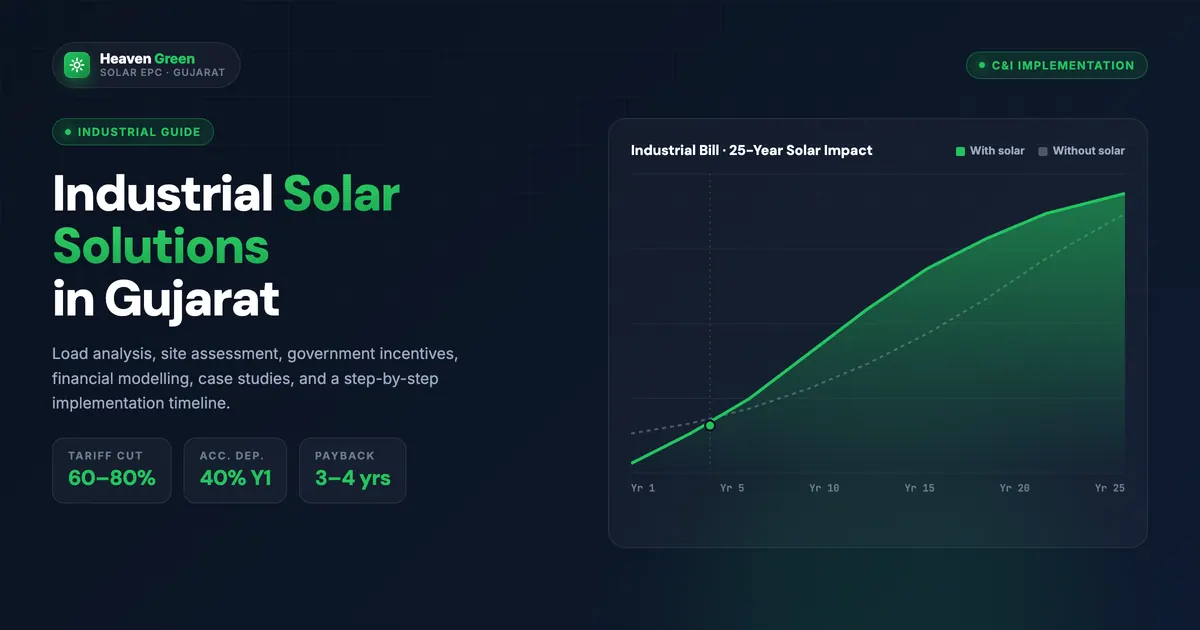
Solar at a levelised cost of ₹2.50/kWh (25-year rooftop system, Gujarat conditions) delivers 65 to 70% savings on every unit generated during daylight hours. For a chemical plant with a significant daytime base load, that equation generates payback within 3 to 4 years, with 20+ years of reduced energy costs beyond that.
Key takeaway. Ankleshwar GIDC chemical plants paying PGVCL HT tariffs of ₹7–₹9/kWh can achieve 65 to 70% energy cost savings on daytime solar generation, with ROI of 3 to 4 years on 100 to 500 kW rooftop systems. The key viability test is whether the plant’s daytime base load is sufficient to consume most of the solar generation without export wastage. Heaven Green Energy has delivered industrial solar EPC projects across Gujarat’s GIDC clusters with documented payback periods of 3.2 to 4.0 years.
This guide gives Ankleshwar manufacturers the specific numbers and a clear viability test before they commit to an installation.
Ankleshwar GIDC: The Energy Landscape
Ankleshwar GIDC spans approximately 2,600 acres with over 2,000 active manufacturing units. The cluster’s energy profile is distinctive among Indian industrial zones:
24×7 process operation: Chemical manufacturing is largely continuous, batch reactors, distillation columns, drying systems, and effluent treatment plants run at all hours. Unlike a garment factory that shuts down at night, a chemical plant has a significant base load around the clock.
High-voltage connections: Most medium and large units in Ankleshwar operate on HT (High Tension) connections at 11 kV or 33 kV. This means PGVCL HT tariff applies, currently ₹7–₹9/kWh depending on connected load and demand factor.
Substantial roof assets: GIDC Ankleshwar units typically have large single-storey factory buildings with flat or gently sloped RCC roofs. A 2,000 to 5,000 sq m factory can accommodate 100 to 500 kW of rooftop solar.
Daytime base load: Even for 24×7 plants, the daytime base load (the load that runs continuously during daylight hours) typically represents 40 to 60% of total daily consumption. This is the segment directly addressable by rooftop solar.
PGVCL Tariff and Solar Savings: The Core Numbers
PGVCL (Paschim Gujarat Vij Company Limited) serves the Ankleshwar region. HT industrial tariff components:
| Category | Demand charges | Energy charges | Effective rate with demand charges |
|---|---|---|---|
| HT-1 Industrial 11 kV | ₹250 to 300/kVA/month | ₹6.80–₹7.50/kWh | ₹7.50–₹8.50/kWh |
| HT-2 Industrial 33 kV | ₹200 to 250/kVA/month | ₹7.00–₹8.00/kWh | ₹7.80–₹9.00/kWh |
| LT Commercial/Industrial | ₹150 to 200/kW/month | ₹5.50–₹6.50/kWh | ₹6.00–₹7.00/kWh |
A 200 kW rooftop solar system in Gujarat’s Ankleshwar region generates approximately 3,000 to 3,200 kWh per day based on Gujarat’s excellent solar resource (5.5 to 6.0 peak sun hours confirmed by GEDA solar resource data). According to Bridge to India’s India Solar Compass 2026, Gujarat industrial solar installations achieve the highest utilisation rates in India due to the state’s solar irradiance and high industrial tariffs.
At ₹8/kWh average effective PGVCL rate, daily savings: ₹24,000–₹25,600. Annual savings: ₹87 to 93 lakh.
System cost for a 200 kW industrial rooftop installation: ₹1.4 to 1.6 crore (turnkey, including mounting, inverters, cabling, DCDB/ACDB, earthing, and commissioning).
Payback (without AD): 1.5 to 1.8 years. That number seems too good, the reason it’s achievable is Gujarat’s high tariff rate combined with excellent solar resource.
Payback (CAPEX model, with 40% AD in Year 1): Even more compelling, the tax benefit in Year 1 effectively reduces the net investment by 20 to 25%.
💰 Real numbers
A 500 kW chemical plant in Ankleshwar generating 7,500 kWh/day from solar, saving ₹8.50/kWh vs grid, saves ₹63,750/day, ₹2.3 crore/year. System cost: ₹3.5 to 4 crore. Payback: 1.5 to 1.7 years before AD benefit. This is among the strongest industrial solar ROI cases in India.
The Chemical Plant Solar Viability Test (Framework)
Not every chemical plant in Ankleshwar is equally well-suited to rooftop solar. The Chemical Plant Solar Viability Test is Heaven Green Energy’s proprietary 4-question framework for quickly assessing whether a specific unit will achieve the projected ROI. CEEW’s industrial solar research identifies load consistency and roof availability as the two most significant drivers of industrial solar ROI across Indian manufacturing clusters.
Question 1: Is the load consistent during daylight hours?
A consistent daytime base load is the foundation of industrial solar economics. If your plant runs the same processes during 7 AM–5 PM as it does at night, your solar utilisation rate will be high (80 to 90%), meaning almost every unit generated is consumed on-site and not exported at lower grid rates.
If your daytime load varies significantly, for example, a batch plant where reactor loads spike for 4 hours and then drop for 8, you need to account for the hours when solar generation exceeds consumption (export) vs when it falls short (import). The economics still work, but the sizing analysis is more complex.
How to check: Pull 3 months of 15-minute interval energy data from your energy management system or DISCOM smart meter. Plot daytime (7 AM–5 PM) hourly average load. A flat profile = ideal for solar.
Question 2: Is the roof unobstructed by process vents, cooling towers, or exhaust stacks?
Chemical plants have process equipment that creates roof obstructions: cooling tower exhaust, reactor vent stacks, flue gas stacks, overhead pipe racks, and condensate lines. Each obstruction creates shading, structural loading conflicts, or exclusion zones that reduce effective roof area.
A site survey quantifies the net available area. Typically, 30 to 40% of gross roof area is excluded due to process equipment. Plan for this in your system size estimate, a 5,000 sq m roof may yield only 3,000 sq m of usable solar area.
How to check: Share a roof plan with our site survey team. We use drone imagery and shadow analysis software to map available area precisely.
Question 3: Does PGVCL allow HT net metering for your connection type?
PGVCL’s net metering policy permits rooftop solar for both LT and HT consumers. HT net metering applications for industrial consumers are processed through the PGVCL commercial division and require a technical feasibility check.
Key limit: solar capacity must not exceed the sanctioned connected load. For a 500 kW HT connection, solar capacity is capped at 500 kW (some DISCOM interpretations apply stricter limits, confirm with your PGVCL circle office before sizing).
How to check: Submit a formal net metering enquiry to PGVCL commercial division with your consumer number and proposed system size. Our team can handle this on your behalf.
Question 4: Is the weekend (or shutdown) load pattern compatible with solar economics?
Chemical plants vary in their weekend operations. Some run 365 days continuously. Others have maintenance shutdowns on Sundays or during Diwali/plant holidays. During shutdown periods, solar generation that cannot be consumed on-site is exported at much lower feed-in tariff rates (or wasted if the plant disconnects from the grid).
For a plant with 52 Sundays of shutdown, that’s 52 × 10 hours × peak solar output that may be underutilised. For a 200 kW plant: 52 × 10 × 200 × 0.8 efficiency = ~83,000 kWh potentially wasted. At the difference between grid rate (₹8) and export rate (₹2 to 3), this is ₹4 to 5 lakh of annual economics to factor in.
How to check: Map your annual shutdown schedule. If weekend/holiday shutdowns are significant, size the system conservatively (70 to 80% of daytime base load rather than 100%) to minimise export.
How to Size a Solar System for an Ankleshwar Chemical Plant
Step-by-step sizing process:
- Establish daytime base load: average hourly consumption during 8 AM–4 PM peak solar window, from 3 to 6 months of interval data
- Apply the solar sizing ratio: size the system to cover 70 to 80% of the daytime base load to minimise export
- Check roof constraint: verify available roof area can accommodate the target kWp (allow 7 to 8 sq ft per 400 Wp panel including structure and spacing)
- Check PGVCL sanctioned load cap: confirm solar kW ≤ sanctioned connected load kW
- Model annual generation: use Ankleshwar’s latitude (21.6°N) and GEDA solar resource data for precise kWh output
- Calculate payback: at current PGVCL HT tariff vs ₹2.50 levelised solar cost, including AD benefit
| Parameter | Small chemical unit | Medium chemical unit | Large chemical unit |
|---|---|---|---|
| Connected load | 100 to 200 kW | 300 to 500 kW | 600 to 1000 kW |
| Recommended solar | 80 to 150 kW | 200 to 350 kW | 400 to 700 kW |
| Annual generation | 1.2 to 2.2 lakh kWh | 3 to 5.2 lakh kWh | 6 to 10.5 lakh kWh |
| Annual saving at ₹8/kWh | ₹9.6 to 17.6 lakh | ₹24 to 41.6 lakh | ₹48 to 84 lakh |
| System cost (turnkey) | ₹70 lakh–1.1 crore | ₹1.4 to 2.5 crore | ₹2.8 to 5 crore |
| Payback (with AD) | 2.8 to 3.5 years | 2.5 to 3.5 years | 2.5 to 3.5 years |
Get a free site visit. Our engineer visits in 24 hours, sends a custom proposal in 48 hours, no cost, no obligation. Get your free quote →
Regulatory Notes: EIA and Chemical Industry Solar
One concern that sometimes surfaces among Ankleshwar plant managers: does installing solar require an Environmental Impact Assessment (EIA)?
The answer for rooftop solar is almost always no:
Rooftop solar is exempt from EIA notification requirements. The EIA Notification 2006 (as amended) requires EIA for large power projects. Rooftop solar installations, regardless of size, are not classified as new power projects for EIA purposes. They are additions to existing industrial premises. The MNRE rooftop solar policy framework confirms this exemption for all captive rooftop installations.
Ground-mount solar above 25 MW may require EIA screening, depending on land classification and state regulations. But Ankleshwar GIDC units installing rooftop solar at 100 kW to 5 MW are entirely within the exempt category.
📘 Regulation note
Chemical plants in Ankleshwar GIDC should confirm with their GIDC allotment officer that rooftop solar installation doesn't violate any lease terms related to structural modifications. GIDC standard lease terms permit rooftop solar installations, but verification with the specific plot lease agreement is good practice before committing capital.
For guidance on Gujarat’s overall solar policy framework and net metering rules across all four DISCOMs (UGVCL, DGVCL, PGVCL, MGVCL), see our Gujarat solar policy guide and GEDA KUSUM guide for Gujarat.
Also relevant: why delaying solar installation costs industries more, each year without solar is a year of full-tariff electricity costs.
Pros and Cons for Ankleshwar Chemical Plants
- High PGVCL HT tariff creates 65 to 70% savings per solar unit
- Consistent 24×7 process load ensures high solar utilisation rate
- Gujarat's 5.5 to 6 peak sun hours, top-tier solar resource in India
- Large GIDC factory roofs, high system capacity possible
- AD benefit (40% Year 1) cuts effective cost for profitable units
- No EIA required for rooftop installations under 25 MW
- Process equipment reduces effective roof area by 30 to 40%
- Corrosive chemical vapours can degrade standard mounting hardware
- PGVCL HT net metering approval takes 30 to 60 days
- Shutdown/holiday days reduce effective utilisation
- Roof waterproofing integrity must be verified before mounting
Special Considerations for Chemical Plants
Corrosion-resistant mounting structures: Ankleshwar’s chemical atmosphere, traces of chlorine, ammonia, and solvent vapours are common in the air around certain processing units, can accelerate corrosion of standard galvanised mounting structures. Specify hot-dip galvanised Class 3 (85 microns) or stainless steel 304 fasteners for mounting systems in this environment. Aluminium alloy rails are also a good choice.
Panel soiling: Chemical plant environments can have elevated particulate matter, including process dust from drying operations. Factor in more frequent panel cleaning (monthly vs quarterly for standard industrial sites) and ensure the cleaning protocol uses deionised or DM water to avoid chemical residue build-up on panel glass.
Safety compliance: Chemical plants in Ankleshwar operate under DGFASLI (Directorate General Factory Advice Service & Labour Institutes) and Factories Act safety requirements. The electrical installation of a solar system must comply with fire zone classification for the relevant areas of the plant. Specify IP-rated inverters and conduit-protected DC cabling for installations near process areas.
For the broader context of industrial solar performance and monitoring, see our industrial solar solutions in Gujarat guide and our why industrial leaders are choosing solar guide.
How Heaven Green Energy Serves Ankleshwar GIDC
Heaven Green Energy is Gujarat’s trusted industrial solar EPC company, with installations across Ahmedabad, Surat, Rajkot, Vadodara, and Bharuch district including Ankleshwar. Our industrial solar team has direct experience with the PGVCL HT net metering application process and GIDC structural requirements.
Our services for Ankleshwar chemical manufacturers:
- Industrial Solar EPC: complete turnkey projects from energy audit to grid commissioning, including corrosion-resistant mounting specification and chemical-environment panel selection.
- Commercial Solar: 10 to 100 kW projects for smaller units within the GIDC cluster.
- Solar EPC Services: project management including PGVCL HT net metering application, GIDC structural approval support, and CEA compliance documentation.
- Solar Calculator: enter your monthly bill and connected load for an instant savings estimate specific to PGVCL tariffs.
Our complete guide to solar installation in Gujarat walks through the full regulatory process applicable to GIDC installations.
Frequently Asked Questions
Is rooftop solar financially viable for a small chemical unit in Ankleshwar with 100 kW connected load?
Yes. A 100 kW HT connection unit installing 80 kW of rooftop solar in Ankleshwar will generate approximately 1.2 lakh kWh per year. At ₹8/kWh PGVCL HT tariff, annual savings are ₹9.6 lakh. System cost: ₹70 to 80 lakh. Payback: 3.5 to 4 years without AD. With 40% Accelerated Depreciation in Year 1 (applicable for profitable units), effective payback drops to 2.5 to 3 years.
What is the PGVCL net metering limit for HT industrial connections?
PGVCL permits rooftop solar capacity up to the consumer’s sanctioned connected load. For a 500 kW HT industrial connection, solar capacity up to 500 kW is permitted. Applications are processed through the PGVCL commercial division. Approval typically takes 30 to 60 days for clean applications with correct technical documentation.
Does the corrosive chemical environment affect solar panel performance?
Corrosive chemical vapours can affect mounting structures more than panels themselves. Standard glass-surface solar panels are resistant to most common industrial chemicals at ambient concentrations. However, mounting structures should use hot-dip galvanised Class 3 or stainless steel fasteners in Ankleshwar conditions. Panel cleaning frequency should be increased to monthly for units with visible process dust accumulation.
Can solar cover 100% of a chemical plant’s electricity consumption?
No, rooftop solar covers daytime consumption only. A 24×7 chemical plant will typically see solar cover 40 to 60% of total daily consumption. Night-time consumption (typically 40 to 60% of the total) continues to draw from the PGVCL grid. Battery storage can extend solar coverage, but battery economics at industrial scale remain challenging, the payback with batteries alone extends to 6 to 8 years versus 3 to 4 years for solar only.
Do I need an Environmental Impact Assessment for rooftop solar on my chemical plant?
No. Rooftop solar installations are exempt from EIA Notification requirements regardless of size. The EIA applies to ground-mount solar power plants above certain capacity thresholds. Installing rooftop solar on an existing GIDC factory building requires only PGVCL net metering approval and standard electrical safety compliance under the Factories Act, no EIA clearance needed.
What is the solar potential of Ankleshwar vs other Indian industrial clusters?
Ankleshwar is in Gujarat at latitude 21.6°N with average global horizontal irradiance of 5.5 to 6.0 kWh/m²/day, among the highest in India. This gives Ankleshwar chemical plants a generation advantage compared to clusters in Maharashtra (5.0 to 5.5) or Tamil Nadu (5.5 to 6.0). The combination of high solar resource + high industrial tariff makes Gujarat’s GIDC clusters some of the best solar ROI locations in India.