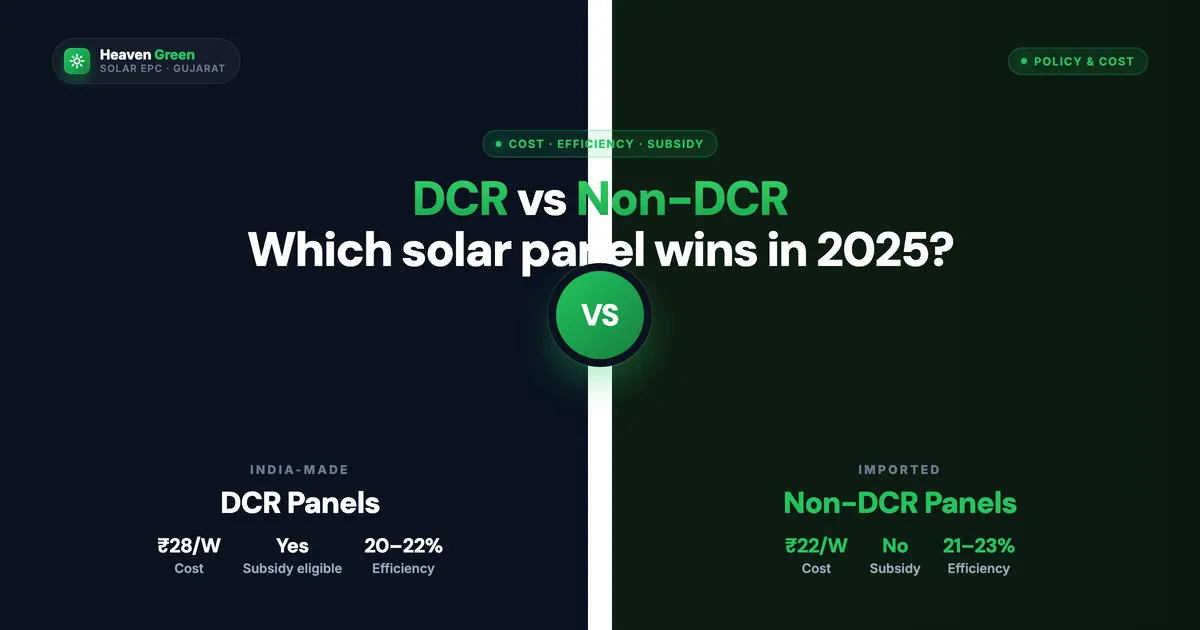
If you have compared two solar quotes for the same system size and found a confusing price gap, “DCR” is often the reason. DCR, Domestic Content Requirement, is the MNRE (Ministry of New and Renewable Energy) rule that decides whether your solar cells and modules must be made in India. Get the DCR status wrong and you can lose your PM Surya Ghar subsidy, a PM-KUSUM sanction, or simply overpay for a private rooftop where DCR was never required.
Direct answer. DCR (Domestic Content Requirement) means the solar cells and the finished module are both manufactured in India. It is mandatory wherever central subsidy applies, including PM Surya Ghar, PM-KUSUM Components B and C, and CPSU Scheme Phase-II, per MNRE’s DCR clarification notice. DCR modules cost roughly ₹8 to ₹11 more per watt than non-DCR imports in 2026. Private, unsubsidised projects can legally use either.
This guide covers what DCR actually gates, when it is mandatory versus optional, the real price and warranty gap, and the exact documents a buyer should ask for before signing a quote. For the plain definition and full form, see DCR meaning in the glossary.
Last verified: 14 October 2026
Checked the PM Surya Ghar DCR condition (modules made in India from Indian cells; any non-DCR module makes the installation ineligible for the subsidy) against the MNRE PM-Surya Ghar guidelines, clause 5(m). Not re-checked: the PM-KUSUM and CPSU conditions, and the ₹8 to ₹11 per watt price gap.
DCR vs ALMM: The Distinction Buyers Get Wrong
DCR and ALMM (Approved List of Models and Manufacturers) are not the same thing, even though most quotes mention both in the same paragraph. Confusing them is the single most common mistake we see in subsidy disputes.
ALMM is an eligibility whitelist: a specific model, from a specific manufacturer, cleared MNRE’s documentation and BIS (Bureau of Indian Standards) testing review to appear on the list. DCR is a sourcing rule: it asks where the cells inside that module, and the module itself, were physically manufactured. A module can be ALMM-listed and still fail DCR, because ALMM List-I accepts finished modules assembled in India from imported cells. DCR does not. (ALMM List-II, which covers cells, now applies to net-metering and open-access projects too, but MNRE has let such projects commission without it until 31 December 2026.) For the full mechanics of List-I versus List-II, see our ALMM list explained guide; this article focuses only on where the two rules diverge.
| Dimension | DCR (Domestic Content Requirement) | ALMM (Approved List of Models and Manufacturers) |
|---|---|---|
| What it checks | Country of manufacture for cells and modules | Whether a specific model cleared MNRE’s eligibility review |
| Issuer | MNRE, via scheme-specific notifications | MNRE, via the ALMM lists (List-I modules, List-II cells), revised regularly |
| Mandatory for | PM Surya Ghar, PM-KUSUM B and C, CPSU Phase-II | Same subsidy schemes, plus most SECI and DISCOM tenders |
| Can pass one, fail the other | Yes, imported-cell modules can be ALMM List-I listed but non-DCR | Yes, a domestically made module can miss ALMM listing on paperwork grounds |
| Verified by | Flash test report, manufacturer DCR self-certification | Model number lookup on MNRE’s ALMM page |
Verdict. Treat ALMM as “is this model allowed at all” and DCR as “was it actually made here.” A subsidised project usually needs to clear both checks, not one.
What Is DCR and Why Does It Exist?
DCR requires that both the solar cells inside a module and the assembled module itself are manufactured in India, not just packaged here from imported components. The rule exists to build a domestic solar manufacturing base rather than let India’s solar boom become a pass-through market for imported cells, similar in intent to the Production Linked Incentive scheme for cell and module capacity.
The distinction matters because assembly alone does not qualify. A factory in Gujarat that imports Chinese cells and solders them into a finished panel produces a module that can still be ALMM-listed, but it is not DCR-compliant, because the cell origin fails the test. Genuine DCR modules go through wafer-to-cell-to-module production inside India, which is a smaller and more expensive supply chain than global cell manufacturing at scale.
📘 Regulation note
MNRE's DCR clarification notice states there is "no relaxation" in Domestic Content Requirement provisions wherever applicable to its schemes, naming PM-KUSUM Components B and C, PM Surya Ghar, and CPSU Scheme Phase-II specifically. Treat DCR as a hard gate on these schemes, not a preference.
When Is DCR Mandatory?
DCR is mandatory the moment a project draws central financial assistance (CFA) or bids into a scheme that names it as a condition. It is optional, though sometimes still recommended, for private and open-market installs with no subsidy attached.
DCR mandatory categories, per MNRE’s scheme notifications:
- PM Surya Ghar (residential rooftop), if you are claiming the central subsidy, DCR provisions apply and are not relaxed, per MNRE’s clarification order and the official PM Surya Ghar scheme rules.
- PM-KUSUM Component B and C, standalone solar pumps and solarised grid-connected pumps carry a firm DCR requirement; Mercom India reported MNRE reaffirming this for Component C in 2026.
- CPSU Scheme Phase-II, central public sector undertaking projects target domestic-content-only capacity.
- SECI and government tenders bid after 31 August 2025, most carry DCR or the related ALMM List-II cell rule as a bid-eligibility condition.
DCR optional categories:
- Private commercial and industrial rooftop with no subsidy claimed, the buyer can legally choose non-DCR modules.
- Open-access and CAPEX/OPEX solar without CFA, DCR is not a legal requirement, though some financiers still prefer it for bankability.
- PM Surya Ghar “Give It Up” consumers, a narrower case explained below, where the buyer voluntarily forgoes the subsidy.
📘 Regulation note
In June 2026 MNRE exempted PM Surya Ghar consumers who choose the "Give It Up" option and [net metering](/glossary/net-metering) from the ALMM List-II cell rule. MNRE's 18 July 2026 office memorandum superseded the June orders: there is no blanket extension of List-II, but all net-metering and open-access projects can commission without List-II cells until 31 December 2026, and projects commissioned after that date must comply. That is an ALMM List-II window, not a DCR exemption. Do not read it as "PM Surya Ghar no longer needs DCR."
Full application mechanics for the residential scheme are covered in our PM Surya Ghar complete guide; the agricultural pump side is covered in our PM-KUSUM complete guide.
The Real Price Gap: What DCR Actually Costs
DCR modules cost more because India’s domestic cell manufacturing base, while growing under the PLI scheme, still runs a smaller, more expensive supply chain than global cell production at scale.
As of early 2026, DCR modules run roughly ₹23 to ₹26 per watt against non-DCR imports around ₹15 per watt, a gap of about ₹8 to ₹11 per watt (industry pricing survey, January 2026). On a 3 kW residential system, that gap is a few thousand rupees. On a 1 MW commercial plant, it can be ₹80 lakh to over ₹1 crore, enough to change the entire ROI case.
A first-hand pattern we see: on subsidy-eligible residential jobs, the DCR premium is almost always smaller than the subsidy itself, so DCR wins on net cost. On unsubsidised commercial rooftops above 100 kW, we routinely see clients choose non-DCR TOPCon or HJT modules once they run the numbers, because the efficiency and price gap outweighs any bankability preference.
That is a genuine tradeoff, not a universal answer. Residential and agricultural buyers who qualify for CFA should treat DCR as effectively free once the subsidy is netted in. Large private commercial buyers with no subsidy on the table should run both scenarios before committing.
Curious what solar would cost for your home? Use our free solar calculator, subsidy eligibility and savings estimate in 60 seconds.
Quality, Warranty, and Efficiency: Does DCR Mean Better Panels?
No. DCR is a sourcing rule, not a quality standard, and this is the second most common myth we hear from buyers.
- ✓ Only legal route to central subsidy on eligible schemes
- ✓ Shorter, India-based supply chain reduces import-delay risk
- ✓ Easier [DISCOM](/glossary/discom) inspection and audit trail for subsidy claims
- ✓ Warranty support is domestic, often faster claim turnaround
- ✗ DCR panels lag behind on newer cell technology adoption
- ✗ Premium non-DCR TOPCon and HJT modules often hit higher efficiency
- ✗ Non-DCR modules cost far less per watt
- ✗ Broader global manufacturer choice for unsubsidised projects
A DCR module and a non-DCR module from equally reputable manufacturers can carry the same 25 to 30 year warranty terms and near-identical degradation curves. The manufacturer’s own warranty document, not the DCR label, is what determines your protection. If you are also comparing panel technologies, our solar quality certifications guide covers BIS, IEC, and tier ratings separately from DCR.
How Heaven Green Verifies a DCR-Compliant Quote: A 3-Step Check
Across our residential and commercial installs, DCR disputes almost never come from fraud; they come from a buyer taking a verbal “yes, it’s DCR” at face value. We call this the Heaven Green DCR Verification Check, three steps any buyer can run themselves before signing.
💡 Fast tip
Ask your installer to write "DCR-compliant" on the invoice against the exact model number, not just the brand name. A vendor who hesitates to put it in writing usually cannot back the claim.
Invoice and Documentation Red Flags
Most DCR-related subsidy denials trace back to one of a small set of paperwork gaps, not deliberate mislabelling.
-
1
Invoice says "Make in India" but not "DCR", a module can be assembled in India from imported cells and still be marketed that way; the two claims are not interchangeable.
-
2
Quote names the brand but not the model number, DCR status is checked at the model level, and one manufacturer can sell both DCR and non-DCR variants side by side.
-
3
Confusing an ALMM listing certificate for DCR proof, ask for the DCR-specific self-certification separately; ALMM paperwork alone does not answer the cell-origin question.
-
4
No DISCOM-facing paper trail before installation, if your DCR proof only surfaces after the DISCOM inspection flags an issue, it is too late to swap modules without delaying your subsidy.
For a broader checklist beyond DCR specifically, see our red flags in a solar quote guide, which covers the other places installers cut corners.
Get a free site visit. A solar advisor responds within 2 hours on business days, then our engineer visits, confirms DCR and ALMM status against your scheme’s requirement, and sends a custom proposal, no cost, no obligation. Get your free quote →
Is DCR Worth It on a Private, Unsubsidised Project?
Not automatically, and this is where the “DCR is always better” myth breaks down completely.
For a private commercial rooftop with no CFA claim, non-DCR TOPCon or HJT modules from established global manufacturers often deliver better efficiency and a shorter payback, because the price gap is not offset by any subsidy. For a residential or agricultural project chasing PM Surya Ghar or PM-KUSUM, DCR is not really a choice at all, it is a condition of the money.
The exception worth flagging: a hybrid utility-scale project can mix DCR and non-DCR capacity across different arrays, using DCR where a tender demands it and non-DCR where open-access rules allow, to balance compliance against total system cost. This is a design decision best made with an engineering partner rather than guessed at from a spreadsheet.
How Heaven Green Energy Helps
Heaven Green Energy has completed 10,000-plus solar installations across 25-plus cities as an MNRE-approved channel partner, and DCR verification is a standard step on every subsidy-linked quote we issue. We confirm the model number, the DCR self-certification, and the applicable ALMM status together, so a buyer never discovers a mismatch after the DISCOM inspection.
- Residential Solar, 1 to 10 kW rooftop systems with PM Surya Ghar subsidy and DCR compliance handled end to end.
- Commercial Solar, 10 to 100 kW systems where DCR versus non-DCR is modelled against your actual ROI, not assumed.
- Solar EPC, turnkey design, procurement, and grid synchronisation with documentation built into the process.
- Solar Calculator, check your subsidy eligibility and estimated savings in 60 seconds.
For the engineering side of sourcing decisions, Heaven Designs’ MNRE DCR compliance guide covers how DCR shapes a project’s bill of quantities during the design stage, which is a useful companion for EPC teams finalising procurement. For agricultural pump sizing tied to PM-KUSUM’s DCR-linked components, Qbits Energy’s KUSUM Yojana subsidy guide covers the component-level eligibility rules in more depth.
Frequently Asked Questions
What is the main difference between DCR and non-DCR solar panels?
DCR panels have both their solar cells and finished module manufactured in India. Non-DCR panels use imported cells, most commonly from China, sometimes assembled into modules within India and sometimes fully imported. The distinction is about where manufacturing happens, not about panel quality or brand reputation.
Is DCR the same as ALMM?
No. ALMM is MNRE’s eligibility whitelist confirming a specific model cleared documentation and BIS testing review. DCR is a separate sourcing rule about where the cells and module were made. A module can be ALMM-listed while still failing DCR if its cells were imported. Subsidised projects generally need to clear both checks.
Does PM Surya Ghar require DCR-compliant panels?
Yes, for consumers claiming the central subsidy. MNRE’s DCR clarification notice states there is no relaxation in Domestic Content Requirement provisions wherever applicable, naming PM Surya Ghar specifically. Separately, MNRE’s 18 July 2026 office memorandum lets net-metering projects commission without ALMM List-II cells until 31 December 2026; that window covers the List-II cell rule, not DCR, and it replaced the June 2026 “Give It Up” exemption.
How much more do DCR solar panels cost than non-DCR?
As of early 2026, DCR modules run roughly ₹23 to ₹26 per watt against non-DCR imports around ₹15 per watt, a gap of about ₹8 to ₹11 per watt. On a residential system the gap is a few thousand rupees; on a megawatt-scale commercial plant it can shift the total budget by tens of lakhs.
Are non-DCR solar panels lower quality than DCR panels?
No. DCR governs sourcing, not performance. Non-DCR modules from established global manufacturers can carry equivalent or longer warranties and, in the case of newer TOPCon and HJT technology, higher efficiency than typical DCR Mono-PERC modules. Always compare the manufacturer’s specific warranty and datasheet rather than assuming DCR status implies quality.
Can I use non-DCR panels for a private commercial solar project?
Yes. DCR is only mandatory where central subsidy or a scheme that names it applies, such as PM Surya Ghar, PM-KUSUM Components B and C, and CPSU Scheme Phase-II. Private commercial and industrial projects with no subsidy claim can legally choose non-DCR modules, and many do for the efficiency and cost advantage.
How do I verify a quote is genuinely DCR-compliant?
Ask for the manufacturer’s DCR self-certification tied to the exact model number, cross-check the flash test report’s plant location against the DCR claim, and verify ALMM listing separately since it does not by itself prove DCR compliance. Get the DCR status written on the invoice against the specific model, not just the brand name.
Does PM-KUSUM require DCR panels for farmers?
Yes, for Components B and C. MNRE has reaffirmed DCR rules for PM-KUSUM Component C grid-connected pump solarisation projects, and Component B standalone pump installations carry the same requirement. Component A land-lease solar plants are governed by separate tender-specific conditions.