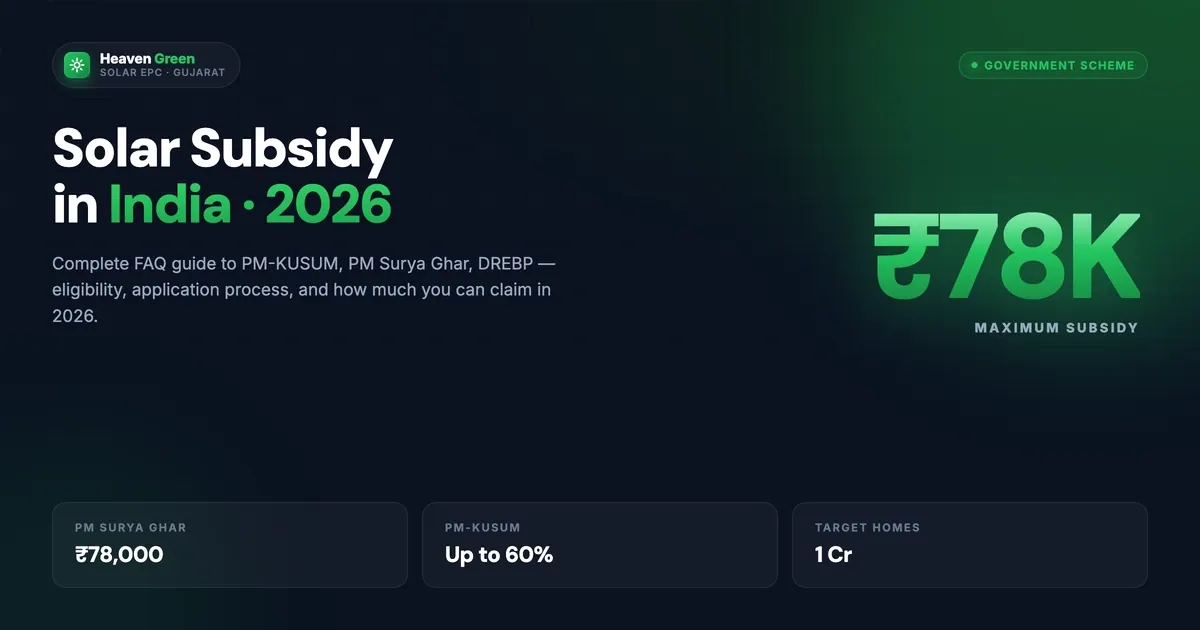
India has never made going solar easier. The PM Suryaghar: Muft Bijli Yojana, launched by the Government of India in February 2024, puts a central subsidy of up to ₹78,000 directly into your bank account for installing a rooftop solar system on your home. The scheme runs until 31 March 2027 under MNRE’s guidelines, with a target of 1 crore homes.
This guide covers every aspect of the scheme: what it pays, who qualifies, how to apply step-by-step, and the exact mistakes that get applications rejected.
Direct answer. PM Suryaghar pays ₹30,000 for 1 kW, ₹60,000 for 2 kW, and ₹78,000 (capped) for 3 kW and above. The subsidy is paid into the bank account on your application after the DISCOM inspection; MNRE’s guidelines say the subsidy is processed within 15 days of the DISCOM approving your installation on the portal. You must install through a vendor registered on the national portal and use DCR panels on the ALMM list.
If you are reading this before choosing an installer, that is the right sequence. Subsidy eligibility depends entirely on decisions you make before installation begins.
Reports have floated a possible next phase, informally called “PM Surya Ghar 2.0,” that could link part of the subsidy to actual generation and add battery storage support. That’s not confirmed policy yet, but if you want our take on what it could mean, read our analysis of PM Surya Ghar 2.0.
What Is PM Suryaghar Muft Bijli Yojana?
PM Suryaghar: Muft Bijli Yojana (translated: Prime Minister Solar Home, Free Electricity Scheme) is a central government programme administered by the Ministry of New and Renewable Energy (MNRE) to expand rooftop solar adoption in residential households across India.
The scheme has three goals:
- Reduce household electricity bills to near zero.
- Reduce India’s dependence on coal-based power in the residential sector.
- Reach 1 crore solar-powered homes by 2027.
The scheme operates on a Direct Benefit Transfer model, subsidy money moves from the central scheme directly to the consumer’s bank account (or solar loan account) after the system passes DISCOM inspection. There is no middleman, no state intermediary holding the money.
What’s covered: Grid-connected rooftop solar systems for residential consumers only. Off-grid systems and commercial/industrial consumers are not eligible under this specific scheme.
Where it applies: All states and Union Territories of India. Each DISCOM listed on the national portal (pmsuryaghar.gov.in) is a participating entity.
PM Suryaghar Subsidy Amounts 2026
The central subsidy is fixed and uniform across India regardless of state.
State top-up subsidies exist in some states and can be stacked on top of the central amount; Rajasthan, for example, adds state support through PM Surya Ghar under its Mukhyamantri Nishulk Bijli Yojana. Check your state nodal agency for the current position. Our detailed guide on stacking central and state subsidies covers this.
Benchmark cost table (from MNRE)
MNRE set the central subsidy at 60% of the benchmark cost for the first 2 kW and 40% for the third kW, and fixed it as a flat amount per kW. It does not change with your installer’s price: whatever you pay above the subsidy is your cost.
| System size | MNRE benchmark cost | Central subsidy |
|---|---|---|
| 1 kW | ₹50,000 | ₹30,000 |
| 2 kW | ₹1,00,000 | ₹60,000 |
| 3 kW | ₹1,45,000 | ₹78,000 |
| 5 kW | No benchmark above 3 kW | ₹78,000 (capped) |
| 10 kW | No benchmark above 3 kW | ₹78,000 (capped) |
Source: MNRE, PM Surya Ghar: Muft Bijli Yojana operational guidelines, benchmark cost and central financial assistance clauses.
Benchmark: ₹50,000/kW for the first 2 kW and ₹45,000 for the third kW (higher in special category states), per MNRE’s operational guidelines of 7 June 2024.
Get a free site visit. Our engineer visits in 24 hours and sends a custom proposal with exact subsidy calculation in 48 hours, no cost, no obligation. Get your free quote →
Who Is Eligible for PM Suryaghar?
You qualify if:
- You own a residential property (house, flat, or villa) in India.
- You have an active electricity connection in your name or a co-owner’s name.
- Your electricity connection is in the Domestic/LT-Residential consumer category.
- You have adequate shadow-free rooftop space (roughly 10 sq m per kW).
- You have not availed a central subsidy for solar at the same premises previously.
- You have a bank account in your name to receive the subsidy.
You do not qualify if:
- Your premises is commercial, industrial, or agricultural (different schemes apply).
- You have already received a central rooftop solar subsidy at the same address.
- Your electricity connection is in a tenant’s name and the tenant has not obtained owner consent.
- Your DISCOM is not participating (check the portal, nearly all are now enrolled).
Renting instead of owning? See our guide on solar options for tenants and renters for the landlord NOC process and portable alternatives.
- Residential homeowner with active connection
- LT-Domestic consumer category
- Bank account in your name
- Shadow-free rooftop available
- No prior central subsidy at this address
- Commercial or industrial connection
- Already availed central subsidy at same address
- Connection in tenant's name without NOC
- Off-grid system (only on-grid qualifies)
How to Apply for PM Suryaghar, Step by Step
The 5-Stage PM Suryaghar Application Funnel is the mental model we use to walk our customers through the process. Each stage has a specific action and a specific failure point. For portal registration, document upload and DISCOM approval in more detail, see our guide on how to apply for PM Surya Ghar online.
📘 Regulation note
The feasibility approval from DISCOM must arrive before you start installation. Starting without it does not void the subsidy automatically, but it creates complications if the DISCOM raises a technical objection later. Always wait for the written feasibility letter.
Documents Required for PM Suryaghar
Gather these before starting the application, incomplete documents are the second-most-common reason for delays.
| Document | Purpose | Where to get it |
|---|---|---|
| Aadhaar card | Identity | UIDAI / DigiLocker |
| Latest electricity bill | Consumer number + category proof | DISCOM / app |
| Property ownership proof | Ensures applicant owns the premises | Sale deed / property tax receipt |
| Bank account details | Subsidy payment (cancelled cheque, passbook or e-statement in your name) | Your bank |
| Passport-size photograph | Portal registration | Standard photo |
| Mobile number (registered with DISCOM) | OTP verification | Update at DISCOM if needed |
Name matching is critical. The name on your Aadhaar must match the name on your electricity bill exactly. Even minor differences (initials vs full name, spelling variations) cause automated rejection. If they don’t match, get the electricity bill name corrected at your DISCOM office before applying.
PM Suryaghar Process Timeline
Based on Heaven Green Energy’s experience across 10,000+ installations in Gujarat and neighbouring states, here is the realistic timeline:
| Stage | Timeframe | Bottleneck |
|---|---|---|
| Portal registration to feasibility approval | 7 to 15 working days | DISCOM workload |
| Feasibility to installation completion | 7 to 14 days (residential) | Vendor schedule |
| Installation to DISCOM inspection | 5 to 10 working days | Inspector availability |
| Inspection to net meter installation | 7 to 15 days | DISCOM meter stock |
| DISCOM approval to subsidy credit | Within 15 days per MNRE guidelines; allow longer in practice | Portal processing |
| Total: application to money in bank | 60 to 90 days | Clean documents = shorter |
The 60-day scenario happens when all documents are clean, the DISCOM is efficient, and the installer submits a complete commissioning report. The 90-day scenario is typical when one correction is required at any stage.
⚠️ Watch out
Do not pay the full system cost upfront before seeing the subsidy in your account. A standard payment structure is 70% before installation and 30% after subsidy receipt. Any installer demanding 100% upfront before subsidy disbursement is a red flag.
Common Mistakes That Get Applications Rejected
Our team has reviewed hundreds of rejected applications. The top reasons:
-
1
Unregistered installer, the subsidy is only available for installations by vendors registered on the national portal. If your installer is not registered, the subsidy is rejected entirely.
-
2
Non-DCR or non-[ALMM](/glossary/almm) panels, panels must be DCR modules (made in India from Indian-made cells, a condition of the subsidy) and on the MNRE ALMM (Approved List of Models and Manufacturers). Cheaper imported or unlisted panels fail inspection. Always ask your vendor for the exact panel model and cross-check on the MNRE portal before signing the contract. See our [ALMM list explained](/blog/almm-list-explained) guide for the exact verification steps, and our [DCR vs non-DCR buyer impact](/blog/dcr-vs-non-dcr-solar-panels) guide for the separate domestic-content check subsidised applicants also need.
-
3
Name mismatch between Aadhaar and electricity bill, even "Ramesh Kumar" vs "R. Kumar" can trigger rejection. Fix this at your DISCOM office before applying.
-
4
Wrong consumer number, entering the meter number instead of the consumer number causes DISCOM verification to fail instantly. Your consumer number is printed on the electricity bill, usually 10 to 12 digits.
-
5
Pending electricity dues, any outstanding arrears on your account disqualify the application. Clear all dues and obtain a no-dues certificate before applying.
-
6
Bank details rejected, the subsidy goes to the bank account on your application. If the account details or holder name don't match, the payment fails. Check the account against your cheque or passbook before applying; keeping it Aadhaar-seeded is a sensible precaution.
-
7
System size exceeds sanctioned load, solar capacity is generally capped at your sanctioned load. A 3 kW system on a 2 kW sanctioned connection usually needs a load enhancement first, though some states (Rajasthan, for example) now make the DISCOM handle it for domestic systems up to 10 kW.
For a complete deep-dive into every rejection scenario, see our dedicated guide: 12 PM Suryaghar Rejection Reasons and How to Fix Them.
PM Suryaghar by State, Key Differences
The central subsidy amount is the same everywhere. What differs is the state-level process.
| State | Key difference | Additional state benefit |
|---|---|---|
| Gujarat | 4 DISCOMs (UGVCL/DGVCL/PGVCL/MGVCL); fastest in India (~60 days avg) | DISCOM nodal officers for PM Surya Ghar subsidy issues (e.g. MGVCL) |
| Maharashtra | MSEDCL (largest DISCOM); longer inspection queue (90 to 120 days common) | Maharashtra state top-up in select districts |
| Rajasthan | JVVNL/AVVNL/JdVVNL; strong solar hours (6+ kWh/m²/day) | State support under Mukhyamantri Nishulk Bijli Yojana via PM Surya Ghar |
| MP | MPPKVVCL/MPMKVVCL/MPPoKVVCL; 3 DISCOMs for 3 zones | MP state subsidy for BPL households |
For state-specific detailed guides see: PM Suryaghar Gujarat · PM Suryaghar Maharashtra · PM Suryaghar Rajasthan · PM Suryaghar MP.
How to Choose the Right System Size
The right system size is the one that covers your average monthly consumption without generating excessive surplus (surplus sells back at lower rates). Here is the Real Bill-to-Solar Sizing Rule we use:
kW required = monthly consumption (kWh) ÷ 120
The 120 figure assumes 4 peak sun hours per day × 30 days. Adjust slightly for geography: Gujarat and Rajasthan see 5 to 5.5 hours; north India in December sees 3 to 3.5 hours.
| Monthly bill | Approx consumption | Recommended system | Expected generation |
|---|---|---|---|
| ₹1,000–₹2,000 | 100 to 200 kWh | 1 to 2 kW | 120 to 240 kWh/month |
| ₹2,000–₹4,000 | 200 to 400 kWh | 2 to 3 kW | 240 to 360 kWh/month |
| ₹4,000–₹7,000 | 400 to 700 kWh | 3 to 5 kW | 360 to 600 kWh/month |
| ₹7,000+ | 700+ kWh | 5 to 10 kW | 600 to 1,200 kWh/month |
Use our free solar calculator to get a personalised estimate including your exact subsidy amount.
💡 Fast tip
Do not oversize your system chasing maximum subsidy. The subsidy cap at 3 kW means there is no additional central benefit from installing 4 kW vs 3 kW. Size to your consumption first, then optimise for subsidy.
How Heaven Green Energy Helps
Heaven Green Energy is an MNRE-empanelled solar EPC company operating across Gujarat, Maharashtra, Rajasthan, and MP. Our Suryaghar-specific process:
-
Document verification before application: we review your Aadhaar, bill, and bank linkage before you submit a single form, eliminating rejection at source.
-
Portal submission and tracking: we manage the entire portal journey, from feasibility application to commissioning report upload.
-
ALMM-certified panels guaranteed: every installation uses ALMM-listed Adani Solar panels from the MNRE ALMM list, with BIS-compliant inverters as standard.
-
Post-installation subsidy follow-up: we track your DBT status and escalate to DISCOM if disbursement is delayed.
-
Residential Solar: 1 to 10 kW rooftop systems with complete PM Suryaghar subsidy handling end-to-end.
-
Solar Calculator: get your subsidy amount, monthly savings, and payback period in 60 seconds.
-
Contact our team: speak with a solar advisor today.
Related reading: Solar Subsidy in India, complete FAQ · Net Metering in India explained · Solar Panel Cost Breakdown · Solar Payback Period.
Frequently Asked Questions
What is the maximum subsidy under PM Suryaghar in 2026?
The maximum central subsidy is ₹78,000 for systems of 3 kW and above. This is a flat cap, whether you install 3 kW or 10 kW, the central government pays ₹78,000. Some states offer additional top-up subsidies that can push the total higher; check your state nodal agency for current amounts.
Can a tenant apply for PM Suryaghar subsidy?
Yes, if the property owner provides a No Objection Certificate (NOC) and the electricity connection is in the tenant’s name. However, the subsidy is paid to the bank account of the consumer in whose name the electricity connection exists. In practice, most tenants apply jointly with the landlord.
How long does PM Suryaghar subsidy take to arrive?
Once the DISCOM inspection passes and the DISCOM approves the installation on the portal, MNRE’s guidelines say the subsidy is processed within 15 days. You redeem the e-token in your portal login and the money goes to the bank account (or loan account) on your application. Allow extra time in practice.
Can I apply for PM Suryaghar without an empanelled vendor?
No. MNRE’s guidelines say the scheme is implemented only through vendors registered on the national portal, so you must choose a registered vendor to receive the subsidy.
What happens if my PM Suryaghar application is rejected?
Your dashboard on pmsuryaghar.gov.in will show the rejection reason. Screenshot it, fix exactly what is flagged (do not change anything else), resubmit the corrected documents. Common fixable rejections include name mismatch, wrong consumer number, and bank account linking. Non-DCR panels and unregistered installers can require reinstallation.
Is PM Suryaghar available for flats in housing societies?
Yes. Individual flat owners in housing societies can apply for PM Suryaghar for their own flat’s electricity connection. Separately, the society can apply for the RWA/GHS category for common-area solar at ₹18,000 per kW. Both applications can run simultaneously.
Can I get PM Suryaghar subsidy if I already have solar panels?
The subsidy is claimed through a national portal application made before installation, and MNRE’s guidelines allow it only once per installation, so a system already installed outside the scheme generally cannot claim it afterwards. MNRE’s guidelines do allow subsidy on added capacity in some cases, capped at 3 kW of total system size, so confirm with your DISCOM before you expand.
What is the difference between PM Suryaghar and PM-KUSUM?
PM Suryaghar targets residential consumers for rooftop solar on homes. PM-KUSUM targets farmers for solar-powered irrigation pumps and small solar plants on agricultural land. Both are central government schemes under MNRE, but the application portals, subsidy structures, and eligible beneficiaries are completely different.