Growatt, Deye, and Sungrow are the three Chinese string inverter brands that dominate Indian rooftop installations in 2026. All three sell models registered with the BIS (Bureau of Indian Standards) under MNRE’s quality control order for solar inverters, tested to standards such as IS 16221 and IS 16169 (inverters are not on MNRE’s ALMM list, which covers modules and cells), and all three are widely stocked through Indian distributors for systems from 3 kW (kilowatt) to 100 kW. The price spread is wide, a 5 kW Growatt sits at ₹35,000–₹40,000, a 5 kW Deye at ₹40,000–₹45,000, and a 5 kW Sungrow at ₹55,000–₹65,000. For Indian buyers staring at three quotes that look superficially identical, the right pick depends on heat tolerance at 45°C ambient, lithium battery plans, warranty horizon, and how close the nearest authorised service centre actually sits.
This guide covers the six-factor scorecard we use during quote review at Heaven Green Energy, the actual specifications and Q2 2026 India pricing for the highest-volume 3 kW, 5 kW, and 10 kW size points, and the use-case verdict that matches your project to the right brand, without brand loyalty getting in the way.
Direct answer. Growatt is the cheapest of the three at ₹35 to 40K for a 5 kW string inverter and suits budget-conscious residential PM Suryaghar projects. Deye sits in the middle at ₹40 to 45K and is the default choice if you want native hybrid and battery-ready capability today. Sungrow is the premium pick at ₹55 to 65K with commercial-grade engineering, the right choice for commercial rooftops and high-ambient sites above 40°C; confirm its datasheet efficiency, derating curve and India warranty term for the exact model.
If you are picking between these three after already shortlisting Indian brands, our Luminous vs Microtek inverter comparison covers the home-battery side; this guide focuses on the grid-tie and hybrid string inverters that PM Suryaghar and commercial net metering applications actually require.
Why These Three Brands Dominate Indian String Inverter Market
The grid-tie inverter market in India has consolidated. Of the many brands registered with BIS for solar inverters, three names appear on the majority of installed quotes, Growatt, Deye, and Sungrow. Each entered the Indian market with a different positioning, and that positioning still holds in 2026.
Growatt was an early entrant and rode the early rooftop solar wave with its MIN series targeting 1 to 10 kW residential projects. Aggressive distribution through EPC (Engineering, Procurement, Construction) partners and competitive pricing on the MIN 3000TL-X and MIN 5000TL-X gave it deep penetration in PM Suryaghar installations. Today Growatt has, in our experience, the widest installer base and the largest field-installed count of the three brands.
Deye built its India footprint around the SUN-3K, SUN-5K, and SUN-12K hybrid inverters, which ship battery-ready out of the box and integrate cleanly with lithium iron phosphate (LFP) battery packs. As hybrid systems became more common in 2024 to 25, driven by unreliable grid in tier-2 and tier-3 markets, Deye captured the niche of buyers who wanted a single inverter that could handle grid-tie, battery charging, and backup loads. Its India service network is the smallest of the three in our experience, but it concentrates on the hybrid use case.
Sungrow is the premium and commercial choice. With high datasheet efficiency, a robust enclosure on its residential range, and broad commercial product depth including SG110CX-class string inverters, Sungrow targets long-horizon buyers, commercial rooftops, EPC contracts with O&M (Operation and Maintenance) tails, and high-ambient sites where heat derating matters. Its service network is smaller than Growatt’s but is staffed with engineers trained on the full SG and SH lineups.
Inverters are not on MNRE’s ALMM register, which lists modules (List-I) and cells (List-II). For PM Suryaghar subsidy installations and DISCOM (Distribution Company) net metering approvals, what matters is that the exact model is BIS-registered under MNRE’s quality control order for solar inverters and meets the standards MNRE specifies.
The 6-Factor Inverter Scorecard for Indian Conditions
Heaven Green Energy uses a named framework, The 6-Factor Inverter Scorecard for Indian Conditions: to score string inverter brands on the six metrics that matter once an inverter is mounted on an Indian rooftop. Lab spec sheets only tell half the story. The other half emerges over five summers, three monsoons, and one warranty claim.
Factor 1, Efficiency (maximum and European weighted). The figures on every datasheet, but worth knowing what they mean. European weighted efficiency averages performance across irradiance bands weighted to European insolation, so it is the better guide to annual generation than the headline maximum. Growatt’s MIN TL-X lists 98.4% maximum efficiency; Deye’s SUN-5K-SG04LP1 lists 97.6% maximum and 96.5% European; check Sungrow’s datasheet for the exact SG RS model. On a 5 kW system generating 8,000 kWh per year, every 1 percentage point of efficiency is about 80 kWh, worth roughly ₹500 to ₹650 per year at residential tariffs.
Factor 2, Durability in heat (derating at high ambient). Every string inverter derates output above a threshold ambient temperature. Deye’s SUN-5K-SG04LP1 datasheet lists derating above 45°C; check the derating curves on the Growatt and Sungrow datasheets for the exact models. In Rajasthan, Gujarat, and Tamil Nadu summers, where rooftop ambient frequently hits 48 to 52°C, a later derating threshold and good heatsinking protect generation in May and June. This matters most on a Jodhpur or Kutch site.
Factor 3, Battery-ready or hybrid-native. Deye is hybrid-native: the SUN-K series is built around a battery port, BMS (Battery Management System) communication over the CAN bus, and seamless grid-tie + backup switching. Growatt’s newer SPH range adds battery capability but requires additional modules for some configurations. Sungrow’s SH series is fully hybrid and built around lithium integration at a higher price point than Deye.
Factor 4, Warranty length and claims process. Deye lists 5 years on its SUN-SG04LP1 hybrids, extendable up to 10 years depending on the installation country. Get the India warranty term in writing for the exact Growatt and Sungrow model too; extensions to 10 years are often paid, and a longer standard term is a real differentiator for commercial buyers modelling 20-year O&M costs. For how product, performance, and workmanship warranty terms typically break down on solar equipment, see our solar warranty types explained guide.
Factor 5, After-sales network density. In our experience Growatt has the widest network, Sungrow follows, and Deye is the smallest but covers the major rooftop markets, Ahmedabad, Surat, Pune, Bengaluru, Hyderabad, Chennai, Mumbai, Jaipur, Delhi NCR. If your site is in a tier-3 city, check Growatt first; if hybrid is mandatory, Deye is worth the trip.
Factor 6, Price per kW. Growatt sets the floor, typically 20 to 25% cheaper than Sungrow for the same kW rating. Deye sits 10 to 15% above Growatt. For PM Suryaghar 3 kW systems where the central subsidy is fixed at ₹78,000, every ₹5,000 saved on the inverter flows directly to the customer’s pocket.
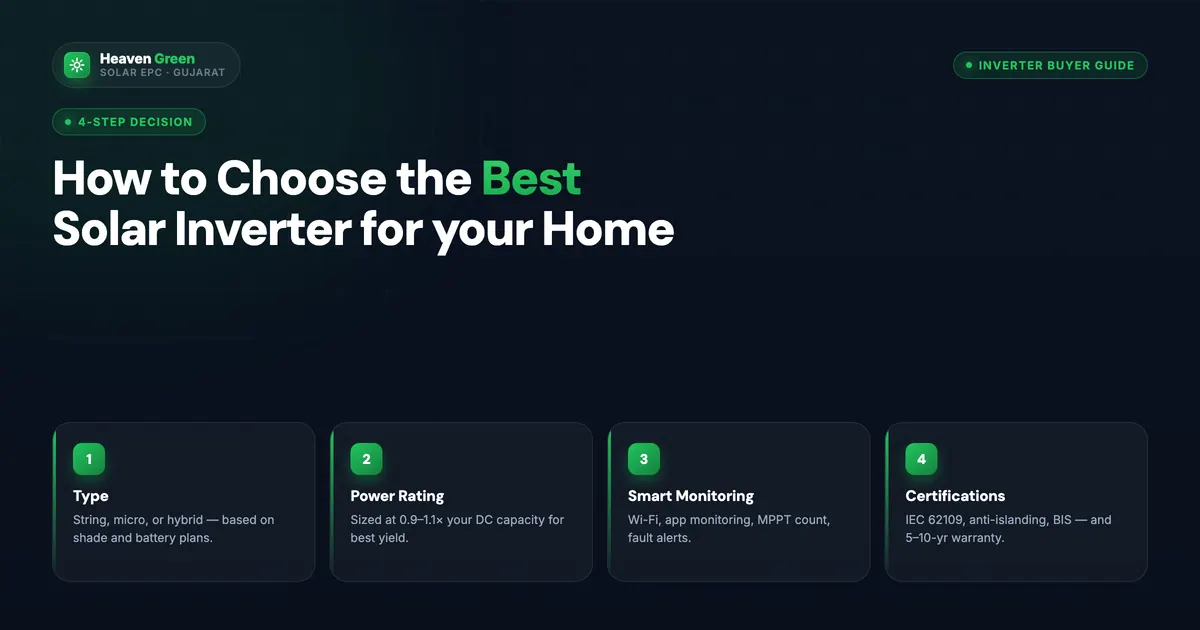
Score a brand by the factor that matches your site. A residential rooftop in Vadodara with stable grid and no battery scores Growatt highest. A villa in Jodhpur with frequent outages and a planned LFP pack scores Deye. A 25 kW commercial rooftop on a warehouse in Pune scores Sungrow. The scorecard does not crown one winner, it matches the inverter to the project. For a deeper general framework, read how to choose the best solar inverter for your home.
Growatt Inverter Lineup, Strengths and Weaknesses
Growatt’s India range covers four product families that span the entire residential and small commercial spectrum. Understanding which series fits which application avoids the common mistake of buying a single-MPPT (Maximum Power Point Tracker) inverter for a multi-orientation roof.
MIN series (2.5 to 10 kW, single-phase residential). The MIN 3000TL-X and MIN 5000TL-X are Growatt’s volume sellers. Single-phase output, dual MPP trackers, transformerless topology, and 98.4% maximum efficiency per Growatt. Wi-Fi monitoring uses a ShineWiFi dongle. Check the casing temperature and derating curve on the datasheet for 45°C-plus rooftops.
MOD series (3 to 15 kW, three-phase residential and light commercial). Three-phase output for homes with three-phase service or small shops, with multiple MPPT inputs for multi-roof configurations. The MOD 10KTL3-X is the most commonly specified model for 8 to 10 kW residential projects in Gujarat.
MAX series (50 kW and above, commercial). Three-phase commercial grade with many MPPT inputs. Used in 25 to 100 kW factory and warehouse installations where Sungrow’s premium pricing is a stretch.
SPH series (hybrid). Growatt’s hybrid line, competing with Deye’s SUN-SG range. Battery-ready with LFP support, but the install base in India is smaller and field engineers have less troubleshooting depth than on the MIN series.
Where Growatt wins. Lowest entry price of the three brands. Widest service network. Largest installer familiarity, most EPC partners in India can install and commission a MIN-X inverter without manufacturer support. Easiest warranty claims because of the dense service footprint and reliable spare-parts stocking through the India master distributor.
Where Growatt loses. Heat derating can hit generation in May and June, so check the derating curve. Extending the warranty to 10 years typically costs extra. Hybrid range is newer and less proven than Deye. Build feel is more plastic, less industrial than Sungrow.
Deye Inverter Lineup, Strengths and Weaknesses
Deye’s product strategy is concentrated rather than broad. The brand picked hybrid as its category and built everything around the SUN-K series. This narrow focus is both its strength and its limitation.
SUN-K hybrid series (3 to 12 kW, single and three-phase). The SUN-3K-SG03LP1, SUN-5K-SG04LP1, and SUN-12K-SG04LP3 are the volume models. All three are battery-ready with CAN-bus BMS integration for Pylontech, BYD, Dyness, and most major LFP packs sold in India. The 5 kW model has two MPPTs and lists 97.6% maximum efficiency, IP65, and a 500 V maximum PV input, with automatic changeover to backup loads during grid failure.
SUN-SG three-phase hybrids (larger sizes). Three-phase hybrid for larger commercial and small industrial sites. Less common in India than the residential SUN-K, but a strong fit for net-metered commercial rooftops that also need critical-load backup.
Where Deye wins. Hybrid is native, not bolted on. Battery integration works out of the box with the major Indian-supplied LFP brands. The seamless transfer between grid-tie and backup mode is the cleanest of the three. Wi-Fi monitoring via the Solarman app is free and integrated. For off-grid and hybrid use cases, increasingly common in Indian residential, Deye is the default. Read more on system architecture choices in our on-grid vs off-grid vs hybrid systems guide.
Where Deye loses. Service network is the smallest of the three, if your site is rural or tier-3, response times can stretch. Pure grid-tie (no battery, no backup) installations are over-specified on a Deye SUN-K; you pay for hybrid hardware you do not use. Build feel is solid but not premium.
Get a free inverter selection consult. Our engineers compare your bill, roof, battery plans, and ambient conditions, then recommend the right QBits inverter configuration for the site. Get your free quote →
Sungrow Inverter Lineup, Strengths and Weaknesses
Sungrow is a major supplier to utility-scale solar farms in India, and the same product depth that supplies multi-MW projects underpins the residential SG and SH ranges. The result is commercial-grade engineering in residential casings, with the price tag to match.
SG RS residential string (single-phase). SG3.0RS and SG5.0RS are the common residential models. Check the datasheet for maximum efficiency, IP rating (Deye’s SUN-SG04LP1 is IP65), derating threshold, and the India warranty term for the exact model. Three-phase models cover larger homes.
SH hybrid series (residential). Sungrow’s hybrid line with high-voltage battery integration. Targets buyers who want a premium hybrid stack with Sungrow’s own battery options or compatible high-voltage packs.
SG-CX commercial (15 to 110 kW, three-phase). Workhorse of Sungrow’s commercial range. SG33CX, SG50CX, SG110CX are the common models for 25 to 100 kW factory rooftops. Check the warranty term and MPPT count on the datasheet for the exact model.
Where Sungrow wins. High efficiency, robust heat performance and a rugged enclosure in our experience. The choice when project lifetime matters more than upfront cost, commercial rooftops, EPC O&M contracts, high-ambient sites. In our experience, Sungrow commercial installations show lower failure rates than the other two brands.
Where Sungrow loses. Price is 35 to 60% higher than Growatt for equivalent kW ratings. Hybrid range is more expensive than Deye for the same battery capability. The premium is not justified for short-payback PM Suryaghar residential projects under 5 kW. Installer pool is smaller, fewer EPC partners are trained on Sungrow than on Growatt.
Feature Matrix and Pricing Comparison Across kW Ratings
This is the head-to-head buyers actually want. All prices are India dealer pricing data from Q2 2026 and include the inverter unit only, not balance of system, panels, or installation.
| Specification | Growatt MIN 5000TL-X | Deye SUN-5K-SG04LP1 | Sungrow SG5.0RS |
|---|---|---|---|
| Type | Grid-tie string | Hybrid string | Grid-tie string |
| Rated power | 5 kW | 5 kW | 5 kW |
| Maximum efficiency | 98.4% | 97.6% (96.5% European) | See current datasheet |
| Number of MPPTs | 2 | 2 | 2 |
| Max input voltage | See current datasheet | 500 V | See current datasheet |
| Output phase | Single | Single | Single |
| Battery-ready | No (MIN), Yes (SPH) | Yes, native | No (SG), Yes (SH) |
| IP rating | See current datasheet | IP65 | See current datasheet |
| Heat derating threshold | See current datasheet | Above 45°C | See current datasheet |
| Standard warranty | Check India term | 5 years (up to 10 by country) | Check India term |
| Wi-Fi monitoring | Optional dongle | Built-in (Solarman) | Built-in (iSolarCloud) |
| BIS registration | Verify model | Verify model | Verify model |
| ALMM listed | Not applicable (ALMM covers modules and cells) | Not applicable | Not applicable |
Pricing Across 3 kW, 5 kW, and 10 kW
| System size | Growatt | Deye | Sungrow |
|---|---|---|---|
| 3 kW string inverter | ₹22,000–₹26,000 | ₹28,000–₹32,000 | ₹38,000–₹44,000 |
| 5 kW string inverter | ₹35,000–₹40,000 | ₹40,000–₹45,000 | ₹55,000–₹65,000 |
| 10 kW string inverter | ₹65,000–₹75,000 | ₹78,000–₹88,000 | ₹1,05,000–₹1,20,000 |
Source: India dealer pricing, Q2 2026. Prices vary by dealer, region, and quantity. EPC project pricing for 10+ units differs from single-unit residential.
Warranty and Support Comparison
| Element | Growatt | Deye | Sungrow |
|---|---|---|---|
| Standard warranty | Check India term | 5 years (up to 10 by country) | Check India term |
| Extended warranty (paid) | Ask for India terms | Up to 10 years | Ask for India terms |
| Spare parts availability | Strong | Moderate | Strong |
| App / portal | ShinePhone | Solarman | iSolarCloud |
India Service Network
| City tier | Growatt | Deye | Sungrow |
|---|---|---|---|
| Tier-1 (Mumbai, Delhi, Bengaluru, Chennai, Kolkata, Hyderabad, Ahmedabad, Pune) | All present | All present | All present |
| Tier-2 (Surat, Vadodara, Jaipur, Lucknow, Indore, Coimbatore, Visakhapatnam, Bhubaneswar) | Most present | Selected | Most present |
| Tier-3 (Rajkot, Bhavnagar, Nashik, Mysuru, Madurai, Salem, Vijayawada) | Strong | Limited | Selected |
| Rural / district HQ | Through EPC partners | Through EPC partners | Through EPC partners |
Watch out
Grey-market Growatt and Deye units enter India through unofficial channels and undercut authorised dealer prices by 10 to 15%. These units carry no India warranty, fail BIS verification during DISCOM inspection, and disqualify the system from PM Suryaghar subsidy. Always insist on the original invoice with the IEC and BIS certificate numbers printed, and verify the serial number on the manufacturer's India portal before installation.
When Each Brand Fits Best, Use-Case Matchups
The three brands sort cleanly along the price-and-purpose axis. Match the site to the brand using the pros/cons grid below, then confirm with the verdict.
- Pros: lowest price, widest service, easy installer support
- Pros: large field-installed base, mature firmware
- Cons: check derating above 40°C, plastic build feel
- Cons: paid extension needed for a 10-year warranty
- Best for: 3 to 5 kW PM Suryaghar residential, stable grid
- Pros: battery integration native, clean backup transfer
- Pros: Solarman app free, broad LFP compatibility
- Cons: smaller service network
- Cons: over-specified for pure grid-tie use
- Best for: hybrid systems with LFP backup, unreliable grid
- Pros: high efficiency, commercial-grade engineering
- Pros: robust enclosure and heat performance
- Cons: 35 to 60% price premium
- Cons: smaller installer pool than Growatt
- Best for: commercial rooftops, 25+ year horizon, high-ambient sites
Verdict. Growatt wins when project payback is the priority and the site has a stable grid and moderate ambient. Deye wins when battery backup is mandatory, frequent outages, unreliable DISCOM supply, or a planned LFP pack. Sungrow wins when project lifetime, heat resistance, and warranty matter more than capex, commercial rooftops above 10 kW, high-ambient sites in Rajasthan and Gujarat, and any installation with a 20-year O&M contract attached.
Quick tip
If your installer is offering a Deye SUN-K hybrid but you have no battery plan and the grid is stable, ask for a Growatt MIN-X or Sungrow SG quote instead. You will save ₹5,000–₹8,000 on hybrid hardware you would not use. Conversely, if you plan to add a lithium pack within two years, paying the Deye premium upfront is cheaper than retrofitting later.
For a broader industry view including Indian manufacturers, see our top solar inverter companies India overview.
Common Inverter Selection Mistakes Buyers Make
Six recurring mistakes account for most of the regret we hear from buyers who picked the wrong brand. Each is preventable with a 15-minute check before signing the quote.
-
1
Picking the cheapest inverter for a 48°C rooftop. An inverter that works well in Pune (35°C summer ambient) can derate on a Jodhpur rooftop hitting 48°C in May and June. Compare derating curves, not just price, for high-ambient sites.
-
2
Buying a hybrid Deye for pure grid-tie use. If you have no battery and no plan to add one, a Deye SUN-K is over-specified. You pay 15 to 20% extra for hybrid hardware that sits idle. Pick Growatt MIN or Sungrow SG instead.
-
3
Skipping the BIS certificate verification. Grey-market Chinese units look identical to authorised stock but fail DISCOM inspection. Always verify the BIS certificate number against the [bis.gov.in](https://bis.gov.in/) register before the inverter is mounted on the roof.
-
4
Choosing a single-MPPT inverter for a multi-orientation roof. If your panels face two different directions (east and west, or south and west), you need two MPPTs. A single-MPPT inverter clips generation by 15 to 20%. All three brands offer dual-MPPT in their 5 kW residential range, confirm on the spec sheet.
-
5
Ignoring service centre distance. An inverter failure means zero generation until it is fixed. Before signing, check the closest authorised service centre for the brand you are picking. In our experience Growatt has the densest network and Deye the sparsest, so tier-3 claims can take longer.
-
6
Comparing only peak efficiency, not weighted efficiency. Peak efficiency is the headline number; European weighted efficiency is closer to what shows up in annual generation. Deye's SUN-5K-SG04LP1, for example, lists 97.6% maximum but 96.5% European. Either number is small relative to the price gap.
How Heaven Green Energy Recommends Inverters
Heaven Green Energy installs QBits inverters as standard. The comparison above is how we help buyers read the market; on our own quotes, the recommendation process is the same six-factor scorecard described above, applied to the specific site, bill, battery plan, and budget in front of you.
For PM Suryaghar 3 to 5 kW residential projects on a stable DISCOM grid (UGVCL, DGVCL, MGVCL, MSEDCL, BESCOM, TANGEDCO), the price-per-kW factor dominates, so we size a QBits string inverter to the array rather than paying for hybrid hardware the site will not use.
For residential rooftops in load-shedding-prone areas, or where the customer wants LFP battery backup from day one, we specify a QBits hybrid inverter, so grid-tie, battery charging, and backup loads run through one unit instead of a separate battery inverter added later.
For commercial rooftops above 10 kW, EPC projects with O&M attached, and any high-ambient site (Rajasthan, Kutch, interior Tamil Nadu), warranty length and heat tolerance carry the scorecard, so we match the QBits inverter rating to the load profile and put the warranty and service terms in writing before the quote is signed.
Explore the services that match your project:
- Solar inverters, full range: QBits inverters with India warranty.
- Residential Solar: 1 to 10 kW with PM Suryaghar subsidy handled end-to-end.
- Commercial Solar: 10 to 500 kW with custom ROI modelling and accelerated depreciation planning.
- Solar Calculator: sizing and savings estimate in 60 seconds.
- Contact our team: request a quote with the QBits configuration matched to your site.
For a complete framework on inverter selection beyond brand choice, read how to choose the best solar inverter for your home. If you are still narrowing down between Indian and Chinese brands, our Luminous vs Microtek comparison covers the home-battery side.
Frequently Asked Questions
Which is the best inverter brand among Growatt, Deye, and Sungrow for an Indian home in 2026?
There is no single best brand, each wins a different use case. Growatt is the best price-to-performance pick for a 3 to 5 kW PM Suryaghar grid-tie installation on a stable DISCOM grid. Deye is best when battery backup is part of the system or a lithium pack is planned within two years. Sungrow is best for premium installations, commercial rooftops, and any site with summer ambient above 45°C. Check that the exact model is BIS-registered for the ₹78,000 PM Suryaghar subsidy; inverters are not on the ALMM list.
How much does a 5 kW Growatt, Deye, or Sungrow inverter cost in India?
A 5 kW Growatt MIN 5000TL-X costs ₹35,000–₹40,000. A 5 kW Deye SUN-5K-SG04LP1 hybrid costs ₹40,000–₹45,000. A 5 kW Sungrow SG5.0RS costs ₹55,000–₹65,000. These are inverter-only prices from India dealer pricing data, Q2 2026. Installed system pricing including panels, balance of system, and labour ranges from ₹2.6 lakh to ₹3.2 lakh for a 5 kW PM Suryaghar residential system depending on which inverter is chosen.
Is Sungrow worth the 35 to 60% premium over Growatt in India?
For residential projects under 5 kW with a payback target under 4 years, the Sungrow premium is hard to justify on pure capex math, and Growatt wins. For commercial rooftops above 10 kW, EPC contracts with O&M tails, and any installation with summer ambient over 45°C, Sungrow’s commercial-grade engineering can pay back over the 25-year project lifetime through higher generation and lower failure-related downtime, provided its datasheet efficiency, derating curve and India warranty term for the exact model bear that out.
Does Deye work with Indian lithium batteries like Pylontech and Dyness?
Yes. Deye hybrid inverters communicate with most Indian-supplied LFP packs over the CAN bus, including Pylontech, BYD, Dyness, and the major OEM-rebranded Indian batteries. Deye publishes compatibility lists and updates them periodically. Always confirm the specific battery model against the latest Deye compatibility document before purchase; firmware updates sometimes add new battery models. CAN bus communication enables full BMS data, state of charge, cell voltages, temperature, to feed back to the Solarman app.
Can I use Growatt, Deye, or Sungrow for PM Suryaghar subsidy applications?
Yes, provided the exact model is BIS-registered. Solar inverters must comply with MNRE’s quality control order for solar inverters, and PM Suryaghar requires IS/IEC 61683, IS 16221 (Part 2) and IS 16169; Deye, for example, lists IEC 61727 among its grid regulations. Inverters are not on MNRE’s ALMM list, which covers modules (List-I) and cells (List-II), so there is no ALMM check for the inverter. Always verify the BIS registration for the specific model before installation. For a deeper look at how BIS and IEC compliance requirements apply to inverters specifically, see QBits Energy’s guide to solar inverter regulations in India.
What is the difference in warranty between the three brands?
Deye lists a 5-year warranty on its SUN-SG04LP1 residential hybrids, extendable up to 10 years depending on the installation country. Growatt and Sungrow warranty terms also vary by model and country, so get the India warranty card in writing for the exact model, including any paid extension to 10 years or longer. Commercial models carry their own terms. Warranty covers manufacturing defects; it typically excludes lightning damage, incorrect installation, and grid abnormality damage.
Which brand has the best after-sales service network in India?
In our experience Growatt has the widest service network, including tier-2 markets and many tier-3 cities. Sungrow follows, with engineers trained on the full SG and SH range. Deye has the smallest network, strong in tier-1 markets but limited in tier-3. Ask each brand for the nearest authorised service point and its claim response time before you sign, and for sites in remote locations, factor the service distance into the decision.
Are Growatt, Deye, and Sungrow inverters made in India or imported from China?
All three are Chinese companies that manufacture primarily in China and sell in India through Indian subsidiaries or authorised partners. Ask whether the specific unit is imported or locally assembled and buy through the brand’s authorised India channel. The BIS registration covers the specific manufacturing line, whether China-built or India-assembled, and the BIS-marked label is what DISCOM inspectors check.