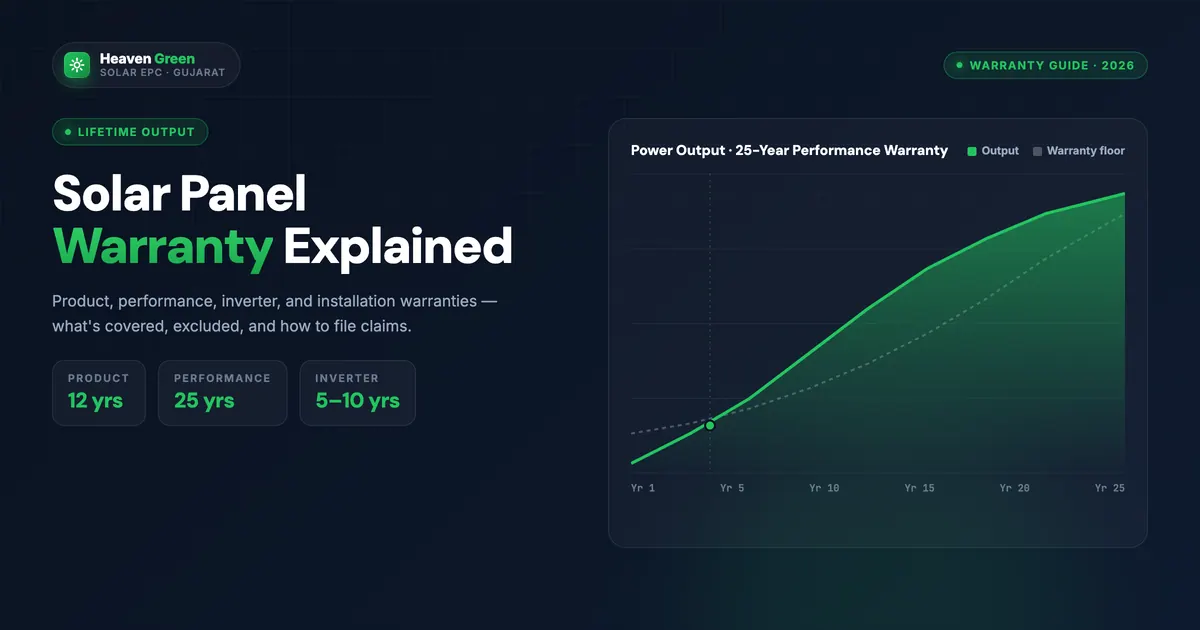
A solar system is a 25-year investment. The three warranties that come with it, product, performance, and workmanship, are the safety net that protects that investment. But most homeowners sign the installation contract without fully understanding what each warranty covers, who provides it, and how to actually make a claim.
This matters because these three warranties are issued by three different parties (manufacturer, manufacturer, and installer), cover three different failure types, and have different claim processes. When something goes wrong, and over 25 years, something usually does, knowing which warranty applies determines whether you pay for the repair or someone else does.
Key takeaway. Solar panels come with a 10 to 15 year product warranty (manufacturing defects), a 25 to 30 year performance warranty (minimum output guarantee), and a 5 to 10 year workmanship warranty from the installer (installation quality). Heaven Green Energy provides a 5-year workmanship warranty and assists with all manufacturer warranty claims for panels and inverters we supply and install, maintaining serial number records throughout the 25-year system life.
Warranty Type 1, Product Warranty (What the Manufacturer Covers)
The product warranty (also called material warranty or module warranty) covers failures in the panel due to manufacturing defects.
What it covers:
- Delamination: the EVA encapsulant separates from the glass, exposing cells to moisture
- Junction box failure: cracked, melted, or corroded junction boxes
- Frame corrosion: aluminium frame deterioration
- Glass breakage from internal thermal stress (not from external physical impact)
- Cell failure due to manufacturing defect (not soiling or shading)
- Connector (MC4) failures if supplied as part of the panel module
Standard terms in India (2026):
- Tier 1 manufacturers (Adani, Waaree, Vikram, LONGi, Jinko): 12 to 15 year product warranty
- Mid-tier manufacturers: 10 year product warranty
- Budget/unknown brands: 5 year product warranty (or none, verify before buying)
What it does NOT cover:
- Physical damage from hailstorm, storm, flood, or falling objects
- Damage from improper installation (no earthing, incorrect torque on mounting bolts causing frame stress)
- Output loss due to soiling, shading, or inverter issues
- Cosmetic issues that don’t affect electrical output (minor discolouration, surface scratches)
Who processes the claim: Contact the manufacturer directly with panel serial numbers, installation date, site photos, and a description of the defect. Most Tier 1 manufacturers have regional representatives in India. Claim response time: 2 to 6 weeks.
💡 Fast tip
Always photograph the back of every panel during installation and record the serial number. You'll need serial numbers for warranty claims. If you install 8 to 13 panels and one fails 7 years later, you need to identify which panel it is from the manufacturer's records, and you need the serial number to do that.
Warranty Type 2, Performance Warranty (Output Guarantee)
The performance warranty is the most important warranty for long-term financial planning, it guarantees your panels produce a minimum level of output throughout their stated life.
Minimum structure (PM Surya Ghar module specification, MNRE guidelines 2024; modules also tested to IEC 61215 / IS 14286):
- Year 1: ≥ 97% of nameplate output
- Years 1 to 10: ≥ 90% of nameplate, with degradation below 0.5%/year
- Year 25: ≥ 80% of nameplate output (the “80/25” standard)
Premium panel structure (TOPCon, HJT, 2026 models):
- Years 1 to 10: ≤ 0.40%/year degradation
- Year 30: ≥ 83 to 87% of nameplate output (30-year warranty increasingly offered)
What this means financially: A 400W panel at year 25 is guaranteed to produce at least 320W. For a 3.2 kW array of 8 panels, the guaranteed year-25 output is at least 2.56 kW, still sufficient to generate meaningful electricity and bill savings.
What triggers a performance warranty claim:
- Measured output at standard test conditions (STC) is below the warranted value for the relevant year
- Comparison is done by a certified testing lab using calibrated irradiance measurement and a traceable reference cell
Practical challenge: Measuring output at true STC conditions (1000 W/m² irradiance, 25°C cell temperature) in the field requires specialised equipment. Most homeowners cannot independently verify performance warranty compliance without professional testing. Your installer can arrange a PR (Performance Ratio) assessment against weather-adjusted generation data, which provides a practical proxy for warranty compliance.
Warranty Type 3, Workmanship Warranty (What the Installer Covers)
The workmanship warranty is provided by your solar EPC company, not the manufacturer. It covers failures caused by installation-related errors.
What it typically covers:
- Roof leakage caused by incorrect mounting bracket installation
- Electrical failures due to improper MC4 crimping or loose terminal connections
- Earthing system failure due to incorrect installation under IS 3043
- Module micro-cracking caused by excessive torque during installation
- Wiring damage from poor conduit routing or inadequate cable management
- Inverter performance issues caused by incorrect configuration by the installer
Standard terms in India (2026):
- Basic: 1 to 2 years (most small regional installers)
- Standard: 3 to 5 years (mid-tier installers registered on the PM Suryaghar portal)
- Premium: 5 to 10 years (established EPCs with service teams and AMC options)
Heaven Green Energy offers a 5-year workmanship warranty on all residential installations.
What it does NOT cover:
- Panel degradation (covered by manufacturer performance warranty)
- Inverter component failure after inverter product warranty (covered by inverter manufacturer)
- Physical damage from hailstorm, flood, or accidents
- Failures caused by the customer tampering with electrical components
Inverter Warranty: A Fourth Important Coverage
Separate from panel warranties, your solar inverter comes with its own manufacturer warranty.
| Inverter Brand | Standard Warranty | Extended Warranty Option | Key Condition |
|---|---|---|---|
| Sungrow | Varies by model; confirm in writing | Paid extension available | Check the brand’s registration terms |
| Huawei FusionSolar | Varies by model; confirm in writing | Paid extension available | Check the brand’s registration terms |
| SMA | Varies by model; confirm in writing | Paid extension available | Check the brand’s registration terms |
| Growatt | 5 years (factory standard) | Paid extension available | Extension must be bought within 2 years of installation |
| Goodwe | Varies by model; confirm in writing | Paid extension available | Check the brand’s registration terms |
A 5-year standard inverter warranty means you will likely need one inverter replacement over a 25-year system life (since inverters typically last 10 to 15 years). Budget ₹20,000–₹40,000 for this replacement at year 10 to 12. Extending inverter warranty to 10 to 20 years costs ₹5,000–₹25,000 but provides cost certainty and often includes remote technical support.
The solar inverter selection guide covers warranty terms and extended warranty value for each major brand.
The Heaven Green Warranty Coverage Matrix
To make warranty responsibilities clear to every customer, Heaven Green Energy provides a written Heaven Green System Warranty Coverage Matrix with every installation, a simple table showing who covers what, for how long, and how to claim.
| Component | Who Provides Warranty | Period | How to Claim |
|---|---|---|---|
| Solar panels (product defect) | Panel manufacturer | 12 years (Adani) | Via Heaven Green or directly to manufacturer |
| Solar panels (output performance) | Panel manufacturer | 25 years (Mono PERC) or 30 years (TOPCon) | Third-party PR test → Heaven Green claim assistance |
| Solar inverter | Inverter manufacturer | As per the written warranty terms (ask for them) | Via Heaven Green or manufacturer’s service app |
| Mounting structure | Structure manufacturer | 10 years (anti-corrosion) | Via Heaven Green |
| DCDB/ACDB | Enclosure manufacturer | 2 years | Via Heaven Green |
| Cables | Cable manufacturer | 25 years | Via Heaven Green |
| Installation workmanship | Heaven Green Energy | 5 years | Direct: +91 63904 05060 or /contact |
This matrix is given to every customer in printed form at commissioning time.
📘 Regulation note
📘 Regulation note
Under the Consumer Protection Act 2019, failure to honour a warranty is a deficiency in service. Solar consumers can file complaints with the District Consumer Disputes Redressal Commission (formerly the District Consumer Forum) if a manufacturer or installer refuses to honour warranty terms without valid justification. Keep all warranty documents, installation records, and claim correspondence in writing. See the BIS portal for IS 14286 certification verification of your panel brand.
Step-by-Step: How to Make a Warranty Claim in India
-
Identify the failure type: Is it a physical defect (product warranty)? Below-warranted output (performance warranty)? Installation-related failure (workmanship warranty)?
-
Document thoroughly: Photograph the failed component, record the panel serial number, screenshot your monitoring app showing the performance drop, note the installation date.
-
Contact your EPC installer first: Even for manufacturer warranty claims, a reputable installer should assist with the claim process and facilitate the manufacturer’s technical assessment.
-
Provide the standard claim package:
- Panel serial number(s)
- Installation date and commissioning certificate
- Site photographs showing the defect
- Performance data from inverter monitoring platform
- Description of when the issue was first noticed
-
Manufacturer assessment: The manufacturer (or their authorised service agent) inspects and determines if the failure falls under warranty coverage.
-
Resolution: Manufacturer replaces or repairs the failed component. For product warranty, this is usually a direct replacement panel. For performance warranty, it may be replacement, credit, or cash settlement depending on the manufacturer’s policy.
The solar panel warranty explained guide covers the full claim process with examples.
Pros and Cons of Extended vs. Standard Warranty
- Cost certainty, one fixed price vs. unpredictable replacement cost
- Often includes remote monitoring and firmware updates
- Priority service response from manufacturer
- Protects 25-year panel output expectation with reliable inverter
- Inverter replacement at year 10 to 12 costs ₹20,000–₹40,000 out of pocket
- Post-warranty faults need self-diagnosis and paid service calls
- No remote monitoring support from manufacturer after warranty expires
How Heaven Green Energy Manages Warranties for You
Heaven Green Energy maintains a customer installation database with full component records, panel serial numbers, inverter model and serial, DCDB/ACDB specifications, for every installation we complete. This ensures that when you need to make a warranty claim 7 or 12 years later, the documentation is available without you having to locate decade-old paperwork.
We also monitor installed systems for performance anomalies that may indicate early-stage warranty-claimable failures, catching issues before they compound into larger losses.
- Residential Solar: 5-year workmanship warranty, full equipment records, warranty claim support.
- Products: Solar Modules: Tier 1 panels with 25- to 30-year performance warranties.
- Products: Solar Inverters: inverters with extended warranty options.
- Solar Panel Warranty Guide: detailed warranty terms and claim process guide.
- Contact our service team: warranty support and claim assistance.
Frequently Asked Questions
What is the difference between a product warranty and a performance warranty on solar panels?
A product warranty covers manufacturing defects (delamination, junction box failure, frame corrosion) for 10 to 15 years. A performance warranty guarantees minimum electrical output, at least 80% of nameplate at year 25. Both are provided by the panel manufacturer. A product warranty replacement gives you a new panel; a performance warranty claim addresses the fact that your panel produces less than guaranteed output.
Who provides the workmanship warranty for a solar installation?
The workmanship warranty is provided by the installing EPC company, not the panel or inverter manufacturer. It covers failures caused by installation errors (roof leaks from mounting bolts, loose electrical connections, incorrect earthing). Heaven Green Energy provides a 5-year workmanship warranty on all residential installations, covering call-outs and repairs for installation-related issues at no additional charge.
What happens if the solar panel manufacturer goes out of business before my warranty expires?
This is a real risk with non-Tier-1 manufacturers. If a panel manufacturer ceases operations, their warranty becomes worthless because there’s no entity to honour the claim. This is why Heaven Green Energy installs only from manufacturers with demonstrated financial stability and an Indian service presence. As an authorised Channel Partner of Adani Green Energy, we install Adani Solar panels. The manufacturer warranty is only as good as the company standing behind it.
Does the PM Suryaghar scheme have any warranty requirements?
Yes. The PM Suryaghar guidelines require the vendors registered on the national portal to provide a minimum 5-year warranty and maintenance cover on the installed system. Panels must be DCR modules on the ALMM that meet IS 14286 (IEC 61215), and inverters must meet IS 16221 (IEC 62109) among other standards. This ensures a minimum quality floor for all subsidised installations. Non-certified equipment automatically disqualifies the installation from the PM Suryaghar subsidy.
What if my solar system underperforms but is still within warranty levels?
If your system generates, say, 88% of original output at year 10 but the warranty only guarantees 80% at year 25, you technically have no performance warranty claim, your system is above the warranty floor. In this case, investigate operational causes: soiling, shading, or inverter partial fault. The performance warranty is a minimum floor guarantee, not a “it must always generate at nameplate” guarantee.
Can I transfer solar warranties when I sell my home?
Solar panel performance and product warranties are generally attached to the equipment, not the original buyer, they transfer with the panels when you sell the property. Some manufacturers require a formal transfer notification and the original installation date and documentation, so check the warranty certificate’s specific transferability clause.