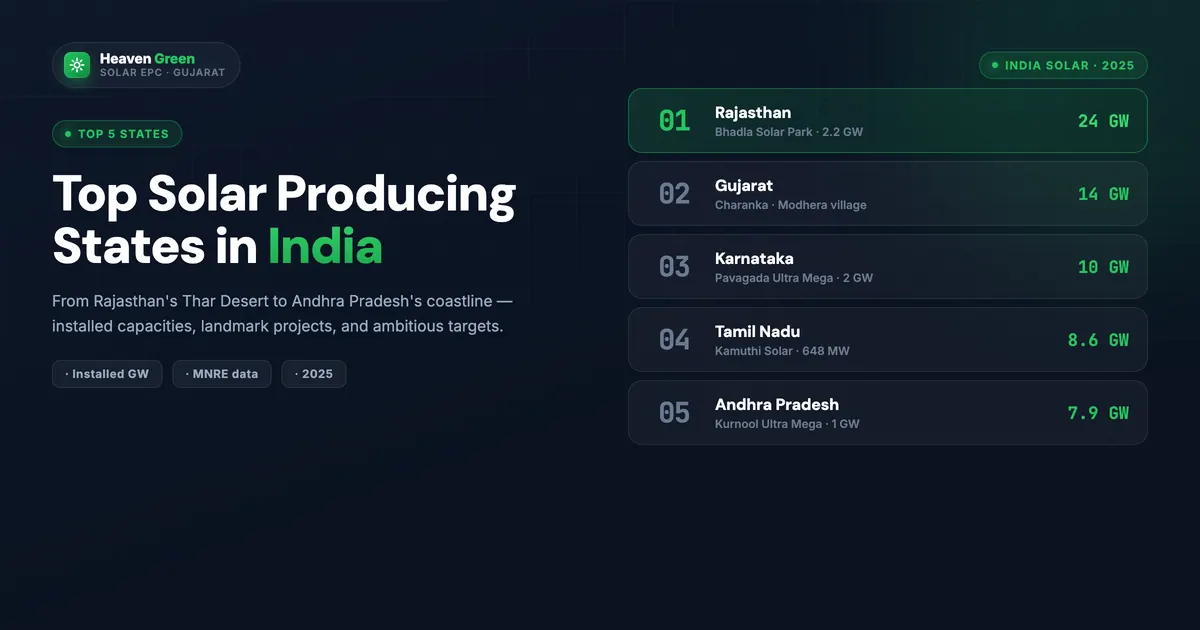
Rajasthan has the highest solar irradiation of any large state in India, 5.5 to 6.0 kWh/m²/day across most of its geography. For homeowners in Jodhpur, Jaipur, Kota, or Bikaner, this means a 3 kW solar system generates 495 to 540 kWh per month, more than any comparable system anywhere else in the country. Combined with the PM Suryaghar central subsidy of up to ₹78,000, rooftop solar in Rajasthan has a payback period as short as 2.5 to 3 years.
This guide covers PM Suryaghar specifically for Rajasthan, DISCOM structure (JVVNL, AVVNL, JdVVNL), application process, timelines, and Rajasthan-specific tips.
Direct answer. PM Suryaghar in Rajasthan pays ₹78,000 central subsidy for 3 kW and above. Three DISCOMs serve Rajasthan: JVVNL for Jaipur region, AVVNL for Ajmer region, and JdVVNL for Jodhpur region. Rajasthan’s exceptional solar irradiation means faster payback than most Indian states. End-to-end timeline is 70 to 100 days.
Rajasthan’s Three DISCOMs
| DISCOM | Full name | Districts served |
|---|---|---|
| JVVNL | Jaipur Vidyut Vitran Nigam Limited | Jaipur, Alwar, Dausa, Sikar, Jhunjhunu, Bharatpur, Sawai Madhopur, Karauli, Tonk, Dholpur, Gangapur City |
| AVVNL | Ajmer Vidyut Vitran Nigam Limited | Ajmer, Bhilwara, Nagaur, Pali, Rajsamand, Chittorgarh, Udaipur, Dungarpur, Banswara, Pratapgarh, Sirohi |
| JdVVNL | Jodhpur Vidyut Vitran Nigam Limited | Jodhpur, Bikaner, Barmer, Jaisalmer, Pali, Jalore, Sanchore, Nagaur, Sri Ganganagar, Hanumangarh, Churu |
Your electricity bill shows the DISCOM name. You can also check at pmsuryaghar.gov.in, entering your consumer number will auto-identify your DISCOM.
Subsidy and Solar Economics in Rajasthan
Rajasthan’s electricity tariff for domestic consumers runs approximately ₹5.00–₹7.50 per kWh for mid-range consumption slabs. At ₹6 per unit, a 3 kW system generating 540 kWh saves ₹3,240 per month: or ₹38,880 per year. After the ₹78,000 subsidy reduces your net system cost to approximately ₹1,17,000, the payback is under 3 years.
Step-by-Step Application for Rajasthan
Documents Required in Rajasthan
| Document | Rajasthan-specific note |
|---|---|
| Aadhaar card | Name must match JVVNL/AVVNL/JdVVNL bill exactly |
| Latest electricity bill | Confirm “Domestic” category; check for pending dues |
| Property ownership | Jamabandi (land record) or registered sale deed accepted |
| Bank account (Aadhaar-seeded) | Jan Dhan accounts are Aadhaar-seeded by default |
| Passport photo | Standard |
Rural Rajasthan note: For rural consumers, the Jamabandi (land ownership record from the Patwari’s office) is the standard property proof. Urban consumers use registered sale deed or municipal house tax receipt.
Rajasthan State Renewable Energy Initiative
The Rajasthan Renewable Energy Corporation Limited (RRECL) coordinates state-level renewable energy policy. Rajasthan has set ambitious solar capacity targets and is one of India’s top states for solar. While the PM Suryaghar subsidy is central-government-funded, Rajasthan’s policy environment is strongly supportive.
Net Metering in Rajasthan
All three Rajasthan DISCOMs participate in net metering. Surplus solar units exported to the grid are credited at the prevailing rate. Given Rajasthan’s very high summer generation (especially in May–August), a 3 kW system often exports 200+ kWh per month during peak summer, building up significant credit against winter months when generation drops slightly.
| Season | Approx monthly generation (3 kW, Jodhpur) | Notes |
|---|---|---|
| Summer (Apr–Jun) | 520 to 570 kWh | Maximum generation; large exports |
| Monsoon (Jul–Sep) | 380 to 430 kWh | Cloudy days reduce output |
| Winter (Oct–Feb) | 410 to 480 kWh | Good generation; short days offset by clear skies |
| Spring (Mar) | 490 to 530 kWh | Excellent generation resumes |
💰 Real numbers
Rajasthan consumers with a 3 kW system typically achieve a near-zero annual electricity bill because the large summer surplus credits offset the smaller winter deficit. This is the best solar financial outcome of any state in India.
Heat and Dust Considerations for Rajasthan
Rajasthan’s climate presents specific equipment requirements:
- High-temperature performance panels: TOPCon or bifacial modules maintain better efficiency at 45°C+ ambient temperatures vs standard mono PERC. Ask your installer for modules with a temperature coefficient better than -0.35%/°C.
- Anti-soiling coating: desert dust accumulation can reduce output by 15 to 25% without weekly cleaning. Anti-soiling glass or hydrophobic coatings reduce cleaning frequency.
- Mounting structure clearance: minimum 150 mm air gap between panel and roof surface for airflow. Reduces operating temperature and improves output.
- Cable UV rating: all cables must be UV-rated for desert exposure (TUV/UL certified).
How Heaven Green Energy Helps Rajasthan Customers
- Residential Solar: complete PM Suryaghar subsidy handling.
- PM Suryaghar Complete Guide: full national scheme overview.
- Solar Subsidy in India: all government schemes.
- Contact us: speak with our Rajasthan-experienced solar team.
Get a free site visit. Our engineer visits your Rajasthan property and sends a proposal in 48 hours. Get your free quote →
Frequently Asked Questions
Which DISCOM serves Jaipur under PM Suryaghar?
Jaipur is served by JVVNL (Jaipur Vidyut Vitran Nigam Limited). Select Rajasthan → JVVNL on the PM Suryaghar portal.
Does Rajasthan offer any additional subsidy over the central ₹78,000?
As of June 2026, there is no universal additional state subsidy for residential consumers in Rajasthan beyond the central ₹78,000. RRECL runs promotional programmes periodically, check rrecl.com for active schemes.
What is the solar payback period in Rajasthan?
With the PM Suryaghar subsidy reducing a 3 kW system cost to approximately ₹1,17,000, and monthly savings of ₹3,000–₹3,500 at Rajasthan tariff rates, the payback period is 2.5 to 3.5 years. This is among the fastest paybacks in India due to high irradiation.
Are there special requirements for desert areas like Barmer or Jaisalmer?
Yes. Desert installations require anti-soiling panel coating, UV-resistant cables, and increased structural clearance for ventilation. Mounting structures in Jaisalmer and Barmer should be rated for wind zone 3 per IS 875 due to periodic sandstorms.