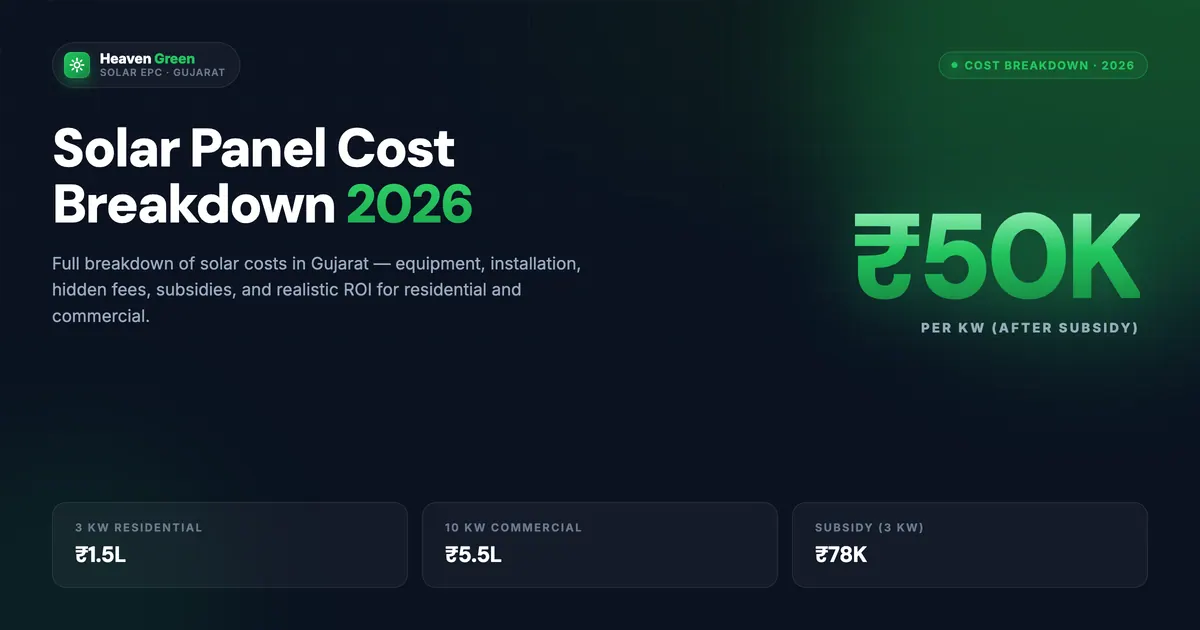
Delhi homeowners face some of the most complex solar decisions in India, three different DISCOMs (BSES Rajdhani, BSES Yamuna, and TPDDL), tiered tariffs that climb to ₹8.00/kWh, and a growing list of solar vendors making competing claims. In 2026, a 3 kW system in Delhi costs ₹1,20,000–₹1,55,000 after PM Suryaghar subsidy, a 5 kW system costs ₹1,80,000–₹2,25,000, and a 10 kW system costs ₹3,25,000–₹4,10,000. The city gets 5.0 to 5.5 peak sun hours per day, solid returns when you understand which DISCOM handles your colony.
Key takeaway. Solar installation in Delhi costs ₹1,20,000–₹4,10,000 after PM Suryaghar subsidy, depending on system size and DISCOM zone. With BSES and TPDDL tariffs reaching ₹8.00/kWh at upper slabs, payback is typically 3.5 to 5 years. Heaven Green Energy is an MNRE-empanelled installer covering Delhi with end-to-end subsidy and net metering support across all three DISCOMs.
One critical step before everything else: identify your DISCOM. Delhi has three electricity distributors, BSES Rajdhani (South and West Delhi), BSES Yamuna (East and Central Delhi), and TPDDL/TPSL (North and Northwest Delhi). The PM Suryaghar process, consumer number format, and net metering application differ by DISCOM. Your electricity bill header tells you which one you’re on.
Delhi’s Solar Context: Three DISCOMs, One National Scheme
Delhi is unique among Indian metros in having three competing private DISCOMs, each with slightly different processes for solar approvals. All three participate in the PM Suryaghar (PM सूर्यघर मुफ्त बिजली योजना) national scheme, and all are governed by DERC (Delhi Electricity Regulatory Commission) net metering regulations.
Delhi’s residential tariff structure in 2026:
- 0 to 200 kWh/month: ₹3.00–₹4.50/kWh (subsidised slabs for low-income consumers)
- 201 to 400 kWh/month: ₹5.00–₹6.50/kWh
- 401 to 800 kWh/month: ₹6.50–₹7.50/kWh
- Above 800 kWh/month: ₹7.50–₹8.00/kWh
A 3 to 4 BHK home in Delhi with 2 ACs typically consumes 400 to 700 kWh/month during summer, landing squarely in the ₹6.50–₹7.50/kWh band. Delhi also experiences very hot summers (45°C+) with high AC usage from April to June, which is precisely when solar generation peaks. The solar irradiation calendar aligns perfectly with the billing pain point.
For a detailed national guide to PM Suryaghar, see our PM Suryaghar complete guide 2026.
Solar Cost by System Size in Delhi: 3 kW, 5 kW, 10 kW
All costs include fully installed systems, Tier-1 BIS-certified mono PERC panels, grid-tie string inverter, mounting structure, cabling, DISCOM application charges, and documentation.
| System Size | Gross Cost (before subsidy) | PM Suryaghar Subsidy | Net Cost (post-subsidy) | Monthly Generation | Ideal For |
|---|---|---|---|---|---|
| 3 kW | ₹1,98,000–₹2,33,000 | ₹78,000 | ₹1,20,000–₹1,55,000 | 360 to 480 kWh | 2 to 3 BHK, bill ₹2,000–₹4,000 |
| 5 kW | ₹2,58,000–₹3,03,000 | ₹78,000 | ₹1,80,000–₹2,25,000 | 600 to 800 kWh | 3 to 4 BHK with 2 ACs, bill ₹4,000–₹9,000 |
| 10 kW | ₹4,03,000–₹4,88,000 | ₹78,000 | ₹3,25,000–₹4,10,000 | 1,200 to 1,600 kWh | Large homes, small offices, clinics |
Delhi-specific pricing notes:
- Labour costs in Delhi are 5 to 10% higher than in Gujarat or Rajasthan due to higher urban wages and more complex building access (multi-storey apartments, gated communities).
- DISCOM application and documentation fees vary: BSES charges ₹2,500–₹4,000, TPDDL charges ₹3,000–₹5,000.
- Panel prices are consistent nationally, Tier-1 mono PERC 540 Wp panels are ₹18,000–₹22,000 per panel ex-factory in 2026 (Bridge to India Solar Market, Q1 2026).
💡 Fast tip
Delhi's winter fog season (December–January) reduces solar generation by 20 to 30% in those months. Budget for this in your annual savings estimate, don't accept a proposal based only on summer generation figures.
The Delhi 3-DISCOM Sizing Framework
The Delhi 3-DISCOM Sizing Framework is Heaven Green Energy’s proprietary method for sizing solar systems in Delhi’s multi-DISCOM environment, because the DISCOM you’re on affects your net metering settlement, export rates, and approval timeline.
Step 1, Identify your DISCOM from your electricity bill:
- BSES Rajdhani: South Delhi (Vasant Kunj, Dwarka, Mehrauli, R.K. Puram, Saket)
- BSES Yamuna: East and Central Delhi (Shahdara, Preet Vihar, Laxmi Nagar, Old Delhi)
- TPDDL/TPSL: North and Northwest Delhi (Rohini, Pitampura, Model Town, Shalimar Bagh, Janakpuri)
Step 2, Check your contracted load (sanctioned load): Solar system capacity cannot exceed 90% of your contracted load per DERC regulations. If your sanctioned load is 4 kW, maximum solar size is 3.6 kW (practically 3 kW). Request a load enhancement from your DISCOM if you need a larger system.
Step 3, Calculate your target offset: Aim to offset 80 to 90% of your monthly consumption, not 100%. Over-generating and exporting to the grid earns a lower rate (feed-in tariff) than what you pay to import. A slightly smaller system maximises financial returns.
Step 4, Apply DISCOM-specific timing expectations:
- BSES Rajdhani: feasibility 12 to 20 days, meter installation 15 to 25 days
- BSES Yamuna: feasibility 12 to 18 days, meter installation 12 to 20 days
- TPDDL: feasibility 10 to 18 days, meter installation 12 to 18 days
Step 5, Add winter derating: Reduce your generation estimate by 15 to 20% to account for December–January fog. This gives you a conservative payback estimate.
The Delhi Solar Application Process: Step by Step
Delhi’s PM Suryaghar process follows the national portal workflow with DISCOM-specific variations:
- Register on pmsuryaghar.gov.in: use your DISCOM consumer number (found on your bill) and registered mobile number.
- Apply for net metering: fill in your system capacity, select your vendor, and upload: Aadhaar, electricity bill, property ownership proof, and the vendor’s MNRE empanelment certificate.
- DISCOM feasibility check: your DISCOM’s technical team inspects within 12 to 20 days. They verify structural suitability, contracted load, and grid capacity.
- System installation: after feasibility approval, your MNRE-empanelled vendor installs the system. Typical installation time: 1 to 3 days for residential.
- Post-installation inspection and meter change: DISCOM replaces your single-direction meter with a bidirectional net meter within 15 to 25 days.
- Commissioning certificate: DISCOM issues commissioning certificate after meter installation.
- Subsidy DBT: PM Suryaghar subsidy (₹78,000 for 3 kW+) transfers to your bank account within 30 days of commissioning.
📘 Regulation note
DERC (Delhi Electricity Regulatory Commission) allows net metering for residential consumers up to the contracted load. Systems above 10 kW require a separate net billing ([gross metering](/glossary/gross-metering)) application. The net metering settlement period in Delhi is typically annual, check your DISCOM's latest order at derc.gov.in for current rates.
Delhi Solar vs Other Indian Cities: How Do the Economics Compare?
| City | Peak Sun Hours | Upper Slab Tariff | 3 kW Net Cost | Payback Period |
|---|---|---|---|---|
| Jaipur | 5.5 to 6.2 hrs | ₹7.15/kWh | ₹1,15,000–₹1,45,000 | 2.5 to 4 years |
| Delhi | 5.0 to 5.5 hrs | ₹7.50–₹8.00/kWh | ₹1,20,000–₹1,55,000 | 3.5 to 5 years |
| Pune | 5.2 to 5.5 hrs | ₹10.00/kWh | ₹1,20,000–₹1,50,000 | 3.5 to 5 years |
| Bengaluru | 5.2 to 5.6 hrs | ₹7.85/kWh | ₹1,25,000–₹1,55,000 | 4 to 5 years |
| Indore | 5.2 to 5.5 hrs | ₹6.50/kWh | ₹1,20,000–₹1,50,000 | 4 to 5 years |
Get a free site assessment. Our Delhi engineers assess your site, check DISCOM feasibility, and send a proposal in 48 hours, no cost, no obligation. Get your free quote →
Pitfalls Delhi Solar Buyers Must Avoid
-
1
Registering on PM Suryaghar portal with the wrong DISCOM selected, if you select BSES Rajdhani but your bill is from TPDDL, your application will fail at feasibility. Double-check your bill header before registering.
-
2
Installing solar in multi-storey apartments without RWA (Resident Welfare Association) approval, many Delhi apartment complexes require RWA NOC before roof solar installation. Skipping this can lead to removal notices later.
-
3
Accepting winter-only generation quotes, Delhi winters (December–February) have 4 to 5 sun hours/day versus summer peaks of 7 to 8 hours. A dishonest vendor may present peak summer generation as the annual average.
Is Solar Worth It in Delhi? Pros and Cons
- High upper-slab tariffs (₹8.00/kWh) make savings very meaningful
- Summer peak generation aligns with peak billing (AC season)
- PM Suryaghar ₹78,000 subsidy brings payback under 5 years
- DERC net metering framework is mature and well-defined
- Good quality MNRE-empanelled vendors available across all three DISCOMs
- Winter fog reduces generation by 20 to 30% in December–January
- Multi-DISCOM complexity increases documentation burden
- Many apartment complexes require RWA NOC before installation
- Labour and installation costs 5 to 10% higher than tier-2 cities
See our solar payback period guide for a detailed methodology on calculating payback in Indian cities.
How Heaven Green Energy Supports Delhi Solar Buyers
Heaven Green Energy has 10,000+ installations across India and a dedicated team experienced in BSES and TPDDL processes. We handle DISCOM identification, portal registration, feasibility follow-up, installation with BIS-certified equipment, and subsidy disbursement, all under one roof.
- Residential Solar: end-to-end PM Suryaghar subsidy management across BSES Rajdhani, BSES Yamuna, and TPDDL.
- Commercial Solar: for offices and shops in Delhi needing 10 to 100 kW systems.
- Solar Calculator: estimate your savings using your actual Delhi bill in 60 seconds.
- Contact Us: engineer visit within 24 hours, proposal within 48 hours.
Frequently Asked Questions
How much does a 3 kW solar system cost in Delhi after subsidy in 2026?
A 3 kW solar system in Delhi costs ₹1,20,000–₹1,55,000 after the PM Suryaghar subsidy of ₹78,000. Gross system cost before subsidy is ₹1,98,000–₹2,33,000 for BIS-certified panels and a quality inverter. With BSES or TPDDL upper-slab tariffs, annual savings are ₹18,000–₹28,000, giving a payback of roughly 4 to 6 years.
Which DISCOM covers my area in Delhi for solar?
BSES Rajdhani covers South and West Delhi (including Dwarka, Vasant Kunj, Mehrauli, Saket, R.K. Puram). BSES Yamuna covers East and Central Delhi (Shahdara, Preet Vihar, Laxmi Nagar, Old Delhi). TPDDL covers North and Northwest Delhi (Rohini, Pitampura, Model Town, Shalimar Bagh, Janakpuri). Check your electricity bill header to confirm.
Can I install solar on a DDA flat roof in Delhi?
Yes, with certain conditions. DDA (Delhi Development Authority) flat owners can install solar on their individual roof section. For multi-storey DDA apartments, you’ll need written permission from the building’s RWA (Resident Welfare Association) and confirm your individual metered connection is with BSES or TPDDL. Many DDA colonies have active solar groups, check with your RWA.
How long does the BSES solar application take in Delhi?
BSES Rajdhani and BSES Yamuna take 12 to 20 days for technical feasibility approval. After installation, meter replacement typically takes 15 to 25 days. PM Suryaghar subsidy arrives within 30 days of commissioning. Total end-to-end timeline: 60 to 90 days with clean documentation.
Does Delhi give any extra subsidy beyond PM Suryaghar?
The Government of Delhi does not currently stack a separate state-level residential solar subsidy on top of the PM Suryaghar subsidy of ₹78,000, as of 2026. Some Delhi government schemes in the past provided additional incentives; check the Delhi government’s energy department website or DVVNL portal for any new announcements.
What is the maximum solar system size for my Delhi home?
Under DERC regulations, residential solar systems cannot exceed 90% of the contracted (sanctioned) load. If your sanctioned load is 5 kW, maximum solar is 4.5 kW (effectively 4 kW). For homes with 3 kW sanctioned load, maximum system is 2.7 kW. If you need a larger system, apply for a load enhancement with your DISCOM first.
Will solar panels survive Delhi’s summer dust storms (aandhis)?
Yes, quality rooftop solar panels are designed to withstand wind speeds up to 130 to 150 km/h under IEC 61215 standards. Delhi’s dust storms are intense but brief. The bigger concern is dust accumulation after storms, clean panels within 24 hours of a major aandhi to recover full generation.