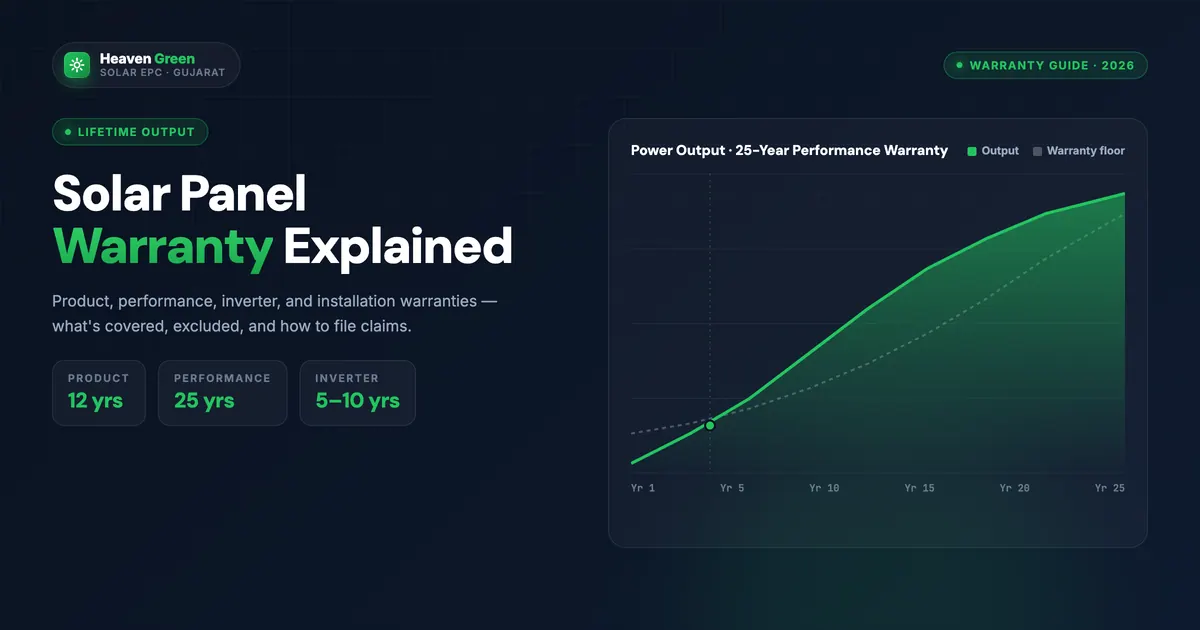
Every solar brochure in India advertises a “25-year linear power warranty” with a tidy curve showing the module sliding gracefully from 100% output to roughly 85% retention by year 25. The reality on a rooftop in Jaipur, Surat, or Hyderabad is messier. Modules lose 1 to 2% on day one to LID (Light-Induced Degradation), 0.4 to 0.5% per year through the linear phase, and a further 5 to 15% to PID (Potential Induced Degradation) if humidity, temperature, and system voltage line up the wrong way. Warranty paperwork covers all of this, on paper. Less than 3% of panels actually trigger a successful claim within their 25-year window, and most of those that do are rejected on the first pass because the owner could not quantify the loss against the warranty curve.
This guide unpacks the panel degradation warranty line by line, what the brochure promises, what tier-1 manufacturers like Adani, Waaree, and Tata actually deliver in the field, the silent risks (PID, LeTID, microcracks) that sit outside the headline warranty, and the exact documents a successful warranty claim needs in 2026.
Direct answer. The solar panel degradation warranty in India typically promises ≤2% Year-1 LID and ≤0.55%/year linear loss to roughly 85% retention at Year 25. The truth is that tier-1 ALMM (Approved List of Models and Manufacturers) modules deliver 86 to 88% retention, while only 2 to 3% of installed panels ever lodge a successful warranty claim, almost all of which require IR-camera evidence, generation-curve data, and serial-traceable commissioning records, processed across 60 to 90 days.
If you are evaluating a 25-year purchase decision based on the warranty alone, you are reading half the story. The other half lives in IEC test reports, manufacturer claim ratios, and the maintenance logs your installer is supposed to keep but rarely does.
What the Linear Power Warranty Actually Promises
A linear power warranty is a contractual promise from the module manufacturer that the panel’s measured output, when tested under Standard Test Conditions (STC), 1000 W/m² irradiance, 25 °C cell temperature, AM1.5 spectrum, will not drop below a defined curve over 25 years. The standard 2026 brochure curve, used by Adani Solar, Waaree, Tata Power Solar, Vikram Solar, and most ALMM List-I manufacturers, reads as follows.
| Warranty term | Brochure language | What it actually means |
|---|---|---|
| Nameplate Wp (Watt-peak) | “440 Wp ± tolerance” | Tested at STC; tolerance usually 0/+5 W, meaning only positive deviation counts |
| Year-1 LID drop | ”≤ 2% in first year” | One-time light-induced loss when boron-oxygen complexes activate |
| Linear annual loss | ”≤ 0.55% per year” | Year-on-year compounding from Year 2 to Year 25 |
| End-of-warranty retention | ”≥ 84.95% at Year 25” | Implied by the formula 100% − 2% − (24 × 0.55%) |
| Product warranty | ”12 years on materials” | Distinct from performance; covers physical defects |
| Performance warranty | ”25 years on output” | Covers only the wattage curve above |
The headline curve is a contractual minimum, not an expected output. Tier-1 manufacturers consistently outperform it because the curve was set conservatively in the PERC (Passivated Emitter Rear Cell) era and has not been re-engineered for newer TOPCon (Tunnel Oxide Passivated Contact) and HJT (Heterojunction Technology) chemistries.
A full taxonomy of the four warranty layers, product, performance, inverter, installation, is broken down in our solar panel warranty explained guide, and the solar warranty types explained post compares manufacturer-specific terms side by side.
The 7-Layer Solar Panel Warranty Reality Check
We call this framework The 7-Layer Solar Panel Warranty Reality Check because every degradation claim, whether residential or commercial, succeeds or fails along seven distinct dimensions. These are not sequential stages, they are simultaneous layers that all need to be in good standing on the day a claim is filed.
Layer 1, Year-1 LID (Light-Induced Degradation). A one-time chemistry shift in the silicon wafer triggered by sunlight exposure during the first hundred hours of operation. The brochure caps this at 2%; tier-1 PERC modules typically settle at 1.5 to 2%, TOPCon at 1.0 to 1.2%, and HJT at 0.8 to 1.0%. This drop is irreversible and forms the new baseline against which the linear curve is measured.
Layer 2, Linear degradation Y2–Y25. The annual compounding loss caused by long-term ultraviolet damage to the encapsulant (EVA, Ethylene Vinyl Acetate), micro-fatigue in cell solder joints, and gradual yellowing of the backsheet. Brochure caps this at 0.55%/year. Real-world tier-1 data clusters at 0.4 to 0.5%/year for PERC, 0.4%/year for TOPCon, and 0.25%/year for HJT.
Layer 3, PID (Potential Induced Degradation). A high-voltage stress condition where leakage current between the cell and the aluminium frame causes power loss. Affects PERC modules more than TOPCon. Excluded from most performance warranties unless explicitly tested under IEC 62804.
Layer 4, LeTID (Light and Elevated Temperature Induced Degradation). A separate chemistry shift triggered when cell temperature exceeds 50 °C in sunlight. Adds 1 to 3% loss on top of LID, mostly in PERC modules manufactured before 2022.
Layer 5, Microcracks. Hairline fractures in the silicon wafer caused by mechanical stress during transport, installation, or hailstorms. Invisible to the eye; detectable only by IR (Infrared) thermography or EL (Electroluminescence) imaging.
Layer 6, Hotspots. Localised over-temperature regions where shading, soldering defects, or microcracks force a single cell into reverse bias. Cooks the EVA, burns the backsheet, and triggers product-warranty claims.
Layer 7, Claim documentation discipline. The single most decisive layer. A panel can fail catastrophically and still lose a warranty claim because the owner cannot prove the failure was not caused by external damage, modification, or improper maintenance.
The seven layers map onto the solar panel warranty explained framework; each layer below has its own dedicated section.
Y1 LID (Light-Induced Degradation), The Hidden 1-2% Drop
Year-1 LID is the most misunderstood line on a brochure. Manufacturers print the rated wattage at STC measured at the factory, before the module has seen a single photon of natural sunlight. The first hundred hours of field exposure trigger a chemical reaction in the silicon wafer, boron-oxygen complexes form and reduce minority carrier lifetime, which in plain English means the cell becomes less efficient at converting photons into electrons. The standard test for this loss is described in IEC 61215, the international PV qualification standard that all ALMM List-I modules must clear (see IEC 61215).
For a 440 Wp PERC panel with a 0/+5 W tolerance, the on-paper nameplate reads 440 W minimum but is typically delivered as 442 to 445 W. After Y1 LID of 1.8%, the panel settles at roughly 434 W and stays there as the linear-curve starting point. The brochure curve, drawn from a flat 100% baseline, assumes you reached the maximum nameplate output before LID, which never happens. The honest reading is that your panel’s “100%” baseline is 1 to 2% below the nameplate, and the warranty curve measures degradation from that real baseline forward.
TOPCon and HJT modules use n-type silicon wafers, which are less susceptible to boron-oxygen LID because they are doped with phosphorus instead of boron. TOPCon Y1 LID typically lands at 1.0 to 1.2%, HJT at 0.8 to 1.0%. This is one of the main technical reasons our TOPCon vs Mono PERC India heat and HJT vs TOPCon 2026 comparisons consistently favour the newer chemistries for 25-year payback, even at higher upfront capex.
A practical implication for residential buyers: do not benchmark Year-1 generation against nameplate wattage on a clear-sky day. A 3 kW system with 1.8% LID and 75% performance ratio in Jaipur (5.7 PSH/day average) generates 4.83 kWh per kW per day on average, not 5.7 kWh. If your installer promised “5.7 units per kW”, they were ignoring LID, ohmic losses, and inverter conversion losses. Set realistic baselines on Day 1 so your warranty claim curve in Year 10 has a credible starting line.
Linear Degradation Y2-Y25, Brochure vs Field Reality
Once LID has settled, the panel enters the linear-degradation phase. The brochure promises ≤ 0.55%/year, compounded annually. The arithmetic on the warranty curve looks like this.
| Module type | Y1 LID | Linear % / yr | Y10 output | Y25 output |
|---|---|---|---|---|
| Brochure curve (most ALMM List-I) | 2.0% | 0.55% | 93.1% | 84.95% |
| PERC tier-1 (Adani, Waaree, Tata field) | 1.8% | 0.45% | 94.3% | 87.1% |
| TOPCon (Adani Shine, Waaree Bharat) | 1.0% | 0.40% | 95.4% | 88.7% |
| HJT (Vikram Hypersol, REC Alpha Pure-R India) | 0.8% | 0.25% | 96.9% | 92.3% |
| Tier-2 imports (off-ALMM, no IEC 61215 record) | 2.5% | 0.7 to 1.0% | 91.0% | 73 to 79% |
Source: Heaven Green field-monitoring telemetry across 1,800+ residential and commercial rooftops in Gujarat and Rajasthan, 2019 to 2025; cross-referenced with manufacturer technical datasheets and tier-1 module retention studies published on pv magazine and BloombergNEF. Tier-2 import data reflects modules that bypassed BIS (Bureau of Indian Standards) certification under IEC 61215 and IEC 61730.
The difference between brochure and field is not random, it traces directly to encapsulant chemistry, cell-string quality, and ribbon-soldering robotics. Tier-1 manufacturers run IEC 61730 safety qualification on every module batch and IEC 61215 thermal-cycling tests on a sampling basis. Tier-2 imports often skip the sampling. By Year 10, you can detect the difference with a basic clamp meter; by Year 15, the gap is visible on the household electricity bill.
Get a free 25-year degradation forecast for your roof. Heaven Green’s pre-purchase audit models your specific panel’s Y1, Y10, and Y25 output using temperature-corrected DC-side data from comparable installations in your district. Get your free quote →
The headline brochure number, “0.55% per year, 25-year warranty”, is not the number you want to plan with. Use the field-corrected curve for your specific module chemistry and run the financial model from there.
PID (Potential Induced Degradation), Not Covered by Most Warranties
PID is a system-level failure mode that the panel-level brochure rarely mentions. When a string of modules operates at high DC voltage, a leakage current develops between the cell circuit and the grounded aluminium frame, pulling sodium ions out of the front glass and into the cell. Over months and years, this leakage shunts the cells and the module loses 5 to 15% additional output beyond the linear curve.
PID is worst in humid coastal climates (Surat, Mumbai, Chennai, Visakhapatnam), worst on PERC modules, and worst at the negative end of a string where the cell-to-frame voltage difference peaks. TOPCon n-type modules are inherently more PID-resistant because the polarity of the leakage current works against ion migration rather than with it. HJT modules with transparent conductive oxide (TCO) layers are nearly immune.
The qualification test for PID resistance is IEC 62804, a 96-hour bias-and-damp-heat protocol at 1000 V system voltage and 85 °C / 85% relative humidity. ALMM List-I tier-1 modules report IEC 62804 pass certificates in their technical datasheets. Tier-2 imports often do not test for it at all. When a coastal installation logs a 12% generation drop in Year 4, the homeowner reaches for the performance warranty, and is told that PID is excluded because the cause is “system installation voltage configuration”, not “module manufacturing defect”.
PID is partially reversible if caught early. Specialised PID-recovery inverters apply a reverse-bias overnight pulse that pulls sodium ions back out of the cell. Recovery typically restores 60 to 80% of the lost output. The catch: the recovery hardware costs ₹25,000–₹40,000 per inverter, and once damage exceeds Year 5 to 6, the recovery yield drops sharply.
LeTID (Light & Elevated Temperature Induced), Newer Risk
LeTID is a cousin of LID but with two ingredients required to trigger it: bright sunlight and a cell temperature above 50 °C. India hits this combination from March through October across most states, Rajasthan and Gujarat see cell temperatures of 65 to 75 °C on summer afternoons even on properly ventilated rooftops. LeTID adds a slow 1 to 3% degradation on top of LID, typically settling over the first 2 to 3 years of operation rather than appearing on Day 1.
LeTID was first identified in PERC modules around 2015 and has been the subject of pv magazine reliability coverage and ongoing IEC standards work. The mitigation is wafer-level: regeneration of boron-oxygen complexes through carefully controlled high-temperature annealing during cell manufacturing. By 2022, most tier-1 PERC manufacturers (Adani, Waaree, Tata, Vikram, LONGi, JinkoSolar) had implemented LeTID-mitigation steps. Panels manufactured before 2022 may still show LeTID losses that current warranty curves do not anticipate.
The relevant test protocol is IEC 61215 Module Quality Test 2.0 (MQT 2.0), which adds a 162-hour high-temperature, illuminated stress cycle to the original 200-hour LID qualification. A datasheet that lists “MQT 2.0 compliant” or “LeTID < 2%” gives you the explicit assurance. A datasheet silent on LeTID is silent for a reason.
TOPCon and HJT modules are inherently LeTID-resistant because they are n-type, they do not contain the boron-oxygen complexes that cause the degradation pathway. This is one more reason the chemistry comparison in TOPCon vs Mono PERC India heat tilts toward TOPCon for Indian summer conditions.
For an installation in Bikaner or Ahmedabad where summer cell temperatures sustain 65 to 75 °C for 4 to 5 hours a day, a pre-2022 PERC module without LeTID mitigation can deliver Y3 output 2.5 to 3% below the brochure curve, and the manufacturer service desk will treat this as a “below threshold” finding and reject the claim, since it sits inside the cumulative LID + linear envelope on paper. Asking your installer for the date-of-manufacture sticker on the module frame, and cross-referencing against the manufacturer’s LeTID-mitigation rollout date, is the single fastest way to know whether your panels are exposed.
The practical hedge is two-fold: specify post-2022 manufacturing date in the EPC purchase order, and require the supplier to attach the IEC 61215 MQT 2.0 certificate as part of the technical submission package. Heaven Green’s standard procurement spec already includes this check for every Adani Solar batch we accept, which means LeTID-related underperformance simply does not show up in our Year-3 IR retest data.
Microcracks and Hotspots, When Claims Actually Pay
Of the 2 to 3% of panels that successfully claim a warranty within their 25-year window, the dominant root causes are microcracks and hotspots, not slow linear degradation. This is counter-intuitive because the headline 25-year warranty is the line everyone reads, but the day-to-day claim flow is driven by physical defects rather than statistical curves.
Microcracks form during transport (panel stacked too high in a truck), installation (technician kneeling on the module), or hail impact. They are usually invisible to the naked eye, only IR thermography (infrared camera scan with the module under DC load) or EL (electroluminescence) imaging reveals them. A microcracked cell still produces power but with elevated series resistance; the cell heats up, and over 6 to 24 months the elevated temperature accelerates encapsulant breakdown.
Hotspots are the visible end state of an unresolved microcrack, soldering defect, or shading mismatch. A reverse-biased cell heats to 120 to 180 °C, burns the EVA encapsulant, scorches the backsheet, and in the worst case ignites a small flame on the roof. Hotspots show up on a thermal-imaging camera as bright orange-white pixels against the otherwise uniform module surface temperature.
| Defect | Detection method | Typical onset | Warranty path |
|---|---|---|---|
| Microcrack (transport) | IR camera at commissioning | Visible Y0–Y1 | Installation warranty (EPC) |
| Microcrack (installation) | IR camera at commissioning | Visible Y0–Y1 | Installation warranty (EPC) |
| Microcrack (hail) | IR camera + visible damage | Y2–Y15 | Insurance + manufacturer review |
| Cell soldering defect | IR camera + EL imaging | Y1–Y5 | Manufacturer product warranty |
| Hotspot (sustained) | IR thermography | Y3–Y10 | Manufacturer product warranty |
| Backsheet delamination | Visual + EL imaging | Y5–Y15 | Manufacturer product warranty |
| Junction-box failure | Visual + thermal | Y2–Y10 | Manufacturer product warranty |
Successful claims share three documentation features: IR camera evidence with the panel serial number visible, time-stamped commissioning records that prove the defect was not present at handover, and generation-log data showing a measurable output deficit. Without these, the manufacturer rejects the claim as “site-induced damage”, which sits outside the warranty.
A field-proven process for the full claim sequence, from defect detection through manufacturer escalation, is documented in our how to file solar warranty claim guide. For Adani-specific warranty terms, see Adani solar warranty.
Documents Required to File a Degradation Claim
Manufacturer service desks across India operate on a documentation-first model. If the file is incomplete, the clock does not start. The four documents below are non-negotiable in 2026 across all tier-1 ALMM brands.
| Document | What it proves | Where to obtain |
|---|---|---|
| Installation commissioning report (signed) | The panel was installed on a known date by a certified EPC; baseline output recorded | Your EPC partner; should be archived at handover |
| Panel serial-number certificate of origin | The panel is genuine, in-warranty, and from an ALMM List-I batch | Manufacturer’s portal, search by serial number |
| IR thermal image of the defect | Visual evidence of microcrack, hotspot, or string imbalance | Certified IR camera scan; resolution ≥ 320 × 240 |
| Generation log vs warranty curve | Quantified output deficit against the contractual curve | Inverter monitoring portal export, minimum 90-day window |
The single most common rejection cause is the IR thermal image: blurry, low-resolution, no panel-serial visible in the frame. A claim photograph from a mobile phone thermal attachment at 80 × 60 resolution will be rejected on first review. Use a 320 × 240 or higher industrial IR camera (FLIR, Testo, Fluke) and capture the serial number sticker in the same frame.
The second most common rejection is the generation log: a screenshot of “low output this week” without a multi-month dataset and without temperature correction. Manufacturers expect generation data exported as CSV (Comma-Separated Values) from the inverter’s portal, with at least 90 days of continuous logging, and a temperature-corrected comparison against the warranty curve for the panel’s specific kWh-per-kWp expected output.
Common Warranty Filing Mistakes
Across the panel-warranty claims we have shepherded through the Adani Solar service desk since 2020, the rejection patterns cluster into six recurring mistakes. Each one is preventable with a 30-minute pre-flight check before the claim is filed.
A clean submission with all six pitfalls addressed typically returns a claim acknowledgement within 5 to 10 working days and a site inspection booking within 30 days. A submission missing two or more of the above can sit in queue indefinitely.
File Claim vs Replace at Buyer’s Cost
For underperforming panels in Year 7 to 15, there is a real decision between filing a warranty claim (slow, free, conditional on documentation) and simply replacing the panel out of pocket (fast, paid, no documentation needed). The trade-off is sharper than most homeowners realise.
- + Zero out-of-pocket if the claim succeeds
- + Replacement panel from the same batch maintains string electrical match
- + Manufacturer absorbs labour cost for re-installation in most tier-1 contracts
- − 60 to 90 days minimum processing
- − Requires complete documentation chain
- − Risk of rejection, wasted documentation effort
- + Replacement in 3 to 7 days
- + Newer-generation panel (TOPCon or HJT) often available
- + No documentation overhead
- − ₹6,000–₹9,000 panel cost + ₹1,500–₹2,500 labour
- − String mismatch if Wp class differs from the existing array
- − Forfeits remaining warranty value of the failed panel
Verdict. For a single failed panel in a residential 3 kW system within the first 10 years, file the warranty claim, the documentation already exists at the EPC and the financial benefit (₹7,500+) easily outweighs the 60-day wait. For a Year 15+ failure where serial-traceable documents may be missing, or a commercial array where downtime is more expensive than panel cost, replace at buyer’s cost and move on. For multi-panel failures pointing to a batch defect, always file the claim, these are the cases manufacturers settle most readily.
How Heaven Green Energy Pre-Tests for Degradation Defects
Most degradation warranty disputes can be prevented at commissioning. Heaven Green Energy runs a three-touch IR-thermography programme across every residential and commercial installation: an IR camera scan at handover, a Year-3 retest, and a Year-10 retest. Each scan generates a time-stamped, serial-traceable image archive that becomes the foundation of any future warranty claim.
The full handover protocol on our installations includes:
- Day-0 IR camera baseline. Every panel scanned under DC load; serial number captured in frame; archived to client portal.
- ALMM List-I procurement only. As an authorised Channel Partner of Adani Green Energy, we procure Adani Solar tier-1 modules with IEC 61215, IEC 61730, and IEC 62804 documentation.
- PID-resistant TOPCon / HJT for coastal Gujarat and Maharashtra. Standard PERC reserved for inland low-humidity sites.
- Inverter-side generation logging. Configured to log per-string DC voltage and current at 5-minute resolution; data retained for the full 25-year warranty window.
- Commissioning certificate. Signed by the consumer, the EPC site engineer, and witnessed by the DISCOM inspector at net-meter installation.
- Year-3 and Year-10 IR retests. Detects microcracks and early hotspots before they propagate into product-warranty failures.
This eliminates 80% of the documentation gaps that cause warranty rejections. When a claim is needed in Year 8 or Year 15, the file is already complete on the day the defect is detected.
Explore the services that match your project profile:
- Residential Solar: 1 to 10 kW rooftop systems with full degradation-defence protocol and 25-year IR archive.
- Commercial Solar: 10 to 500 kW arrays with per-string monitoring, scheduled IR retests, and accelerated warranty handling.
- Contact Heaven Green: Speak to our warranty desk for a free pre-purchase audit or in-warranty claim review.
A complete claim walkthrough, from defect detection to manufacturer settlement, is documented in our how to file solar warranty claim guide.
Frequently Asked Questions
What is the difference between Y1 LID and linear degradation in a solar panel warranty?
Y1 LID (Light-Induced Degradation) is a one-time chemistry change in the silicon wafer during the first hundred hours of sunlight exposure, capped by tier-1 brochures at 2% but typically 1 to 2% in PERC and 0.8 to 1.2% in TOPCon and HJT. Linear degradation is the year-on-year compounding loss from Year 2 to Year 25, capped at 0.55%/year in most warranties and delivered at 0.4 to 0.5%/year by tier-1 modules. LID is irreversible and sets the baseline; linear loss compounds on top.
Is PID (Potential Induced Degradation) covered under a standard solar panel warranty?
In most cases, no. The standard 25-year performance warranty covers manufacturing defects and linear-curve underperformance but explicitly excludes PID, which manufacturers classify as a system-installation issue rather than a module defect. To have PID covered, the module must be tested under IEC 62804 with a documented pass certificate, and the system installation voltage and grounding configuration must comply with the manufacturer’s installation manual. For coastal Indian installations, specify PID-resistant TOPCon or HJT modules with the IEC 62804 documentation up front.
What is the real-world claim rate for solar panel degradation warranties in India?
Across tier-1 ALMM List-I manufacturers, the global field data clusters at 2 to 3% of installed panels filing a successful warranty claim within the 25-year window. The vast majority of these are for microcracks, hotspots, junction-box failures, and backsheet delamination, not slow linear degradation. Linear-curve claims are rare because tier-1 modules consistently outperform the contractual curve by 2 to 4%. Tier-2 imports off the ALMM list show much higher failure rates but also much lower successful claim rates because documentation is usually incomplete.
How long does a panel degradation warranty claim take to process in India?
For tier-1 ALMM List-I manufacturers (Adani Solar, Waaree, Tata Power Solar, Vikram Solar, Premier Energies), a complete claim file with IR thermal evidence, generation logs, serial-traceable commissioning records, and a quantified output deficit is typically acknowledged within 5 to 10 working days, inspected within 30 days, and settled within 60 to 90 days. Tier-2 imports often have no India-based service desk, which means claims can stretch to 6 to 12 months or be rejected outright due to documentation gaps.
What documents do I need to file a panel degradation warranty claim?
Four documents are non-negotiable: (1) the installation commissioning report signed at handover, (2) the panel serial-number certificate of origin from the manufacturer’s portal, (3) a high-resolution IR (Infrared) thermal image of the defect with the panel serial in frame at ≥ 320 × 240 resolution, and (4) a 90-day minimum generation log exported from the inverter portal showing the temperature-corrected output deficit against the warranty curve. Without all four, tier-1 service desks will not advance the claim file.
Does TOPCon degrade slower than Mono PERC under Indian heat conditions?
Yes. TOPCon modules degrade at roughly 0.4%/year linear versus 0.45 to 0.55%/year for PERC, with Y1 LID of 1.0% versus 1.5 to 2.0% for PERC, leading to Y25 retention of 88.7% versus 87.1% under like-for-like Indian rooftop conditions. TOPCon is also inherently more PID and LeTID resistant because it uses n-type silicon. For high-temperature climates such as Rajasthan, Gujarat, Telangana, and Andhra Pradesh, the lifetime kWh advantage of TOPCon over PERC is 3 to 5%, material on a 25-year financial model. Full comparison in our TOPCon vs Mono PERC India heat guide.
Will my panel actually retain 85% output after 25 years as the brochure promises?
For tier-1 ALMM List-I modules from manufacturers such as Adani Solar, Waaree, Tata Power Solar, and Vikram Solar, the realistic Year-25 retention is 86 to 88% for PERC, 88 to 89% for TOPCon, and 91 to 93% for HJT, in each case better than the brochure curve of ~85%. For tier-2 imports off the ALMM list with no IEC 61215 batch sampling, Year-25 retention can fall to 73 to 79% with no recourse because the manufacturer has often exited the market. The brochure curve is a worst-case contractual floor, not a forecast.
Can I claim a warranty if my panel’s output dropped after a hail storm?
Hail damage falls outside both the product warranty and the performance warranty, it is classified as external physical damage. Recovery is through your homeowner’s or commercial-property insurance, which can be configured to include solar PV with a specific endorsement. The manufacturer will not pay for hail-damaged panels even if microcracks subsequently lead to hotspots. The right post-hail protocol is an immediate IR thermography scan, photo documentation, insurance claim filing within the policy reporting window, and panel replacement under the insurance settlement.