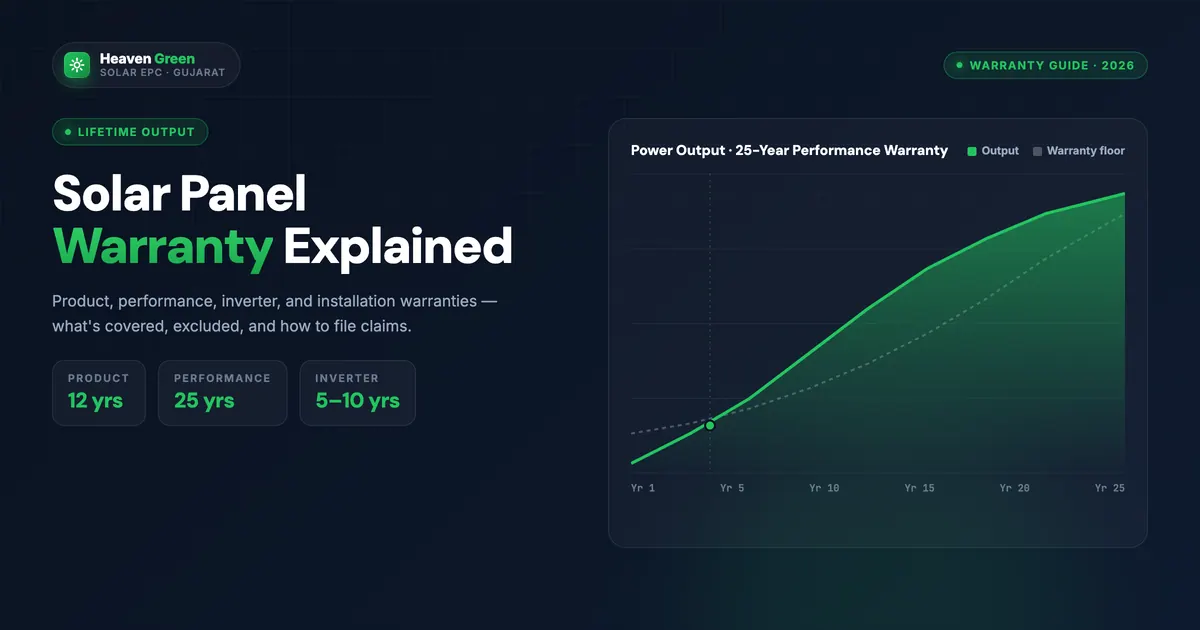
The 25-year performance warranty on solar panels is not marketing language, it’s a contractual guarantee backed by IEC 61215 accelerated life testing. But “25-year warranty” doesn’t mean panels die at year 25. Many panels installed in the 1990s and early 2000s in India and globally are still generating power today, decades past their warranty period.
Understanding what determines how long your panels last, and what degrades them faster, is important for protecting a ₹1–₹3 lakh investment over its full useful life.
Key takeaway. Solar panels installed in India in 2026 carry a 25-year linear performance warranty guaranteeing at least 80% of nameplate output at year 25. The actual degradation rate for quality monocrystalline panels is 0.3 to 0.5% per year, meaning panels retain 88 to 92% output at year 25. Heaven Green Energy installs only BIS IS 14286 and IEC 61215 certified Adani Solar panels, ensuring your panels perform for 25+ years in Indian conditions.
What the 25-Year Warranty Actually Guarantees
Solar panel warranties in India consist of two separate guarantees:
Product warranty (10 to 15 years): Covers manufacturing defects, delamination, junction box failures, frame corrosion, and glass breakage under normal use. If a panel fails due to a manufacturing fault within this period, the manufacturer replaces it.
Performance warranty (25 to 30 years): Guarantees the panel produces a minimum percentage of its nameplate output. The typical structure:
- Year 1: ≥ 97% of nameplate (allows for initial calibration variance)
- Year 2 to 12: Linear degradation at no more than 0.55%/year
- Year 12 to 25: No less than 80% of nameplate at year 25 (the “80% at 25 years” standard)
Premium panels (TOPCon, HJT): Many now offer 30-year performance warranties with a better end-of-warranty guarantee (83 to 87% at year 30).
What the warranty does NOT cover:
- Physical damage from hailstorm, storm, flood (covered by home insurance)
- Damage from incorrect installation (covered by installer’s workmanship warranty)
- Output loss from soiling, shading, or inverter-related issues
The solar panel warranty guide covers the warranty claim process and what to do if a panel fails mid-life.
Real-World Degradation Rates: What the Data Says
The warranty specifies a maximum degradation rate. Actual measured degradation from field studies is often better than warranty terms.
| Panel Technology | Warranty Max Degradation | Real-World Measured Avg | Source |
|---|---|---|---|
| Monocrystalline PERC | 0.55%/yr | 0.32 to 0.45%/yr | NREL 2024 field data |
| TOPCon (n-type) | 0.45%/yr | 0.25 to 0.35%/yr | PV Magazine, 2025 |
| HJT | 0.40%/yr | 0.20 to 0.30%/yr | PV Magazine, 2025 |
| Polycrystalline | 0.70%/yr | 0.45 to 0.60%/yr | NREL 2022 field study |
At 0.40% actual annual degradation:
- Year 5: 98% output
- Year 10: 96% output
- Year 15: 94% output
- Year 20: 92% output
- Year 25: 90% output
At year 25, a 3 kW system that was generating 400 kWh/month when new would still generate 360 kWh/month. That’s still meaningful generation, and the system is fully paid off by this point.
Factors That Accelerate (or Slow) Panel Degradation in India
India’s climate presents specific challenges that can affect panel lifespan beyond what European or North American test conditions anticipate.
Heat and UV exposure: India’s summers routinely see panel surface temperatures of 65 to 80°C. High sustained temperatures accelerate EVA (Ethylene Vinyl Acetate) encapsulant yellowing and delamination over decades. Panels with UV-stabilised encapsulants and tempered anti-reflective glass are better suited for Indian conditions.
Humidity and coastal environments: High relative humidity, especially in coastal cities (Mumbai, Chennai, Kochi), promotes moisture ingress through junction box seals and accelerates cell-level corrosion. Panels with IP67 junction boxes and robust edge sealing perform better.
Thermal cycling: Repeated heating and cooling from day to night (especially in desert climates like Rajasthan) creates mechanical stress from differential thermal expansion. Panels with robust cell interconnection ribbons and EVA formulations designed for high thermal cycling rate better.
Soiling and sand abrasion: In Rajasthan and Gujarat, wind-blown sand can cause micro-scratches on panel glass over many years, slightly reducing transmission. This is a very slow effect, negligible over 25 years compared to electrical degradation.
PID (Potential Induced Degradation): A specific failure mode where high voltage stress between panel cells and the grounded frame causes cell degradation. Modern n-type TOPCon and HJT panels are PID-resistant by design. Older p-type panels with positive grounding inverters are at risk. BIS IS 14286 testing now includes PID resistance checks.
The Heaven Green Panel Longevity Assessment Framework
When we recommend panels for a specific installation, we use the Heaven Green 5-Factor Panel Durability Score to evaluate suitability for Indian conditions:
Factor 1, Cell technology: TOPCon and HJT > MonoPERC > Poly for lifespan. Score weight: 30%.
Factor 2, Manufacturer Tier rating: Tier 1 manufacturers (Adani, Waaree, Vikram, LONGi, Jinko) have financial standing to honour 25-year warranties. Tier 3 manufacturers may not exist in 25 years. Score weight: 25%.
Factor 3, Junction box IP rating: IP68 > IP67 > IP65 for humid and rainy environments. Score weight: 15%.
Factor 4, BIS IS 14286 and IEC 61215 certification: Mandatory for PM Suryaghar, and a quality benchmark. Score weight: 20%.
Factor 5, Thermal performance data: Temperature coefficient of Pmax (-0.30%/°C better than -0.45%/°C), important for Gujarat’s and Rajasthan’s hot summers. Score weight: 10%.
Comparison: Panel Technologies for Indian Longevity
| Panel Type | Expected Lifespan | Year-25 Output Guarantee | Best Indian Conditions | Typical Cost Premium |
|---|---|---|---|---|
| MonoPERC | 25 to 30 years | 80 to 83% | General India, most cost-effective | Baseline |
| TOPCon (n-type) | 30 to 35 years | 84 to 87% | Hot and humid climates | +8 to 12% |
| HJT | 30+ years | 85 to 90% | High heat, coastal areas | +15 to 25% |
| Bifacial | 25 to 30 years | 80 to 84% | Ground-mount, light-coloured roofs | +10 to 15% |
Performance data sources: IEC 61215 test standards; manufacturer published spec sheets; PV Magazine 2025 field analysis.
For most residential installations in Gujarat and Maharashtra, MonoPERC panels from Tier 1 manufacturers offer the best balance of cost and longevity. TOPCon makes sense for customers who plan to stay in the property for 25+ years and want maximum lifetime generation.
Get a free panel recommendation. Our engineers specify the right panel technology for your climate and budget. Contact our team →
What Happens to Panels After 25 Years?
Option 1, Keep running: Panels don’t expire at year 25. They simply produce less than their nameplate output. A 400W panel at year 25 produces 320 to 360W (80 to 90% output). If the inverter and mounting structure are still functioning, continuing to use the system generates essentially free electricity with no additional capital cost.
Option 2, Upgrade: After 25 years, panel technology will have advanced significantly. A 400W panel today may be equivalent to what a 600W panel provides in 2050. Upgrading to higher-efficiency panels in the same roof space significantly increases generation.
Option 3, Solar panel recycling: End-of-life panels contain recoverable silicon, aluminium, glass, and small amounts of silver and other metals. India’s solar panel recycling industry is nascent but growing, with MNRE establishing Extended Producer Responsibility (EPR) guidelines for panel manufacturers. By 2030 to 2035, panel recycling infrastructure is expected to be widely available.
Warranty Claim: What to Do If a Panel Fails
If a panel fails before its warranty period expires:
Heaven Green Energy assists with manufacturer warranty claims for all panels we install. We maintain installation records (serial numbers, installation date, commissioning photos) for every project for exactly this purpose.
Pros and Cons: Quality Panels vs. Budget Panels for Indian Conditions
- 0.30 to 0.45%/yr actual degradation
- Manufacturer financially stable to honour 25-yr warranty
- BIS/IEC certified, PM Suryaghar eligible
- 15 to 20% more lifetime generation vs budget option
- 0.70 to 1.0%/yr degradation common
- Manufacturer may not exist in 10 to 15 years to honour warranty
- Not BIS/IEC certified, PM Suryaghar subsidy ineligible
- [DISCOM](/glossary/discom) may reject [net metering](/glossary/net-metering) inspection
How Heaven Green Energy Ensures Long Panel Life
As an authorised Channel Partner of Adani Green Energy, Heaven Green Energy installs only Adani Solar panels, a Tier 1 manufacturer, all BIS IS 14286 and IEC 61215 certified. We do not install budget panels regardless of the cost pressure.
Our installation standards also protect longevity: correct mounting tilt (preventing water pooling), IP67+ junction boxes, proper earthing (preventing PID), and no load-bearing wiring that can crack over thermal cycling.
We maintain panel serial number records for every installation to support warranty claims throughout the 25-year life of your system.
- Residential Solar: Tier 1 panels, 25-year performance warranty, full installation records.
- Products: Solar Modules: BIS-certified monocrystalline and TOPCon panels.
- Solar Panel Warranty Explained: full warranty terms and claim process.
- Contact our team: free panel specification consultation.
Frequently Asked Questions
How long do solar panels last in India’s climate?
Quality monocrystalline solar panels (BIS IS 14286 / IEC 61215 certified) installed in India last 25 to 30 years in good functional condition, with output declining at approximately 0.30 to 0.45% per year. After 25 years, panels typically produce 88 to 92% of their original nameplate capacity. India’s high heat and UV exposure can slightly accelerate degradation compared to temperate climates, but Tier 1 manufacturers account for this in their product and encapsulant design.
What does “25-year warranty” mean for solar panels?
A 25-year performance warranty guarantees the panel produces at least 80% of its nameplate wattage at year 25. This is not the same as the panel “dying” at 25, it means the manufacturer guarantees a minimum performance level. Most panels continue generating well beyond 25 years at 85 to 90% of original output.
Do solar panels degrade faster in hot climates like Gujarat and Rajasthan?
Slightly. High temperatures accelerate EVA encapsulant yellowing and can increase degradation by 0.05 to 0.10%/year above temperate baseline rates. However, modern panels designed with UV-stabilised encapsulants and high-temperature EVA formulations are specifically engineered for hot climates. The performance warranty covers output regardless of climate, if your panels degrade faster than warranted, you can claim against the manufacturer.
What should I do to make my solar panels last longer?
The three most important maintenance practices for maximising panel longevity: (1) Clean panels monthly in dry seasons to prevent soiling-induced hotspots. (2) Ensure proper earthing to prevent Potential Induced Degradation. (3) Have an annual inspection to check for delamination, junction box seal integrity, and mounting structure corrosion. The solar maintenance guide covers all three in detail.
Can solar panels be recycled in India?
Yes, though the recycling ecosystem is still developing. Solar panels contain recoverable silicon (5%), glass (75%), aluminium (10%), and small amounts of silver and other metals. MNRE is establishing EPR (Extended Producer Responsibility) guidelines for panel manufacturers that will mandate take-back programs. By 2030, proper recycling infrastructure is expected to be available through authorised recyclers. Panels should NOT be disposed of in general waste due to the small quantity of heavy metals in older cell types.
What is the life expectancy of the solar inverter vs. panels?
Solar panels typically last 25 to 30 years. Solar inverters have a shorter life of 10 to 15 years before performance degrades or components fail. Budget for one inverter replacement over a 25-year system life (approximately ₹20,000–₹40,000 depending on inverter size). Mounting structures and cables typically last 25+ years with the original installation, requiring no replacement under normal conditions.