You asked for a solar quote, received two proposals for a 5 kW system, and one is ₹1.2 lakh cheaper than the other. Both look similar on paper. Which one should you trust, and more importantly, what is actually driving the difference?
Solar system pricing in India is not arbitrary. Every rupee gap between a ₹55,000/kW budget system and a ₹1,10,000/kW premium system traces back to specific, measurable choices: panel technology, inverter brand, mounting structure grade, installation complexity, whether the quote includes DISCOM charges and net metering fees, and how subsidy capture is handled. This guide dissects every layer so you know exactly what you are paying for, and what you might be giving up.
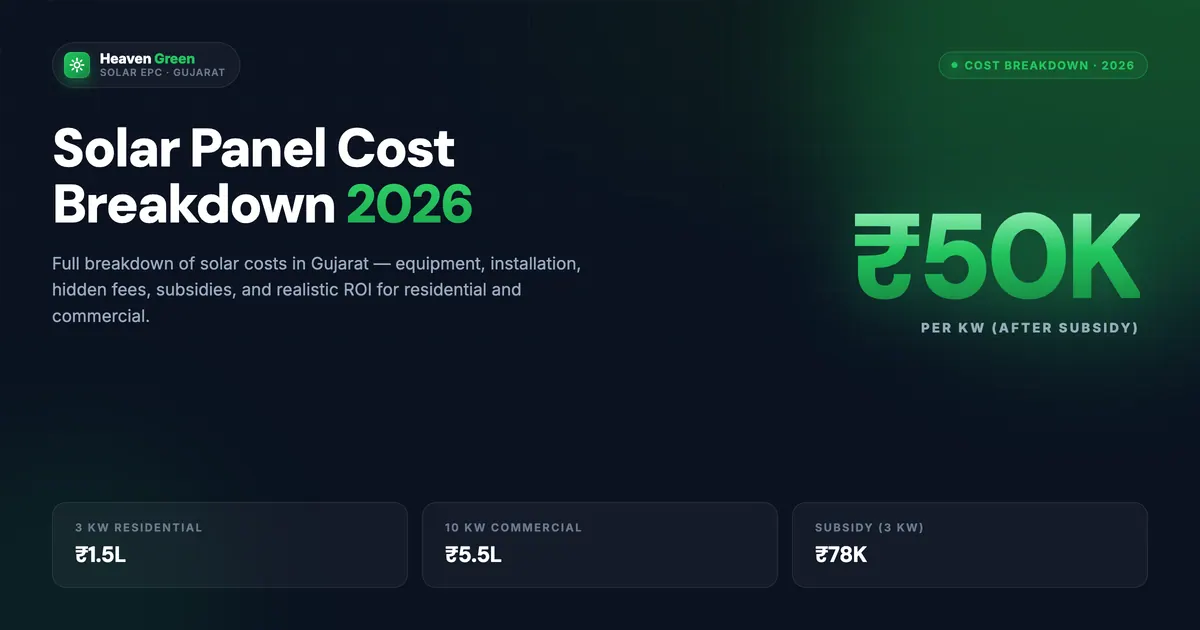
How much does a solar system cost in India in 2026? A 3 kW residential system costs ₹1.65–₹2.5 lakh before subsidy; a 5 kW system costs ₹2.75–₹4.5 lakh before subsidy. After the PM Surya Ghar central subsidy (up to ₹78,000), effective costs fall to ₹87,000–₹1.72 lakh for 3 kW and ₹1.97–₹3.72 lakh for 5 kW. Payback periods run 3 to 7 years depending on your state tariff and system grade.
Why Solar Prices in India Vary by Up to 200%
The cheapest functional solar system in India today costs around ₹40,000–₹50,000 per kW installed. A premium system with top-tier panels, a hybrid inverter, and full documentation support can cross ₹1,00,000 per kW. That is not a mark-up, it reflects genuinely different components, warranties, and long-term generation outcomes.
Three forces create this range.
Equipment tier differences. A DCR mono-PERC panel from a Tier 1 Indian manufacturer costs roughly ₹23 to 28 per watt. A non-DCR TOPCon panel from a global brand might cost ₹18 to 22 per watt but offers 1.5 to 2 percentage points of additional efficiency and lower degradation over 25 years. The upstream choice of panel technology and brand sets the foundation for every downstream cost and performance figure.
System design choices. A string inverter for a flat, unshaded roof costs roughly ₹7,000 to 15,000 per kW. A hybrid inverter with battery readiness costs ₹18,000 to 28,000 per kW. Galvanised iron mounting on a simple flat roof costs ₹6,000 to 10,000 per kW; an elevated tilt structure on an RCC roof with load calculations can cost ₹12,000 to 18,000 per kW. These are the components most commonly downgraded in budget quotes.
Soft cost inclusion. DISCOM application fees, net metering charges, earthing and safety compliance, cable routing on complex roofs, and extended workmanship warranties can add ₹15,000–₹40,000 to a residential install. Budget installers exclude these from headline quotes, they surface as surprises mid-project.
Understanding the full solar panel cost breakdown before comparing quotes is the single most useful thing you can do to avoid being misled by a low headline number.
Panel Cost Factors: Technology, Origin, and Wattage
Solar panels typically account for 45 to 55% of total system cost. Every decision in this category, technology type, DCR status, wattage, and brand, has compounding effects on both price and 25-year output.
DCR vs. Non-DCR panels. The Domestic Content Requirement classification determines whether a panel qualifies for government subsidies under PM Surya Ghar and MNRE-backed tenders. DCR panels use Indian-made solar cells, which pushes their manufacturing cost higher: typically ₹23 to 28 per watt at the module level. Non-DCR panels, often TOPCon or HJT technology manufactured overseas, cost ₹18 to 22 per watt but are ineligible for residential subsidies under current MNRE guidelines.
The subsidy maths matter here. A DCR panel system at ₹25/Wp for 5 kW costs ₹1,25,000 in panels alone. The same capacity in non-DCR TOPCon at ₹20/Wp costs ₹1,00,000. But without the ₹78,000 PM Surya Ghar subsidy (which requires DCR panels), your net panel cost for DCR is actually lower. See our DCR vs. non-DCR solar panels guide for the full ROI comparison.
Mono-PERC vs. TOPCon. The shift from mono-PERC to TOPCon is currently the most impactful technology decision in residential solar.
| Feature | Mono-PERC (DCR) | TOPCon (Non-DCR) |
|---|---|---|
| Efficiency | 19 to 21% | 22 to 23% |
| Annual degradation | 0.55%/yr | 0.45%/yr |
| 25-year output retention | ~80% | ~85 to 88% |
| Typical cost (per Wp) | ₹23 to 28 | ₹18 to 22 |
| Subsidy eligible? | Yes (DCR) | No (imported cells) |
| Best for | Subsidy-eligible residential | Commercial, large C&I |
For a residential buyer in 2026 installing under PM Surya Ghar, mono-PERC DCR panels are almost always the right financial choice once subsidy eligibility is factored in. For a commercial buyer with no subsidy access and a large roof, TOPCon’s higher efficiency per square metre and lower degradation make the non-DCR premium worthwhile.
Wattage and brand. Higher wattage panels (550Wp–600Wp) reduce the panel count needed for a given system size, cutting mounting hardware and wiring costs slightly. Premium brands (Adani, Waaree, Vikram, Goldi) carry better warranty infrastructure and bankability than no-name modules. The cheapest solar quotes frequently use panels from obscure brands with no service presence in India, a significant risk for a 25-year investment.
Inverter Cost Factors: Type, Brand, Warranty, and Efficiency
The inverter converts your panels’ DC output into the AC power your home uses. It is the most complex electronic component in the system, the most likely to require replacement within 25 years, and, after panels, the largest single cost factor. Our detailed solar inverter buying guide covers the full selection process; here we focus on how inverter choice drives system price.
Inverter type cost differences. The table below shows typical residential ranges for a 5 kW system in 2026:
| Inverter Type | Cost for 5 kW | Best Application |
|---|---|---|
| String inverter (basic) | ₹35,000–₹65,000 | Flat unshaded roofs, on-grid only |
| String inverter (premium brand) | ₹60,000–₹90,000 | Unshaded, requires strong service network |
| Hybrid inverter (battery-ready) | ₹90,000–₹1,40,000 | Future battery, backup power |
| Microinverter (per panel) | ₹1,20,000–₹2,00,000 | Shaded/complex roofs, maximum monitoring |
Brand and warranty. An inverter from Sungrow, Growatt, Solaredge, or Delta with a 5-year warranty and an India-based service network is substantively different from a generic inverter with a 1-year warranty and no local support. Budget quotes frequently substitute brand-name inverters with alternatives that pass the spec sheet but lack serviceability. Inverter replacement at year 12 costs ₹25,000–₹60,000 for a residential system, far more than any upfront brand premium.
Efficiency. Premium inverters operate at 97 to 98.5% efficiency versus 94 to 96% for budget units. On a 5 kW system generating 7,000 kWh/year, even a 2% efficiency difference means 140 kWh of lost generation annually, worth ₹700–₹1,400 per year at typical residential tariffs. Over 10 years, that efficiency gap costs more than the brand premium on the inverter.
On-grid vs. hybrid cost comparison.
| System Type | Inverter Cost (5 kW) | Battery Cost | Total Extra vs. On-Grid | When It Pays |
|---|---|---|---|---|
| On-grid only | ₹35,000–₹90,000 | Nil | Baseline | Grid-reliable areas |
| Hybrid (no battery now) | ₹90,000–₹1,40,000 | Nil | +₹30,000–₹60,000 | Planning future battery |
| Hybrid + 5 kWh battery | ₹90,000–₹1,40,000 | ₹80,000–₹1,50,000 | +₹1,10,000–₹2,10,000 | Frequent outages, high tariffs |
Structure and Balance-of-System Costs
The mounting structure and balance-of-system (BOS) components, cabling, junction boxes, earthing, surge protection, and AC distribution, are the most frequently cut corners in budget installations. They are also among the components with the greatest long-term safety and performance consequences.
Mounting structure grades. Standard galvanised iron (GI) structures for flat residential roofs run ₹6,000–₹10,000 per kW. Hot-dip galvanised structures built to IS standards with proper load calculations cost ₹9,000–₹14,000 per kW. Aluminium structures, preferred for coastal areas due to corrosion resistance, range from ₹12,000–₹18,000 per kW. Budget installers frequently use thinner-gauge GI profiles that meet no published standard, these can sag, rust, or fail in high-wind events within 5 to 8 years.
For ground-mounted and elevated tilt systems, structural costs increase significantly. An elevated fixed-tilt structure on an RCC roof (which requires proper anchor engineering to avoid waterproofing damage) can cost ₹15,000–₹25,000 per kW depending on span and loading requirements.
Cable quality and earthing. DC cables must be UV-resistant, double-insulated, and rated for the expected current and temperature. Cheap installations use single-insulated general-purpose cable that degrades under roof-level heat within 5 to 8 years. Proper earthing, essential for both safety and DISCOM approval, involves copper or galvanised earthing pits with appropriate resistance readings. An earthing setup done right costs ₹4,000–₹10,000. Done wrong, it is a fire risk.
Surge protection devices (SPDs). DC-side surge protection prevents inverter damage from lightning events, a real risk for rooftop systems in monsoon-prone regions. SPDs cost ₹1,500–₹4,000 per installation. Many budget quotes exclude them entirely.
Total BOS and structure costs for a quality residential installation: ₹15,000–₹35,000 per kW. Budget installations bring this below ₹8,000 per kW by substituting materials.
Installation and Soft Costs: DISCOM Fees, Net Metering, and Site Complexity
Installation costs and regulatory fees are the most variable and least-quoted component of solar pricing in India. They depend on your state’s DISCOM, your property type, roof complexity, and the quality of documentation support your installer provides.
DISCOM application and inspection fees. Every grid-connected system requires formal application to your Distribution Company. Fees vary by state and DISCOM:
- Gujarat (PGVCL, DGVCL, MGVCL, UGVCL): Application fee ₹500–₹1,000; inspection fee ₹2,000–₹5,000
- Maharashtra (MSEDCL, Tata Power): Application + inspection ₹3,000–₹8,000
- Rajasthan (JVVNL, AVVNL): ₹1,500–₹4,000
- Delhi (BSES, TPDDL): ₹2,000–₹6,000
Net metering charges, the cost of upgrading or replacing your meter with a bidirectional meter, run ₹2,000–₹8,000 in most states. Some DISCOMs charge an annual net metering maintenance fee of ₹500–₹2,000. These fees are real costs that belong in your project budget; many installers omit them.
Site complexity factors. A straightforward flat RCC roof with easy panel and cable access is priced at standard labour rates: ₹8,000–₹15,000 per kW for installation. Complexity multipliers apply for:
- Sloped/tiled roofs: Requires specialised anchoring; +₹5,000–₹15,000 total
- Multi-storey routing: Cable runs of 30+ metres from roof to main panel; +₹3,000–₹8,000
- Load panel upgrades: If your existing main board cannot handle the solar circuit; +₹10,000–₹30,000
- Shading analysis and string design: Premium design work for complex sites; +₹5,000–₹12,000
Liaison and documentation support. The PM Surya Ghar portal process involves DISCOM coordination, technical documentation, and follow-up through inspection and commissioning. Experienced installers handle this as part of their service. Inexperienced or budget installers frequently abandon customers mid-process, leaving them to navigate DISCOM offices independently, which can delay commissioning by weeks and delay subsidy disbursement by months.
See our hidden costs of solar financing guide for a complete accounting of every fee that should appear in your project budget.
Tip: How to read a quote for completeness
A complete residential solar quote should line-item: panels (brand, model, Wp, quantity), inverter (brand, model, kW), structure (type, material, gauge), cabling (DC + AC, length, specification), earthing, surge protection, DISCOM application fee, net metering charge, commissioning support, and workmanship warranty duration. If any of these are missing, ask specifically before signing. What is not listed is usually not included.
How Subsidies Change Your Effective Price
Government subsidies are the single largest source of price variation between an informed buyer and an uninformed one. A buyer who captures the full PM Surya Ghar subsidy effectively pays 30 to 40% less for their system than a buyer who installs outside the subsidy framework, even for identical hardware.
PM Surya Ghar Muft Bijli Yojana (2026 rates).
The central government subsidy structure for residential rooftop under PM Surya Ghar:
- Up to 2 kW: ₹30,000 per kW (₹60,000 for 2 kW)
- 2 to 3 kW: ₹18,000 per kW for the incremental capacity (₹78,000 total for 3 kW)
- Above 3 kW: ₹78,000 cap (no additional central subsidy for capacity beyond 3 kW)
This means a 5 kW system receives the same ₹78,000 subsidy as a 3 kW system. The per-kW subsidy rate drops sharply for larger systems, which affects the ROI calculus for choosing between 3 kW and 5 kW.
State top-up subsidies. Several states add their own subsidies on top of the central scheme. Gujarat, Rajasthan, Uttar Pradesh, and Maharashtra have offered state-level top-ups ranging from ₹10,000 to ₹30,000 per kW at various points. State subsidies change with government policy, check current rates with your DISCOM or MNRE-empanelled installer at the time of your project. Our solar subsidy in India guide tracks current scheme rates.
Subsidy eligibility conditions. Not all systems qualify. The conditions are specific:
- You must be a residential consumer (domestic tariff category on your electricity bill)
- System capacity must not exceed your sanctioned load or DISCOM limit for your category
- Installation must be done by an MNRE-empanelled vendor
- Panels must meet DCR norms (domestically manufactured cells and modules)
- Application must be filed through the PM Surya Ghar national portal before installation
Missing any of these conditions disqualifies your system from the central subsidy. This is why an installer’s MNRE empanelment status is not a formality, it is a ₹78,000 question.
How subsidy affects the price range table.
| System Size | Market Rate Range | After ₹78,000 Subsidy |
|---|---|---|
| 3 kW | ₹1.65–₹2.5 lakh | ₹87,000–₹1.72 lakh |
| 5 kW | ₹2.75–₹4.5 lakh | ₹1.97–₹3.72 lakh |
| 10 kW | ₹5.5–₹9.0 lakh | ₹4.72–₹8.22 lakh |
The True Cost of Solar Formula: A Proprietary Pricing Framework
Most buyers compare solar quotes on sticker price. That is the wrong number. The figure that actually determines whether solar is a good investment is what we call The True Cost of Solar: a simple three-step formula that accounts for everything a headline quote leaves out.
The True Cost of Solar Formula:
Net Total Cost = System Cost − Subsidy − 25-Year Bill Savings
In plain terms: take your total installed system cost (including all fees, GST, and soft costs), subtract the subsidy you will actually receive, and subtract your projected electricity bill savings over the system’s 25-year life. The resulting number, which will be deeply negative for most well-designed systems, is your true financial outcome.
Why this matters for quote comparison. Consider two 5 kW quotes:
-
Quote A (Budget): ₹2,75,000 installed, generic panels, basic string inverter, no documentation support. Subsidy: ₹0 (non-empanelled vendor). 25-year generation: 1,55,000 kWh (lower efficiency, higher degradation). At ₹6/kWh: ₹9,30,000 saved. Net Total Cost: ₹2,75,000 − ₹0 − ₹9,30,000 = −₹6,55,000
-
Quote B (Premium): ₹3,80,000 installed, DCR mono-PERC, premium string inverter, full documentation. Subsidy: ₹78,000. 25-year generation: 1,75,000 kWh (better efficiency, lower degradation). At ₹6/kWh: ₹10,50,000 saved. Net Total Cost: ₹3,80,000 − ₹78,000 − ₹10,50,000 = −₹7,48,000
Quote B costs ₹1,05,000 more upfront. But its Net Total Cost is ₹93,000 better than Quote A, meaning over 25 years, the “expensive” system actually costs you less. The formula makes this visible in a single calculation.
Use the Heaven Green Energy Solar Calculator to run The True Cost of Solar Formula for your actual consumption and local tariff rate.
Warning: Red flags in suspiciously cheap solar quotes
If a residential 5 kW quote is below ₹2,00,000 installed in 2026, something is missing. Common omissions in budget quotes: no brand names on panels or inverter, no mention of DISCOM/net metering charges, "applicable subsidies" included in quoted price without confirmation of vendor empanelment, workmanship warranty of 1 year or less, no site survey conducted before quoting, and per-kW price below ₹40,000. Any one of these warrants specific written clarification before you sign.
Financing Costs: Loan EMI, GST, and CAPEX vs. OPEX
Solar system pricing changes meaningfully depending on how you pay for it. Most buyers see only the hardware quote; financing structure can add 20 to 40% to the total money you spend.
GST on solar systems. The Goods and Services Tax on solar systems in India is currently 12% on panels, inverters, and mounting structures when supplied as part of an EPC contract. This is applied on the full contract value and must be included in any legitimate quote. A quote that excludes GST is understating the true cost by 12%. Verify that the quotes you receive state whether GST is included.
Loan vs. cash purchase. Solar loans from nationalised banks and NBFCs are available at 7 to 12% per annum. The difference matters:
- Cash purchase: Pay ₹3,50,000 once. Full bill savings from month one accrue to you.
- 10-year loan at 10%: EMI approximately ₹4,600/month. Total repaid: ₹5,52,000. Interest cost: ₹2,02,000 on a ₹3,50,000 system, a 58% premium for the convenience of financing.
For buyers who qualify for the PM Surya Ghar scheme, MNRE has arranged concessional loans through nationalised banks at 7% per annum. This substantially reduces the interest burden vs. standard consumer loans. See our hidden costs of solar financing guide for a detailed EMI vs. cash comparison.
CAPEX vs. OPEX models. Some commercial installers offer OPEX (Power Purchase Agreement / Rental) models in which you pay no upfront cost and purchase electricity from the installer at a fixed rate. While this eliminates upfront spend, it transfers 25 years of asset returns to the installer. For residential buyers, CAPEX (ownership) is almost always better. For asset-light commercial operations with no capital for solar, OPEX can make sense, but the per-unit rate must be negotiated carefully against a CAPEX scenario.
Pros and cons of cheap system vs. premium system.
- Full subsidy capture, MNRE-empanelled vendor, DCR panels
- Higher 25-year generation, better panels, lower degradation
- Branded inverter with India service network and 5+ year warranty
- IS-compliant structure with corrosion protection
- Complete documentation for DISCOM and subsidy processing
- Lower 25-year net total cost despite higher upfront price
- No subsidy, non-empanelled vendor or non-DCR panels
- Lower 25-year generation, lower efficiency, faster degradation
- Generic inverter, no local service, 1-year warranty, replacement risk
- Thin-gauge structure, risk of rust, sag, or wind failure within 5 to 8 years
- Incomplete DISCOM paperwork, delays or failures in net metering approval
- Higher 25-year net total cost despite lower upfront price
How to Evaluate a Solar Quote: 8 Steps to Find the True Price Per Watt
A “price per watt” comparison between quotes is only meaningful if both quotes cover the same scope. Here is the step-by-step process to evaluate any solar quote on an apples-to-apples basis.
-
Calculate the total installed cost including GST. Ask explicitly: does the quoted price include 12% GST and all DISCOM/net metering charges? Add these if not included. This is your real base cost.
-
Identify the panel brand, model, and watt-peak. Look up the manufacturer’s datasheet. Check their efficiency, degradation rate, product warranty (years), and performance warranty (output guarantee at year 25). No brand listed = no warranty to rely on.
-
Identify the inverter brand, model, and warranty period. Verify the brand has an India service centre. Check the standard warranty period and whether extension is available. Calculate the likely replacement cost at year 12 and add it to the lifetime cost.
-
Check structure material and specification. Is it GI, hot-dip galvanised GI, or aluminium? What thickness/gauge? Is a structural load calculation included for your roof type? If none of this is specified, ask in writing.
-
Confirm vendor MNRE empanelment. Visit the PM Surya Ghar national portal or ask the installer to show their empanelment certificate. If they are not empanelled, the ₹78,000 subsidy is not available, factor this into your price comparison.
-
Subtract the subsidy you will actually receive. For an empanelled vendor with DCR panels, subtract the applicable PM Surya Ghar amount. This gives you your net cash outlay.
-
Estimate 25-year generation and bill savings. Use the panel’s efficiency and your location’s peak sun hours (available from the MNRE Solar Atlas at mnre.gov.in). Apply your current per-unit tariff. See our solar payback period guide for the exact calculation method.
-
Apply The True Cost of Solar Formula. Net Total Cost = (Total installed cost inc. GST) − Subsidy − 25-year bill savings. The quote with the best (most negative) Net Total Cost wins, regardless of sticker price.
How Heaven Green Energy Prices Its Systems
We believe solar pricing should be transparent at every layer. Here is exactly how we build our quotes.
Equipment selection. As an authorised Channel Partner of Adani Green Energy, we specify DCR mono-PERC or TOPCon panels from Adani Solar, depending on project requirements. We do not substitute panels without explicit client approval. Panel brand, model, Wp rating, and datasheet are included in every proposal.
Inverter selection. We use QBits inverters, matched to system size and application. Every inverter we specify has an India-based service centre and a minimum 5-year warranty. We discuss hybrid vs. on-grid options upfront and will not oversell hybrid where on-grid is adequate.
Structure and BOS. We use IS-compliant hot-dip galvanised GI structures for standard rooftops, and aluminium for coastal or marine environments. Earthing, surge protection, and DC/AC cabling are line-itemised in every quote, not bundled into a lump sum.
Soft costs and documentation. Our quotes include DISCOM application fees, net metering processing, commissioning support, and subsidy follow-through as part of our standard scope, not as add-ons. We are MNRE-empanelled, which means every eligible residential system we install qualifies for PM Surya Ghar subsidy.
Warranty. We back our installations with a 5-year workmanship warranty on mounting, electrical work, and commissioning, separate from panel and inverter manufacturer warranties. See our full solar panel warranty guide for what each warranty layer covers.
Pricing range. Our residential systems are priced at ₹65,000–₹95,000 per kW installed (all-inclusive, including GST and DISCOM charges, before subsidy). This reflects genuine quality at each component level, not a premium for our brand name. After the ₹78,000 PM Surya Ghar subsidy, a 5 kW system with us typically costs ₹2.47–₹3.97 lakh net.
We offer residential solar and commercial solar installations across Gujarat. Contact us for a site-specific quote that includes all the line items above.
Frequently Asked Questions
What is the average cost of a 1 kW solar system in India in 2026?
A 1 kW rooftop solar system in India costs approximately ₹55,000–₹95,000 installed in 2026, depending on panel type, inverter brand, mounting structure, and location. The PM Surya Ghar subsidy applies at ₹30,000/kW for the first 2 kW, making the effective cost ₹25,000–₹65,000 per kW for subsidy-eligible systems. Standalone 1 kW systems are uncommon in residential installs, most home systems start at 2 to 3 kW.
Does a higher price always mean a better solar system?
Not automatically, but the price range does reflect genuine differences. The highest prices reflect premium panels with better efficiency and degradation warranties, branded inverters with India service networks, IS-compliant structures, complete documentation, and extended workmanship warranties. The lowest prices often exclude subsidy-critical documentation, use unbranded components, and omit DISCOM fees. The True Cost of Solar Formula, Net Total Cost = System Cost − Subsidy − 25-Year Bill Savings, is a more reliable comparison tool than price alone.
Why do solar quotes differ so much between installers for the same system size?
Three main reasons: (1) equipment tier, branded vs. generic panels and inverters have different prices and 25-year performance; (2) scope of inclusion, one quote may include DISCOM fees, net metering, earthing, and surge protection while another does not; (3) subsidy handling, an MNRE-empanelled installer can deliver ₹78,000 in subsidy that a non-empanelled installer cannot. Always ask for line-item quotes and confirm what is and is not included.
Is it worth paying more for TOPCon panels over mono-PERC for a home installation?
For residential systems under PM Surya Ghar, generally no, because TOPCon panels currently come from imported cells and do not qualify as DCR. This makes them subsidy-ineligible, which typically offsets their efficiency advantage. For systems above 3 kW where the marginal subsidy is zero anyway, or for commercial projects with no subsidy access, TOPCon’s higher efficiency and lower degradation can justify the cost. See our DCR vs. non-DCR comparison for the full analysis.
What DISCOM charges should I expect beyond the panel and inverter cost?
Typical DISCOM-related charges for a residential grid-connected system include: application processing fee (₹500–₹1,500), technical feasibility inspection fee (₹2,000–₹6,000), bidirectional net meter supply and installation (₹2,000–₹8,000), and annual net metering maintenance fee in some states (₹500–₹2,000/year). These vary by state DISCOM. Your installer should provide estimates for your specific DISCOM in the project quote.
Does GST apply to solar systems in India?
Yes. The effective GST rate on solar energy systems (panels, inverters, structures) supplied as part of an EPC contract is 12% as of 2026. This applies to the full contract value. A quote that says “GST extra” is understating your cash outlay by 12%. Always confirm whether the price you are shown is GST-inclusive, and verify against your proforma invoice before signing.
How much does the mounting structure affect the total solar system price?
Mounting structure costs range from ₹6,000 to ₹18,000 per kW depending on material (GI vs. aluminium), roof type (flat vs. sloped), tilt angle requirements, and whether an engineering load calculation is included. For a 5 kW system, the difference between a basic GI structure and a premium hot-dip galvanised structure with engineered anchoring is ₹30,000–₹60,000, and a structure failure at year 7 requiring roof repair and panel removal can cost far more than that.
How do I know if my solar installer is eligible to process my PM Surya Ghar subsidy?
Ask for their MNRE empanelment certificate or search the approved vendor list on the PM Surya Ghar national portal (pmsuryaghar.gov.in). Empanelled vendors are listed by state. If an installer is not on that list, they cannot file your PM Surya Ghar application and you will not receive the central subsidy, regardless of what they tell you verbally.