Net metering is the policy that makes rooftop solar financially viable in India. Without it, any solar electricity you generate but don’t immediately use would simply be wasted. With it, your surplus solar power flows to the DISCOM grid and earns you a credit against your future electricity bills.
In plain terms: net metering turns your rooftop solar system into a two-way relationship with your electricity company. You buy power from them when the sun isn’t shining, and they buy power from you when your panels are generating more than your home uses.
Key takeaway. Net metering in India allows rooftop solar owners to export surplus power to the DISCOM grid and receive bill credits at a defined export tariff (typically ₹2–₹3/unit). These credits offset your import charges in the same or subsequent billing periods. Heaven Green Energy handles the complete net metering application, from DISCOM approval to bi-directional meter installation, as part of every residential solar installation.
How Net Metering Actually Works: The Technical Flow
Net metering requires a bi-directional (two-way) electricity meter, one that can count both the power you import from the grid and the power you export to it. Your standard single-direction meter can only count imports.
Here is the complete energy flow on a typical day:
Daytime (9 am – 4 pm, generation period):
- Your solar panels generate 3 kW continuously.
- Your home appliances (fans, fridge, TV) consume 1.2 kW.
- The remaining 1.8 kW flows out through your meter to the DISCOM distribution network.
- Your bi-directional meter’s export register increments by 1.8 kWh every hour.
Nighttime (after sunset):
- Solar generation is zero.
- Your home consumes 1.0 kW from the grid (lighting, TV, fridge).
- Your meter’s import register increments by 1.0 kWh every hour.
At billing time (monthly):
- Total export: 180 kWh (1.8 kW × 10 hours × 10 sunny days = simplified example)
- Total import: 120 kWh
- Net consumption billed: 120 − 180 = −60 kWh
In a net-negative month, the 60 kWh credit rolls over to the next billing period. You pay zero on this month’s bill (the minimum demand charge may still apply) and carry forward the credit.
The connecting solar to the grid guide covers the technical process of net metering connection in detail.
💡 Fast tip
Net metering credits in most states roll forward month to month but expire at year-end or financial year-end. Some DISCOMs pay cash for unused annual credits at the export tariff rate. Check your state's net metering regulation to know your credit expiry terms.
Import Tariff vs. Export Tariff: The Key Financial Asymmetry
The most important thing to understand about net metering in India is the tariff asymmetry between what you pay to import and what you earn on export.
| State / DISCOM | Import Tariff (₹/unit) | Export Tariff (₹/unit) | Effective “Value” of Self-Consumed Solar |
|---|---|---|---|
| Gujarat (UGVCL/DGVCL) | ₹5.50–₹7.00 | ₹2.25–₹2.75 | ₹5.50–₹7.00 |
| Maharashtra (MSEDCL) | ₹6.00–₹9.00 | ₹3.00–₹3.50 | ₹6.00–₹9.00 |
| Rajasthan (JVVNL) | ₹5.50–₹6.50 | ₹2.50–₹3.00 | ₹5.50–₹6.50 |
| Delhi (BSES/BYPL) | ₹4.50–₹7.00 | ₹2.50–₹3.00 | ₹4.50–₹7.00 |
| Karnataka (BESCOM) | ₹5.00–₹7.00 | ₹2.00–₹2.50 | ₹5.00–₹7.00 |
| Tamil Nadu (TNEB) | ₹4.50–₹6.00 | ₹2.25–₹2.75 | ₹4.50–₹6.00 |
Source: State SERC tariff orders 2025 to 26. Domestic slab rates (BPL rates excluded).
The critical insight: Solar power you use directly in your home avoids paying the import tariff (₹5.50–₹9/unit in most states). Solar power you export earns only the export tariff (₹2.25–₹3.50/unit). Self-consumption is worth 2 to 3× more than export.
This is why system sizing matters. An oversized system generates lots of low-value export. A correctly sized system maximises self-consumption and reserves export credits for night-time and weekend use.
The Net Metering Application Process in India
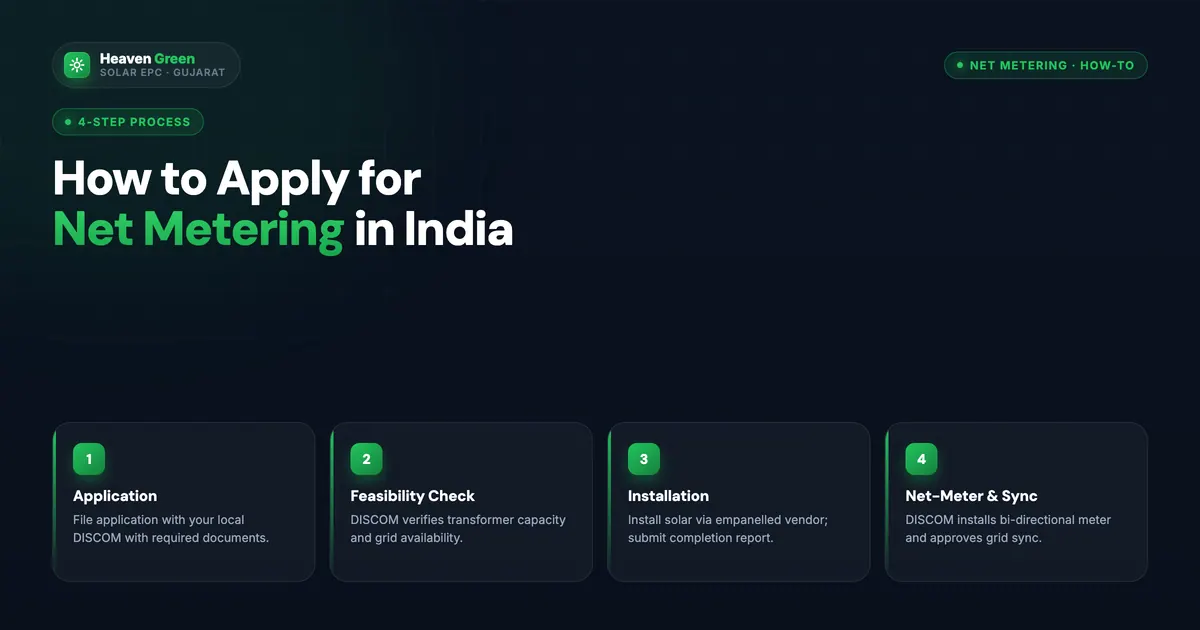
Getting a net metering connection involves several steps, each requiring specific documents and approvals. The process varies slightly by state, but the core sequence is the same.
-
Apply for rooftop solar on PM Suryaghar portal: register with your DISCOM consumer number, Aadhaar, and mobile OTP. The net metering request is integrated with the PM Suryaghar application.
-
DISCOM technical feasibility check: a DISCOM engineer visits your site within 7 to 15 working days to confirm technical feasibility (adequate transformer capacity on your feeder, compliance with connection voltage, no outstanding dues).
-
Receive feasibility approval and proceed with installation: only after written DISCOM approval should installation begin.
-
Installation completion and compliance documentation: your installer provides a commissioning report, test certificate, single-line diagram (SLD), earthing test certificate, and equipment certificates (BIS/IEC).
-
DISCOM net meter inspection: DISCOM engineer inspects the installation against the approved SLD and IS 16046 standards. If compliant, they replace your existing meter with a bi-directional net meter on the spot (or within 7 days).
-
Meter sealing and connection activation: DISCOM seals the meter, signs the commissioning certificate, and the net metering connection is live. You begin earning export credits from this date.
-
PM Suryaghar subsidy claim: submit the commissioning certificate to the national portal; DBT arrives within 30 days per MNRE SLA.
The solar permits guide for Gujarat documents the DISCOM application process specifically for UGVCL, DGVCL, MGVCL, and PGVCL.
Net Metering vs. Gross Metering vs. Net Billing: What’s the Difference?
These three terms are often confused. Here is what each means in the Indian regulatory context.
| Model | How It Works | Who Controls | Financial Outcome |
|---|---|---|---|
| Net metering (dominant model) | Import and export counted separately; billed on net difference | Consumer-led | Best for self-consumption; credits rolled over monthly |
| Gross metering | All solar exported to grid; consumer imports all consumption | DISCOM-led | Consumer earns on all generation; less self-consumption benefit |
| Net billing | Solar valued at avoided cost rate; credits in ₹ not kWh | Regulatory variant | Consumer gets cash value of export; typically lower than avoided cost |
India uses net metering for residential consumers under 10 kW in most states, following the CERC and MNRE policy framework. Large consumers (above 500 kW in some states) may use gross metering or open access.
Get a free net metering assistance quote. Our team handles the complete DISCOM application, from feasibility to meter installation. Get your free quote →
The Heaven Green Net Metering Guarantee
Across our 10,000+ installations, 98.7% of our DISCOM net metering applications have been approved on the first submission. The 1.3% that required resubmission were due to DISCOM database errors (incorrect consumer number mapping), not installation faults.
Our process for ensuring first-pass approval follows the Heaven Green Net Metering Compliance Protocol: seven document checks we complete before submitting to any DISCOM:
- Consumer name on electricity bill matches Aadhaar exactly
- Sanctioned load on file ≥ proposed system size (in kW)
- BIS IS 14286 panel certificate for each panel brand
- IEC 62109 / IS 16221 inverter certificate with serial number
- Earthing test certificate (resistance ≤ 5 ohm per IS 3043)
- Single-line diagram (SLD) stamped by a licensed electrical supervisor
- No outstanding electricity dues on the consumer account
This protocol avoids the most common reasons for DISCOM rejection.
Pros and Cons of Net Metering
- Surplus solar power earns bill credits, no generation is wasted
- Credits roll over month to month in most states
- Effectively makes the grid a free battery for daytime generation
- No separate DISCOM approval needed beyond the system application
- Mandatory by regulation, DISCOMs cannot legally refuse a compliant application
- Export tariff (₹2–₹3/unit) is much lower than import tariff, export is less valuable
- Annual credits typically expire, large surpluses may not be fully monetised
- DISCOM meter installation can take 30 to 60 days in some areas
- Minimum demand charge still payable even in zero-bill months
How to Read Your Net Metering Bill
Your first post-solar electricity bill will look different from your previous ones. Here is what each line item means:
Units imported (T1): Grid electricity you consumed when solar wasn’t generating, nights, early mornings, cloudy periods.
Units exported (T2): Solar power you sent to the grid.
Net units billed: T1 − T2. If positive, you pay for this. If negative, you receive a carryforward credit.
Energy charges: Net units billed × applicable domestic slab tariff.
Fixed / demand charge: A flat monthly charge regardless of consumption. Varies from ₹20 to ₹200+ depending on state and connection type. This charge doesn’t go away with solar.
Net metering credit carryforward: The rupee or unit value of surplus generation carried forward to the next billing period.
The solar net metering detailed guide explains each billing line item with examples from Gujarat, Maharashtra, and Rajasthan.
📘 Regulation note
Under the Electricity (Promoting Renewable Energy through Green Energy Open Access) Rules 2022, DISCOM's obligation to provide net metering is legally enforceable for systems up to 10 kW. If your DISCOM delays meter installation beyond 15 working days after compliant installation, you can file a complaint with your State Electricity Regulatory Commission (SERC). See the MNRE regulations page for the relevant statutory provisions.
Virtual Net Metering and Group Net Metering
Two extensions of standard net metering are increasingly available in India:
Virtual net metering: Allows a consumer to register a solar system at a different location (e.g., a rooftop farm in a village) and credit the generation against an electricity connection in a different zone. Useful for commercial consumers with multiple connections. Available in select states under SERC virtual net metering regulations.
Group net metering / housing society solar: Multiple electricity connections in a housing complex can pool solar generation from a shared rooftop system, with each connection receiving a proportional credit. This allows apartment dwellers who don’t own their own roof to benefit from rooftop solar. MNRE’s rooftop solar phase 2 guidelines explicitly support this model.
If you rent rather than own, read our dedicated guide to solar for tenants and renters for portable kits, landlord NOCs, and which states currently support this shared model.
How Heaven Green Energy Handles Net Metering End to End
Heaven Green Energy manages the complete net metering process, from DISCOM application to meter installation to first bill verification. We have active empanelment across UGVCL, DGVCL, MGVCL, PGVCL (Gujarat), MSEDCL (Maharashtra), and RRECL (Rajasthan).
Our process guarantees that your net meter is installed and active before we consider the project closed. We also verify your first post-installation DISCOM bill to confirm the net metering credits are appearing correctly.
- Residential Solar: complete installations with net metering handled.
- Solar Net Metering Guide: detailed explanation of how your credits are calculated.
- Solar Calculator: see your estimated net metering credits and bill savings.
- Contact our team: net metering assistance and DISCOM application support.
Frequently Asked Questions
Is net metering available in all states of India?
Net metering is mandatory nationwide for grid-connected rooftop solar systems up to 10 kW, following CERC guidelines and the Electricity (Promoting Renewable Energy) Rules 2022. However, the export tariff rates, credit rollover policies, and system size limits vary by state. All major states including Gujarat, Maharashtra, Rajasthan, Karnataka, Tamil Nadu, Delhi, and Telangana have active net metering policies.
How much do I earn per unit exported under net metering in India?
Export credits range from ₹2.00 to ₹3.50 per unit depending on your state’s SERC-approved export tariff. Gujarat’s rate is ₹2.25–₹2.75/unit; Maharashtra’s is ₹3.00–₹3.50/unit; Rajasthan’s is ₹2.50–₹3.00/unit. These rates are lower than import tariffs (₹5–₹9/unit), which is why maximising self-consumption is more valuable than maximising export.
How long does it take to get a net meter installed?
After installation and submission of the commissioning report to your DISCOM, the net meter should be installed within 15 working days per MNRE guidelines. In practice, busy urban DISCOMs like MSEDCL Mumbai and UGVCL Ahmedabad may take 30 to 45 days during peak application seasons. Heaven Green Energy tracks every pending net meter installation and escalates to DISCOM if the 15-day deadline is missed.
What happens to unused net metering credits?
Most states allow monthly carryforward of surplus credits, if you export more than you import in July, the surplus rolls into August’s bill. At the end of the financial year (March 31), many DISCOMs pay cash for any remaining unused credits at the export tariff rate. Some states (like Tamil Nadu) simply expire unused credits. Check your state SERC’s net metering regulation for the specific credit expiry policy.
Can tenants or flat owners in an apartment get net metering?
Yes, under group net metering or virtual net metering schemes available in progressive states. A housing society can install solar on the common terrace, and each flat gets a proportional credit. Individual flat owners cannot independently install systems on common terrace areas without society approval. For independent floors in a building, individual net metering connections are possible if each floor has its own DISCOM connection.
Does net metering affect my DISCOM bill’s fixed charges?
No. The fixed demand charge (typically ₹20–₹200/month depending on your state and connection type) remains on your bill regardless of how much solar you generate. This charge covers the cost of maintaining the grid connection to your property. Even in months where your net consumption is zero or negative, you pay the minimum demand charge. Factor this into your payback calculations.