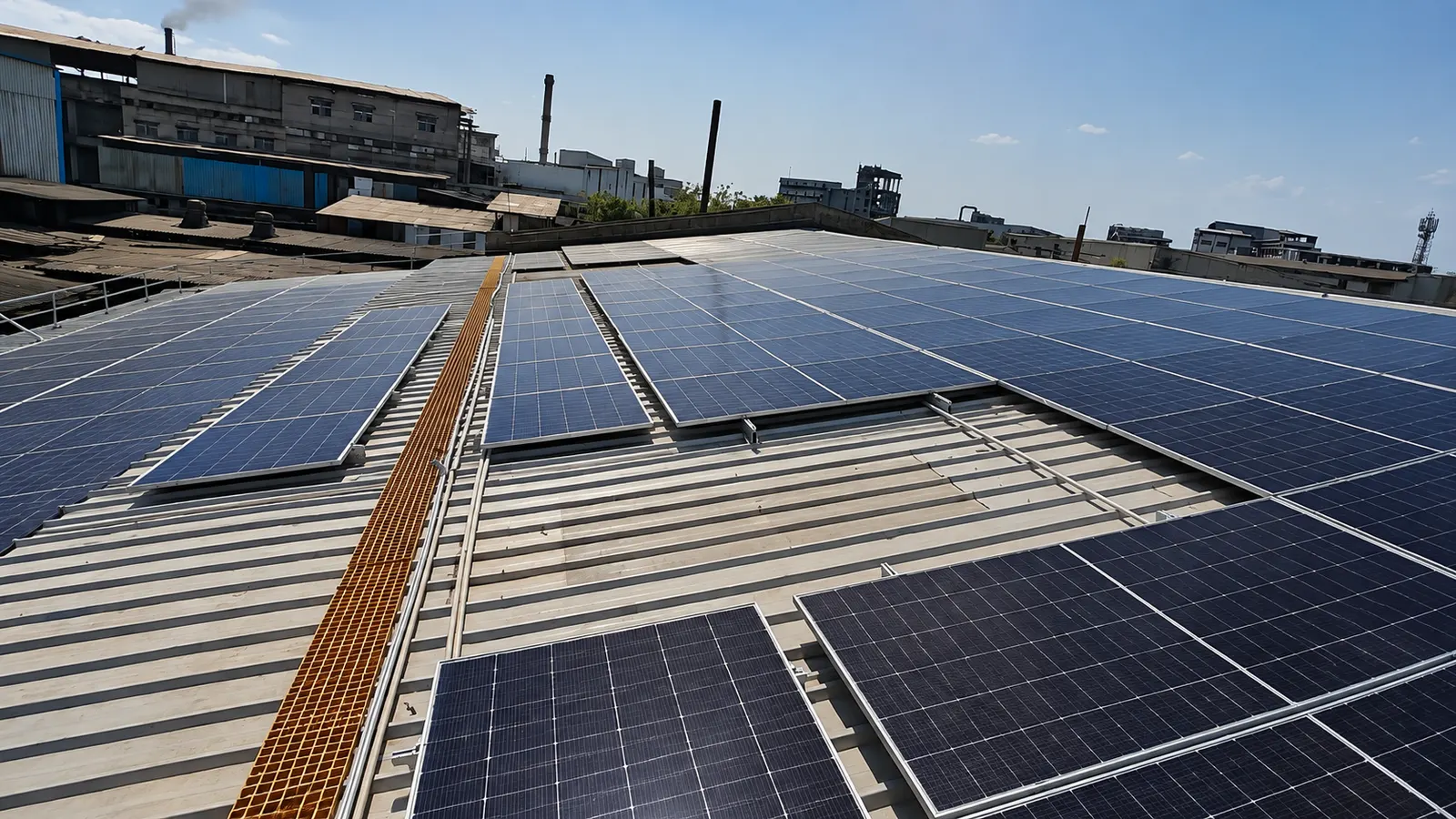
First identify the factory's electrical boundary
An HT consumer receives supply at a higher voltage and transforms it for plant loads. Many production loads then run from low-voltage distribution boards, while the utility revenue meter, CT/PT equipment, transformer and protection define the utility-facing boundary. A rooftop array produces DC electricity; inverters convert it to AC and connect it to a suitable point in that electrical system. That sentence sounds simple until the plant has multiple transformers, diesel generators, capacitor banks, old switchgear and a main panel nobody wants to open during a production shift.
The first engineering question is therefore where the solar output can safely join the plant, not merely how many panels fit on the roof. A connection on an LT bus after a transformer can suit one plant configuration; a different capacity or distribution layout can lead to a different architecture. The choice affects cable runs, switchgear, transformer loading, fault levels, protection settings, metering and the outage needed for connection. It must be decided from a site single-line diagram and electrical study, then accepted by the relevant authority and licensee. The CEA distributed-generation connectivity standards and the 2026 GERC regulation supply the governing framework; neither is a substitute for a site design.
Ask your EPC to mark four boundaries on one drawing: the utility meter and point of supply; the transformer and its protection; the proposed solar tie-in; and any DG or backup supply. If a quote says “connect to the nearest panel” without showing the existing bus rating and protection, the connection price is not yet reliable. A close roof does not automatically mean a cheap or safe cable route.
The sketch accompanying this page is a conceptual flow diagram, not an installation drawing. The final SLD must show actual equipment ratings, CT/PT and meter positions, interlocks, earthing, isolation and protection. It should also say which party supplies each item and who signs off before energisation.
Size solar from the load curve, then test the rule limits
Contract demand, monthly kWh and roof area each answer a different question. Contract demand says something about the connection agreement and demand-charge basis. Monthly kWh gives total energy, but hides the time of use. Roof area gives a physical upper bound after accounting for structural capacity, setbacks, obstructions and maintenance access. The project needs all three, plus an interval load profile where available.
For example, two factories may both consume 100,000 kWh in a month. One runs process equipment steadily through daylight; the other starts large loads after sunset. The same nominal rooftop capacity would have very different self-use and export patterns. This is a hypothetical comparison, not a claim about any Heaven Green project. Ask for 15- or 30-minute meter data if the facility has it, and match it to an hourly solar production estimate. Keep the assumptions visible: location, orientation, shade, temperature, inverter limits and downtime. NREL's PVWatts documentation is one established reference for the inputs and limits of a PV production estimate; a site proposal should use local weather and an inspected roof.
The 2026 GERC regulation permits net metering or net billing for eligible consumers of all categories from 1 kW AC up to 1,000 kW AC / 1,250 kWp DC, subject to its other provisions. Gross metering has a different band, from 6 kW AC up to 4,000 kW AC, subject to technical feasibility. Do not interpret those maxima as automatic permission for your roof. The licensee assesses the application, protection and network conditions. For a consumer with contract demand above 100 kW, capacity above contract demand under net metering, net billing or group net metering brings a specified battery requirement: at least two hours per cycle for at least 50% of the excess capacity. The units and exact design must be checked on the application. GERC Regulations 4.3, 4.9 and 8.
There is a second, commercial sizing limit worth noticing. Under the 2026 net-metering rule, a non-residential prosumer may adjust exported energy against no more than 30% of the energy imported from the grid in that billing period; excess exports above that limit lapse. Applicable banking charges can also apply. This makes a self-consumption study more useful than a roof-maximising sales estimate. GERC Regulation 9.1.5.
A simple export check, without a savings promise
Suppose an eligible non-residential net-metering factory imports 1,000 kWh from the grid in a billing period and its bidirectional meter records 400 kWh exported. Under the 30% cap, no more than 300 kWh of those exports can be adjusted against the 1,000 kWh imported; 100 kWh of excess export is treated as lapsed under the cited clause. Before time-of-day matching, banking charges and other billing conditions, the energy side would have 700 kWh of net drawal. These numbers are illustrative meter readings chosen to explain the rule, not a proposed system size, generation forecast, bill estimate or advice to export. Directly consumed solar is a separate quantity: it reduces what the plant draws before the import meter records it. GERC Regulations 9.1.3–9.1.9.
| Quantity in the illustrative billing period | kWh | What it means |
|---|---|---|
| Grid import | 1,000 | Electricity the plant still took from the licensee |
| Solar export | 400 | Electricity that crossed outward through the bidirectional meter |
| Maximum export adjustment under the 30% rule | 300 | 1,000 × 0.30, before ToD and other conditions |
| Export above the adjustment limit | 100 | Lapsed under this net-metering example |
| Import after the illustrative adjustment | 700 | Energy figure only; not the entire payable bill |
Source and scope: GERC 2026 Regulation 9.1.5, checked 23 November 2026. The table does not calculate direct self-consumption, ToD matching, banking charges, demand charges, duty or taxes. The regulation says exported kWh do not offset those other charges. Where ToD applies, off-peak exports can offset off-peak imports only, while peak exports can offset peak and off-peak imports, subject to the same regulation. GERC Regulation 9.1.7.
What changes on an HT electricity bill?
Think of the bill as several related calculations, rather than one unit rate multiplied by monthly consumption. Rooftop solar can reduce grid energy imported while the factory is using it. It can also create measured export if generation exceeds immediate plant use. The utility's bill then applies the chosen metering rule and applicable tariff. The outcome depends on the intervals when energy is generated and used, the metering mechanism, and which charges remain payable.
The demand line is a useful reality check. Under DGVCL's HTP-I schedule for FY 2026–27, billing demand is the highest of actual maximum demand in the month, 85% of contract demand, or 100 kVA. That is a specific DGVCL HTP-I rule, not a claim about all Gujarat HT tariffs. A solar system might lower some daytime peaks, but a night shift, an early start-up or the 85% floor can keep billing demand unchanged. It is unsafe to subtract the proposed solar kW from contract demand and call the difference a guaranteed demand-charge saving. DGVCL tariff order, Schedule 11.4.
The time-of-use line deserves its own review. DGVCL's HTP-I schedule lists additional charges for specified morning and evening peak periods and a concession for consumption during the specified middle-of-day period. Actual bill treatment and the current schedule must be checked before projecting value. A factory whose largest load runs after sunset will not get the same direct solar match as one whose processes run mainly in daylight. The export-adjustment rules also distinguish peak and off-peak periods. DGVCL HTP-I Schedule 11.3 and 11.10; GERC Regulation 9.1.7.
The power-factor line also needs care. The DGVCL HTP-I schedule has a poor-power-factor adjustment and a high-power-factor rebate tied to its defined thresholds. A solar inverter changes real-power flow; capacitor-bank and APFC behaviour can therefore need rechecking at different production and solar outputs. An EPC proposal should show who reviews PF and reactive-power settings after commissioning. It should not claim that panel output automatically removes a PF penalty. DGVCL HTP-I Schedule 11.6.
| Bill or electrical item | Why it matters before sizing | What to ask for |
|---|---|---|
| Grid import and export kWh | Shows direct use and settlement exposure | Monthly readings plus interval data if available |
| Maximum and contract demand, kVA | Demand charges may remain after solar | Twelve bills, demand curve and contract agreement |
| Time-of-use registers | Solar production and factory use occur at different hours | Current tariff category and interval register data |
| Power factor and APFC operation | Reactive-power behaviour may change at low net load | Existing settings and an engineer's review plan |
| Metering and CT/PT | Determines measured generation, import and export | Approved meter scheme and test certificates |
Source note: The charge structure is illustrated from the DGVCL FY 2026–27 HTP-I schedule and GERC 2026 metering rules. Confirm the exact licensee and category on the buyer's bill. The term “kVAh” appears in some buyer searches, but this particular DGVCL order describes HTP-I energy charges per unit and demand in kVA; do not recast it as kVAh billing without a source for the actual account.
Metering, approvals and commissioning
The application route starts with the distribution licensee, which reviews the proposed distributed renewable system against technical feasibility and the applicable procedures. The 2026 GERC regulation names multiple arrangements: net metering, net billing, gross metering, group net metering and virtual net metering. A factory evaluating power for its own premises will normally compare the relevant on-premises options first; the correct mechanism is a project-specific choice. The regulation also says an eligible consumer has only one of the listed arrangements for the same service connection. GERC Regulations 3, 5, 6 and 8.1.
For net metering, the regulation refers to a generation meter and bidirectional meter. The utility records generation, import, export, net billed electricity and direct solar consumption in the billing information. A large or complex HT project can require additional CT/PT, check, ABT or communication equipment as specified by the licensee, GETCO or other competent body. Do not assume an existing import meter can simply be reprogrammed without the approved meter scheme. GERC Regulations 9.1.3–9.1.4 and model agreement clause 6.
Electrical safety and inspection are separate from energy settlement. The 2026 regulation's activity chart calls for installation charging approval of the Chief Electrical Inspector whenever applicable, a meter/CTPT test certificate from a NABL-accredited lab, equipment certificates and protection documentation at the commissioning stage. Its model agreement also describes Chief Electrical Inspector approval and a commissioning certificate. The engineer and licensee should confirm which approvals apply to the actual voltage, capacity and scheme; a marketing page cannot give a blanket “CEIG required” or “CEIG not required” answer. The final design must meet the applicable CEA safety regulations and the licensee's current procedure. GERC 2026 activity chart and model agreement.
A sensible sequence is: confirm connection details and no-dues status; survey roof and electrical room; choose a metering arrangement; prepare the SLD, protection and capacity proposal; apply to the licensee; resolve any technical or network works; agree the plant tie-in window; complete installation and tests; obtain applicable inspection and meter approvals; and commission only after the required certificate and utility process. The published regulation has activity durations, but a page cannot promise a completion date for a specific plant. Network strengthening, document corrections, shutdown access and inspection bookings can change the real schedule.
For HT consumers above 6 kW of DRES, the regulation also describes system-strengthening charges using a licensee-specific basis. Treat these as a line item to investigate, not as “always included” or “never needed” in an EPC quote. Ask the EPC to distinguish the licensee estimate from the contractor's equipment and labour price. GERC Regulation 6.4.
Keep production running where the design allows
Rooftop installation and electrical tie-in have different operational effects. Mounting on an accessible roof may be staged around production areas, but the final electrical connection can require an isolation window. “No shutdown” is a claim to prove for a specific electrical arrangement, not a default promise.
Roof suitability needs more than a visual look at sheets. Ask for the structural engineer's assessment of the roof and purlins, the expected loading and wind actions, and how the design protects weatherproofing. For older sheds, confirm the sheet condition before specifying clamps or penetrations. Mark skylights, smoke vents, maintenance paths and fire access on the roof plan. Do not rely on panel weight alone: the load path into the supporting structure and the condition of each fastening detail matter.
Operations also need an access plan. If cleaning or maintenance requires walking across production sheds, the design needs safe routes and agreed access. If the plant has multiple roof blocks, compare a single large tie-in with distributed sections only after cable length, electrical loss, switchgear and outage work are assessed. These are engineering decisions to document in the proposal, not reasons to assume one layout is always best.
What a useful HT factory proposal should contain
A proposal should let the plant team see what is fixed, what is assumed and what remains subject to approval. Request the following items before comparing a rupees-per-kW headline:
- Connection identity: licensee, consumer number, HT tariff category, contract demand, supply voltage and the bill period reviewed.
- Roof basis: surveyed usable area, structural review owner, roof condition, access, exclusion zones and mounting approach.
- Electrical basis: marked SLD with proposed tie-in, inverter AC capacity, DC capacity, cables, switchgear, protection, earthing, CT/PT and meter locations.
- Energy model: hourly or interval generation assumptions, direct self-use, expected import/export, clipping, availability and uncertainty. A model result is an estimate, not a promised bill.
- Regulatory basis: selected metering arrangement, applicable 2026 GERC clause, current licensee procedure, CEI/CEIG review status, testing and network-strengthening allowance.
- Execution plan: roof work sequence, electrical outage window, permits, commissioning tests, who signs each certificate and what happens if the utility requests changes.
- Commercial boundaries: equipment schedule, exclusions, utility fees, taxes, payment stages, change-order mechanism and the named warranty provider for each component, once confirmed in writing.
This list also helps compare two bids that appear similar at first glance. If one includes a transformer-side modification and approved metering while the other excludes both, their totals are not like for like. If one sizes from a 12-month bill and the other uses the roof's theoretical maximum, ask each to show the same import/export assumptions under the current regulation.
Questions an HT factory usually asks
Can rooftop solar reduce my contract demand? It can change measured grid draw during some intervals, but it does not automatically change the contract agreed with the licensee. Under DGVCL HTP-I, billing demand has an 85% contract-demand floor and a 100 kVA floor. Model the actual demand curve, then review any contract change as a separate utility decision. DGVCL HTP-I Schedule 11.4.
Can I use all the roof area? Physical roof area is only one constraint. A structural review, access needs, shadow and cable routes, load matching, inverter sizing and the applicable regulatory capacity limits all affect the final proposal. A roof-full layout may create more export than the plant can use or adjust under its chosen arrangement.
Will solar keep machines running in a grid outage? Ordinary grid-connected solar must follow anti-islanding and protection requirements. Backup operation needs a separate approved system architecture, with switching and storage or generation designed for the critical loads. Do not treat a standard rooftop quotation as a backup-power quotation. GERC technical-feasibility provisions; CEA connectivity standards.
Does the factory need a CEIG approval? The answer depends on the actual installation and the competent authority's requirements. The 2026 activity chart explicitly says Chief Electrical Inspector installation charging approval “whenever applicable”. Put that decision, its owner and the supporting drawings into the project approval register before electrical work starts. GERC 2026 activity chart.
Can you quote from the sanctioned kVA alone? It permits an initial conversation, not a defensible proposal. The kVA figure cannot reveal hourly load, roof condition, point of connection, export pattern or outage constraints. Send the bills and SLD first, then let the site survey resolve the remaining variables.
Get a proposal based on your plant
Heaven Green Energy is a Surat solar company founded in 2017. For an HT factory enquiry, the useful starting documents are the last 12 bills, connection and tariff details, a roof plan or clear photos, and the latest SLD if your team has one. The proposal discussion can then address the load curve, roof, tie-in, metering and approval path together. It should say where assumptions remain open and which utility or engineering decisions must happen before a final price or schedule.
Get a load-based proposal for my plant. Use the industrial enquiry form, or call +91 63904 05060. For the broader service, see industrial rooftop solar; for a business connection that is not an HT factory, see commercial solar.