Start with the tariff printed on your bill
“MSME” describes the enterprise. It does not tell you the electricity tariff. Read the consumer category on the most recent bill and check the distribution company named on it. In the DGVCL tariff schedule effective 1 April 2026, Non-RGP applies to premises not covered by another tariff category with aggregate load up to and including 40 kW. LTMD applies to such premises above 40 kW; an eligible Non-RGP consumer may opt for LTMD. The schedule also has other categories, so do not reclassify your connection from the size of your factory alone.
That distinction changes the bill calculation. A Non-RGP bill has fixed and energy charges. The LTMD schedule adds demand charges, time-of-use terms and reactive energy charges. Its billing demand is the highest of 85% of contract demand, actual maximum demand registered during the month, or 6 kW. Solar generation may reduce imported energy in daylight, but the remaining demand charge cannot be assumed to fall in the same proportion. The right comparison is an interval-by-interval or time-of-use model plus the actual bill components, not simply “monthly units × one tariff.” Source: GERC DGVCL tariff, LTMD sections 5.1–5.7, March 2026.
| Bill field | Why it matters for a small factory solar proposal | What to hand over |
|---|---|---|
| DISCOM and tariff category | Determines which published schedule and billing terms apply | Current complete bill, including reverse pages |
| Sanctioned load or contract demand | A connection and sizing input, not a substitute for measured daytime use | Bill and any revised-load approval |
| Monthly imported units | Shows consumption and seasonality but hides the hours when it occurred | Twelve months of bills, if available |
| Maximum or billing demand | May continue to drive charges even after midday imports fall | Demand and time-of-use register, where shown |
| Shift hours and major machines | Tells the designer when solar can be consumed on site | Shift schedule and connected-load list |
| Roof ownership and condition | Controls whether an array can be installed and maintained safely | Roof drawing, shed age and lease or owner consent |
The table is a document checklist, not a claim that any specific saving will follow. If your bill is from Torrent Power, MGVCL, PGVCL or UGVCL, use that licensee’s current schedule and process. The figures in one DISCOM’s tariff must not be pasted into another licensee’s proposal. The GERC tariff schedule register is a starting point for checking the right document.
How much rooftop solar fits an LT factory?
There are three separate limits: the usable roof, the electrical connection, and the energy that the factory can use or settle under its approved metering arrangement. A quote based on roof area alone misses the other two. A quote based on a single month’s units may miss a seasonal shutdown, a future machine or an unusually busy month.
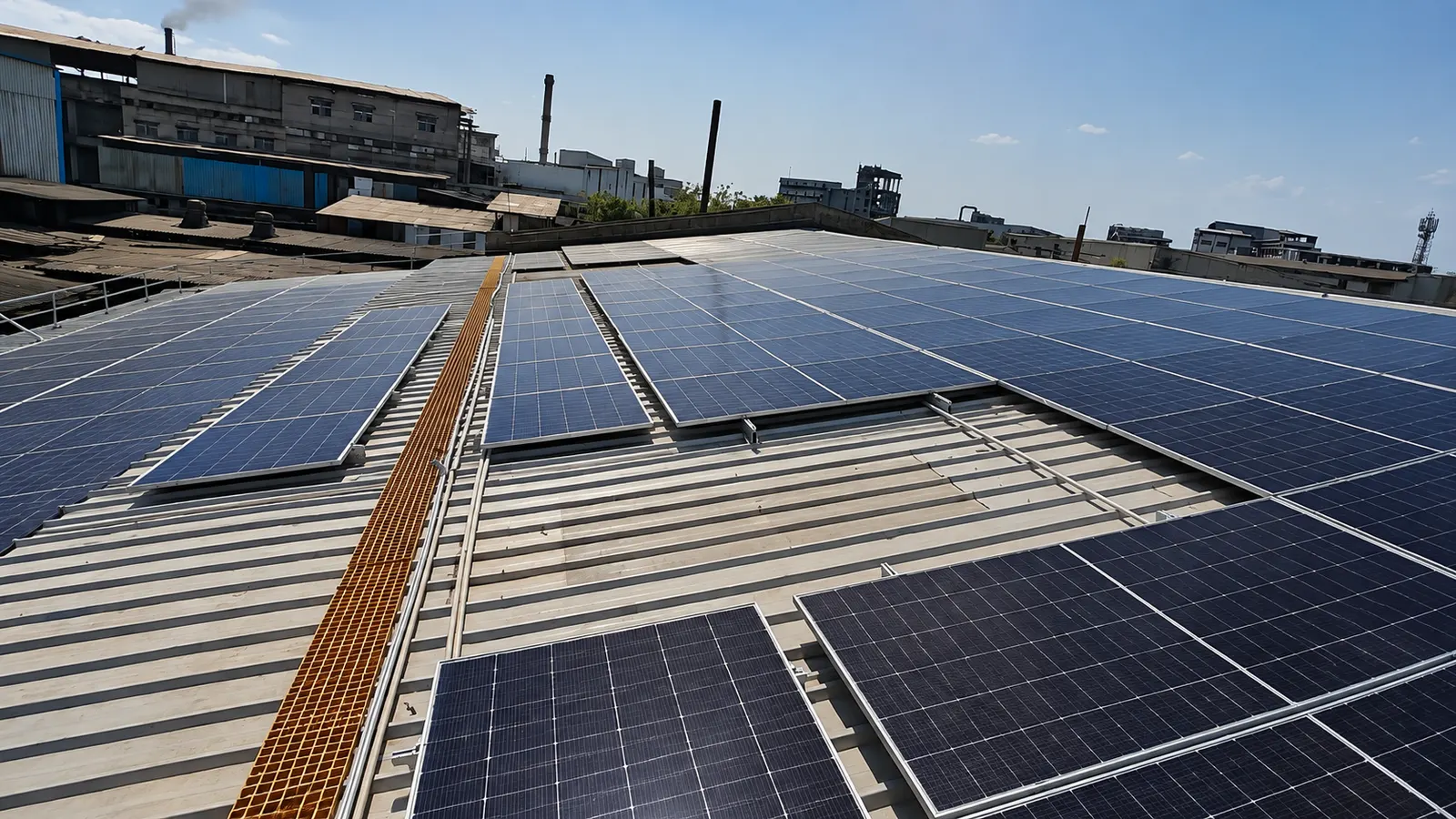
First, determine the usable roof. Remove skylights, rooflights, exhausts, fragile sheets, parapet shadows, access routes and space needed for cleaning and fire or electrical access. Check whether the roof is metal sheet, standing seam or reinforced concrete; its fastening method and condition affect the mounting design. A roof that looks large in satellite imagery may have too little structurally suitable area. An engineer should review load paths, purlins, corrosion, wind uplift and the remaining roof life before finalising the array layout. The project must not turn a weak shed into a dangerous support structure.
Second, measure the working load, ideally from interval data or a representative operating-day log. A workshop with machines running from 9 a.m. to 6 p.m. has a different use pattern from one that runs mostly after dark or closes for long seasonal periods. Add air compressors, process heat auxiliaries, ventilation, cold storage and office load only when they actually operate at the relevant hour. A large motor’s nameplate rating is not its continuous demand. The design should show both the expected solar generation curve and the factory’s load curve on the same hourly axis.
Third, check the regulatory route. The GERC 2026 regulation applies to distributed renewable systems commissioned on or after its notification. It allows consumers of all categories to establish eligible systems under net metering and net billing, with a general 1 kW AC minimum and 1,000 kW AC / 1,250 kWp DC maximum for those arrangements. Those are regulatory outer limits, not a recommendation to put a 1 MW plant on a small LT factory. Voltage suitability, technical feasibility, the DISCOM procedure, roof and load still control the actual proposal. Larger or different arrangements have their own provisions.
Do not use an older “50% of sanctioned load” line from a search result without checking whether the source has been repealed. GERC’s register lists the 2016 rooftop regulation under repealed regulations, and the 2026 notification states that it repeals the 2016 regulation and amendments. Existing commissioned systems and their agreements may need a separate reading. For a new application, start with the current notification and the relevant DISCOM’s approved implementation procedure.
A sizing worksheet, without a made-up yield
The first pass should be transparent enough for the owner to challenge. Record: (1) usable roof area, after exclusions; (2) array DC capacity in kWp; (3) inverter AC capacity in kW; (4) measured or estimated hourly factory load in kW; (5) location-specific monthly generation estimate, including orientation, shading and system losses; and (6) the intended metering and settlement route. The ratio of DC modules to inverter AC capacity should be explicitly labelled. These units are different and should not be used interchangeably.
If a proposal gives a single “units per day” figure, ask for the month-by-month and hourly assumptions. The US National Renewable Energy Laboratory’s PVWatts model is one transparent way to create a planning estimate, but its result depends on the entered location, orientation, DC/AC ratio and losses. It is not a guarantee of output on your particular roof. An on-site shade study and the actual equipment layout may change the estimate.
Why some electricity charges remain after solar
A grid-connected solar plant normally reduces power imported when its generation is available and the factory is using it, subject to the approved meter arrangement. It does not erase all bill components. A small factory may still pay fixed or demand charges, time-of-use charges for grid imports, taxes and duty where applicable, and charges related to the selected renewable connection. It will import grid electricity at night, during cloud cover, maintenance or whenever the plant load exceeds solar output.
The DGVCL LTMD schedule is a useful example of why a promise based only on “units replaced” is weak. Demand charge is calculated against billing demand, with a floor tied to contract demand. The schedule also identifies additional charges for energy used in specified morning and evening periods, a daytime time-of-use discount under stated meter conditions, and reactive energy charges. Whether a particular item changes after solar depends on the meter records and the revised operating pattern. Source: GERC DGVCL tariff, sections 5.1–5.7.
For a fair proposal, ask for two bills: the actual baseline and an estimated post-solar bill that shows each retained line item. The model should identify self-consumed solar units, grid imports and any exported units separately. Export should be valued or credited using the arrangement that will actually be approved, not the full retail rate by default. The model should name the tariff order and the expected commissioning date. If the site has more than one meter, the proposal must say which connection receives the solar plant and whether a group or virtual arrangement has been considered under the applicable conditions.
Solar also does not make an ordinary on-grid inverter an automatic backup system during a power cut. Grid-connected equipment must meet anti-islanding and protection requirements. If production needs continuity, specify the critical load and a properly engineered backup arrangement as a separate question. Do not let a rooftop quote quietly imply that machines will run through an outage. The CEA distributed-generation connectivity standards and the 2026 GERC regulation are the starting technical sources for interconnection, with the current DISCOM requirements controlling the final design.
What happens between a quote and a working meter?
The path below is a planning sequence. It is not a promised approval time or a claim that Heaven Green Energy has completed every listed filing for every project. The final responsibility split belongs in the signed scope of work.
- Collect the right inputs. Share the current bill, up to twelve previous bills, operating hours, a list of major equipment, roof drawing if available, and who owns or leases the premises. A brief shutdown history helps explain unusual demand months.
- Check the roof and electrical tie-in. An appropriate professional should inspect roof condition and load capacity; the electrical designer should inspect the main LT panel, available space, cable route, inverter location, earthing and protection. The drawing must show where power joins the existing system.
- Compare metering routes. Check eligibility and settlement under the latest GERC regulation and the licensee procedure. Decide whether self-consumption with net metering or net billing is the appropriate application, instead of assuming all exported units have the same value.
- Submit the application and documents. The 2026 regulation calls for a DISCOM application in the approved format with its required enclosures and connectivity fee. It also provides for technical feasibility analysis and applicable registration, safety, commissioning and metering approvals. The exact checklist should come from the current utility procedure and project size.
- Complete engineering and installation. Final structural and electrical drawings, equipment selection, safe site access and work permits should precede installation. Plan the main-panel tie-in around a written production shutdown window. Roof work can often be staged separately from the electrical cutover, but the exact sequence depends on the plant.
- Inspect, test and commission. Verify the installed system against the approved design, protection settings and meter requirements. Record test results and handover documents. Do not operate or expand the grid-connected plant outside the approved arrangement.
GERC requires the DISCOM to prepare detailed implementation guidelines and application formats under the 2026 rules. It says the absence of those procedures does not prevent implementation, but it also means a salesperson should not invent a document checklist or a fixed approval date while procedures are being updated. Source: GERC 2026 regulation, sections 5–7.
Will installation stop the factory?
The answer depends on the building and tie-in point. Work around rooflights, fragile sheets, cranes, exhaust outlets and hot process vents needs more control. Some activities, especially the final connection to the LT panel and protection testing, may require a shutdown or controlled isolation. The owner and contractor should agree those windows before signing the schedule.
Ask the installer for a simple work plan: which roof zones are accessed on each day, how material is lifted, where workers may walk, where temporary barriers go, and when power will be isolated. This is more useful than a blanket claim that production will never be affected. If the roof needs strengthening or sheet replacement, that work may dominate the schedule. A structurally doubtful roof is a design issue to resolve first, not something to cover with lighter rails and optimistic wording.
For leased premises, get written rights for installation, access and maintenance, plus a decision about ownership when the lease ends. The 2026 GERC regulation recognises that a distributed renewable system owner may own, lease or have lawful possession or authority to use the installation site. That does not replace a sound landlord agreement. The permission should address roof repairs, removal, insurance and access to the meter and inverters.
Which finance route should an MSME compare?
Start with ownership and cash flow, not a “subsidy” line in a brochure. A factory can consider buying the plant with its own funds, taking a business loan for the asset, or discussing a third-party ownership or service arrangement if one is genuinely offered for the specific project. Each route changes who owns the equipment, who bears maintenance obligations, how payments are scheduled, and what happens if production or tenancy changes.
| Route | Main question for the owner | Evidence to request before signing |
|---|---|---|
| Own funds | Can the business fund the full scope while keeping working capital? | Itemised scope, payment milestones, exclusions, warranties with named warrantors |
| Loan-financed purchase | Do instalments and fees fit the business cash-flow cycle? | Written lender terms, security, rate, tenure, fees, and asset ownership |
| Third-party ownership | Who sells or allocates the power and who owns the roof asset? | Signed energy price/adjustment formula, roof licence, exit terms, maintenance responsibility |
The table deliberately contains no interest rate or return claim. SIDBI’s green-finance material describes a Green Finance Scheme and an End-to-End Energy Efficiency Finance Scheme for eligible MSME investments, including renewable energy. It does not establish that this factory qualifies or that a specific offer is open on a particular day. Ask SIDBI or the lender for current product terms, eligibility and a written sanction before presenting finance as secured.
The national PM Surya Ghar central financial assistance is for residential consumers under its published guidelines. The MNRE guidelines and non-residential clarification do not support placing that residential subsidy on a factory quotation. Other state, lender or tax provisions should be checked separately for eligibility and date. For any depreciation or GST treatment, have the business’s chartered accountant review the current law and the exact invoice structure rather than accepting a one-line saving claim.
Compare proposals on the same scope
An apparently cheaper rooftop quote may omit roof reinforcement, electrical protection, civil work, meter-related costs, longer cable runs, monitoring or maintenance. It may also use a different DC module capacity from the inverter AC capacity without explaining the difference. Compare on a common scope sheet and request each bidder to fill the same fields. A price-per-kW headline is a starting unit, not a substitute for a bill of quantities.
Ask for the module and inverter models, an array layout with maintenance access, a single-line diagram, a structural review boundary, the interconnection and meter scope, proposed production shutdown window, protection and earthing scope, expected monthly generation with assumptions, the equipment and workmanship warranty documents, exclusions and handover list. If an item is “by client” or “by DISCOM,” it should be explicit. If the roof owner or factory operator must provide access equipment or a shutdown, put that in writing too.
Then compare the financial model. It should state which units are self-consumed, which are exported, and which grid charges remain; it should show financing and maintenance separately. Re-run the model with a lower daytime load if the factory has seasonal work. A range of outcomes from stated inputs is more useful than a single guaranteed payback year. For a plant likely to expand, ask whether cable, panel space and meter scope allow an approved future addition. The [2026 GERC rules](https://www.gercin.
If your plant is still at the question stage, our industrial solar overview explains the broader factory route, while the commercial solar page covers other business premises. Keep the bill, roof and connection documents together so each bidder is pricing the same job.
What to send for a load-based proposal
Send the latest complete electricity bill, up to twelve earlier bills if available, your operating shifts, approximate roof dimensions and any roof drawing, the age and type of the shed, and the name of the person who can approve a site visit. If you do not have all of this, the current bill and working hours are a sensible start; missing inputs should appear as assumptions in the first response.
For the factory owner, the useful output is a proposal that states the proposed DC and AC sizes, assumptions, roof and electrical checks still required, DISCOM route, scope of work, and bill model with remaining charges. A final quotation should follow site-specific verification. We should not make a price, saving, approval or installation-time promise from this page alone.
Get a load-based proposal for my plant. Use the factory enquiry form on this page, or call +91 63904 05060 or WhatsApp +91 63537 89503. Include “LT factory rooftop solar” and your tariff category if it is printed on the bill.
Common questions
Is LTMD the same as an MSME connection?
No. MSME describes the business. LTMD is a tariff category. Under DGVCL’s tariff effective 1 April 2026, premises not covered by another category with aggregate load above 40 kW are under LTMD; Non-RGP covers eligible loads up to and including 40 kW. Check the category on the actual bill and the current schedule for its DISCOM.
Can a factory on an LT connection use net metering?
Gujarat’s 2026 distributed renewable energy regulation makes consumers of all categories eligible to establish a system under net metering, subject to its conditions and the licensee’s procedure. Eligibility is not automatic approval of a proposed roof, size, inverter or point of connection. Ask the relevant DISCOM for the project-specific route.
How many kilowatts can a small factory install?
There is no sensible universal number from “small factory” alone. The usable and structurally suitable roof, actual daytime load, connection voltage and technical feasibility must be checked. The 2026 regulation’s overall maximum for net metering is an outer legal limit, not a recommended plant size for an LT unit.
Does rooftop solar remove demand charges?
Do not assume it will. Under DGVCL’s LTMD schedule, billing demand has a floor of 85% of contract demand, actual maximum demand or 6 kW, whichever is highest. A proposal should calculate retained charges explicitly and explain any changed demand profile from real interval data.
Is the PM Surya Ghar subsidy available for a factory?
The central financial assistance under PM Surya Ghar is published for eligible residential consumers. MNRE’s guidelines say no CFA is provided to non-residential segments under that scheme component. A factory should ask about its own financing and applicable tax treatment, verified from current primary documents and its accountant.
Can a plant be added later?
Possibly, if the electrical design, roof and DISCOM approval allow it. Do not connect an addition without approval. The 2026 GERC regulation specifically addresses unauthorised post-commissioning capacity additions. Put the future expansion option in the initial design and cost comparison.
Will the factory need to shut down during installation?
Roof work may be phased, but the electrical connection and tests can require a controlled outage. The required shutdown depends on the existing LT panel and tie-in design. Request a work plan and agree any isolation window before installation begins.
Do I need a structural engineer’s report?
The roof and mounting loads need competent structural review before final design. The exact deliverable and who signs it should be written into the proposal and approved with the project-specific requirements. A photograph or satellite area estimate is not a load-capacity certificate.