To estimate apparent energy from a bill, enter the kWh and average power factor for the same billing period. The calculator uses kVAh = kWh ÷ average power factor. It shows the electrical relationship, not a rupee bill. For a DGVCL factory in FY 2026–27, the published tariff schedule describes energy charges per unit and separate power-factor adjustments, so do not multiply estimated kVAh by a generic rate and call it the payable amount.
Calculator inputs: billing-period kWh (non-negative) and average power factor (greater than zero and at most one). Output: estimated kVAh for that same period, rounded for display while preserving the unrounded value for calculations. The tool accepts copied bill figures, shows the formula and rejects impossible inputs. The method and limits are explained below.
What kVAh tells you
kWh records active electrical energy over time. kVAh records apparent energy over time. A factory bill may also show average power factor, which is the ratio of kWh to kVAh for a measured period under the relevant meter definition. The Central Electricity Authority's definitions state that average power factor is the ratio of registered kWh to registered kVAh over the specific period. Rearranging that ratio gives the calculator's formula.
This does not mean every Gujarat consumer is billed on kVAh. Tariff categories, meter records and billing schedules differ. For example, GERC's DGVCL FY 2026–27 tariff order sets out HTP-I energy charges in its schedule and separate power-factor adjustment clauses. Read the exact category on your bill before interpreting a kVAh figure. A tool can compute an electrical quantity accurately while the bill interpretation is wrong.
For a plant manager, kVAh is useful because it makes poor average power factor visible as a larger apparent-energy requirement for the same active kWh. It can also reveal a mismatch between data copied from different sources: a kWh value from one month and a power factor from a different month will produce a mathematically valid result with no billing meaning. The first instruction in the tool should therefore say same meter, same billing period.
Use the calculator in three steps
First, locate the meter or bill's total active-energy reading in kWh for the chosen billing cycle. If the bill gives opening and closing cumulative readings, use the billed consumption after any multiplier specified by the meter or bill; do not subtract raw display values and overlook a CT/PT multiplier. If multiple meters or ToD registers appear, the total you choose must correspond to the power factor field you enter. Ask the electrical team if the bill layout is unclear.
Second, read the average power factor for the same cycle. Some bills show it as a decimal such as 0.92; some show a percentage such as 92%. This calculator accepts a decimal ratio only: enter 0.92, not 92. It does not silently guess the format. A value of zero or greater than one is invalid, as is a negative kWh input.
Third, calculate and inspect both the unrounded and displayed answer. If the bill itself lists registered kVAh, compare the result with it. A difference may come from rounded power factor, separate time blocks, meter multipliers, register definitions or a transcription error. The tool should explain these possibilities; it should never claim the utility meter is wrong from a two-field estimate.
| Bill or meter field | What to enter | Check before calculation |
|---|---|---|
| Active energy | kWh for the selected period | Billing multiplier and whether the value includes all relevant registers |
| Average power factor | Decimal greater than 0 through 1; this tool does not accept percentages | Same meter and dates as the kWh value |
| Registered apparent energy, if shown | Keep for comparison, not as an input to this direction | Whether the meter's displayed figure uses the same period |
| Tariff category | Do not enter into the electrical conversion | Use separately to interpret actual charges |
The primary keyword says “billing calculator,” but the useful promise is narrower: a transparent kWh–kVAh–PF conversion that helps a reader inspect a bill. The published DGVCL tariff, meter and bill control any financial statement.
A worked example with labelled assumptions
Suppose a single meter records 12,000 kWh over a billing month and its average power factor is 0.90 for that same month. The estimated apparent energy is 12,000 ÷ 0.90 = 13,333.333… kVAh, displayed as 13,333.33 kVAh. The extra 1,333.33 in this comparison is not “wasted electricity” in kWh and it is not automatically a chargeable unit count. It is the difference between two electrical energy measures under the assumed average factor.
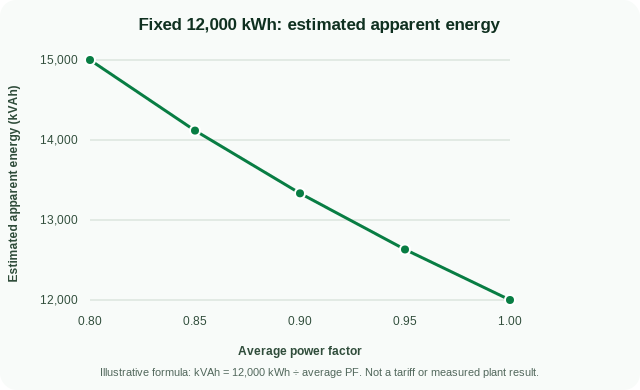
Now hold kWh fixed and vary only the assumed factor. At 1.00, the estimate is 12,000 kVAh. At 0.95, it is about 12,631.58 kVAh. At 0.85, it is about 14,117.65 kVAh. These are illustrative arithmetic outputs, not Heaven Green site measurements or a tariff simulation. The curve becomes steep as the factor falls because division by a smaller number grows the result. The curve does not tell you how much a specific factory would save by changing equipment.
| Illustrative average PF | Fixed active energy | Estimated apparent energy | Formula |
|---|---|---|---|
| 0.80 | 12,000 kWh | 15,000.00 kVAh | 12,000 ÷ 0.80 |
| 0.85 | 12,000 kWh | 14,117.65 kVAh | 12,000 ÷ 0.85 |
| 0.90 | 12,000 kWh | 13,333.33 kVAh | 12,000 ÷ 0.90 |
| 0.95 | 12,000 kWh | 12,631.58 kVAh | 12,000 ÷ 0.95 |
| 1.00 | 12,000 kWh | 12,000.00 kVAh | 12,000 ÷ 1.00 |
The chart below plots the same illustrative values as the table. Its horizontal axis is average PF and its vertical axis is estimated kVAh; the fixed 12,000-kWh assumption is visible. The table above is its text equivalent.
Why the result may differ from your bill
The first source of difference is rounding. A utility bill might show average PF to two decimal places even though the meter calculated it with more precision. If the actual ratio was 0.9048 and the bill displayed 0.90, dividing by 0.90 will not reproduce the registered kVAh exactly. The tool should keep input precision and warn that rounded PF limits comparison accuracy; it should not silently add more decimals.
The second source is period mismatch. The active-energy total might cover thirty days while the copied average factor came from a dashboard displaying the last seven days. A solar inverter's power factor is also not the whole-factory meter's average factor. Motors, drives, capacitor banks, transformers and other equipment affect what the utility connection sees. Use the factor from the utility meter for the period whose bill you are inspecting.
The third source is register and multiplier interpretation. An HT bill can have ToD blocks, export/import records, and a CT/PT multiplier. Summing only one time block or using a raw meter display can produce a figure that differs from billed energy. Rooftop solar adds separate generation and grid-import quantities, which should not be mixed casually. Ask which meter and register your bill refers to before using this calculator as a diagnostic.
Finally, the bill may not bill energy on the same measure you are calculating. The DGVCL FY 2026–27 published schedule should be checked by rate category, including its power-factor clause. A result that matches registered kVAh does not by itself validate demand charges, ToD additions, FPPAS, tax or the net amount due.
kVAh, kWh and kVArh are different measures
The short definitions matter when someone proposes a correction. kWh is active energy. kVAh is apparent energy. kVArh records reactive energy. The average PF ratio used here links the first two over the same interval. It is tempting to draw a single right triangle for a whole month and derive kVArh from kWh and kVAh. That shortcut can mislead when operating conditions vary, harmonics exist, or meter register methods differ. This calculator therefore reports kVAh from kWh and average PF only.
An instantaneous power-factor reading also does not replace the billing-period average. A technician may see 0.99 on a meter at midday after the APFC panel switched capacitor steps, while a shift-dependent motor load pulled the period average lower. Comparing one moment with a month is like comparing one speedometer reading with a whole journey's average speed. Both observations can be true without contradicting each other.
For a deeper explanation of the reactive-energy register, a planned kVArh glossary may eventually provide a separate definition. This tool's decision is deliberately limited to two measured inputs and one derived output. That keeps the calculation testable and prevents a bill explanation from masquerading as a full electrical audit.
Does a lower power factor increase a Gujarat factory bill?
It can, but the mechanism is tariff-specific. The DGVCL tariff order for FY 2026–27 includes power-factor adjustment provisions for relevant HT rate categories. Their thresholds, increments and base amount are defined in the schedule. A number taken from a different tariff, year or licensee should not be pasted into a DGVCL bill review. The power-factor penalty calculator addresses the tariff-specific rupee line, subject to its stated scope.
This page should instead answer: how much apparent energy corresponds to the meter's active energy and average power factor? That result can help an electrical manager decide whether to examine PF correction, equipment schedules or billing records. It does not diagnose the cause of low PF and cannot tell whether a capacitor bank is properly sized. An engineer needs load logs, capacitor-stage records, harmonic information and the actual plant topology before recommending hardware or settings.
The distinction also matters for rooftop solar. Solar generation can reduce grid-import kWh during daylight while fixed demand charges and some other bill elements remain. It may change the measured power-factor pattern at the grid connection. Neither this calculator nor a generic solar savings figure can predict the final bill without interval import/export, tariff and plant operation data. Use a plant-specific study for that decision.
How solar changes the bill-reading question
Before solar, a plant manager may look at one import meter and a monthly bill. After grid-connected solar, the available records can include inverter generation, generation meter, bidirectional import/export meter and utility bill. Each measures a different boundary. The current GERC Grid Interactive Distributed Renewable Energy Sources Regulations, 2026 govern relevant new distributed systems in Gujarat and repeal the earlier 2016 rooftop regulations. The applicable metering arrangement and the licensee's approved procedure determine which registers appear.
Do not feed inverter-generation kWh and utility-import PF into one kVAh calculation. They are not measured at the same electrical boundary. If the goal is to assess the grid bill, use the utility import meter's period values. If the goal is to check inverter operation, use its own measures and documentation. A factory can have excellent inverter PF and still need to inspect the PF at the utility connection because loads and controls sit between those points.
The correct financial comparison is also broader than a one-line conversion. It starts with pre- and post-solar interval demand, the energy used on site, energy exported under the permitted arrangement, contract demand, ToD periods and the present tariff. It should separate existing bill components that solar can affect from components it cannot. A transparent model is better than a promise that a given kW of panels produces a fixed monthly rupee saving.
What the finished tool should show
The final page needs two labelled fields, a calculate action, inline validation, the numeric result and an explanation of the calculation. If a user enters 12000 and 0.90, show 13,333.33 kVAh, the formula with those inputs, and the note that the number is an estimate if PF is rounded. A reverse mode can accept registered kVAh and average PF to estimate kWh; it must be visibly separate so a user does not confuse direction.
The input contract matters as much as the formula. Reject negative kWh, zero PF, PF above one, non-numeric values and numbers beyond a safe range for precise display. Accept PF equal to one. For zero kWh and any valid positive PF, return zero. Clear the output or label it stale when inputs change. Do not keep a previous result on screen while the user changes one field and assume it remains applicable.
For accessibility, each input needs a visible label and unit. Errors should identify the affected field and be announced to assistive technology. The output should be ordinary selectable text, not only canvas or an image. A small table like the example above can supplement a chart, but the chart cannot be the only place a result appears. On a phone, the calculation and source note should remain legible without horizontal scrolling.
| Test case | Inputs | Expected behaviour |
|---|---|---|
| Normal | 12,000 kWh, PF 0.90 | 13,333.33 kVAh displayed |
| Unity | 12,000 kWh, PF 1.00 | 12,000.00 kVAh displayed |
| Zero consumption | 0 kWh, PF 0.90 | 0.00 kVAh displayed |
| Invalid PF | 12,000 kWh, PF 0 or 1.01 | Show error, no result |
| Invalid energy | −1 kWh, PF 0.90 | Show error, no result |
The “Sources checked” date identifies when the linked CEA definition and tariff order were reviewed. The electrical conversion does not change every year; the surrounding tariff interpretation might. Check for a newer applicable tariff order before using the result in a later bill review.
When to request a plant review
If your calculated kVAh is materially different from the bill, first check the input dates, meter multiplier and rounded PF. If the bill itself is unclear, ask the utility or your electrical manager for the register explanation. If the issue is repeated poor average PF, review APFC operation and load changes with a qualified electrical engineer. If you are planning rooftop solar, collect interval import and load information before estimating plant size or savings.
Heaven Green Energy's relevant next step is a load-based proposal for your business through the commercial enquiry form on this page. The proposal should use the correct meter, current tariff category and roof facts. Share recent bills and identify the DISCOM and site; that lets the team state what more is needed for a defensible solar assessment.
Get a load-based proposal for my business. Call +91 63904 05060 or use the commercial enquiry form on this page. The calculator is an educational electrical conversion, not a utility bill, tax statement or engineering sign-off.