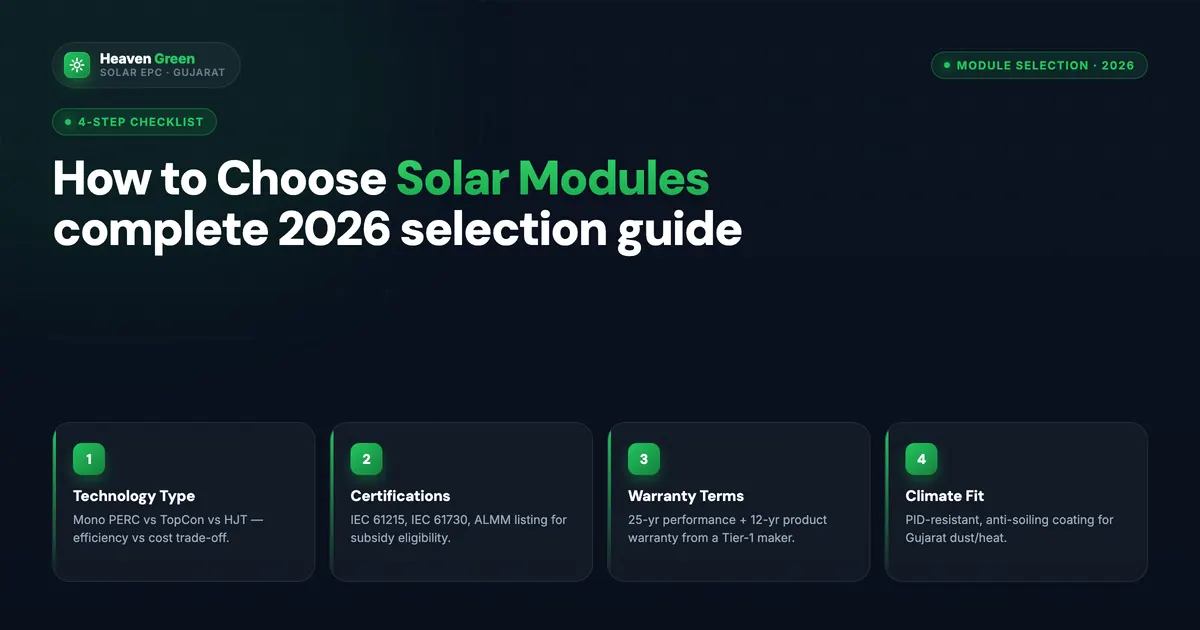
Adani Solar and Waaree Energies are the two biggest names on many Indian rooftop quotes in 2026, both manufacture in Gujarat, both are ALMM-listed (Approved List of Models and Manufacturers under MNRE), and both are Bloomberg tier-1 brands. The difference between them in 2026 is no longer about whether one is “better”, it is about manufacturing scale, panel lineup depth, service density, and which plant has the right model for your kilowatt-peak (kWp) load. Waaree, with 20.17 GW of ALMM-listed module capacity in India (December 2025), is the largest Indian PV manufacturer; Adani, with 10 GW of modules and 4 GW of cells at Mundra, is vertically integrated from ingot and wafer through cell to module: and that fact changes the warranty conversation.
This page is the specs, price and warranty comparison: manufacturing scale, 2026 product lineups, price per watt, warranty terms and service network side by side. For the short head-to-head answer on which brand to pick by use case, read Adani vs Waaree: which is better.
Direct answer. Adani and Waaree publish closely matched efficiency and 30-year TOPCon performance warranties, so the differences are scale (Waaree has more module capacity), Adani’s ingot-to-module integration, and price. DCR status moves Adani’s list price (about ₹23 to ₹25 versus ₹13 to ₹14 per Wp, excluding GST) more than brand does. Our pick for most homes is Adani.
If your installer is asking you to choose, the right way to think about it is not “which is the better brand”, it is “which lineup fits the kWp I am buying, the roof I am putting it on, and the service map I will lean on for the next 25 years.”
Why Both Adani and Waaree Dominate Indian Solar in 2026
Indian rooftop has consolidated hard in the last three years. Of the many module manufacturers on the MNRE ALMM List-I, a handful supply most residential and small-commercial installs, and Adani and Waaree are two of them.
Both make their modules in Gujarat, and the geography matters more than buyers realise. Gujarat has India’s deepest PV supply chain, encapsulant film, backsheet, junction boxes, anodised aluminium frames, and both Adani Mundra and Waaree’s Gujarat plants (led by Chikhli) sit inside that supply web. That keeps their bill-of-materials costs lower than competitors in Tamil Nadu or Andhra Pradesh, and it keeps freight to north Indian rooftops (Delhi NCR, Rajasthan, Punjab, UP) shorter and cheaper.
Both are also on most PM Suryaghar (Pradhan Mantri Surya Ghar: Muft Bijli Yojana) installers’ “default short-list” because both clear the BIS (Bureau of Indian Standards) IS 14286 module certification, the IEC (International Electrotechnical Commission) 61215 / 61730 performance and safety standards, and both publish per-model ALMM identifiers that DISCOMs (Distribution Companies) verify during net-meter inspection. ALMM listing and DCR (domestically manufactured cells and modules) are non-negotiable for the ₹78,000 central subsidy, and both brands sell DCR models.
The 7-Factor Solar Panel Scorecard (Adani vs Waaree)
We use a named framework at Heaven Green Energy for every brand-versus-brand decision a homeowner or commercial buyer asks us to settle. It is called The 7-Factor Solar Panel Scorecard, and it forces both brands through the same seven gates so the answer does not collapse into “whichever is cheaper today.”
Factor 1, Manufacturing scale and vertical integration. Waaree wins on absolute scale: 20.17 GW of ALMM-listed module capacity in India, most of it at Chikhli, Gujarat (16.444 GW). Adani wins on integration depth: its Mundra complex makes ingots, wafers, cells and modules on one site (4 GW of cells against 10 GW of modules), which keeps much of the quality-control chain, from wafer to final flash test, in one place. Waaree also has its own cell lines (5.25 GW approved on ALMM List-II, per Waaree) but makes far more modules than cells. For a 25-year warranty conversation, integration matters; for sheer availability and lead time, scale wins.
Factor 2, Cell technology mix. Both brands now ship a full range of cell technologies, Mono PERC (Passivated Emitter Rear Cell), TOPCon, and bifacial, and Waaree also lists HJT (Heterojunction) modules. Waaree’s n-type range covers a wider wattage spread (about 435 to 715 Wp across its models); Adani’s Shine TOPCon is listed at 610 to 640 Wp.
Factor 3, Efficiency and degradation curve. Adani lists its Shine TOPCon at 22.3% module efficiency and Waaree lists up to 23.02% on its n-type range. Adani specifies 0.40% annual degradation on Shine TOPCon; check Waaree’s datasheet for the model you are quoted. A 0.05 percentage-point difference in annual degradation compounds to roughly a 1.2% generation gap at year 25, which is real but small.
Factor 4, Warranty terms and bankability. Waaree lists a 12-year product warranty with a 30-year performance warranty on its n-type range (27 or 30 years on Mono PERC); Adani lists a 30-year warranty on power across its Shine TOPCon, Shine and Pride series. Bankability, the financier’s confidence that the manufacturer will still exist at year 25, favours both: Adani Group balance sheet on one side, Waaree’s listed balance sheet on the other.
Factor 5, Price per watt (₹/W). DCR status moves the price far more than brand: Adani lists DCR modules at about ₹23 to ₹25 per Wp and non-DCR at about ₹13 to ₹14 per Wp (excluding GST). Larger plants can amortise fixed costs over more megawatts, so ask for a like-for-like Waaree quote. Every ₹1 per Wp of difference is ₹5,000 on a 5 kWp residential system, meaningful, but not deal-breaking.
Factor 6, Service network density. Waaree has the broader Indian dealer and service map. Adani is expanding its channel, and Heaven Green is an Adani authorised Channel Partner in Rajasthan and Gujarat, so Adani warranty service inside our region is handled by us directly.
Factor 7, Mechanical and environmental certification. Mechanical load ratings (front and rear, in Pa) are published per model, so compare the exact datasheets. For coastal sites, ask for the IEC 61701 salt-mist certificate, which MNRE’s PM Suryaghar specifications require for modules used in a highly corrosive atmosphere.
Read more on how to apply this scorecard to any brand in our guide on how to choose solar modules and the deeper dive on solar panel warranty explained.
Adani Solar 2026 Lineup
Adani Solar’s 2026 product map is tighter than Waaree’s, fewer SKUs (stock-keeping units), built around large-format modules. The complete lineup is published on adanisolar.com; check every model number against the live ALMM list.
- Shine series (Mono PERC): 540 to 560 Wp, 144 half-cut cells on M10 gallium-doped wafers, up to 21.22% module efficiency, 30-year warranty on power. Adani lists DCR versions at ₹23.35 to ₹23.86 per Wp and non-DCR at ₹12.70 to ₹13.20 per Wp (excluding GST).
- Shine TOPCon series (n-type): 610 to 640 Wp, 144 half-cut cells, 22.3% module efficiency, up to 85% bifaciality, 0.40% year-on-year degradation, 30-year warranty on power. DCR at ₹23.25 to ₹24.76 per Wp and non-DCR at ₹13.70 to ₹14.20 per Wp (excluding GST). Best where space is constrained or rear-side gain is available.
- Pride series (Mono PERC): 132 half-cut cells on G12 wafers, up to 20.87% module efficiency, aimed at utility and ground-mount projects. Adani also lists Elan (bifacial) and Eternal (monofacial) ranges.
- DCR (Domestic Content Requirement) compliant modules: Adani lists DCR versions of its Shine and Shine TOPCon series for PM Suryaghar, KUSUM, CPSU (Central Public Sector Undertaking), and state government tenders requiring Indian-origin cells.
Adani’s cell-and-module vertical integration shows up in two warranty advantages. First, a single OEM (Original Equipment Manufacturer) signature on the warranty, there is no “we made the module but the cell supplier handles cell-defect claims” gap. Second, Adani issues a warranty certificate per panel serial number through its online portal, which simplifies warranty claims if a defect ever materialises.
Waaree Energies 2026 Lineup
Waaree’s lineup is broader, reflecting its 20 GW+ capacity and historical focus on serving a wide installer channel rather than its own EPC (Engineering, Procurement, Construction) projects. The full datasheets are at waaree.com and again, check every model number against the live ALMM list.
- Mono PERC: up to 21.29% module efficiency, 12-year product warranty, and a 27- or 30-year performance warranty depending on model. The workhorse for cost-led residential systems.
- Half-cut designs: lower hot-spot risk thanks to half-cell design, common in the Indian residential 3 to 5 kWp band.
- TOPCon n-type: roughly 435 to 715 Wp across 108- to 156-cell formats, efficiency up to 23.02%, 12-year product warranty and 30-year performance warranty.
- Bifacial and HJT: bifacial n-type modules (about 80% bifaciality) and HJT modules for ground-mount and commercial use.
Waaree also supplies export markets, including large utility orders in the US, and that international quality bar feeds back into Indian production lines.
Talk to an authorised Adani Channel Partner. Heaven Green Energy installs Adani Solar panels across residential and commercial rooftops in Rajasthan, Gujarat, and the wider north-Indian belt. As an authorised Channel Partner of Adani Green Energy, we handle supply, spares, and warranty escalation directly, so the specification on your roof is driven by your project, not our margin. Get a free site assessment →
Adani vs Waaree Specs: Efficiency, Wattage and Cell Technology
The table below compares the main Mono PERC and TOPCon lines from each brand, using the figures each manufacturer publishes on its product pages. Where a figure is not published there, take it from the current datasheet for the exact model you are quoted, and check that model on the MNRE ALMM List-I.
| Specification | Adani Mono PERC (Shine) | Waaree Mono PERC | Adani TOPCon (Shine TOPCon) | Waaree TOPCon (n-type) |
|---|---|---|---|---|
| Peak power (Wp) | 540 to 560 | See current datasheet | 610 to 640 | About 435 to 715 (by model) |
| Module efficiency | Up to 21.22% | Up to 21.29% | 22.3% | Up to 23.02% |
| Cell technology | Mono PERC half-cut | Mono PERC | TOPCon N-type | TOPCon N-type |
| Cell count | 144 | See current datasheet | 144 | 108 to 156 (by model) |
| Temperature coefficient (Pmax) | See current datasheet | See current datasheet | See current datasheet | See current datasheet |
| Bifaciality factor | n/a | n/a | Up to 85% | About 80% on bifacial models |
| Front / rear load rating | See current datasheet | See current datasheet | See current datasheet | See current datasheet |
| Annual degradation (yr 2 onwards) | See warranty certificate | See current datasheet | 0.40% | See current datasheet |
| ALMM listed | Yes | Yes | Yes | Yes |
| BIS IS 14286 certified | Yes | Yes | Yes | Yes |
Two callouts on this table. First, the published efficiency figures are close: the gap between the two brands’ TOPCon lines is under one percentage point, and the temperature coefficient on each datasheet decides how much power each gives back on 55 to 65°C summer rooftops. Second, bifacial SKUs change the math: both brands sell bifacial n-type modules that gain extra rear-side generation over white-painted or galvanised metal sheds.
Quick read
Inside the same technology, Adani and Waaree publish efficiencies within about one percentage point of each other. On a Jaipur or Surat rooftop, that is a small generation difference on a 5 kWp system. Pick on price, service, and lineup depth, not on the datasheet.
Adani vs Waaree Warranty Terms Compared
The performance warranty is the single longest commitment in your solar purchase. The terms below come from each brand’s product pages; Adani’s exact retention figures are in the warranty certificate it issues per serial number.
| Warranty term | Adani Solar 2026 | Waaree Energies 2026 |
|---|---|---|
| Product (workmanship) warranty | Per the warranty certificate (download by serial number) | 12 years |
| Linear performance warranty (Mono PERC) | 30 years on power (Shine, Pride) | 27 or 30 years, by model |
| Linear performance warranty (TOPCon) | 30 years on power | 30 years |
| Annual degradation (yr 2+) | 0.40% (Shine TOPCon) | See current datasheet |
| Warranty claim turnaround (Heaven Green territory) | 14 to 21 days (Adani direct + ACP escalation) | 18 to 25 days (Waaree direct + channel partner) |
Both warranties are bankable. The practical difference in our territory is the 4 to 5 day faster Adani claim turnaround, which comes from our Adani ACP (authorised Channel Partner) status, we escalate directly into Adani’s regional service desk, while Waaree claims route through the broader channel network.
Adani vs Waaree Price per Watt 2026
Adani publishes indicative prices on its product pages (excluding GST). Waaree prices vary by dealer, region and order size, so get a quote on the same DCR status, technology and wattage. Spot prices move with polysilicon and EVA (Ethylene Vinyl Acetate) film inputs.
| Module type | Wattage band | Adani DCR (₹/Wp) | Adani non-DCR (₹/Wp) | |---|---|---|---|---| | Shine Mono PERC | 540 to 560 Wp | ₹23.35–₹23.86 | ₹12.70–₹13.20 | | Shine TOPCon | 610 to 640 Wp | ₹23.25–₹24.76 | ₹13.70–₹14.20 |
DCR status moves the price far more than brand: on Adani’s list, DCR modules cost about ₹10 per Wp more than non-DCR. PM Suryaghar requires DCR, so for a subsidised home compare DCR quotes only. Every ₹1 per Wp of brand difference works out to:
- 5 kWp residential system: ₹5,000.
- 100 kWp commercial system: ₹1 lakh.
- Context: small as a share of total system cost, but large enough to matter in tendered projects.
For commercial buyers at 100 kWp and above, that is where Waaree’s scale can show up as a sharper volume quote, so ask both brands.
Service Network Comparison
The brand on the box matters less than the service team that shows up when a panel fails in year 7. The table below compares 2026 service infrastructure.
| Service factor | Adani Solar | Waaree Energies |
|---|---|---|
| Distribution | Authorised distributors listed by zone on adanisolar.com | Broader national dealer network |
| Warranty documents | adanisolar.com warranty certificate portal (by serial number) | waaree.com module warranty support |
| Average replacement panel TAT (turnaround time) | 14 to 21 days | 18 to 25 days |
| Field engineer dispatch | Through ACP network | Through channel partner network |
| Heaven Green Energy coverage | Rajasthan + Gujarat (as ACP) | n/a (not in our supply chain) |
For projects inside Heaven Green’s service map (most of Rajasthan, all of Gujarat, parts of UP and Delhi NCR), Adani warranty escalation runs through us directly as the Channel Partner. For projects outside our territory, Waaree’s denser channel network is a genuine edge worth weighing.
When Adani Wins vs When Waaree Wins
- + You want vertical integration, single OEM from cell to module
- + You are in a Heaven Green ACP territory (Rajasthan / Gujarat)
- + You want a 30-year warranty on power with published 0.40% annual degradation (Shine TOPCon)
- + Project is a group-housing or society install where vertical-integration claim simplifies legal warranty
- + Adani Group banking / corporate finance is in play
- + Budget is the binding constraint and Waaree quotes lower like-for-like
- + You need the widest TOPCon wattage spread (about 435 to 715 Wp across its n-type range)
- + Your site sits far from the nearest Adani service point
- + 100 kWp+ commercial where the per-watt saving scales meaningfully
- + You want the brand with the deepest installed base and longest field history
Verdict. On the raw numbers, Waaree’s scale can win on price and it has the wider national service map, and we say so. As an authorised Channel Partner of Adani Green Energy, Heaven Green Energy installs Adani Solar panels, so our recommendation for most homes is the brand we install, stand behind, and warranty-handle locally: Adani. For a typical 3 to 5 kWp PM Suryaghar residential job the two brands publish closely matched efficiency and 30-year TOPCon performance warranties, and with us you get single-brand spares, ALMM-verified supply, and channel-partner claim handling in 14 to 21 days. For 10 to 50 kWp commercial and 100 kWp+ ground-mount, a sharper Waaree per-watt quote is possible; our recommendation still lands on Adani because the partner that answered the quote is the one that answers the warranty call in year 7. For DCR-mandatory PSU tenders, Adani’s cell-and-module integration keeps the cell-origin declaration clean.
Compare these conclusions against our Tata vs Waaree vs Adani three-way analysis and the Waaree vs Tata side-by-side if Tata is also on your short-list.
Common Panel Selection Mistakes
Across the 1,200+ residential and commercial systems Heaven Green has commissioned in 2024 to 2025, brand-choice errors cluster into six patterns. Each one is preventable with a 15-minute pre-purchase check.
-
1
Buying on brand reputation, not model-specific ALMM status. ALMM listing is model-specific, and listings can change between list revisions. Always [verify the exact model number](/blog/verify-genuine-adani-panels) on the live MNRE ALMM register before signing.
-
2
Comparing Mono PERC of one brand against TOPCon of the other. The price gap looks dramatic but you are comparing two technologies. Always benchmark within the same cell tech.
-
3
Ignoring the warranty registration step. Both brands require panel serial numbers to be registered at commissioning. If the installer skips this, your warranty may not be honoured 8 years later. Always ask for the registration confirmation.
-
4
Buying TOPCon on a roof that does not need it. If your roof has room for 25 to 30% more Mono PERC area, the cheaper Mono PERC build delivers the same kWh at lower upfront cost. TOPCon earns its premium only on space-constrained roofs.
-
5
Mixing panel brands and wattages on the same string. Even within the same brand, mixing wattages on a single [MPPT (Maximum Power Point Tracker) input](https://qbitsenergy.com/blog/dual-mppt-vs-single-mppt/) drags the whole string down to the lowest-output module. Configure strings by identical SKU.
-
6
Skipping the cell-origin verification on DCR projects. KUSUM and CPSU tenders require Indian-origin cells, not just Indian-assembled modules. Adani's vertical integration makes this cleaner; Waaree's [DCR-compliant variant](/blog/dcr-vs-non-dcr-solar-panels) is also compliant, but verify the cell-origin declaration on the invoice.
For a structural walk-through on avoiding these traps, the how to choose solar modules framework is worth a read.
How Heaven Green Energy Helps Choose
Heaven Green Energy is Adani Solar’s authorised Channel Partner in Rajasthan and Gujarat. That position means the recommendation we make to you is driven by the engineering and your project economics, and the supply, spares, and warranty escalation behind it sit with one accountable partner.
Here is the process we run for every quote:
- Site survey: roof area, shading map, tilt, azimuth, structural load. The roof decides whether Mono PERC or TOPCon is the right pick before the brand conversation starts.
- Load and bill analysis: your DISCOM bill, sanctioned load (kW), monthly kWh consumption profile, slab structure. This sets the optimal kWp size.
- ALMM cross-check: we pull the live ALMM register and confirm the Adani SKUs quoted for your roof are currently listed.
- Sealed quote: we quote the Adani configuration with identical inverter, structure, cabling, and earthing, itemised per watt so you can benchmark it cleanly against any other quote you hold.
- PM Suryaghar handling: DISCOM application, vendor empanelment listing, net-meter coordination, subsidy DBT (Direct Benefit Transfer) tracking. Our vendor rank on the national portal is publicly visible.
- 25-year warranty escalation: we own the Adani warranty claim end to end. We file it, escalate it through the channel-partner desk, and handle the replacement logistics.
Explore the services that match your project:
- Solar Modules product page: the Adani SKUs we ship.
- Residential Solar: 1 to 10 kWp PM Suryaghar systems with Adani panels.
- Contact: get an Adani panel quote for your roof in 24 hours.
For our earlier baseline of this comparison, see our Adani vs Waaree reference. For the broader three-way picture including Tata, see Tata vs Waaree vs Adani panels and the focused Adani vs Tata comparison.
Frequently Asked Questions
Is Adani or Waaree the larger Indian solar panel manufacturer in 2026?
Waaree Energies is the larger Indian solar panel manufacturer in 2026, with 20.17 GW of ALMM-listed module capacity in India as of December 2025, most of it at its Chikhli, Gujarat plant, making it the largest PV module manufacturer in India by capacity. Adani Solar has 10 GW of module, 4 GW of cell, and 2 GW of ingot and wafer capacity at Mundra, Gujarat. Adani’s site is vertically integrated (ingots, wafers, cells and modules on one site); Waaree has its own cell lines but makes far more modules than cells, so it also sources cells externally. Both are on the MNRE ALMM List-I and both are BloombergNEF tier-1 rated.
Which is cheaper in 2026, Adani or Waaree solar panels?
It depends on DCR status more than brand. Adani publishes list prices (excluding GST) of ₹23.35 to ₹23.86 per Wp for DCR Shine Mono PERC and ₹23.25 to ₹24.76 for DCR Shine TOPCon, against ₹12.70 to ₹14.20 for non-DCR versions. Waaree prices vary by dealer and order size, and its larger scale can produce a sharper quote, especially on 100 kWp+ commercial orders. Compare like-for-like quotes on the same DCR status, technology and wattage; every ₹1 per Wp of difference is ₹5,000 on a 5 kWp residential system.
Are both Adani and Waaree panels approved under PM Suryaghar?
Yes. Both Adani Solar and Waaree Energies have multiple model variants listed on the MNRE ALMM List-I, and both sell DCR variants. PM Suryaghar’s ₹78,000 central subsidy requires an ALMM-listed module made with domestically manufactured cells (DCR). Always cross-check the specific model number your installer quotes against the live ALMM register, because individual model listings can change. Both brands also clear BIS IS 14286 and IEC 61215 / 61730 module certification.
What is the difference between Adani TOPCon and Waaree TOPCon?
The two TOPCon lines are closely matched. Adani lists its Shine TOPCon at 610 to 640 Wp and 22.3% module efficiency, with 0.40% year-on-year degradation and a 30-year warranty on power. Waaree’s n-type range spans roughly 435 to 715 Wp with efficiency up to 23.02%, a 12-year product warranty and a 30-year performance warranty. Compare the temperature coefficient and degradation figures on the datasheets for the exact models you are quoted; on a typical Indian rooftop the kWh-yield difference between comparable models is small.
Which brand has better after-sales service in India, Adani or Waaree?
Waaree has the broader national dealer and service map. Adani’s channel is younger but expanding, and Adani lists its authorised distributors by zone on adanisolar.com. In Heaven Green Energy’s coverage area (Rajasthan, Gujarat, parts of UP and Delhi NCR), Adani warranty escalation runs through us directly as the Channel Partner, with 14 to 21 day replacement turnarounds.
Are Waaree and Adani panels BloombergNEF tier-1 rated?
Yes, both Waaree Energies and Adani Solar are listed in the BloombergNEF tier-1 module manufacturer rating, which financial institutions use as a bankability filter for project finance. Tier-1 status reflects manufacturing financial stability and the willingness of major banks to finance projects using the brand’s modules. The list is revised quarterly, so check the current edition, and both brands also supply major Indian government projects.
Does Adani’s vertical integration justify the price premium over Waaree?
For most residential buyers, a small premium is not justified by the engineering differential alone, since both brands publish closely matched efficiency and 30-year TOPCon performance warranties. If an Adani quote comes in above a like-for-like Waaree quote, the vertical-integration premium starts to make sense in three scenarios: 25-year-life institutional projects where single-OEM warranty simplicity matters legally; group-housing and society installations where the buyer wants a single corporate counterparty; and projects where the Adani Group financial bankability is a specific contractual requirement.
Can I mix Adani and Waaree panels on the same rooftop system?
Technically yes, but engineering-wise not recommended. Even within a single brand, mixing wattages on the same MPPT (Maximum Power Point Tracker) string drags the whole string output down to the lowest module’s current. Mixing Adani and Waaree at the same wattage is allowed if they are on separate MPPT inputs of a multi-string inverter, but the cleaner approach is to dedicate the full system to one brand. For warranty claim simplicity, single-brand systems are also much easier to manage 5 to 10 years later.
Where are Adani and Waaree panels manufactured in India?
Adani Solar manufactures at Mundra, Gujarat, where it has 10 GW of module, 4 GW of cell, and 2 GW of ingot and wafer capacity. Waaree Energies manufactures mainly in Gujarat, led by its Chikhli plant (listed at 16.444 GW), for a total of 20.17 GW of ALMM-listed module capacity in India including Indosolar (December 2025). Adani is headquartered in Ahmedabad, and both companies tap into Gujarat’s deep PV supply chain for encapsulants, frames, and junction boxes.