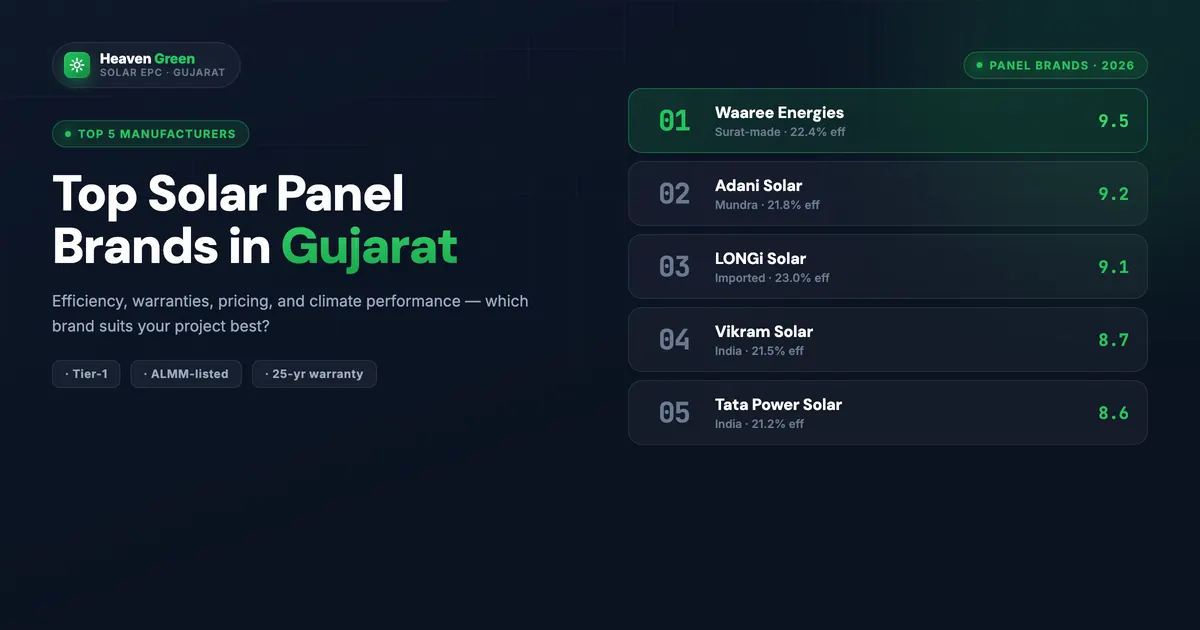
Adani Solar and Waaree Energies are India’s two largest solar panel manufacturers, and for good reason, both produce high-quality, BIS-certified, ALMM-listed panels at competitive prices. If you are buying a rooftop solar system in 2026, you will almost certainly receive a quote featuring one or both of these brands. The question is not whether either is a bad choice, both are solid. The question is which one is the better fit for your specific project, budget, and long-term needs.
Direct answer. Both are ALMM-listed, BIS-certified makers with closely matched Mono PERC and TOPCon panels, and Waaree has the wider dealer network. For most homes our recommendation is Adani, the brand Heaven Green Energy installs and warranty-handles as an authorised Channel Partner of Adani Green Energy. Use the use-case table below to see when each brand fits.
This comparison is based on publicly available specification data, MNRE ALMM listings, and Heaven Green Energy’s installation experience across 10,000+ residential and commercial projects.
Company Backgrounds: Adani Solar vs Waaree Energies
Understanding where each company sits in India’s solar manufacturing ecosystem helps you evaluate their long-term reliability as a panel supplier.
Adani Solar is the Adani Group’s solar manufacturing business (Mundra Solar PV Limited), separate from Adani Green Energy, which develops and operates power plants. Its Mundra, Gujarat complex has 10 GW of module, 4 GW of cell, and 2 GW of ingot and wafer capacity, per Adani Solar. That integration from ingot and wafer through cell to finished module gives it tight quality control and cost advantages. The Mundra facility produces panels for both domestic rooftop installations and large utility-scale projects, Adani Green operates one of India’s largest solar portfolios, which means internal quality standards are high.
Waaree Energies is India’s largest solar module manufacturer by installed capacity (20.17 GW of ALMM-listed module capacity in India as of December 2025, per Waaree). Waaree operates multiple facilities in Gujarat, led by its Chikhli plant (listed at 16.444 GW). Unlike Adani, Waaree has historically focused primarily on module manufacturing rather than owning power plants, this means its distribution and channel network for the installer market is exceptionally broad, with strong dealer presence across all Indian states.
Specification Comparison: Adani vs Waaree Panels
The table below compares the most popular product lines from each manufacturer in the Indian residential and commercial market as of mid-2026, including the Adani TOPCon module line. For detailed panel technology background, see our Mono PERC vs TOPCon vs HJT comparison.
| Specification | Adani Mono PERC | Waaree Mono PERC | Adani TOPCon | Waaree TOPCon |
|---|---|---|---|---|
| Maximum efficiency | Up to 21.22% (Shine) | Up to 21.29% | Up to 22.3% (Shine TOPCon) | Up to 23.02% |
| Temperature coefficient | See current datasheet | See current datasheet | See current datasheet | See current datasheet |
| Power tolerance | See current datasheet | See current datasheet | See current datasheet | See current datasheet |
| Product warranty | See warranty certificate | 12 years | See warranty certificate | 12 years |
| Linear performance warranty | 30 yr on power | 27 or 30 yr (by model) | 30 yr on power, 0.40%/yr degradation | 30 yr |
| ALMM listed? | ✓ | ✓ | ✓ | ✓ |
| BIS certified (IS 14286)? | ✓ | ✓ | ✓ | ✓ |
| India price per Wp (2026) | ₹23.35 to 23.86/Wp DCR; ₹12.70 to 13.20/Wp non-DCR (Adani list, excl. GST) | Dealer quote | ₹23.25 to 24.76/Wp DCR; ₹13.70 to 14.20/Wp non-DCR (Adani list, excl. GST) | Dealer quote |
The specifications are closely matched, as expected, both companies target the same Indian market with similar manufacturing equipment. The meaningful differences show up in distribution, service, and specific use-case suitability. For per-model price per Wp, warranty tables and the 7-factor scorecard, see our Adani vs Waaree 2026: specs, price and warranty compared.
💡 Fast tip
Both Adani and Waaree publish their ALMM model numbers on their websites. Before confirming any order, cross-check the specific model number your installer is quoting against the current MNRE ALMM list, ALMM status is model-specific, and not all models from a brand are always listed simultaneously. See our guide on how to [verify genuine Adani panels](/blog/verify-genuine-adani-panels) before you sign off on an order. For a deeper look at how ALMM listings feed into the wider procurement bill of quantities, Heaven Designs' [ALMM list explainer](https://heavendesigns.in/blog/almm-list-explained-solar-boq-impact/) is a useful reference for EPC teams.
The Brand Selection Triangle
We use a structured evaluation tool at Heaven Green Energy called The Brand Selection Triangle. It maps three factors, manufacturing reliability, channel serviceability, and product range fit, to identify the right brand for a given project.
Corner 1: Manufacturing Reliability This covers production consistency, quality control, and the manufacturer’s financial stability (their ability to honour 25-year warranties). Both Adani and Waaree are established Tier-1 panel manufacturers and score high here. Adani’s vertical integration, from wafer to module, gives it a slight edge in production quality control. Waaree’s larger volume and longer market history provides more field performance data.
Corner 2: Channel Serviceability After-sales support, warranty claims, replacement panels, technical guidance, depends on the brand’s distributor network. Waaree has the broader dealer network in India; in many tier-2 and tier-3 cities, getting a replacement Waaree panel is faster than sourcing an Adani replacement. In Gujarat specifically, both brands have strong direct and dealer presence.
Corner 3: Product Range Fit Does the brand’s specific model line-up match your system requirements? Waaree has a broader residential product range (more Wp options, more module sizes). Adani’s range is more focused, built around large-format 144- and 132-half-cell modules (its Shine Mono PERC is listed at 540 to 560 Wp and Shine TOPCon at 610 to 640 Wp). For large commercial or industrial systems, Adani’s utility-grade large-format panels can offer economies of scale.
Decision: Score each corner 1 to 5 for your specific project. Choose the brand that scores highest on your priority corners.
Performance in Indian Field Conditions
Raw specifications matter, but real-world performance in Indian conditions, particularly summer heat, dust loading, and monsoon humidity, tells a fuller story.
Heaven Green Energy’s monitoring data across its Adani Solar installations shows:
- Performance Ratio (actual vs rated generation): Adani panels hold 78 to 82% PR in Gujarat conditions, the same band comparable tier-1 Mono PERC and TOPCon modules deliver. The difference is negligible.
- Soiling losses: Dust and soiling behaviour is driven by panel glass texture and coating, and anti-reflective coated glass, which Adani uses, behaves alike across the tier-1 cohort.
- Degradation after 2 to 3 years: Early Adani installations show Year 2 to 3 degradation within warranty spec (under 0.55%/year for Mono PERC).
No meaningful real-world performance gap exists between Adani and Waaree panels of comparable specifications. The choice should not rest on performance grounds alone.
Get a free site assessment. Our engineers recommend the right Adani model and configuration for your specific roof and budget: as an authorised Channel Partner of Adani Green Energy, we size the system, not the badge. Get your free quote →
Warranty Claims: Which Brand Is Easier to Deal With?
Our experience handling panel warranty claims over 10,000+ installations is relevant here. For the full mechanics of how solar warranty terms actually play out over 25 years, see our solar panel degradation and warranty truth guide.
Adani Solar warranty process: Claims are routed through the dealer network. Response times for module replacement are typically 15 to 30 days once validated. For residential warranty claims, expect 3 to 6 weeks for physical panel replacement. Our Adani Solar panel warranty explainer breaks down the terms and claims process in detail.
Waaree warranty process: Waaree has a dedicated customer support portal and a broader dealer network, which often means faster physical access to replacement stock, with 10 to 20 day turnaround for residential claims and clearer documentation requirements.
Both brands run robust, well-documented warranty claim processes, backed by strong corporate balance sheets and dedicated customer support teams. Adani Solar’s vertically integrated Mundra operations give Gujarat customers a logistics edge for in-state replacements, while Waaree’s wider pan-India network supports faster turnaround for customers in other states. For Adani systems, Heaven Green Energy files and tracks the claim end to end on behalf of every customer through our channel-partner desk.
⚠️ Watch out
A panel warranty is only useful if the manufacturer is still in business and honouring claims 15 to 20 years from now. Both Adani and Waaree have strong balance sheets in 2026, but ensure your installation includes generation monitoring so you can document any underperformance early and build a strong warranty claim case.
Which Brand for Which Use Case?
| Use case | Better choice | Reason |
|---|---|---|
| Residential 1 to 5 kWp, PM Suryaghar | Either, focus on installer quality | Specs equivalent; both ALMM-listed |
| Small commercial 10 to 50 kWp | Waaree | Broader product range, faster replacement logistics |
| Large commercial 50 to 200 kWp | Adani | Better volume pricing, utility-grade modules |
| Industrial 200 kWp+ | Adani | Larger format modules, direct manufacturer relationship |
| Constrained rooftop | Waaree TOPCon | Marginally higher efficiency range |
| Rural / tier-3 location | Waaree | Broader distributor reach outside metros |
Pros and Cons Summary
- Vertically integrated manufacturing, tighter quality control
- Strong pricing for large commercial and industrial volumes
- Both Mono PERC and TOPCon ALMM-listed
- Part of a financially strong conglomerate
- India's largest panel manufacturer, maximum supply reliability
- Broadest product range for all system sizes
- Nationwide dealer network, fastest replacement logistics
- Strong residential channel presence across all states
Verdict. On paper, Waaree’s wider dealer network and faster replacement logistics outside Gujarat are a genuine edge, and Adani’s manufacturing scale and utility-grade quality carry the large commercial and industrial case. The honest answer: your installer’s expertise matters far more than the brand of panel on your roof. As an authorised Channel Partner of Adani Green Energy, Heaven Green Energy installs Adani Solar panels, so our recommendation for most homes is the brand we install, stand behind, and warranty-handle locally: Adani. Inside Gujarat, Mundra logistics keep replacement stock close, and single-brand spares with channel-partner claim handling close the service gap the dealer-count tables show.
How Heaven Green Energy Helps You Choose
Heaven Green Energy installs Adani Solar panels as an authorised Channel Partner of Adani Green Energy. With 10,000+ installations across 25+ cities, we select the model and configuration that is right for your project.
- Solar modules and panels: ALMM-listed Adani Solar panels for all project sizes.
- Residential solar systems: 1 to 10 kWp rooftop with PM Suryaghar subsidy.
- Commercial solar systems: 10 to 100 kWp with custom energy modelling.
- Solar calculator: estimate system size, subsidy, and savings in 60 seconds.
For a broader brand comparison including Tata Solar, see our Tata vs Waaree vs Adani vs Heaven Green 2026 guide. For the Waaree-Tata head-to-head, read our Waaree vs Tata solar panel comparison.
Frequently Asked Questions
Which is better, Adani Solar or Waaree, for a home in India?
For most homes, both brands deliver equivalent real-world performance. Waaree’s broader dealer network offers faster warranty support outside Gujarat. As an authorised Channel Partner of Adani Green Energy, our recommendation for most homes is Adani, the brand we install, stand behind, and warranty-handle locally.
Are Adani Solar and Waaree panels eligible for PM Suryaghar subsidy?
Yes, both Adani Solar and Waaree have multiple models on the MNRE ALMM list and sell DCR variants. PM Suryaghar subsidy requires an ALMM-listed module made with domestically manufactured cells (DCR). Always verify that the specific model number your installer is quoting appears on the current ALMM list at mnre.gov.in.
What is the price difference between Adani Solar and Waaree panels in 2026?
Adani publishes indicative prices on its product pages (excluding GST): DCR modules at about ₹23 to ₹25 per Wp and non-DCR modules at about ₹13 to ₹14 per Wp. DCR status moves the price far more than the brand does, so compare Waaree and Adani quotes on the same DCR status and technology. For large commercial projects, Adani Solar may offer marginally better volume pricing. Always get project-specific quotes rather than relying on published indicative prices.
Do both brands offer TOPCon solar panels in India?
Yes, both Adani Solar and Waaree Energies have expanded their TOPCon product lines. Adani lists its Shine TOPCon at 610 to 640 Wp and up to 22.3% efficiency; Waaree’s n-type range spans roughly 435 to 715 Wp with efficiency up to 23.02%. ALMM-listed DCR variants are eligible for PM Suryaghar.
How do I claim a warranty on an Adani or Waaree solar panel?
Warranty claims for both brands are processed through the installer or authorised dealer network. You will need to document the defect through an inspection report and generation data showing underperformance. For Heaven Green Energy installations, we manage the entire warranty claim process on your behalf.
Is Adani Solar a reliable brand for a 25-year investment?
Yes. Adani Solar is backed by the Adani Group, one of India’s largest corporate conglomerates. The manufacturing facility at Mundra operates at utility scale and supplies panels for major national solar projects. The financial backing and operational scale make Adani Solar a credible 25-year warranty provider.