A typical solar quote in India runs 1 to 3 pages and lists 15 to 25 line items that most buyers cannot decode. You are expected to sign a ₹1 to 5 lakh contract based on a document you do not fully understand. This guide changes that. We will go through every standard line in an Indian solar quote, explain what it means, what the right numbers look like in 2026, and which lines are commonly used to overcharge or hide substitutions.
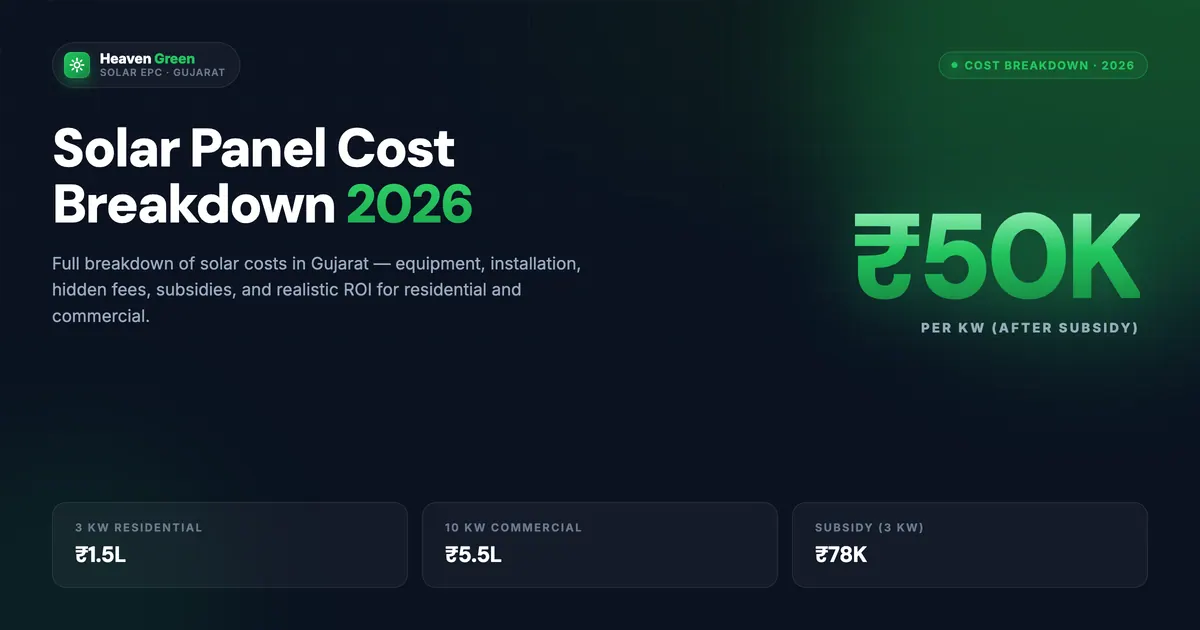
Key takeaway. A fair solar quote for a residential 3 kWp system in India in 2026 should total ₹1.4 to 1.8 lakh before PM Suryaghar subsidy, or ₹65,000 to 1 lakh after the ₹78,000 central subsidy. The most common misrepresentations are inflated panel Wp ratings, incorrect inverter sizing, and missing line items (like DC cables or net metering charges) that surface later as “extra” costs.
Before diving in: always get at least three quotes and compare them line-by-line, not just on total price. The cheapest quote is rarely the best quote, and the most expensive is not always the best either.
What a Standard Solar Quote Should Contain
A complete solar installation quote should have these sections. If any of these sections are missing, ask for them before signing.
Section 1: System summary
- System capacity (kWp)
- Panel brand, model, and Wp rating
- Inverter brand, model, and kVA rating
- Battery (if off-grid or hybrid), brand, model, capacity in Ah or kWh
- Mounting structure type (GI, aluminium)
- Estimated annual generation (kWh/year)
Section 2: Component-level line items
- Panels: quantity × Wp × brand/model × price per Wp
- Inverter: brand, model, rated kVA, and price
- Mounting structure: type, weight (or m² coverage), and price
- DC cables: mm² cross-section, length, and price
- AC cables: mm² cross-section, length, and price
- ACDB/DCDB (AC/DC Distribution Box): brand and price
- Net meter and metering equipment: price
- Earthing kit: price
Section 3: Services
- Site survey fee (usually zero for residential)
- Installation labour
- Net metering application and DISCOM coordination
- PM Suryaghar application handling (for residential)
- Commissioning and testing
- System monitoring setup
Section 4: Warranty and support
- Panel warranty (product + performance)
- Inverter warranty
- Workmanship warranty
- AMC options and pricing
Section 5: Financial summary
- Total before subsidy
- PM Suryaghar subsidy (if applicable)
- Net cost to buyer
- Payment schedule
The Quote Decoder: Every Line Explained
Line: Solar Panels (e.g., “8 × Waaree 400 Wp Mono PERC, ₹2,400/panel”)
What to check:
- Does the Wp rating match the brand’s published datasheet? An installer claiming 400 Wp panels from a brand that sells 380 Wp maximum in that model is inflating the spec. See our solar panel wattage guide for how 400W, 540W, and 600W panels actually differ.
- Is the panel model ALMM-listed? Verify on the MNRE ALMM portal.
- Is the per-panel price consistent with the per-Wp price? (₹2,400 ÷ 400 Wp = ₹6/Wp, far too low; should be ₹22 to 28/Wp for retail Mono PERC)
- Are the panels the same brand throughout (no brand mixing)?
Red flag: “400 Wp panels, BIS-certified” without naming the specific brand and model.
Line: Solar Inverter (e.g., “3 kVA Luminous NXG MPPT, ₹12,500”)
What to check:
- Is the inverter a dedicated solar MPPT model, not a modified UPS with solar input?
- Does the kVA rating match or slightly exceed your total panel Wp? (3 kW panels → 3 kVA inverter is correct; 3 kW panels → 1.5 kVA inverter is an undersized, incorrect configuration)
- Is the efficiency rating stated? Should be ≥94% for MPPT.
- Is the inverter pure sine wave? (Necessary for modern appliances)
Red flag: Inverter price that seems very low (under ₹6,000 for a 1.5 kVA solar inverter) often means a non-branded or PWM model.
For a line-by-line breakdown of what every number on an inverter spec sheet actually means, see QBits Energy’s guide to decoding solar inverter specifications.
Line: Mounting Structure (e.g., “GI hot-dip galvanised, 60 m² coverage, ₹18,000”)
What to check:
- Material: Galvanised Iron (GI) or aluminium. GI is standard for most Indian rooftops; aluminium is preferred for coastal areas due to corrosion resistance.
- Does the description specify the gauge (thickness)? Sub-grade thin-gauge GI structures rust and fail within 5 years.
- Does the quantity match the number of panels and their arrangement?
Red flag: “MS (mild steel) mounting structure”, mild steel without galvanising rusts in 2 to 3 years.
For help matching the structure type to your roof, see our guide to choosing solar mounting structures.
Line: DC Cables (e.g., “Solar DC cable 4 mm², 30 m, ₹4,500”)
What to check:
- Cable cross-section: 4 mm² is standard for strings up to 10 A; 6 mm² for higher currents. Undersized cables create resistive losses.
- Are the cables specifically solar-rated (XLPE insulation, UV resistant)? Standard electrical cables degrade in UV exposure within 3 to 5 years.
- Is the length realistic for your roof layout? A 30 m length for a 3 kWp system is plausible; 10 m would be suspicious.
See our solar cables FAQ guide for more on cross-section, insulation, and safe connections.
Line: Net Metering / DISCOM Application (e.g., “Net metering charges, ₹3,000 to ₹8,000”)
What to check:
- Is net metering coordination included in the quote or listed as an extra?
- Are government fees (DISCOM meter installation fee) separated from installer charges?
- What is the quoted timeline for net meter activation?
This line is frequently “forgotten” in cheap quotes and added later as an extra charge. Always confirm net metering handling is explicit and priced in the quote.
For the full net metering process in India, see our net metering in India guide.
Get a free site assessment. A solar advisor responds within 2 hours on business days, then our engineers visit and send a detailed line-item proposal, no hidden charges. Get your free quote →
The Quote Comparison Framework
We use a structured method at Heaven Green Energy called The Quote Transparency Test to evaluate competing solar quotes. Apply it to every quote you receive:
Step 1: Extract the per-Wp price for panels Take the panel cost line item ÷ total panel Wp. For a 3 kWp system (3,000 Wp):
- ₹70,000 panel cost ÷ 3,000 Wp = ₹23.3/Wp, reasonable for Mono PERC
- ₹50,000 panel cost ÷ 3,000 Wp = ₹16.7/Wp, suspiciously cheap; likely non-ALMM
Step 2: Check inverter sizing ratio Inverter kW ÷ Panel kWp should be 0.9 to 1.1. A ratio below 0.8 indicates an undersized inverter that will clip generation.
Step 3: Add up all line items Sum every line item in the quote. Does it match the quoted total? Discrepancies suggest missing or hidden charges.
Step 4: Check what is absent Does the quote include: DC cables, AC cables, ACDB/DCDB, earthing, net metering, installation labour, and monitoring? If any of these are absent, add them to your comparison.
Step 5: Calculate the all-in cost per kWp Total quote ÷ system kWp. In 2026, a fair all-in installed cost for a residential system is ₹50,000 to 65,000/kWp before subsidy. If a quote is ₹35,000/kWp, something is being omitted.
For a broader list of warning signs beyond price alone, see our red flags in a solar quote guide.
What a Fair 3 kWp Residential Solar Quote Looks Like
Here is a benchmark for a 3 kWp on-grid residential system in Gujarat in 2026 with PM Suryaghar:
| Item | Specification | Indicative cost |
|---|---|---|
| Solar panels | 8 × 375 Wp Adani Mono PERC (ALMM) | ₹67,500 |
| Solar inverter | 3 kVA QBits MPPT, pure sine | ₹22,000 |
| Mounting structure | Hot-dip GI, 2.5° tilt provision | ₹18,000 |
| DC cables | Solar-rated 4 mm² XLPE, 30 m | ₹4,500 |
| AC cables | 6 mm² copper, 15 m | ₹3,000 |
| ACDB/DCDB | MCB-protected distribution box | ₹5,000 |
| Earthing | 2-point copper earthing | ₹3,000 |
| Net metering | DISCOM application + coordination | ₹5,000 |
| Installation labour | 3-day installation team | ₹8,000 |
| PM Suryaghar handling | Portal registration, docs, commissioning | Included |
| Monitoring (optional) | IoT Wi-Fi monitoring device | ₹4,000 |
| Total before subsidy | ₹1,40,000 to 1,60,000 | |
| PM Suryaghar subsidy | 3 kW central subsidy | –₹78,000 |
| Net cost to buyer | ₹62,000 to 82,000 |
Any total significantly below ₹1.2 lakh for a 3 kWp system before subsidy should be examined carefully for missing components or non-ALMM panels. See our solar panel cost breakdown guide for state-wise pricing details.
Pros and Cons: Evaluating a Solar Quote
- Exact brand and model number for every component
- ALMM panel status confirmed in writing
- Net metering and PM Suryaghar handling explicitly included
- Workmanship warranty and AMC options specified
- Estimated annual generation stated (kWh/year)
- "Quality panels" or "BIS certified" without naming the brand
- All-in price under ₹40,000/kWp before subsidy
- No line item for DC cables, earthing, or net metering
- Payment 100% upfront before any installation
How Heaven Green Energy Helps
Heaven Green Energy provides fully transparent, line-item solar quotes with exact brand and model specifications for every component. Our quotes include PM Suryaghar subsidy processing, DISCOM net metering coordination, IoT monitoring setup, and a 1-year workmanship warranty, with no hidden extras added after signing.
- Residential solar systems: transparent pricing for 1 to 10 kWp with PM Suryaghar subsidy.
- Commercial solar systems: detailed ROI analysis with component-level pricing.
- Solar calculator: get an indicative system cost and savings estimate in 60 seconds.
- Contact Heaven Green Energy: call +91 63904 05060 for a same-day quote.
For a guide on negotiating after you understand a quote, see our solar quote negotiation tactics guide. For understanding solar ROI, read our solar ROI calculation guide.
Frequently Asked Questions
What is a fair price for a 3 kWp solar system in India in 2026?
A fair all-in installed cost for a 3 kWp residential solar system in India is ₹1.4 to 1.8 lakh before PM Suryaghar subsidy. After the ₹78,000 central subsidy, net buyer cost is ₹62,000 to 1 lakh depending on state. All-in cost per kWp should be ₹50,000 to 60,000 before subsidy. Quotes below ₹40,000/kWp typically involve non-ALMM panels, undersized inverter, or missing components.
Why are solar quotes in India missing line items like cables and earthing?
Some installers omit standard line items (DC cables, AC cables, earthing, ACDB) from initial quotes to appear cheaper, then charge them as extras during installation. This practice is common among smaller local installers. Always ask “is this an all-inclusive price?” and request an itemised quote covering every component including cables, earthing, net metering, and monitoring.
How do I check if the panels in my quote are ALMM-listed?
Ask the installer for the exact panel manufacturer name and model number. Then visit the MNRE website (mnre.gov.in) and search the ALMM list for that specific model. ALMM status is model-specific, the brand being on the list does not mean every model from that brand is listed. Always verify the exact model.
Should the PM Suryaghar subsidy be deducted from the quote or paid to me later?
The PM Suryaghar subsidy is paid directly by the central government to you via DBT (Direct Benefit Transfer) to the bank account in your name submitted on the portal after commissioning, it is not deducted by the installer from the installation cost. You pay the full cost upfront; the subsidy is processed within 15 days of DISCOM approval and released when you redeem the e-token on the portal (to the loan account first if the system is financed). Some installers offer to manage the subsidy application but you still pay full cost and get subsidy separately.
Is GST included in solar quotes?
Solar panels attract 5% GST; inverters attract 5% GST; mounting structures and cables attract 18% GST; installation services attract 18% GST. A transparent quote should show whether prices are inclusive or exclusive of GST. For residential PM Suryaghar installations, the MNRE benchmark cost is GST-inclusive. Always clarify whether the quoted price is GST-inclusive or exclusive before comparing. See our complete guide to GST on solar for a full component-wise rate breakdown.