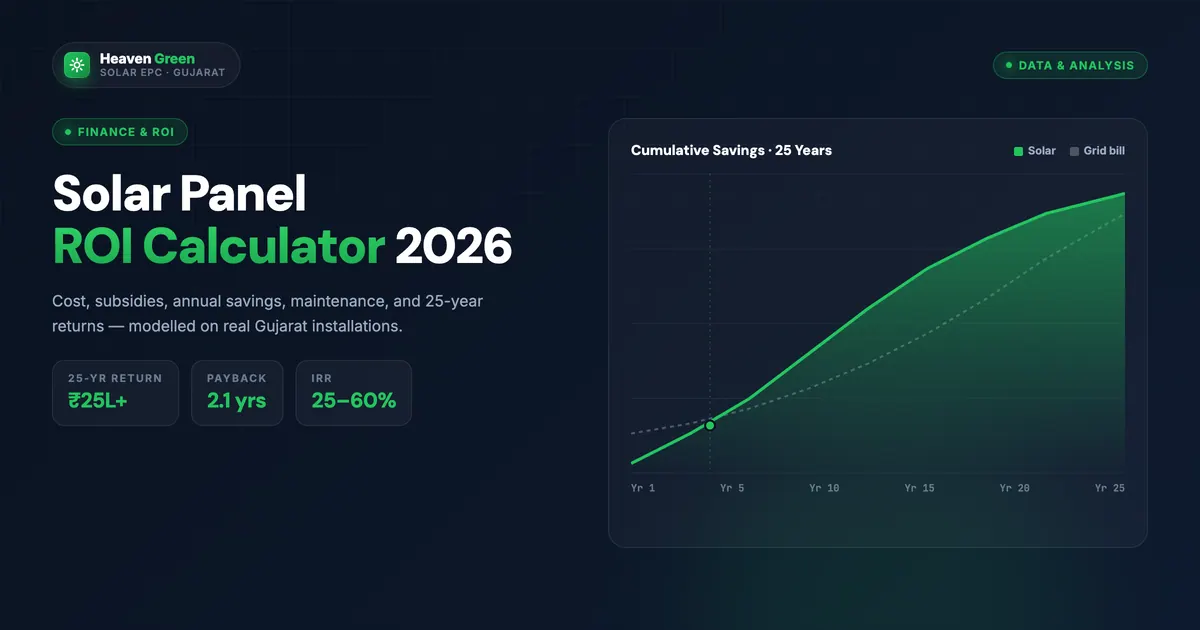
Solar is one of the highest-returning investments available to Indian households and businesses in 2026. A 5 kWp residential rooftop system in Gujarat delivers a pre-subsidy return on investment (ROI) of 18 to 22% per year over 25 years, better than most fixed deposits, mutual fund averages, and certainly better than leaving the electricity bill unchecked. But calculating solar ROI correctly requires accounting for subsidy, tariff escalation, net metering income, maintenance costs, and degradation. Most online calculators skip half of these variables.
Key takeaway. A 3 kWp residential solar system in Gujarat costs about ₹1.55 lakh installed, receives ₹78,000 PM Suryaghar subsidy, and nets about ₹77,000 effective cost to the buyer. It saves about ₹30,000 in the first year at ₹8/unit, less at lower tariffs. Simple payback: 2.5 to 4 years. Over 25 years at 5% annual tariff escalation, the system delivers about ₹13 lakh in gross savings, roughly ₹12 lakh after maintenance. Heaven Green Energy’s 10,000+ installed systems confirm these figures from real monitoring data.
This guide teaches you to calculate solar ROI yourself using a step-by-step method, and to verify any claim an installer or salesperson makes.
Why Solar ROI Calculations Often Go Wrong
Three variables consistently produce inflated ROI claims in India:
Incorrect baseline consumption assumption. If you currently pay ₹4,000/month for electricity and someone calculates savings against a flat ₹4,000, they are ignoring the 5 to 8% annual tariff increase that makes that same consumption cost ₹6,500/month in year 10. Ignoring tariff escalation understates total savings by 40 to 60% over 25 years.
Ignoring system degradation. Solar panels lose approximately 0.5% of their rated output per year after year 1. Over 25 years, a system produces roughly 88 to 91% of what it did in year 1. Ignoring degradation overstates total generation by 5 to 8%.
Double-counting net metering income. Some calculators credit you for 100% of solar generation as bill savings, even when you export 30 to 40% of it to the grid at a net metering rate that may be lower than your purchase tariff. For accurate ROI, account for self-consumption vs export separately. QBits Energy’s net metering guide for India walks through how DISCOMs typically set export rates relative to retail tariffs.
For a deeper dive into the payback mechanics, see our solar payback period guide and the solar panel cost breakdown.
The 6-Step Solar ROI Formula
We use a structured calculation approach at Heaven Green Energy called The 6-Step Solar ROI Formula. It takes 20 to 30 minutes with a spreadsheet and gives you a defensible, accurate ROI figure.
Step 1: Calculate Your Effective Net Investment
Start with the installed system cost, the total amount you pay for the complete system including panels, inverter, mounting, cables, and installation.
Then deduct the PM Suryaghar subsidy:
- Central subsidy: ₹30,000 (1 kW), ₹60,000 (2 kW), ₹78,000 (3 kW+)
- State subsidy: varies by state; Gujarat adds no state top-up for residential rooftop solar (see our guide on stacking central and state solar subsidies)
Effective net investment = Installed cost − PM Suryaghar subsidy − State subsidy
Example: 3 kWp system installed at ₹1,55,000 − ₹78,000 = ₹77,000 net cost.
For understanding all financing options to cover this net cost, see our solar financing options guide.
Step 2: Calculate Year 1 Annual Solar Generation
Formula: Annual generation (kWh) = System size (kWp) × Peak sun hours/day × 365 × Performance Ratio
Peak sun hours by city (average daily):
- Ahmedabad, Rajkot, Vadodara: 5.5 to 5.8 hours
- Surat: 5.2 to 5.5 hours
- Mumbai: 4.8 to 5.2 hours
- Bengaluru: 5.0 to 5.3 hours
- Delhi: 4.9 to 5.5 hours (seasonal variation)
Performance Ratio (PR): 0.75 to 0.82 for a well-installed residential system. Accounts for inverter losses, cable losses, temperature, soiling, and mismatch. Use 0.78 as a conservative default.
Example: 3 kWp × 5.5 hr/day × 365 days × 0.78 PR = 4,698 kWh/year (call it 4,700)
Step 3: Separate Self-Consumption from Export
In a typical Indian home with net metering, solar generation is used in real-time first (self-consumption) and excess is exported to the grid.
- Self-consumption rate: 60 to 70% for most Indian homes (varies by consumption pattern)
- Export rate: 30 to 40% of generation
Self-consumed energy saved at retail tariff: 4,700 × 65% = 3,055 kWh × ₹8/kWh = ₹24,440 Exported energy: 4,700 × 35% = 1,645 kWh × ₹3.5/kWh = ₹5,758 (a conservative blended value: in Gujarat, exported units are set off against your consumption within the billing cycle, and only surplus left at the end of the cycle is bought at ₹2.25/unit)
Year 1 total benefit: ₹30,200
For net metering rates by state and DISCOM, see our net metering in India guide.
Step 4: Build the 25-Year Projection with Tariff Escalation
The most important variable for long-term ROI is the annual tariff escalation rate. India’s residential electricity tariffs rise in most years, and this guide assumes 5% a year, a trend we break down in how solar insulates you from tariff hikes.
Use a spreadsheet with these annual adjustments:
- Annual electricity tariff increase: 5% (conservative)
- Annual panel degradation: –0.5% (reduces generation by 0.5% each year)
- Annual maintenance cost: ₹5,000 to 8,000 (AMC for monitoring + cleaning)
Year-by-year annual savings calculation:
- Year 1: ₹30,200
- Year 2: ₹30,200 × (1 + 0.05) × (1 − 0.005) = ₹31,550
- Year 5: ~₹36,000
- Year 10: ~₹44,800
- Year 25: ~₹86,400
25-year cumulative gross savings: ~₹13.4 lakh (nominal) 25-year cumulative maintenance cost: ~₹1.5 lakh (at ₹6,000 a year) Net 25-year savings: ~₹11.9 lakh
Step 5: Calculate Simple Payback Period
Simple payback = Net investment ÷ Year 1 annual savings
Example: ₹77,000 ÷ ₹30,200 = 2.5 years
This is a conservative payback figure at current Gujarat tariffs with PM Suryaghar subsidy. Without subsidy (₹1,55,000 net cost), payback extends to 5.1 years, still excellent by any investment standard.
Step 6: Calculate ROI and IRR
Simple ROI: (Net 25-year savings − Net investment) ÷ Net investment × 100 = (₹11,90,000 − ₹77,000) ÷ ₹77,000 × 100 = about 1,450% over 25 years
IRR (Internal Rate of Return): Use Excel’s =IRR() function on the annual cash flows (Year 0: −₹77,000; Years 1 to 25: annual savings minus ₹6,000 maintenance). The IRR for the above example is approximately 37% per year: reflecting the fact that payback is achieved in year 2.5 and the remaining 22.5 years are pure return.
💰 Real numbers
At ₹77,000 net investment (after PM Suryaghar subsidy) and ₹30,000 annual savings, a 3 kWp Gujarat residential system has an IRR of approximately 37%/year, higher than any bank FD, PPF, or typical equity mutual fund SIP over equivalent periods. The comparison is imperfect (solar savings are in-kind, not liquid cash) but the economic case is strong.
ROI Comparison by System Size (Gujarat, 2026)
| System | Installed cost | After subsidy | Year 1 savings | Payback | 25-yr gross savings |
|---|---|---|---|---|---|
| 1 kWp | ₹58,000 | ₹28,000 | ₹10,000 | 2.8 yr | ₹4.4L |
| 2 kWp | ₹1,08,000 | ₹48,000 | ₹20,000 | 2.4 yr | ₹8.9L |
| 3 kWp | ₹1,55,000 | ₹77,000 | ₹30,000 | 2.5 yr | ₹13.3L |
| 5 kWp | ₹2,55,000 | ₹1,77,000 | ₹50,000 | 3.5 yr | ₹22.2L |
| 10 kWp | ₹5,00,000 | ₹4,22,000 | ₹1,00,000 | 4.2 yr | ₹44.4L |
Assumptions: Gujarat 5.5 peak sun hours/day, ₹8/kWh average tariff, 65% self-consumption, 5% annual tariff escalation, 0.5% panel degradation, ₹78,000 max central subsidy; 25-year savings are before maintenance.
The larger the system, the higher the absolute 25-year savings, but payback is slightly longer for systems above 3 kWp because the subsidy cap (₹78,000) does not scale with system size. This makes 3 kWp the sweet spot for subsidy-optimised ROI.
ROI for Commercial Solar (No Subsidy)
Commercial and industrial solar systems do not receive PM Suryaghar subsidy, which covers only homes and housing societies, but benefit from:
- Accelerated Depreciation (AD): 40% on the solar asset value in Year 1 under Income Tax Act, providing significant tax savings.
- Higher tariff displacement: Commercial tariffs in India are typically ₹9 to 14/kWh vs ₹6 to 8/kWh for residential.
- Larger systems: Economies of scale reduce installed cost per Wp.
For a 100 kWp commercial system:
- Installed cost: ~₹45 lakh
- Year 1 tax savings (40% AD at 30% tax rate): ₹5.4 lakh
- Year 1 electricity savings: ~₹9 lakh (at ₹10/kWh, 75% self-consumption)
- Effective payback including AD: 4.5 years
- 25-year savings: ₹2.5 to 3 crore
For detailed commercial solar ROI modelling, see our commercial solar page.
Pros and Cons of Solar as an Investment
- IRR of 25 to 40% for residential (post-subsidy)
- Inflation-protected, savings grow as tariffs rise
- ₹78,000 central subsidy reduces effective investment
- No market risk, generation is deterministic
- Can add resale appeal to the property
- Savings are in-kind (reduced bill) not liquid cash
- Returns depend on your electricity consumption staying high
- Net metering terms may be revised by the state regulator
- Tied to property, cannot be moved easily
How Heaven Green Energy Helps
Heaven Green Energy provides transparent ROI analysis for every installation proposal. Our engineers model your exact consumption profile, local tariff, peak sun hours, and PM Suryaghar subsidy to deliver a site-specific financial case, not a generic brochure calculation.
- Solar calculator: enter your monthly bill and get an instant ROI estimate.
- Residential solar systems: complete 1 to 10 kWp installations with subsidy handling.
- Commercial solar systems: detailed ROI modelling with Accelerated Depreciation analysis.
- Solar financing options: loans, PPAs, and subsidy financing explained.
Ready to see your exact solar ROI? Use our free solar calculator or call +91 63904 05060 for a personalised analysis.
Frequently Asked Questions
What is the typical solar ROI in India in 2026?
For a residential 3 kWp system in Gujarat after PM Suryaghar subsidy, the Internal Rate of Return (IRR) is approximately 35 to 40% per year, with a simple payback period of 2.5 to 4 years. Over 25 years, cumulative savings (net of maintenance and adjusted for degradation) come to about ₹12 lakh on a ₹77,000 net investment at ₹8/unit and 5% tariff escalation. Commercial systems without subsidy deliver 18 to 22% IRR after Accelerated Depreciation.
How do I calculate my solar payback period?
Simple payback = Net investment after subsidy ÷ Annual electricity savings. For a 3 kWp Gujarat home at ₹8/kWh tariff: Net investment ₹77,000 ÷ Annual savings ₹30,000 = 2.5 years. Use our solar calculator at heavengreenenergy.com for a location-specific calculation based on your actual electricity bill.
Does the PM Suryaghar subsidy improve solar ROI significantly?
Yes, the ₹78,000 central subsidy for a 3 kWp system reduces the buyer’s net investment by approximately 50% (from ₹1.55 lakh to ₹77,000). This halves the payback period and approximately doubles the IRR. For a 1 kWp system, the ₹30,000 subsidy reduces net investment by 52%. The subsidy is the single biggest ROI driver for residential solar buyers.
How does net metering affect solar ROI in India?
Net metering allows you to export surplus solar power to the DISCOM grid and receive a credit on your electricity bill. Surplus export rates are well below the retail purchase tariff of ₹6 to 10/kWh: in Gujarat, exports are set off within the billing cycle and any surplus left over is bought at ₹2.25/unit. To maximise ROI, size your system to maximise self-consumption and minimise export, a 3 kWp system sized for 70% self-consumption delivers better ROI than a 6 kWp system exporting 60% at the lower net metering rate.
How does electricity tariff escalation affect solar ROI?
Every 1% increase in your electricity tariff increases the value of your solar savings by approximately 1% annually. At 5% annual tariff escalation, your Year 10 savings are approximately 50% higher than Year 1 savings in nominal terms. Over 25 years, tariff escalation is responsible for roughly 45 to 50% of the total cumulative savings figure. Ignoring tariff escalation (as many simple payback calculators do) understates total 25-year ROI by 40 to 50%.
Is solar a better investment than a fixed deposit in India?
On a pure return comparison, yes for most buyers. A post-subsidy residential solar investment in Gujarat delivers an IRR of 35 to 40% vs a bank FD at 6 to 7.5%. However, the comparison is not perfect: solar savings are in-kind (reduced electricity bill), not liquid cash; returns are tied to your continued ownership of the property; and net metering policy changes could reduce export credits. Treat solar as a high-yield inflation-protected utility cost reduction, not a liquid financial investment.