PM Surya Ghar 2.0 is the name now attached to a set of proposals the central government is reportedly examining for the next phase of India’s rooftop solar subsidy programme, according to a Times of India report and a follow-up piece in the Financial Express. Neither outlet describes a finalised scheme. Both describe a government “mulling” a shift from paying subsidies on installed capacity to paying them, at least partly, on actual generation, with battery storage and shared rooftop solar for housing societies as add-ons under discussion.
Nothing below should be read as confirmed policy. We are Heaven Green Energy, an MNRE-approved EPC that has completed 10,000+ residential and commercial installations across 25+ Indian cities, and we have applied for and tracked PM Surya Ghar subsidies through UGVCL, DGVCL, MGVCL, PGVCL, MSEDCL, BESCOM and a dozen other DISCOMs since the scheme launched. This article is our read of where the reported direction of Surya Ghar 2.0 would take the industry if it lands close to what’s being reported, written as analysis and opinion, not as a restatement of finalised rules.
Direct answer. PM Surya Ghar 2.0 is a proposal, reportedly under government review, to pair India’s ₹78,000 rooftop solar subsidy with generation-based incentives and battery storage support. If implemented as reported, it would reward systems for the power they actually produce rather than just for being installed, likely raising install quality standards while adding upfront cost and complexity for both installers and homeowners.
The distinction between “mulled” and “notified” matters more than most coverage lets on. India has floated storage-linked and performance-linked solar incentives before without full rollout. Treat this as a live policy conversation worth planning around, not a scheme you can apply to today.
Why Installation-Based Subsidies Have Reached Their Limit
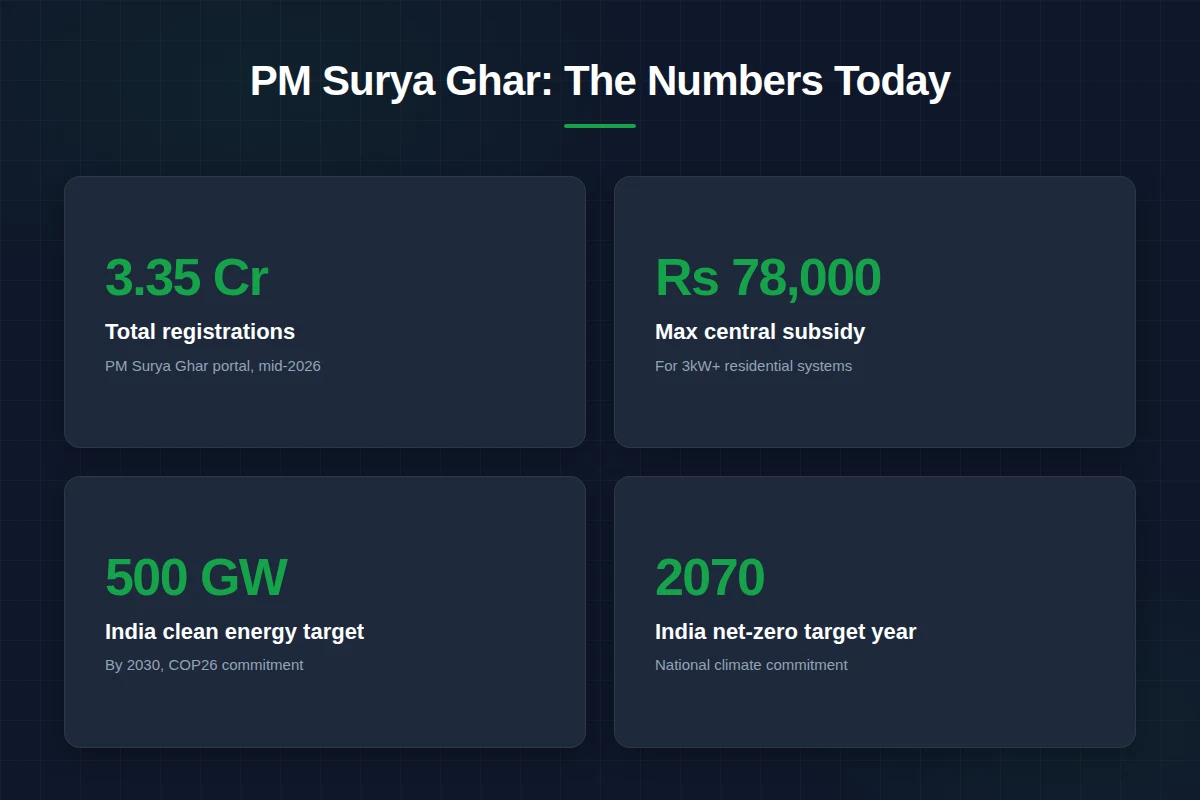
The current PM Surya Ghar structure pays ₹30,000 for the first kW, an additional ₹30,000 for the second kW, and ₹18,000 for the third, capping at ₹78,000 for any system of 3 kW or above. That subsidy is disbursed once the DISCOM verifies commissioning and net metering, according to MNRE’s official scheme guidelines. It does not depend on how much electricity the panels generate in year one, year five, or year fifteen.
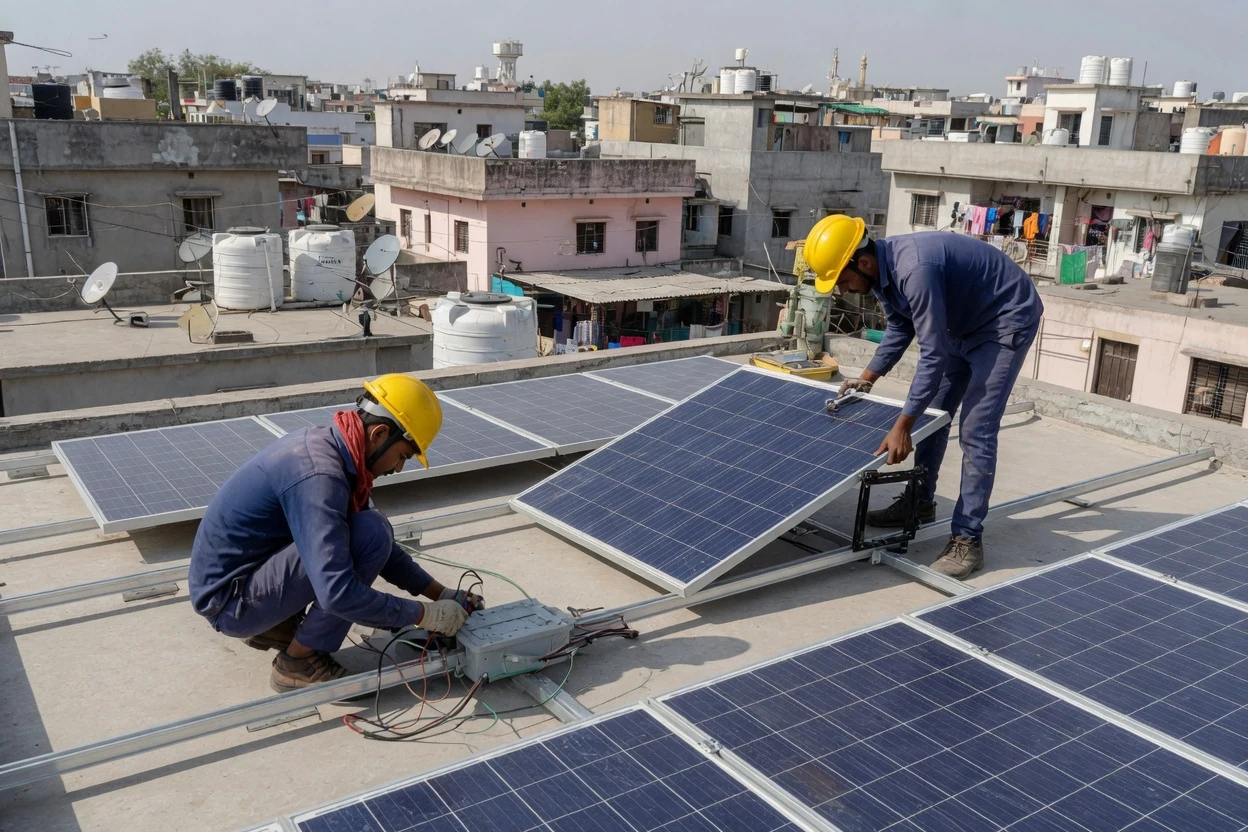
That design choice made sense for a scheme trying to hit 1 crore households fast. It is simple to administer, easy for vendors to quote, and easy for DISCOMs to audit at the point of commissioning. But it has an obvious flaw: a system with a poorly oriented array, undersized cables, or a panel string shaded by a neighbour’s water tank collects the same ₹78,000 as a system generating 20% more energy from the identical footprint.
We see this gap in our own site surveys. A 3 kW system in Ahmedabad should generate roughly 360 to 450 kWh a month under good conditions. In our field data, systems installed by lower-cost vendors chasing subsidy volume routinely underperform that range by 10 to 15%, usually from tilt angle mistakes, thinner cable gauges that lose more to voltage drop, or MC4 connectors that were never properly crimped. The homeowner still received the full subsidy. The DISCOM still counted the connection toward its target. Nobody in that chain was financially accountable for the shortfall.
⚠️ Watch out
An installation-based subsidy pays for capacity, not output. Two 3 kW systems can collect the identical ₹78,000 while producing meaningfully different amounts of power over 25 years.
Our opinion: this is the single biggest structural weakness in Surya Ghar 1.0, and it’s the one problem generation-linked incentives are explicitly designed to fix. If the government moves in that direction, expect resistance from the volume-installer segment of the market, because their entire business model depends on cheap, fast commissioning rather than sustained yield.
How Generation-Based Incentives Could Transform the Market
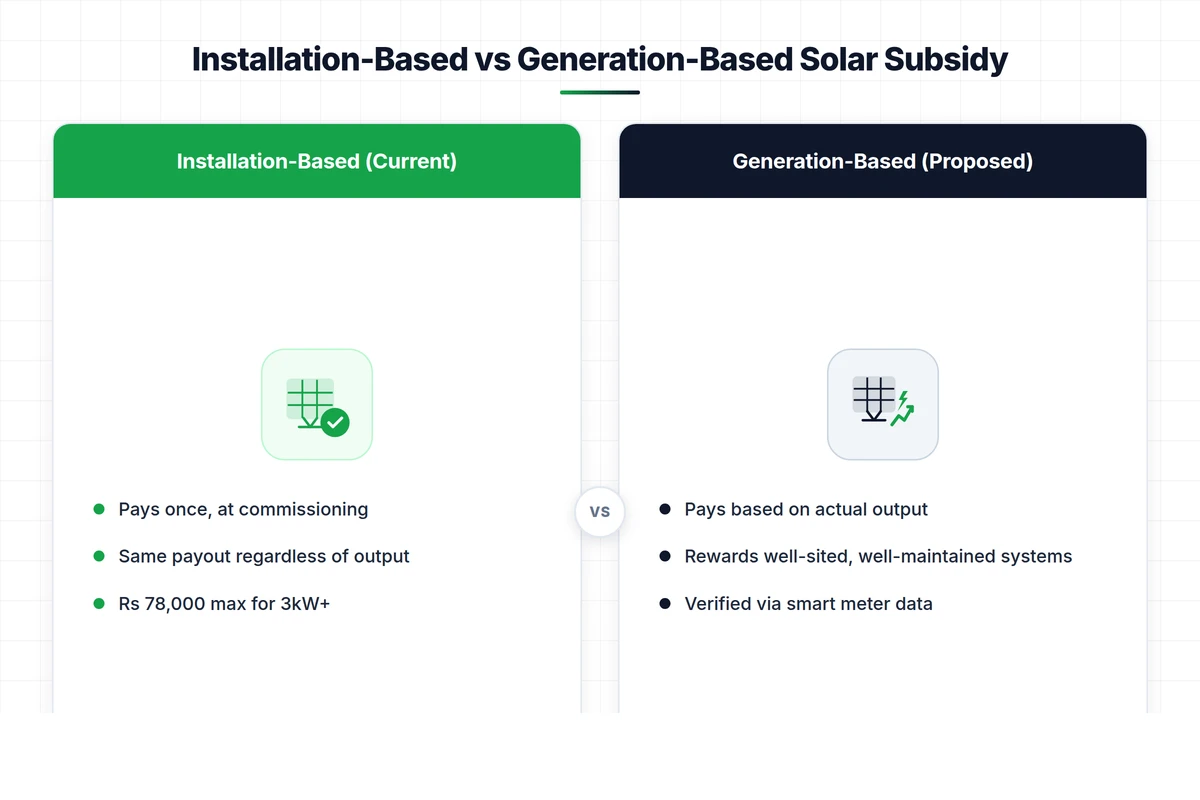
If Surya Ghar 2.0 links even a portion of the subsidy to metered generation, verified through net metering data over the first one to three years, the incentive structure for every installer in the country changes overnight.
Right now, an EPC’s profit is locked in the day the system is commissioned and the subsidy clears. Under a generation-linked model, part of that payout would depend on the system actually producing power months or years later. That single change would push the industry toward decisions installers currently treat as optional:
- Site surveys become non-negotiable. Shading analysis, roof orientation, and structural load checks stop being a courtesy and start being the difference between full and partial payout.
- Component quality gets scrutinised. BIS-certified panels and inverters, correct cable sizing per IS 16221, and proper earthing move from “nice to have” to directly linked to the installer’s own revenue.
- After-sales service becomes a profit centre, not a cost. A system that degrades from neglected cleaning or an undetected fault costs the installer real subsidy money, not just goodwill.
- Undersized or oversized systems lose their appeal. Right-sizing to the household’s actual load, rather than the maximum subsidy-eligible capacity, becomes the economically rational choice.
We’d call this the accountability shift, and it is the most defensible argument in favour of the reported redesign. Our analysis: generation-linked subsidy is a proxy for quality control that MNRE currently has no scalable way to enforce at 1 crore-household volume. Instead of auditing installers, the government would let metered output do the auditing.
Get a free site assessment. Our engineers visit within 24 hours and send a custom savings proposal in 48 hours, no cost, no obligation. Get your free quote
The tradeoff is administrative. Verifying generation data at scale requires either smart meters that report reliably to DISCOMs, or a third-party monitoring layer, or both. India’s smart-metering rollout is uneven across states, and DISCOM billing software varies widely in how cleanly it exposes generation data. A generation-linked subsidy is only as good as the metering infrastructure behind it, and that infrastructure is not uniformly ready today.
Battery Storage: From Nice-to-Have to Grid Asset
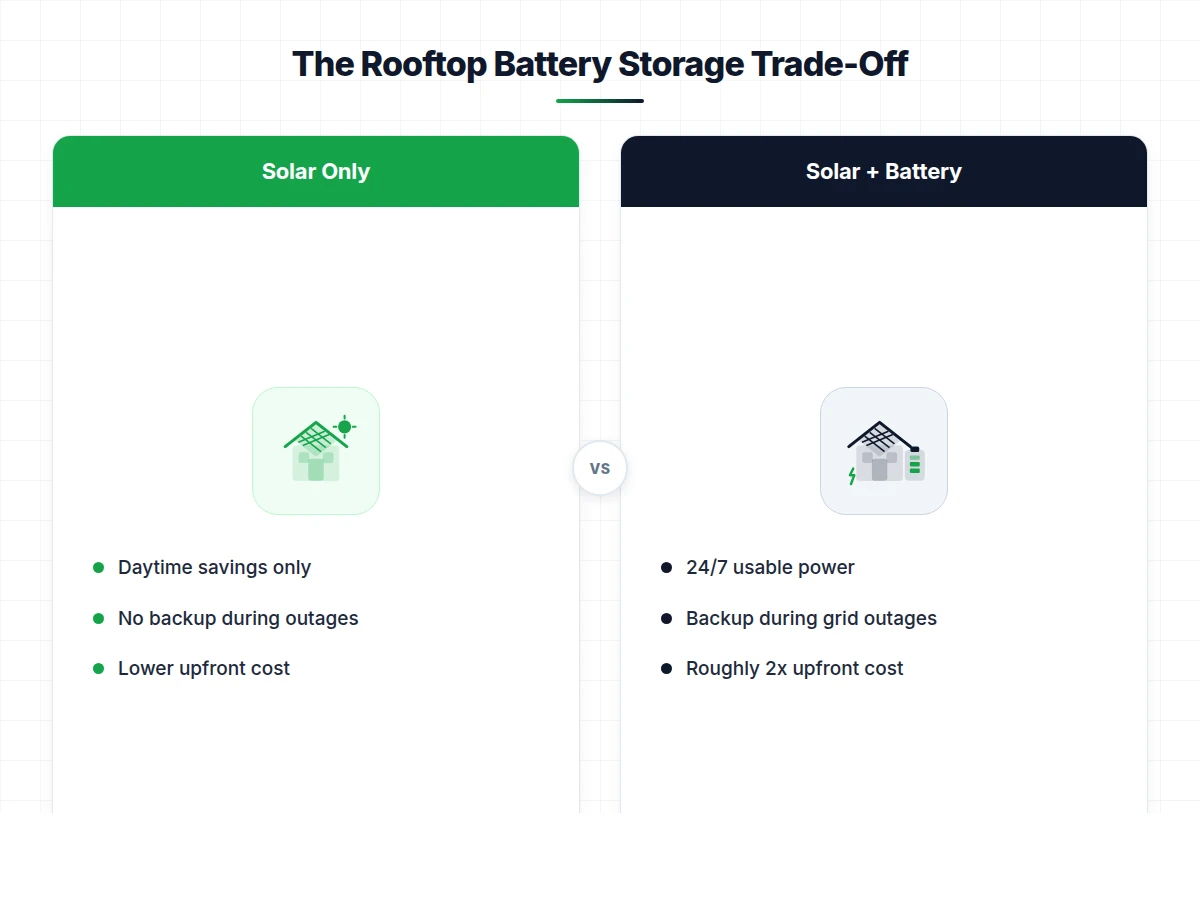
Both source reports flag battery storage as a likely pillar of Surya Ghar 2.0. That’s a bigger shift than it sounds.
Rooftop solar without storage is a daytime offset. It reduces your DISCOM bill when the sun is up and does nothing for you after dark unless you have net metering banking your daytime export against nighttime draw. Add a battery and the same rooftop system becomes something closer to a grid asset: it can shift load, provide backup during outages, and in a shared or virtual net metering configuration, potentially support neighbouring consumers too.
The catch is cost. Under the current framework, the central subsidy is calculated on solar PV capacity alone and does not increase for adding a battery. A hybrid inverter and LiFePO4 battery bank can roughly double the upfront cost of a residential system. If Surya Ghar 2.0 extends meaningful subsidy support to storage, it would materially close that gap. If it only makes batteries “eligible” without extending real financial support, as the current scheme already technically does, most homeowners will keep skipping storage regardless of what the scheme allows on paper.
Our opinion here is blunt: eligibility without subsidy is a policy footnote, not a market mover. For battery storage to become mainstream in Indian rooftop solar, the subsidy has to follow the storage, not just the panels. We’ve covered how to size and add a battery to an existing system in more detail in our guide on adding battery storage to existing solar, including the tradeoffs between lithium and lead-acid chemistry.
How AI Will Improve Installation Quality
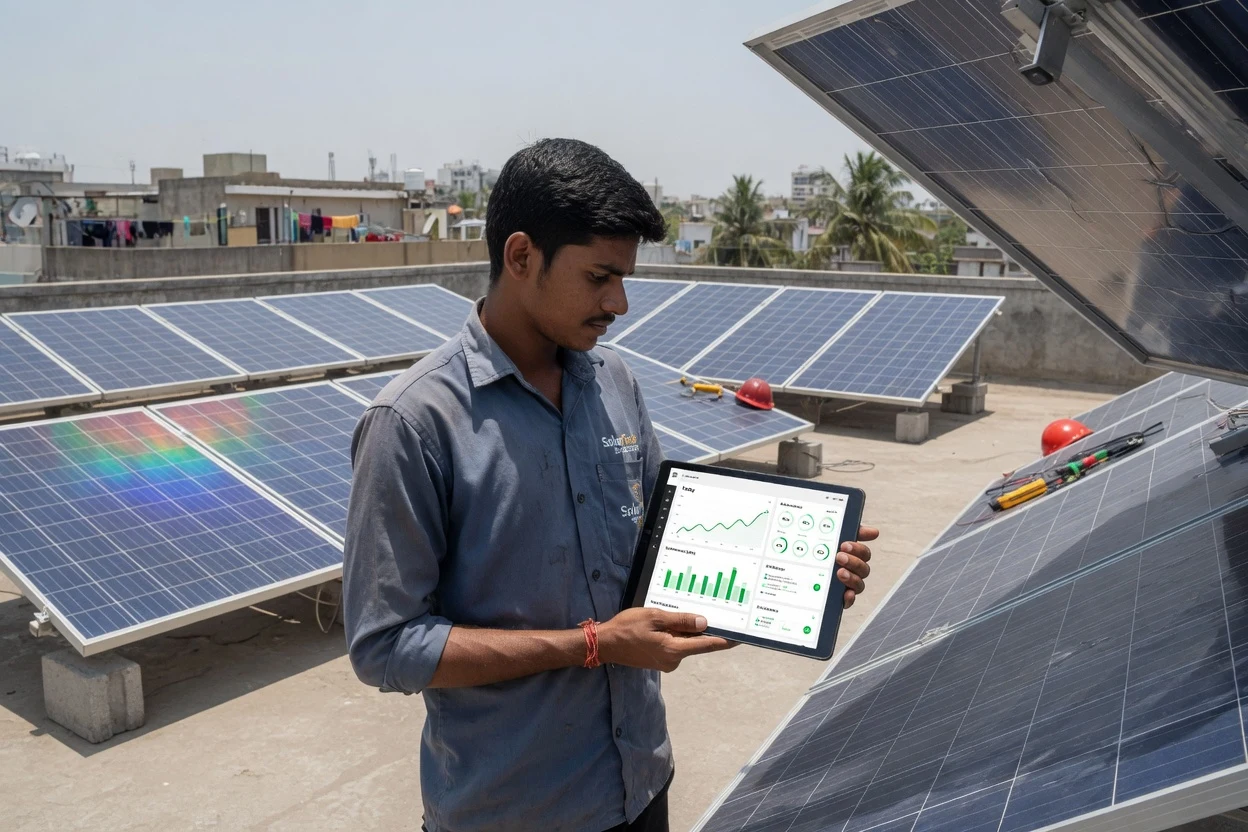
A generation-linked subsidy only works if someone can verify generation reliably, at scale, without sending an inspector to every rooftop. That’s where AI-based monitoring stops being a convenience feature and becomes policy infrastructure.
We already use remote monitoring across a meaningful share of our residential and commercial installs, and the pattern is consistent: predictive analytics catch underperformance weeks before a homeowner would notice a higher bill. A string producing 8% below its expected output based on weather-adjusted models usually points to a loose MC4 connector, early-stage soiling, or a developing shading issue, not equipment failure. Catching that in week three instead of month eight preserves both the homeowner’s savings and, under a generation-linked model, the installer’s subsidy eligibility.
Where AI Adds Real Value in a Generation-Linked Scheme
- Weather-normalised performance baselines: comparing actual output against what the system should have produced given real irradiance, not a flat estimate, so genuine underperformance doesn’t hide behind a cloudy month.
- Fault detection before failure: inverter clipping, string mismatch, and connector degradation flagged from data patterns rather than a physical inspection.
- DISCOM-facing verification layers: aggregated, tamper-resistant generation data that a subsidy authority could plausibly use to release generation-linked payouts without manual audits at 1 crore-household scale.
- Installer accountability scoring: a longer-term possibility where MNRE or state nodal agencies rank empanelled vendors by fleet-wide generation performance, not just installation count.
We’ve written more extensively about this shift in why AI is the future of solar operations and maintenance. The nuance worth admitting: AI monitoring is a verification tool, not a generation booster on its own. It tells you a system is underperforming faster; it does not fix bad workmanship. The gains only materialise if installers act on the alerts, which again comes back to whether the subsidy structure makes that action financially necessary.
Opportunities for Solar Companies
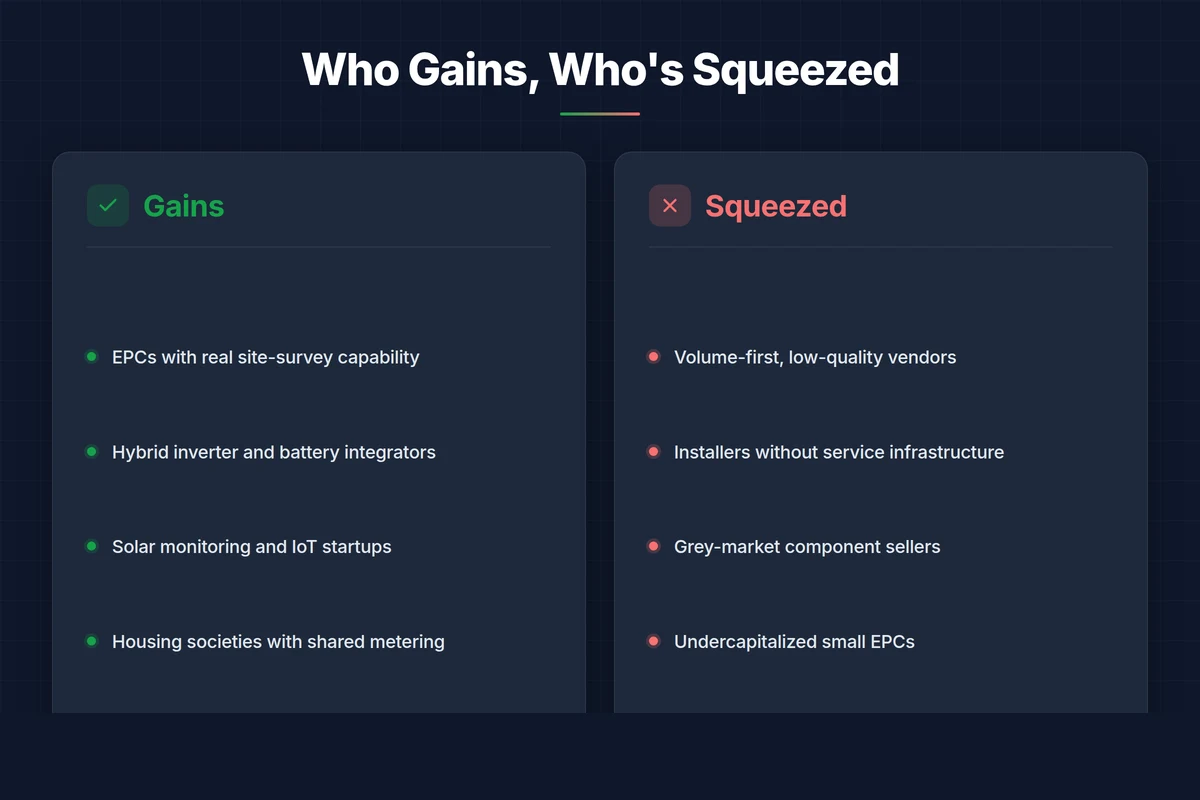
A generation-linked, storage-inclusive Surya Ghar 2.0 would reward a fairly specific type of solar company, and punish another type just as clearly.
- ✓ EPCs with real site-survey and O&M capability, not just install-and-exit crews
- ✓ Companies already offering hybrid inverters and battery integration
- ✓ Monitoring-software and IoT startups serving the residential segment
- ✓ Battery manufacturers scaling LiFePO4 production for the residential price band
- ✓ RWAs and housing societies able to organise shared or group net-metered systems
- ✗ Volume-first vendors whose margin depends on fast, low-quality commissioning
- ✗ Installers without post-sale service infrastructure
- ✗ Vendors using uncertified or grey-market inverters and cabling
- ✗ Smaller EPCs without capital to add monitoring or storage to their offering
For serious EPCs, this is an opening to differentiate on something that’s currently hard to prove to a customer: actual long-term output. A generation-linked subsidy would make performance data a sales asset, not just an operational nicety.
Challenges for Installers
We’d be doing readers a disservice if we only covered the upside. A shift like this creates real friction for the installer community, including for companies like ours.
The most immediate challenge is working capital. Installation-based subsidy is straightforward: commission, verify, collect. If even part of the payout shifts to a generation-linked schedule paid out over one to three years, EPCs need to either finance that gap themselves or pass the risk to homeowners through higher upfront pricing, both of which slow adoption in exactly the price-sensitive segment PM Surya Ghar was built to serve.
Second, smaller regional installers, many of whom operate on thin margins and lean heavily on subsidy-driven volume, may lack the working capital or technical staff to run monitoring infrastructure. If DISCOM-level verification becomes mandatory, some of that segment consolidates or exits, which cuts both ways: fewer bad-faith vendors, but also fewer installers serving smaller towns where margins were already tight.
Third, metering readiness varies wildly by state and DISCOM. An installer in Gujarat working with UGVCL or MGVCL, both of which have relatively mature net metering processes, would adapt faster than one working with a DISCOM still running manual meter reads. A generation-linked national scheme built on uneven state-level infrastructure risks penalising installers for metering gaps that are entirely outside their control.
📘 Regulation note
Generation-linked subsidy verification depends on smart meter and net metering infrastructure. State-level DISCOM readiness, not just central policy design, will decide how evenly a scheme like this actually rolls out.
Investment Opportunities
If the reported direction holds, three categories of investment look better positioned than the market currently prices them.
| Category | Why it benefits | Who’s already active |
|---|---|---|
| Residential-scale battery manufacturing | Storage moves from optional to subsidy-relevant, lifting volume demand | LiFePO4 producers scaling domestic cells |
| Solar monitoring / IoT software | Becomes verification infrastructure for generation-linked payouts, not just a consumer app | Independent monitoring platforms, inverter-bundled software |
| EPCs with proven O&M track records | Generation-linked payout rewards installers who can prove sustained output | Established, empanelled EPCs with multi-year fleet data |
We’d add a caveat that applies to all three: none of this is investable today on the strength of a “government mulling” report. Capital allocation decisions should track the actual notification, draft guidelines, and MNRE budget allocation, not preliminary news coverage. What’s worth doing now is positioning, not committing.
Impact on Homeowners: What Actually Changes for You
For the household deciding whether to go solar this year, the honest answer is that PM Surya Ghar 2.0 changes very little about the decision to act now, and quite a lot about what a system should look like if you’re installing anyway.
If generation-linked incentives arrive, homeowners with well-sited, properly installed systems stand to benefit; the subsidy structure would start rewarding exactly the kind of system a careful buyer already wants. Homeowners who chose the cheapest quote with the least site survey work would be the ones exposed if any part of future incentives ties back to verified output.
Our practical advice, independent of how Surya Ghar 2.0 eventually shakes out: insist on a proper site survey before signing anything, request the specific inverter and panel model numbers with BIS certification, and ask whether the vendor offers any form of generation monitoring. Those three checks protect you under the current scheme and position you well under any future generation-linked one. We cover the full vendor vetting process in our guide on PM Surya Ghar rejection reasons and how to avoid the common application pitfalls.
Curious what solar would cost for your home? Use our free solar calculator to see subsidy-adjusted savings for your rooftop in 60 seconds.
Surya Ghar 2.0 and India’s Net Zero Ambitions
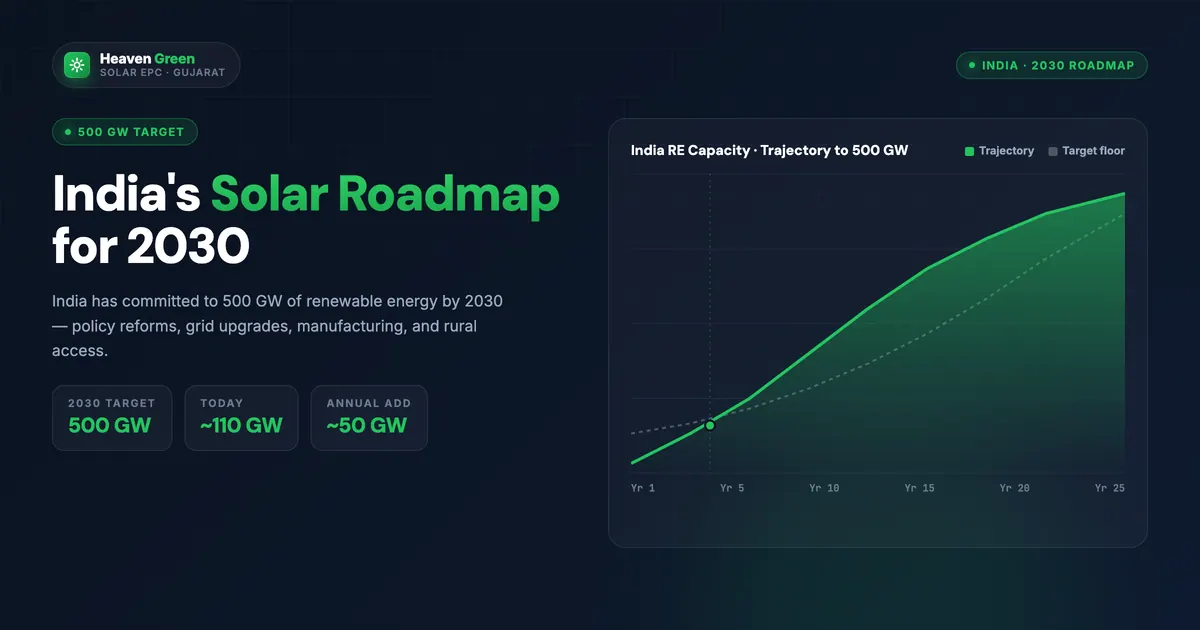
India committed to net-zero emissions by 2070 and a 500 GW clean energy target by 2030 at COP26, a target reaffirmed in the government’s own communications on its renewable energy trajectory. Rooftop solar alone was never going to carry that target; utility-scale and ground-mount solar do the heavier lifting in raw gigawatts. But distributed rooftop solar plays a role no utility-scale plant can: it puts generation directly at the point of consumption, reduces transmission losses, and turns millions of individual households into active grid participants rather than passive consumers.
PM Surya Ghar’s original goal, 1 crore households, translates to roughly 30 GW of distributed capacity if fully realised. As of mid-2025, official figures put confirmed beneficiary households in the low millions, well behind the pace needed to hit that ceiling by 2026-27. A generation-linked, storage-inclusive Surya Ghar 2.0 would not by itself close that gap. What it could do is make the gigawatts that do get installed count for more, both in actual electricity delivered and in grid resilience through storage.
Our analysis: net zero commentary tends to focus on installed capacity as the headline number. The more useful number, and the one a generation-linked subsidy would finally start tracking properly, is delivered energy. A country doesn’t decarbonise on nameplate capacity; it decarbonises on electrons actually displaced from the coal-fired grid.
Predictions for the Next Five Years
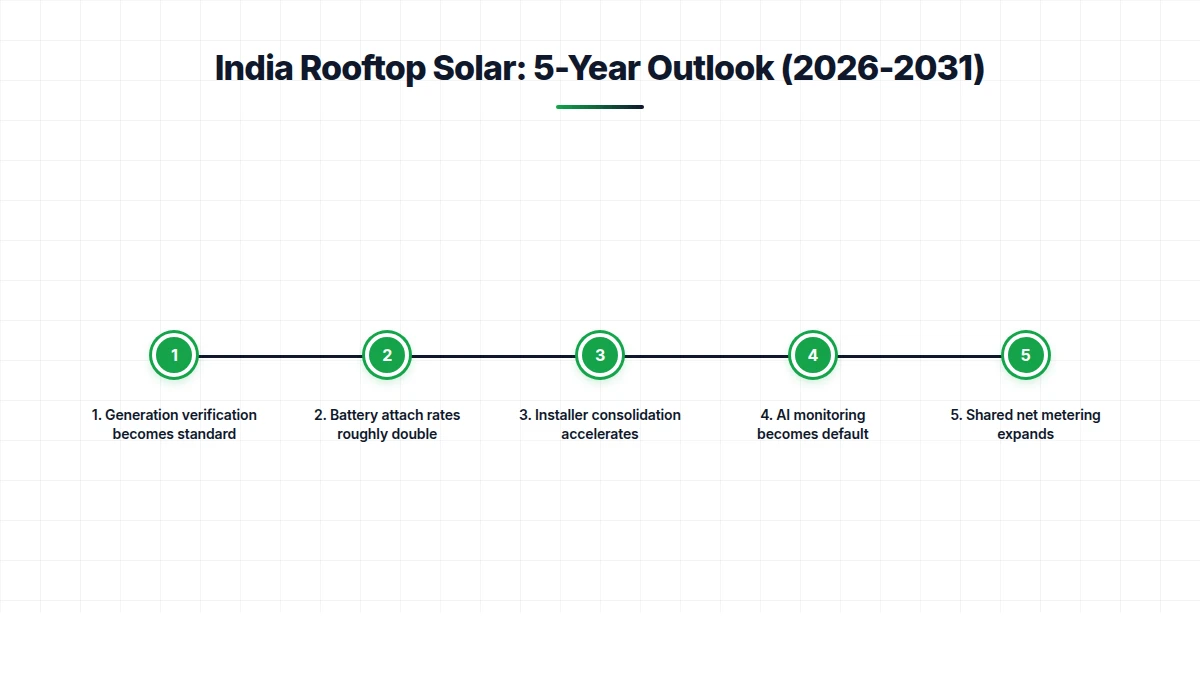
Treat everything in this section as our forecast, not a confirmed roadmap. Based on the direction reported and the structural pressures we’ve laid out above, here’s where we expect Indian rooftop solar to land by roughly 2031:
- Generation verification becomes standard practice, even if the subsidy formula itself phases in gradually. DISCOMs and installers converge on smart-meter-based reporting because it’s operationally necessary regardless of whether it’s subsidy-linked.
- Battery attach rates roughly double among mid-income and above residential buyers, driven more by falling LiFePO4 costs and outage-prone grid conditions than by subsidy alone.
- Installer consolidation accelerates. The volume-first, low-quality segment of the EPC market shrinks; well-capitalised regional and national EPCs absorb their market share.
- AI-based monitoring becomes a default inclusion, not a premium add-on, in most mid-tier and above residential quotes, pushed by both installer risk management and eventual scheme requirements.
- Shared and virtual net metering expands meaningfully for housing societies and RWAs, unlocking rooftop solar for the large share of urban India that doesn’t own an independent roof.
Risks If the Policy Is Not Implemented Well
We’d be overstating our confidence if we didn’t flag how this could go wrong. A poorly executed Surya Ghar 2.0 carries real downside risk, and it’s worth naming plainly.
-
1
Payment delays discourage adoption. If generation-linked payouts stretch subsidy disbursement over years instead of weeks, price-sensitive households, the exact segment the scheme targets, may simply opt out.
-
2
Metering infrastructure gaps create unfair outcomes. A homeowner in a DISCOM with poor smart-meter coverage could lose out on generation-linked payouts through no fault of their own or their installer's.
-
3
Complexity shrinks the installer base. If compliance and monitoring requirements outpace what small regional EPCs can absorb, rural and tier-2/tier-3 coverage could contract right as the scheme most needs those installers.
-
4
Battery eligibility without real subsidy support repeats the current gap. Making storage technically allowed changes nothing if the economics still don't work for an average household.
The exception worth admitting: none of these risks are arguments against the reported direction itself. They’re arguments for careful, staged rollout with metering infrastructure upgrades running ahead of, not behind, the policy shift.
How Heaven Green Energy Helps
Whatever shape PM Surya Ghar 2.0 eventually takes, the fundamentals of a good rooftop installation don’t change: correct sizing, certified components, a real site survey, and post-install accountability. We’ve applied this discipline across 10,000+ installations, and we already build systems designed to perform well under a generation-linked lens, whether or not that lens becomes official policy.
- Residential Solar: 1-10 kW rooftop systems with PM Surya Ghar subsidy handled end-to-end, sized for real household load rather than maximum subsidy capture.
- Commercial Solar: 10-100 kW systems with ROI modelling built around actual generation forecasts, not nameplate capacity.
- Industrial Solar EPC: 100 kW+ turnkey projects with performance guarantees, the same accountability model a generation-linked subsidy would enforce nationally.
- Solar Calculator: see your subsidy-adjusted savings and payback in 60 seconds.
Frequently Asked Questions
Is PM Surya Ghar 2.0 an official government scheme?
Not yet. As of this writing, PM Surya Ghar 2.0 is a proposal reportedly under discussion within the central government, covered by outlets including the Times of India and Financial Express. There is no notified scheme, official guideline document, or confirmed launch date. Homeowners should continue applying under the existing PM Surya Ghar Muft Bijli Yojana rather than waiting for a future version.
What is the difference between installation-based and generation-based solar subsidies?
An installation-based subsidy, the current model, pays a fixed amount once a system is commissioned and verified, regardless of how much electricity it later produces. A generation-based subsidy would tie some or all of the payout to actual metered output over time, rewarding systems that perform well and, in theory, penalising underperforming ones. Reports suggest Surya Ghar 2.0 could combine both approaches.
Will battery storage be subsidised under PM Surya Ghar 2.0?
Reports indicate battery storage is under consideration, but it’s not confirmed whether that means direct subsidy support or simple scheme eligibility, which is already technically the case today without changing project economics much. The central subsidy currently applies only to solar PV capacity, up to ₹78,000 for 3 kW or more, and does not increase for adding a battery.
Should I wait for PM Surya Ghar 2.0 before installing rooftop solar?
We don’t recommend waiting. The current PM Surya Ghar scheme already offers a substantial subsidy, typically 3-4 year payback for a well-sized residential system, and there’s no confirmed timeline for a Surya Ghar 2.0 rollout. A properly installed, well-monitored system today will likely qualify for whatever generation-linked benefits arrive later, since it’s already built to perform.
How does generation-based subsidy get verified in practice?
The most likely mechanism, based on how similar performance-linked schemes work elsewhere, is net metering data reported through smart meters to the DISCOM, potentially cross-checked against inverter-level monitoring data. This is why AI-based remote monitoring is increasingly relevant even under the current scheme, independent of whether generation-linked subsidy becomes official policy.
What happens to my current subsidy if PM Surya Ghar 2.0 replaces the existing scheme?
Based on how Indian government schemes typically transition, existing beneficiaries and systems already commissioned under the current guidelines would very likely be grandfathered under the terms they applied for. No official transition guidance exists yet, since Surya Ghar 2.0 itself hasn’t been notified.
Which DISCOMs are best prepared for a generation-linked subsidy model?
DISCOMs with more mature net metering and digital billing infrastructure, including several in Gujarat such as UGVCL, DGVCL, MGVCL, and PGVCL, are better positioned than DISCOMs still reliant on manual meter reads. This is our assessment based on field experience with subsidy processing timelines, not an official readiness ranking from MNRE.
Will PM Surya Ghar 2.0 help India meet its net-zero 2070 target?
It could meaningfully improve the quality of India’s existing 500 GW by 2030 clean-energy push by increasing how much of installed rooftop capacity actually generates and displaces grid electricity, rather than adding new capacity by itself. Rooftop solar remains a smaller share of India’s total renewable buildout compared with utility-scale solar and wind.