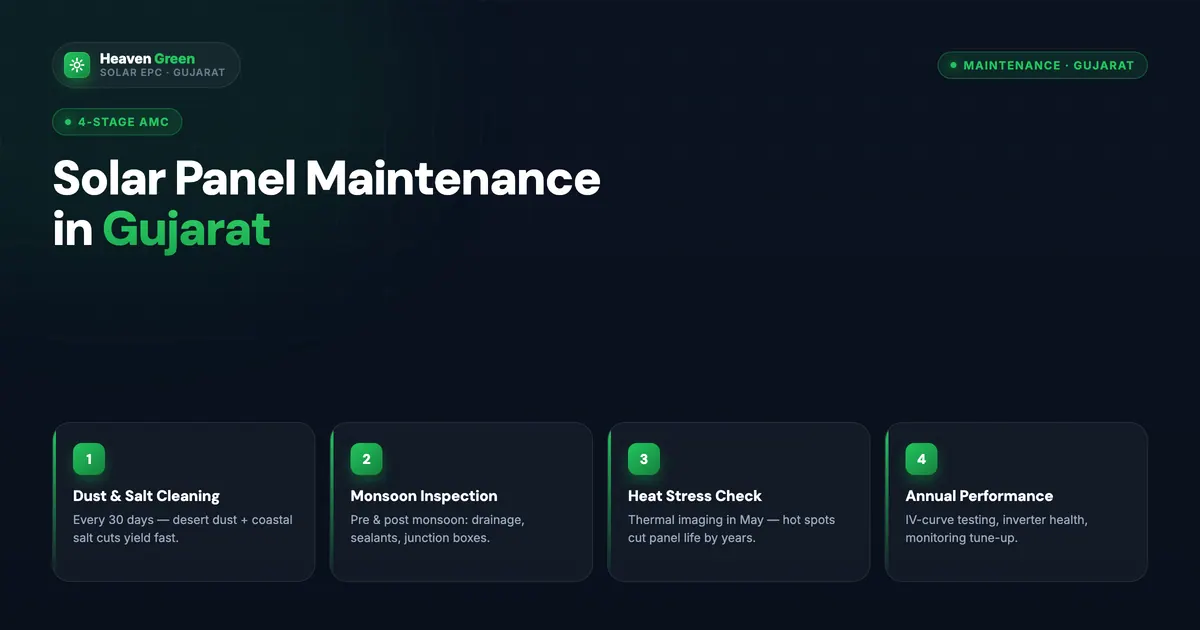
When you sign a solar AMC (Annual Maintenance Contract) in India, the contract document rarely makes clear what is covered and what is not, until you actually call for a service visit and discover that your specific problem falls outside the scope. This guide gives you a complete, specific checklist of what a good solar AMC should include, what it legitimately excludes, the three AMC tiers available in India, and how PM Suryaghar’s 5-year warranty requirement fits alongside your AMC coverage.
Key takeaway. A comprehensive solar AMC in India covers panel cleaning (4× per year in high-dust zones), annual electrical safety check, inverter performance check, DC cable insulation inspection, mounting bolt torque check, monitoring app support, and a generation performance report. What it does not cover: panel physical breakage, inverter or battery replacement after warranty, structural damage, storm damage, and DISCOM net metering disputes. Heaven Green Energy’s AMC includes all covered items for residential systems at ₹3,000/kW/year.
Understanding the scope before you sign prevents two common problems: discovering a gap at the worst moment (when something breaks), and overpaying for coverage you don’t need.
The Three Tiers of Solar AMC in India
Not all AMCs are the same scope. India’s solar market has evolved three distinct AMC tiers:
| Feature | Basic AMC | Standard AMC | Comprehensive AMC |
|---|---|---|---|
| Panel cleaning (visits/year) | 2 | 4 | 4+ as needed |
| Annual electrical safety check | ✗ | ✓ | ✓ |
| Inverter health check | ✗ | ✓ | ✓ |
| String performance analysis | ✗ | ✗ | ✓ |
| Earthing resistance test | ✗ | ✓ | ✓ |
| DC cable inspection | ✗ | ✓ | ✓ |
| Monitoring app support | ✗ | ✓ | ✓ |
| Generation performance report | ✗ | Quarterly | Monthly |
| Emergency response SLA | None | 48 hours | 24 hours |
| Thermal (IR) scan for hotspots | ✗ | ✗ | Annual |
| Typical cost (residential, per kW/year) | ₹1,000–₹1,500 | ₹2,000–₹3,000 | ₹3,000–₹4,500 |
Source: Heaven Green Energy field data, 2026.
Which tier is right for you?
- Basic AMC: acceptable only for systems under 2 years old with a full manufacturer warranty still active, or for systems in low-dust coastal zones where cleaning needs are minimal.
- Standard AMC: the minimum advisable tier for any residential system. Covers the electrical checks that prevent costly failures.
- Comprehensive AMC: recommended for commercial systems above 20 kW and for residential systems in high-dust zones (Gujarat, Rajasthan, Madhya Pradesh). The thermal scan catches hotspot problems that standard visual inspection misses.
For AMC pricing benchmarks by system size, see our companion post on solar AMC cost per kW.
💡 Fast tip
The most common AMC upgrade trigger is an inverter fault that wasn't caught early. Upgrading from Basic to Standard AMC costs approximately ₹1,000–₹1,500 per kW more per year, typically less than the cost of one emergency call-out visit.
What Your Solar AMC Should Include: The Full Checklist
Every residential and commercial solar AMC should cover these seven service elements. This is the baseline scope that a credible provider must deliver:
1. Panel Cleaning (4× per year in high-dust zones)
Solar panel cleaning is the most visible AMC service and the most frequently skimped on. A proper cleaning visit should:
- Use clean water (ideally deionised or RO water) with a soft-bristle brush or microfibre cloth
- Clean panel frames and junction box surfaces, not just the glass face
- Remove bird droppings individually (they cause local shading and hotspots if left)
- Be performed before 9 AM or after 4 PM to avoid thermal shock on hot panels
- Leave a visit record signed by the technician with date and observations
What counts as a cleaning visit: Physical on-site cleaning by a technician. Not a remote monitoring check. Not a “passed by and the panels looked clean” visit.
Research by the IEA Photovoltaic Power Systems Programme finds dust soiling reduces output by 5 to 15% in typical conditions and up to 25% in high-dust desert zones. Four cleaning visits per year in Gujarat or Rajasthan is the minimum to maintain rated output. In the solar panel maintenance guide, we cover the full cleaning protocol in detail.
2. Annual Electrical Safety Check
This is the most safety-critical element and the one most commonly omitted from low-cost AMC contracts. A full annual electrical safety check covers:
- Isolation resistance test (IR test): Measures insulation integrity of DC cables. Values below 1 MΩ indicate insulation breakdown, a fire and safety hazard.
- Earth pit resistance measurement: Should be below 5 ohms per IS 3043 (BIS standard for earthing of electrical installations).
- Visual inspection of all live connections: DC string connections, AC output connections, earth continuity conductors.
- MCB/MCCB function test: Trip each circuit breaker manually to verify it functions. A breaker that won’t trip during a fault provides no protection.
- Surge arrester check: Verify lightning protection devices are intact and connected.
📘 Regulation note
CEA (Central Electricity Authority) Regulations 2010, amended 2019, require rooftop solar installations to maintain earthing systems and have periodic safety inspections. The BIS standard IS 16221 for solar photovoltaic systems also specifies maintenance requirements. Your AMC should explicitly reference compliance with these standards. See cea.nic.in for the full CEA electrical safety regulations.
3. Inverter Performance Check
Your inverter converts DC power from the panels into AC power for the home or grid. It is the most electronically complex component and the most likely to fail first. A proper inverter check includes:
- Review of fault logs for recurring error codes (these are early-warning signs)
- Comparison of DC input performance against expected string current at the time of visit
- Check inverter temperature and cooling fan operation
- Verify firmware is up to date (most inverter brands release firmware updates annually that improve efficiency or fix known bugs)
- Isolation resistance test on DC input side
4. DC Cable Insulation Check
DC cables on a solar system carry 300 to 1,000V DC. Unlike AC, DC arcs do not self-extinguish, once a DC arc starts from damaged insulation, it continues burning until the power source is isolated. This makes cable inspection one of the most important safety checks in any AMC.
The technician should:
- Visually inspect all exposed DC cabling for chafing, rodent damage, or UV degradation
- Check that all cable clips and conduit mounts are secure and that no cable hangs free
- Check MC4 connector locks are fully engaged, a partially-mated MC4 connector can arc
- Flag any areas where cable routing creates physical damage risk (sharp metal edges, heat sources)
5. Mounting Bolt Torque Check
Solar panel mounting structures vibrate slightly in wind. Over time, bolts work loose. A mounting structure with loose bolts fails in a strong wind, panels can shift, cable connections can pull apart, and in worst cases panels can fall from the roof.
The annual torque check uses a torque wrench to verify all structural bolts and panel-clamp bolts are at the specified torque. This takes 30 to 90 minutes depending on system size. It is quick to do and catastrophic to skip.
6. Monitoring App Support
Most modern inverters include a WiFi monitoring system that feeds generation data to a manufacturer app (Huawei FusionSolar, SolarEdge, Fronius, SMA Sunny Portal, Growatt, etc.). When the monitoring app stops updating or shows anomalies, it is often the first sign of a problem.
AMC support for monitoring should include:
- Verifying the monitoring connection is active at each visit
- Explaining the app dashboard to the consumer if requested
- Diagnosing and restoring monitoring connectivity when it drops
- Setting up generation alerts if the inverter supports them
Our guide on how to monitor solar generation explains what monitoring metrics to watch.
7. Generation Performance Report
A monthly or quarterly written report comparing your actual kWh generated against the expected kWh for your system size, location, and the prevailing weather. This report:
- Shows if your system is degrading faster than expected (normal degradation is 0.5 to 0.7% per year per MNRE benchmark data)
- Provides documentation for any warranty claim (manufacturers require performance data)
- Alerts you to seasonal underperformance that may indicate a developing fault
What Is NOT Included in a Solar AMC
This is as important as the inclusions. Any legitimate AMC has a defined exclusions list. Here are the standard exclusions and why they exist:
-
1
Panel breakage or theft, physical damage from external causes (hailstorm, thrown objects, theft) is covered by property insurance, not AMC. If you have valuable panels, ensure your home insurance policy covers the solar system as part of the building structure.
-
2
Inverter or battery replacement after warranty, the AMC covers inverter health checks and early fault detection, not replacement of major components. Inverter replacement (₹30,000–₹1,00,000) and battery replacement (₹50,000–₹3,00,000 for lithium systems) are separate cost items billed at actuals.
-
3
Structural damage to the mounting system, if the roof or mounting structure is damaged by the building owner's actions (renovation, adding weight, drilling), repair is the building owner's cost. Structural damage from normal system operation is covered.
-
4
Acts of nature, cyclone, flood, earthquake, or lightning strike damage falls under force majeure. Some comprehensive AMC contracts include storm-damage inspection and documentation assistance for insurance claims, but not repair costs.
-
5
DISCOM [net metering](https://qbitsenergy.com/blog/net-metering-india-complete-guide/?utm_source=hge&utm_medium=blog&utm_campaign=portfolio) issues, disputes with the DISCOM (Distribution Company) about net metering credits, meter readings, or billing errors are the consumer's responsibility to resolve with the DISCOM directly. The AMC provider can help document the system's generation data but cannot intervene in DISCOM billing processes.
-
6
Subsidy-related issues, PM Suryaghar DBT delays or disputes are between the consumer and MNRE/DISCOM. The AMC provider is not involved in the subsidy chain.
⚠️ Watch out
Some AMC contracts exclude "electrical faults" entirely, meaning any failure of inverter, cables, or protection devices is excluded. This is not a legitimate AMC exclusion. Only component replacement costs (inverter board, fuse replacement above ₹500) are reasonable exclusions. The inspection and diagnosis of those faults should always be included.
The Heaven Green AMC Coverage Matrix
This proprietary framework maps each type of solar system failure to the correct coverage layer, telling you exactly who is responsible and what it costs:
| Failure Type | Covered by Manufacturer Warranty? | Covered by Installer Warranty (5 yr)? | Covered by AMC? | Out-of-Pocket? |
|---|---|---|---|---|
| Panel delamination or cell cracking (manufacturing) | ✓ (25-year product warranty) | ✓ | ✗ | ✗ |
| Panel soiling / output loss from dirt | ✗ | ✗ | ✓ (cleaning) | ✗ (if AMC active) |
| Inverter hardware failure (within warranty) | ✓ | ✓ | ✗ | ✗ |
| Inverter hardware failure (post-warranty) | ✗ | ✗ | ✗ (detection only) | ✓ (full cost) |
| Inverter firmware / software glitch | ✗ | ✗ | ✓ (update included) | ✗ |
| MC4 connector corrosion | ✗ | ✗ | ✓ (inspection + replacement ≤₹500) | ✓ if expensive |
| Earthing resistance degradation | ✗ | ✗ | ✓ (test + minor remediation) | ✓ if major work needed |
| Mounting bolt loose / panel shift | ✗ | ✗ | ✓ (torque check) | ✗ |
| Panel glass breakage (hail, impact) | ✗ | ✗ | ✗ | ✓ (or property insurance) |
| Battery degradation (lithium cycle loss) | ✓ if within battery warranty | ✗ | ✗ | ✓ replacement cost |
| Storm / flood / earthquake damage | ✗ | ✗ | ✗ | ✓ (or property insurance) |
| DISCOM billing / net metering error | ✗ | ✗ | ✗ | Consumer resolves with DISCOM |
How to use this matrix: When something goes wrong with your solar system, identify the failure type and trace the row. This tells you whether to call the panel manufacturer, the installer under warranty, your AMC provider, or accept it as an out-of-pocket cost.
For the full manufacturer warranty breakdown, see our solar panel warranty explained guide.
Ready to protect your solar investment? Our AMC team visits in 24 hours and covers your system completely. Get your free AMC quote →
PM Suryaghar 5-Year Warranty and Your AMC
PM Suryaghar Muft Bijli Yojana requires the portal-registered vendor to warrant the complete system for 5 years from commissioning and to provide 5 years of comprehensive maintenance; this is written into the scheme’s model vendor-consumer agreement. This warranty covers:
- Installation workmanship defects (improper wiring, wrong fuse sizing, poor earthing)
- Panel performance degradation beyond MNRE-specified limits in year 1 to 5
- Inverter failure due to installation error (wrong DC input voltage connection, improper grounding)
This warranty does not cover:
- Ongoing cleaning and maintenance needs
- Normal wear-and-tear on cables and connectors
- Earthing resistance increase over time (a normal phenomenon in some soil types)
The 5-year warranty and your AMC are complementary, not interchangeable. During the warranty period, an AMC ensures you catch any warranty-claimable defects early, an underperforming string that a warranty inspection would repair, for example, may go unnoticed for years without AMC monitoring.
After year 5 (when the installer warranty expires), your AMC becomes even more important, it is the only systematic protection layer remaining for non-manufacturing-defect issues.
According to the CEEW solar O&M survey, 2025, Indian rooftop solar systems with regular AMC coverage show 18% higher generation efficiency after 5 years compared to unmaintained systems. This translates directly to faster payback on your original investment.
How to Verify Your AMC Provider Is Reliable
Before signing any AMC contract, verify these three things to avoid getting locked into a contract with a provider who can’t deliver:
Check 1, Are they linked to your original installer? A solar AMC provider does not need any MNRE registration of its own. For PM Suryaghar systems, the original installer must be a vendor registered on the PM Surya Ghar national portal and owes you 5 years of comprehensive maintenance, so warranty coordination works best when the AMC provider and the original installer are connected. You can check a vendor’s registration on the PM Surya Ghar national portal.
Check 2, Do they have a local service team in your city? AMC response time commitments are meaningless if the company’s nearest engineer is 4 hours away. Ask specifically: “How many trained engineers do you have in my city?” A credible AMC provider for a 5 kW residential system should have a team that can reach you within the stated SLA.
Check 3, Can they show you a sample performance report from an existing client? A performance report is the core deliverable that separates a substantive AMC from a paper contract. Ask to see a redacted sample report. If they can’t produce one, they’re not delivering this service to existing clients either.
According to the Bridge to India solar O&M market report, 2025, the lack of qualified O&M providers is the primary reason Indian rooftop solar systems underperform after year 3. Choosing an AMC provider with a verifiable local team and a reporting track record is as important as the AMC price.
For help identifying red flags in any solar service proposal, see our guide on red flags in solar quotes.
How Heaven Green Energy’s AMC Works
Heaven Green Energy offers residential and commercial AMC across Gujarat (Ahmedabad, Surat, Rajkot, Vadodara, Morbi, and 20+ cities). Our AMC scope matches the Comprehensive tier described above:
Residential Comprehensive AMC (₹3,000/kW/year):
- Panel cleaning: 4 visits per year, scheduled quarterly, using deionised water and soft brushes
- Annual electrical safety inspection: IR test, earth resistance, connection check, breaker test
- Inverter health check: fault log, DC performance, temperature, firmware check
- DC cable and MC4 inspection: full visual inspection for insulation damage or connector issues
- Mounting torque check: all structural bolts verified with torque wrench annually
- Monitoring app setup and support: WiFi connectivity verified, app training for homeowner
- Quarterly performance report: actual vs. expected generation in kWh
- Emergency response: 48-hour SLA; on-site engineer, not just phone support
- Consumables included: fuses, MC4 connectors, small cables up to ₹1,500/year
Our service pages:
- Residential Solar: 1 to 10 kW systems with first-year AMC included.
- Commercial Solar: 10 to 100 kW systems with dedicated AMC team.
- Solar AMC cost guide: pricing benchmarks for India 2026.
- Solar maintenance guide: what you can do yourself between AMC visits.
Frequently Asked Questions
What is included in a standard solar AMC in India?
A standard solar AMC in India includes 4 panel cleaning visits per year, annual electrical safety inspection (IR test, earthing check, breaker test), inverter health check (fault log review, DC performance check, firmware update), DC cable visual inspection, monitoring app support, and a quarterly generation performance report. Emergency fault response is typically included with a 48-hour SLA for residential systems.
What is excluded from solar AMC contracts?
Standard exclusions include: panel physical breakage or theft, inverter or battery replacement after the manufacturer warranty period, structural damage from the building owner’s actions, storm or act-of-nature damage, and DISCOM billing or net metering disputes. The AMC covers inspections and minor consumables, not major component replacements.
How does solar AMC differ from the PM Suryaghar 5-year warranty?
The PM Suryaghar 5-year installer warranty covers manufacturing defects and installation workmanship errors. It is reactive, it responds when a failure is discovered. Solar AMC is proactive, it includes scheduled visits to clean, inspect, and detect problems early. Both are needed: the warranty covers defect replacement at no cost; the AMC keeps the system performing at rated output day to day.
What is a Basic vs. Comprehensive AMC?
A Basic AMC covers only panel cleaning (typically 2 visits/year) with no electrical inspections or performance reporting. A Standard AMC adds inverter checks, earthing test, and quarterly reporting. A Comprehensive AMC adds string performance analysis, annual thermal scan for hotspots, and a faster emergency response SLA. For residential systems in India, Standard AMC is the minimum advisable tier.
Is the earthing check really important in solar AMC?
Yes, it is safety-critical. Earthing resistance should be below 5 ohms per IS 3043 (BIS standard for electrical earthing). If earthing resistance increases beyond this (common in clay soils during dry summer), your lightning protection system stops functioning correctly. In a lightning event, an improperly earthed solar system transfers voltage to the building structure. This check takes 15 minutes but is routinely skipped in low-cost AMCs.
Can I transfer my AMC if I sell my house?
Yes, in most cases. A solar AMC is typically linked to the system at the property address, not to the individual owner. When you sell your house, you can transfer the remaining AMC period to the new owner, check your AMC contract for the transfer clause. Heaven Green Energy AMC contracts allow a one-time ownership transfer at no additional charge.