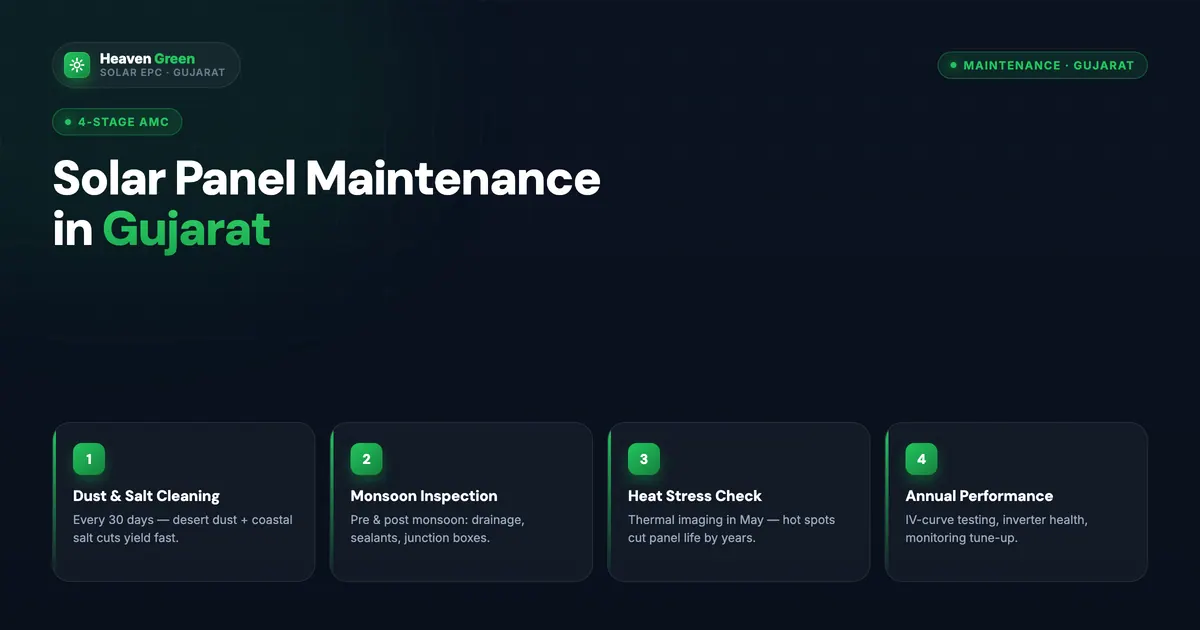
A solar AMC (Annual Maintenance Contract) is the post-installation service agreement that keeps your rooftop plant generating at design output for its full 25-year life. In 2026, the Indian rooftop market has settled on a 12-element quality AMC scope: scheduled cleaning, IR (infrared) thermal scan, panel inspection, structure tightness, inverter health check, MCB (Miniature Circuit Breaker) and isolator testing, earth resistance test, monitoring sync, warranty interface, performance reporting, fault repair SLA (Service Level Agreement), and emergency callout. Pricing ranges from ₹300 to ₹1,500 per kW per year depending on the tier, and the gap between a ₹300/kW cleaning-only contract and a ₹1,000/kW comprehensive one is the difference between a 2% performance loss and a 12% one over a five-year window.
This guide walks through every element a credible AMC must include, the tier-by-tier pricing buyers should expect, what cheap quotes routinely skip, and the buyer mistakes that turn a maintenance contract into an expense without coverage.
Direct answer. A quality solar AMC in 2026 includes 12 elements: scheduled cleaning (4 to 24 visits/year), annual IR thermal scan, quarterly visual panel inspection, yearly structure bolt tightness, inverter health check, MCB and isolator testing, earth resistance test, monitoring app sync, warranty claim interface, monthly performance reporting, fault repair SLA, and emergency callout. Pricing runs ₹300–₹500/kW/yr (Basic), ₹500–₹1,000/kW/yr (Standard), and ₹1,000–₹1,500/kW/yr (Premium). Without an AMC, expect 10 to 15% generation loss within two years.
If you are choosing between three vendor quotes that range from ₹250/kW to ₹1,200/kW, the rest of this guide tells you exactly what each tier should deliver and which line items are non-negotiable for warranty protection.
Why Solar AMC Matters, Generation Loss Without It
A rooftop solar plant is not a fit-and-forget asset. Dust soiling, microcrack propagation, connector oxidation, structure bolt loosening, and inverter firmware drift all chip away at output every quarter. Data from the Ministry of New and Renewable Energy (MNRE) and field studies by the International Energy Agency PV Power Systems Programme consistently show that unmaintained rooftop plants lose 10 to 15% of nameplate generation within 24 months, with a further 1 to 2% annual drift after that. A quality AMC keeps the loss curve flat, under 2% in year one, under 0.5% per year afterwards.
The financial picture is straightforward. A 10 kW residential plant generating 15,000 kWh per year at ₹7/kWh yields ₹1.05 lakh of annual self-consumption value. A 12% generation loss is ₹12,600 of value disappearing every year, far more than the ₹8,000 a Standard AMC costs at the same scale. The AMC, in other words, is not an expense. It is the cheapest insurance the rooftop industry sells.
There is also the warranty side. Panel warranties run 12 to 25 years, inverter warranties 5 to 10 years, and structure warranties 5 years. Every one of those warranties carries clauses around “documented maintenance”, and an unmaintained plant with no AMC service log routinely loses warranty cover when a manufacturer audits the claim. Our companion guide on solar AMC cost per kW breaks down the budget side; this post focuses on scope.
The 12-Element Quality Solar AMC Scope
This is the named framework we use at Heaven Green Energy to specify every contract. The 12 elements are derived from MNRE rooftop O&M guidelines, IS 14286 (Bureau of Indian Standards specification for crystalline silicon PV modules), and IEC 62548 (the international PV array design and safety standard). If a quote you receive omits any of these, ask the vendor to add it in writing or move to a different supplier. The full element list and what each one delivers in practice is below.
Element 1: Scheduled Cleaning
Physical on-site cleaning by a technician, not a remote check, not a drive-by. Frequency runs from 4 visits per year (Basic, low-dust zones) to 24 visits per year (Premium, industrial dust corridors near cement plants or highways). Standard residential AMC across the high-dust belt of Gujarat, Rajasthan, and Madhya Pradesh sits at 8 to 12 visits per year. For the cleaning cadence specific to your climate, see solar panel cleaning frequency in India.
Each visit should use deionised or RO (reverse osmosis) water with a soft-bristle telescopic brush, performed before 9 AM or after 4 PM to avoid thermal shock, and end with a signed visit log noting visible soiling, bird droppings, and any panel damage spotted from the wash deck.
Element 2: Annual IR Thermal Scan
An IR scan uses a calibrated thermal imaging camera (handheld or drone-mounted) to identify hotspots, localised temperature anomalies that indicate microcracks, PID (Potential Induced Degradation), bypass diode failure, or cell-level shading. A 10°C delta against the surrounding cells is the conventional flag threshold under IEC 62446.
Basic tier AMCs typically skip the IR scan entirely. Standard tier includes one annual scan. Premium tier runs quarterly scans. The scan output is a thermograph report with location-tagged anomalies and a recommendation set, repair, monitor, or warranty claim.
Element 3: Quarterly Visual Panel Inspection
A trained technician walks the array four times a year and looks at each panel for delamination (the EVA, ethylene vinyl acetate, encapsulant separating from the glass), browning, snail trails, microcracks visible to the naked eye, hail or impact damage, junction box ingress, and frame corrosion. Visual inspection catches what the IR scan does not, physical damage that has not yet become a thermal anomaly.
Element 4: Structure Bolt Tightness Check
Mounting structures use galvanised steel or anodised aluminium fasteners. Wind cycling loosens bolts over time. A yearly torque check with a calibrated torque wrench, against the structure manufacturer’s specified Nm rating, prevents panel uplift events during high-wind months. Loose bolts also strain the panel frame and accelerate microcracks.
Element 5: Inverter Health Check
The inverter is the most failure-prone component in the system. A health check covers cooling fan inspection (dust clogging is the leading cause of inverter de-rating), firmware version verification and update if the manufacturer has released a patch, DC and AC terminal torque check, MPPT (Maximum Power Point Tracking) curve sanity check, and a log download to spot fault codes the system reset before generating an alert.
Element 6: MCB and Isolator Testing
Every solar plant has at least one DC isolator and one AC MCB. These must be manually tripped once per year to verify they function, a breaker that has not been operated for years can seize and fail to trip during an actual fault, which converts a small DC ground fault into a roof fire. The test is fast (5 minutes) and one of the highest-safety-value items in the entire AMC scope.
Element 7: Earth Resistance Test
Per IS 3043 (the BIS, Bureau of Indian Standards, code for earthing of electrical installations), the earth pit should read under 5 ohms. The test uses a four-terminal earth tester and a fall-of-potential method, performed semi-annually. A bad earth pit voids most inverter warranties and creates a safety hazard during a lightning strike.
Element 8: Monitoring App Sync Verification
Modern inverters log generation to a manufacturer cloud (SolarEdge, Growatt, Sungrow, Deye) and surface the data through a phone app. The AMC must verify monthly that the app is syncing, the Wi-Fi or 4G dongle is online, and the generation reading on the inverter screen matches the cloud reading. A monitoring outage means you have no visibility into a fault, which is the single biggest reason generation drops go unnoticed for months.
Element 9: Warranty Claim Interface
Panel warranties run 12 to 25 years (linear performance + 10-year product), inverter warranties 5 to 10 years, structure warranties 5 years. A quality AMC vendor acts as the consumer’s interface to these warranties, filing the claim with the OEM (Original Equipment Manufacturer), supplying the service logs as evidence, and coordinating the replacement. Without this interface, most consumers do not know how to file a panel warranty claim, and the manufacturer rejects it on documentation grounds.
Element 10: Performance Report
A monthly PDF (or dashboard view) that shows actual generation against expected generation, soiling loss, weather-adjusted yield, and any anomalies. The benchmark is the design PR (Performance Ratio), most rooftop systems should run at PR ≥ 78%. The report tracks against the panel manufacturer’s performance warranty (typically ≥ 80% of nameplate at year 25) and creates the evidence trail you need if a warranty claim is ever required.
Element 11: Fault Repair SLA
A documented response time for fault tickets. Industry standard tiers are 24-hour response for Premium, 48 hours for Standard, and 72 hours for Basic. The SLA defines response, not resolution, repair time depends on part availability, but the clock starts when the technician arrives. An AMC without a written SLA is not an AMC; it is a wish list.
Element 12: Emergency Callout
A clause that defines what happens when the system trips outside the scheduled service window, a lightning event, a roof leak around panels, a DC arc fault. The AMC should specify whether emergency callouts are included (Premium) or chargeable (Basic and Standard), the per-visit fee if chargeable, and the maximum arrival window. A Premium AMC includes unlimited emergency callouts; a Basic AMC typically excludes them entirely.
AMC Tier Comparison, Basic vs Standard vs Premium
The 12 elements split across three commercial tiers. Use this table as the spec sheet against which to evaluate any AMC quote.
| Element | Basic (₹300 to 500/kW/yr) | Standard (₹500 to 1,000/kW/yr) | Premium (₹1,000 to 1,500/kW/yr) |
|---|---|---|---|
| Scheduled cleaning | 4 to 6 visits/yr | 8 to 12 visits/yr | 24+ visits/yr |
| Annual IR scan | Not included | 1 / year | Quarterly |
| Visual panel inspection | Annual | Quarterly | Quarterly + after-storm |
| Structure bolt tightness | Annual | Annual | Annual + after-storm |
| Inverter health check | Annual | Annual | Semi-annual |
| MCB + isolator testing | Not included | Annual | Annual |
| Earth resistance test | Not included | Semi-annual | Semi-annual |
| Monitoring app sync | Not included | Monthly | Monthly + alerts |
| Warranty claim interface | Not included | Included | Dedicated CRM (Customer Relationship Management) handler |
| Performance report | Not included | Monthly PDF | Monthly + live dashboard |
| Fault repair SLA | 72 hours | 48 hours | 24 hours |
| Emergency callout | Charged | Charged | Included unlimited |
Source: Heaven Green Energy AMC contract templates and field benchmarks, 2026.
A Basic AMC is acceptable only for systems under two years old that still carry full OEM warranty cover and sit in low-dust zones. Standard is the minimum advisable tier for any residential system above 2 years old. Premium becomes the right answer for commercial rooftops above 25 kW, where the per-kW spend on the AMC is dwarfed by the financial value of avoided generation loss.
Two tier-selection signals matter more than any other. First, the dust load, a Jaipur or Ahmedabad rooftop loses 6 to 8% to soiling between cleaning visits in summer, which means anything below 8 cleanings per year is structurally insufficient. Second, the commercial scale, a 50 kW commercial rooftop loses ₹4,200 of monthly generation value at a 7% performance dip, which justifies the Premium-tier price differential many times over. For PM Suryaghar-subsidised residential systems sitting in the 3 to 10 kW band on a north Indian roof, the Standard tier hits the right scope-to-cost balance and is the default we recommend across the JVVNL, JdVVNL, and AVVNL belt.
What Each Element Actually Means in Practice
Reading a 12-line spec sheet is one thing; knowing what a vendor actually does on-site is another. Here is what each element looks like during an actual service visit.
A scheduled cleaning visit takes 45 to 90 minutes for a 5 kW residential plant. The technician arrives with a 20-litre RO water tank, a telescopic soft-bristle brush, microfibre cloths for frame edges, and a digital camera for the before-and-after photos uploaded to the consumer portal. An IR scan adds 20 minutes, the technician shoots each string from a stable position, tags any hotspots with the panel serial number, and uploads the thermograph to the report.
A visual panel inspection runs alongside the cleaning. The technician notes any delamination, browning, or junction box ingress on a tablet form. Structure bolt tightness uses a calibrated torque wrench at the specified Nm; loose bolts are tightened on the spot. The inverter health check involves an SD card download of the log file, a fan visual inspection, and a firmware check against the OEM portal, any pending updates are flagged for owner consent before applying.
MCB and isolator testing is the safety highlight, the technician shuts down the DC side at the array isolator, then the AC side at the consumer MCB, and confirms each trips cleanly. The earth resistance test takes 10 minutes with an earth tester and is performed before the monsoon and after, so warranty-grade evidence exists for any lightning event. Monitoring app sync verification is a remote check, the AMC ops team logs in to your inverter portal monthly and confirms data is flowing. For a deeper walkthrough of every line item, the quarterly maintenance checklist lists the on-site protocol step by step, and the how-to-monitor solar generation guide covers the app side.
Book a free AMC scope review. Our Jaipur team will read your existing AMC contract, flag the missing elements, and quote a compliant replacement against your current vendor. Get your free quote →
₹ Per kW Pricing for AMC, Residential vs Commercial
AMC pricing scales with system size, but not linearly. Larger systems get a per-kW discount because the per-visit travel cost is amortised across more kW. The table below shows what an honest Standard-tier AMC should quote across plant sizes.
| Plant size | Segment | Standard AMC ₹/kW/yr | Annual AMC ₹ | Notes |
|---|---|---|---|---|
| 3 kW | Residential | ₹900 to 1,000 | ₹2,700 to 3,000 | Minimum viable plant size |
| 5 kW | Residential | ₹800 to 900 | ₹4,000 to 4,500 | Most common PM Suryaghar size |
| 10 kW | Residential / small commercial | ₹700 to 850 | ₹7,000 to 8,500 | Upper net-metering cap |
| 25 kW | Commercial | ₹600 to 750 | ₹15,000 to 18,750 | Single-shift SMEs (Small and Medium Enterprises) |
| 50 kW | Commercial | ₹550 to 700 | ₹27,500 to 35,000 | Mid-size commercial roofs |
| 100 kW | Commercial | ₹500 to 650 | ₹50,000 to 65,000 | Large commercial / institutional |
| 250 kW+ | Industrial | ₹400 to 550 | ₹1,00,000+ | Custom O&M (Operations and Maintenance) contracts |
Source: Heaven Green Energy commercial AMC quotations, 2026.
Heaven Green Energy’s published Standard residential AMC is ₹800/kW/year for systems under 10 kW; our Premium AMC is ₹1,200/kW/year. Both are quoted on a 1-year renewable, 3-year discounted (10% off), or 5-year locked basis. The 3-year contract is the buyer-favourite because the discount is meaningful and the lock-in is short. For the full pricing logic and how AMC fits into the lifetime cost of ownership, see solar AMC cost per kW. For residential and commercial segment fits, our residential solar and commercial solar pages list the AMC tier matched to each system class.
Two pricing nuances catch buyers off guard. First, the per-kW rate drops as plant size grows, but the absolute annual fee still climbs, a 100 kW commercial AMC at ₹600/kW is ₹60,000/year, which is 20× a residential AMC even though the per-kW rate is 25% lower. Second, AMC payments are quoted exclusive of GST (Goods and Services Tax) at 18%, so the effective ₹/kW figure on the invoice is 18% higher than the published rate. Commercial consumers recover the GST as input tax credit; residential consumers do not. Always compare quotes on a like-for-like GST-inclusive basis before signing.
What Cheap AMC Quotes Typically Skip
The ₹200 to 300/kW/year quotes you see on classified portals and from one-truck operators look attractive, but every one of them skips elements that matter. Here is the pattern across the cheap-quote market.
| Skipped element | Why it gets cut | Buyer consequence |
|---|---|---|
| IR thermal scan | Camera costs ₹2 to 4 lakh; vendor cannot justify | Hotspots cascade into module failure within 18 months |
| Earth resistance test | Requires earth tester + trained operator | Inverter warranty void; lightning risk uninsured |
| MCB / isolator trip test | Adds 15 minutes per visit | Seized breaker fails during a fault |
| Monitoring sync verification | Requires ops desk team | Generation drops go unnoticed for months |
| Warranty claim interface | Requires OEM relationships + paperwork | Consumer files own claim and usually fails |
| Performance reporting | Requires data + report generation | No evidence trail for warranty enforcement |
| Documented SLA | Vendor avoids accountability | Fault response is whenever it is convenient |
| Structure torque check | Requires calibrated wrench | Panel uplift during high-wind events |
The blunt heuristic: any AMC quote below ₹400/kW/year is a cleaning contract, not a maintenance contract. It is cheaper to skip the contract entirely and pay per visit when you need a service, at least then you know exactly what you are paying for. For a deeper inclusion/exclusion checklist, see what’s included in a solar AMC scope, and for verifying any installer before signing an AMC, the how-to verify a solar installation guide covers the credentialling checks.
Common Buyer Mistakes Choosing AMC
Across the residential and commercial AMC conversations we run every week, six mistakes recur. Each is preventable with a five-minute scope read before signing, and each one we have seen end with a consumer paying a second time for what should have been included in the first contract.
A seventh mistake worth flagging is mixing your AMC vendor with your original EPC (Engineering, Procurement, Construction) installer without checking whether they actually run a service desk. Many EPC companies install well but treat AMC as an afterthought, and when a fault hits, the same sales team that closed the install has no field operations to respond. Always ask for the AMC vendor’s service-desk phone number, response history, and a list of ten current AMC customers you can call before signing. A vendor who cannot produce that list is selling a contract, not a service.
DIY Maintenance vs AMC Contract
Some buyers consider running their own maintenance instead of signing an AMC. For a 3 kW plant on an accessible roof, this is not unreasonable for the cleaning portion. For everything else, the maths and the safety case favour an AMC.
- + Trained technician with calibrated tools
- + IR scan + earth test + MCB test require kit you do not own
- + Documented service log preserves warranty cover
- + Vendor handles OEM warranty claims for you
- + Fault repair SLA limits downtime
- + No roof-access safety risk
- − Roof falls during cleaning are a real safety risk
- − No IR camera, earth tester, or torque wrench at home
- − No documented log, warranty claims often fail
- − Hard-water deposits on panels reduce output
- − Inverter firmware updates are missed
- − One avoided AMC year pays for itself with one missed fault
Verdict. A Standard AMC at ₹800/kW/year is the correct answer for any residential rooftop above 3 kW. DIY cleaning is acceptable as a complement (a quick rinse between visits during dust storms), but the electrical, thermal, and warranty-interface elements of the AMC cannot be replicated at home. The avoided-loss maths is decisive, one missed fault recovered late costs more than five years of AMC fees.
A nuanced middle path some buyers take is the AMC + owner-cleaning hybrid, sign a Standard AMC that includes all the electrical, thermal, and warranty elements but only 4 cleanings per year, then top up with owner-initiated quick rinses during peak dust events. This shaves about ₹200/kW off the AMC fee while preserving the safety-critical and warranty-critical scope. The catch is that the AMC visit log no longer carries the full cleaning record, so warranty claims involving soiling-related output drops become harder to substantiate. We recommend the hybrid only for low-dust coastal locations where 4 cleanings per year is genuinely enough.
How Heaven Green Energy Structures Its AMC
Heaven Green Energy operates two published AMC tiers, both built around the 12-element framework above. Our Standard AMC is ₹800/kW/year and covers all 12 elements at the residential-rooftop frequency. Our Premium AMC is ₹1,200/kW/year and upgrades cleaning to 24+ visits, IR scan to quarterly, SLA to 24 hours, and adds a dedicated CRM handler who takes warranty calls on your behalf.
Contract terms are 1-year renewable as the default, with a 10% discount on a 3-year contract and a 15% discount on a 5-year contract. The 3-year option is the most popular among residential customers; the 5-year option is the right answer for commercial rooftops where the locked rate compounds across more kW. For deeper coverage of our maintenance protocol, the solar panel maintenance guide walks through how each element is executed in our field operation.
Explore the services that match your project:
- Residential Solar: 1 to 10 kW systems with Standard AMC bundled into the first year free of charge.
- Commercial Solar: 10 to 500 kW systems with Premium AMC and custom O&M scoping for industrial rooftops.
- Contact us: request an AMC quote with a 12-element scope sheet attached.
External references for the underlying standards: MNRE rooftop O&M framework, IS 14286 module specification, IEC 62548 PV array design and safety, and the IEA PV Power Systems Programme soiling studies.
Beyond contract scope, our service operation maintains a regional spares inventory across Jaipur, Sikar, and Alwar, replacement panels, inverter boards, MC4 connectors, and structure fasteners, so SLA response times are not dependent on OEM logistics. Our CRM (Customer Relationship Management) team logs every visit, every IR thermograph, and every performance reading into a consumer portal you can access at any time. The portal is the documented evidence trail for warranty claims, and it survives even if the consumer’s contact at our office changes. For new AMC enquiries, the contact us form routes directly to the AMC ops desk; for existing customers, the renewal team reaches out 45 days before contract expiry with a tier-comparison sheet so you can upgrade, downgrade, or extend without time pressure.
Frequently Asked Questions
What is included in a solar AMC in India in 2026?
A quality solar AMC in 2026 includes 12 elements: scheduled cleaning (4 to 24 visits per year), annual IR thermal scan, quarterly visual panel inspection, yearly structure bolt tightness check, inverter health check, MCB and isolator testing, earth resistance test, monthly monitoring app sync verification, OEM warranty claim interface, monthly performance report, fault repair SLA, and emergency callout. Pricing tiers run ₹300 to 500/kW/year (Basic), ₹500 to 1,000/kW/year (Standard), and ₹1,000 to 1,500/kW/year (Premium).
How much does a residential solar AMC cost per kW per year?
A Standard residential AMC runs ₹500 to 1,000 per kW per year, with most credible Indian vendors quoting ₹700 to 900/kW for a 5 to 10 kW plant. Heaven Green Energy’s published Standard AMC is ₹800/kW/year and the Premium is ₹1,200/kW/year. Quotes below ₹400/kW are usually cleaning-only contracts that skip the IR scan, earth test, MCB testing, and warranty interface, the elements that actually protect the asset.
Do I need an AMC if my system is still under manufacturer warranty?
Yes, panel and inverter warranties require documented maintenance to remain valid. Without an AMC service log, an OEM auditor can reject a warranty claim on the grounds that the plant was not maintained per the warranty terms. The first 5 years (when the inverter warranty is active) are actually the highest-value AMC years because the warranty interface element saves you the inverter replacement cost if a fault occurs.
What is the difference between an AMC and a warranty?
The warranty is the OEM’s guarantee that the panel, inverter, or structure will perform as specified, it covers product defects and performance shortfalls. The AMC is the service contract that maintains the plant in good working order: cleaning, inspection, testing, and fault repair. A warranty does not pay for cleaning or call-outs; an AMC does not pay for replacement panels. Both are required, and a quality AMC includes the warranty claim interface that connects the two.
How often should solar panels be cleaned under an AMC?
Cleaning frequency depends on dust load. In low-dust coastal zones (Kerala, coastal Karnataka), 4 visits per year is sufficient. In medium-dust zones (most of north India), 8 visits per year is the working standard. In high-dust corridors (Gujarat, Rajasthan, Madhya Pradesh, areas near cement plants or highways), 12 to 24 visits per year is required to maintain rated output. Soiling losses can hit 25% in unmaintained high-dust plants.
What is an IR scan and why is it in the AMC scope?
An IR scan (Infrared thermal scan) uses a calibrated thermal imaging camera to find hotspots on solar panels, localised temperature anomalies indicating microcracks, PID (Potential Induced Degradation), bypass diode failure, or shading damage. The scan catches faults before they cascade into module failure. A 10°C delta against surrounding cells is the standard flag threshold under IEC 62446. Standard AMCs include one annual scan; Premium AMCs run quarterly scans.
Can I do solar maintenance myself instead of signing an AMC?
For routine cleaning of a small residential plant on an accessible roof, DIY cleaning is workable as a complement to a formal AMC. For the electrical and thermal elements, IR scan, earth resistance test, MCB testing, inverter firmware updates, warranty interface, you cannot replicate the AMC at home without buying ₹3 to 5 lakh of test equipment. The avoided-loss maths is decisive: one missed fault costs more than five years of AMC fees.
How long are AMC contracts and what is the renewal process?
Standard AMC terms are 1-year renewable, 3-year discounted (typically 10% off), or 5-year locked (15% off). The 3-year option is the residential favourite because the discount is meaningful without the long commitment. Renewal is automatic in most contracts unless cancelled 30 days before expiry; some vendors require a fresh signature each year. Always set a calendar reminder 45 days before renewal so you can review the scope and negotiate without time pressure.
What happens if my AMC vendor goes out of business mid-contract?
Indian solar AMC contracts rarely include a vendor-failure indemnity, so consumers lose the prepaid balance. The mitigation is to choose an established vendor with multi-year operations, an MNRE empanelment, and a public service track record. Heaven Green Energy is India’s #1 ranked PM Suryaghar installer on the national portal, with a multi-state field operation; in the unlikely event of any service gap, AMC dues are pro-rated and refunded per contract clause.
Is GST applicable on solar AMC contracts in India?
Yes, solar AMC is treated as a service under GST and attracts 18% GST. The amount is added to the AMC fee on the invoice and is fully claimable as input tax credit for commercial and industrial consumers who are GST-registered. Residential consumers pay the GST as an unrecoverable cost, but the post-GST AMC fee is still a fraction of the avoided generation loss.