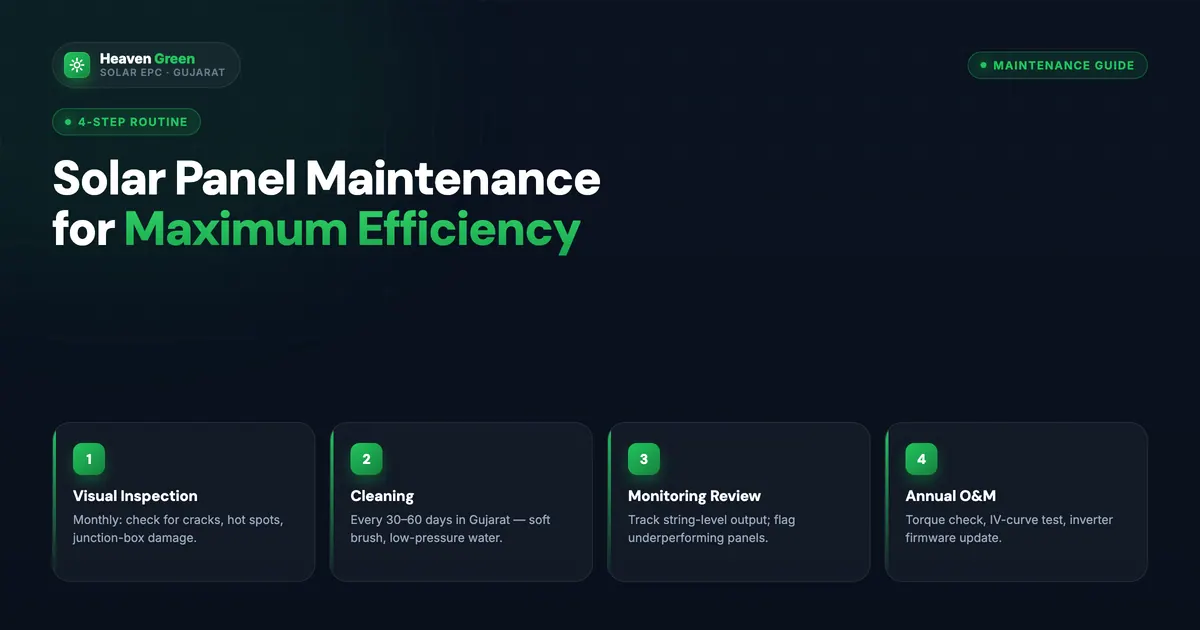
A solar system that goes without maintenance can lose a noticeable share of its energy output to soiling and undetected faults within a few years. Yet many homeowners and business owners who invest ₹2–₹10 lakh in a rooftop solar installation have no maintenance plan in place. An AMC (Annual Maintenance Contract) exists to prevent this, but AMC pricing in India ranges wildly from ₹1,500 to ₹8,000 per kW per year for residential systems. Knowing what fair pricing looks like, and what a good AMC must cover, saves you from overpaying or from running a system into the ground.
Key takeaway. Fair solar AMC pricing in India in 2026 is ₹2,500–₹4,000 per kW per year for residential systems and ₹1,000–₹2,000 per kW per year for commercial systems above 50 kW. A comprehensive AMC should include 4 cleaning visits per year, annual inverter health check, earthing resistance test, cable inspection, and a generation performance report. Heaven Green Energy offers residential AMC at ₹3,000 per kW per year with a 48-hour emergency response commitment across Gujarat.
This guide breaks down AMC pricing by system size, lists what every AMC must include, flags what to watch out for, and introduces the Solar AMC Value Audit, our 5-point framework to evaluate any AMC proposal before you sign.
Why Solar AMC Is Not Optional
Solar panels produce less power when dirty. Soiling research, including work by the IEA Photovoltaic Power Systems Programme, shows that losses vary widely by location and cleaning frequency, and are highest in dry, dusty regions such as parts of Gujarat and Rajasthan.
Beyond cleaning, proactive maintenance prevents expensive failures:
- Inverter health checks catch failing capacitors before a complete shutdown (inverter replacement costs ₹30,000–₹1,00,000)
- Connection tightness checks prevent resistance hotspots that lead to overheating
- DCDB/ACDB fuse inspection ensures protection devices remain functional
- String performance analysis identifies a single underperforming string dragging down the whole array
Without an AMC, these checks rarely happen. Across Heaven Green Energy’s 10,000+ installations, many of the performance issues we diagnose are in systems that have never had a formal maintenance check since commissioning.
The AMC definition in our solar glossary establishes that solar AMC is preventive, distinct from a warranty claim (manufacturing defects) or a reactive repair call. AMC is the scheduled, proactive layer.
Solar AMC Pricing Benchmarks: India 2026
Fair AMC pricing varies by system size due to economies of scale in service visits. These are the 2026 market benchmarks:
| System Size | Annual AMC Cost (Range) | Per kW Annual Cost | Cleaning Visits Included |
|---|---|---|---|
| 1 to 3 kW (residential) | ₹3,000–₹9,000 | ₹2,500–₹4,000/kW | 2 to 4 times/year |
| 3 to 10 kW (residential) | ₹7,500–₹40,000 | ₹2,500–₹3,500/kW | 2 to 4 times/year |
| 10 to 50 kW (small commercial) | ₹20,000–₹75,000 | ₹1,500–₹2,500/kW | 4 to 6 times/year |
| 50 to 200 kW (medium commercial) | ₹60,000–₹2,80,000 | ₹1,000–₹1,800/kW | Monthly or bi-monthly |
| 200+ kW (industrial) | ₹1,80,000–₹6,00,000 | ₹800–₹1,500/kW | Monthly |
Source: Heaven Green Energy field pricing data for solar O&M, 2025 to 26.
Price variation within each band depends on geographic location (dust zone vs. coastal), system age, coverage scope (cleaning-only vs. comprehensive), and response time SLA. For comparison of your overall solar investment, see our solar panel maintenance guide.
What a Comprehensive AMC Must Include
A complete solar AMC covers eight distinct service elements. Any AMC that omits more than one of these should be renegotiated or rejected:
Service 1, Panel Cleaning Frequency: minimum 2 times/year in coastal zones; 4 times/year in Gujarat, Rajasthan, and Central India. Method: soft brush with clean water or deionised solution, no high-pressure jets, which damage junction boxes. The cleaning visit record should be signed and dated.
Service 2, Inverter Health Check Annual check: DC input voltage and current against expected string parameters, inverter temperature measurement, cooling fan operation, fault log review, isolation resistance (IR) test. This catches inverter issues 6 to 12 months before complete failure.
Service 3, String Performance Analysis Compare output currents across parallel strings. A string producing 20%+ below peers indicates shading, panel failure, or connector fault. In our experience at Heaven Green, this check catches a large share of avoidable long-term generation losses.
Service 4, Cable and Connector Inspection Visually inspect all MC4 connectors for corrosion or moisture ingress. Check cable clips, conduit security, and insulation condition. Chafed insulation is the primary cause of DC arc fires, the most serious rooftop solar safety hazard.
Service 5, DCDB and ACDB Inspection Check fuse ratings, MCB/MCCB operation, and isolator function. Verify fuse ratings match inverter input specifications, undersized fuses are a common installation error. See our DCDB vs ACDB guide for what these protection boxes should contain.
Service 6, Earthing Check Test earth pit resistance against the value specified for your installation (many installers target below 5 ohms). Inspect lightning arrester connections. Earthing resistance deteriorates in monsoon zones, this check is safety-critical and often skipped.
Service 7, Generation Performance Report Monthly or quarterly report comparing actual kWh generated vs. expected (based on local irradiance data). This report serves as your evidence base for warranty claims and shows you whether the system is degrading faster than expected.
Service 8, Emergency Fault Response A written SLA specifying response time in hours. Residential: 48-hour maximum. Commercial: 24-hour maximum. “Response” means an engineer on-site, not just a phone call.
The Solar AMC Value Audit
This is Heaven Green Energy’s proprietary 5-point framework. Before signing any AMC contract, verify these five line items:
Audit Point 1, Cleaning Scope and Frequency The contract must name: how many visits per year, what cleaning method, and what happens if a scheduled visit is missed. Anything less than 4 visits/year in a high-dust zone (Gujarat, Rajasthan, Madhya Pradesh) is inadequate. Ask directly: “If the quarterly visit is missed, does the next visit happen sooner or is it simply skipped?”
Audit Point 2, Electrical Inspection Checklist The contract must include a written checklist naming at minimum: inverter fault log review, isolation resistance test, MC4 connector check, and earthing resistance measurement. If these are not listed by name in the contract, they are likely not being performed.
Audit Point 3, Performance Reporting Format You should receive a written generation report comparing actual kWh vs. expected kWh. A credible report references your system’s rated capacity and uses local irradiance data, for example from a calibrated on-site sensor or MNRE’s NIWE solar resource data. “Your system is working fine” is not a report.
Audit Point 4, Response Time SLA The contract must state fault response time in hours, not “as soon as possible.” Confirm whether response means phone acknowledgement or on-site engineer. For commercial systems, insist on a written SLA with penalty clauses for missed response times.
Audit Point 5, Exclusions List Clarity Read the exclusions section. A credible AMC lists specific exclusions: panel glass breakage, inverter board replacement beyond warranty, storm or act-of-nature damage. Vague exclusions like “any damage not caused by normal wear” are a mechanism to reject almost any claim.
For the full coverage scope breakdown, read our companion post on what solar AMC includes and excludes.
Get a free site assessment. Our engineers visit within 24 hours and send a custom AMC proposal, no cost, no obligation. Get your AMC quote →
PM Suryaghar Maintenance vs. AMC: Understanding the Coverage Gap
Under PM Suryaghar Muft Bijli Yojana, MNRE’s guidelines require the registered vendor to provide a 5-year Comprehensive Maintenance Contract (CMC) from the date of commissioning: repairs and maintenance free of cost, replacement or repair of non-performing components, regular health checks, and a plant performance ratio maintained through the 5-year warranty period. Many homeowners do not realise that this cover ends after year 5, and that routine module cleaning is left to the consumer (the vendor only has to educate you on cleaning). Here’s the coverage split:
| Coverage Type | PM Suryaghar Vendor CMC (years 1 to 5) | Solar AMC |
|---|---|---|
| Panel or inverter failure, non-performing components | ✓ repair/replacement free of cost | ✗ triggers warranty claim |
| Periodic health checks of the system | ✓ in vendor scope | ✓ |
| Performance ratio of the plant | ✓ vendor must maintain it for 5 years | ✓ report per contract |
| Routine module cleaning | ✗ consumer’s responsibility | ✓ |
| Cover after year 5 | ✗ CMC ends; OEM warranties only | ✓ |
| Written response-time SLA | ✗ not specified | ✓ per contract |
Source: MNRE operational guidelines for PM Surya Ghar CFA to residential consumers (June 2024), see our MNRE compliance guide; Heaven Green Energy AMC terms.
The OEM warranties on panels and inverters cover manufacturing defects, and the PM Suryaghar CMC covers repairs during the first 5 years. Your AMC covers what those don’t: keeping the system clean, documenting performance, and continuing preventive checks after the CMC ends.
Formal maintenance arrangements are uncommon among Indian residential rooftop owners, and an unmaintained system loses output steadily to soiling and undetected faults.
For a deeper look at what warranties cover, see our solar panel warranty explained guide.
AMC Pricing Red Flags
-
1
No scope of work definition, "Solar maintenance AMC, ₹X per year" with no description of what is covered is a blank cheque for the provider to do nothing substantive. Always insist on a written scope document.
-
2
Cleaning-only, no electrical checks, a cleaning-only AMC misses electrical faults that cause real failures. Inverter health, earthing, and string checks are as important as physical cleaning.
-
3
No performance report, without a generation vs. expected report, you have no way to know if your system is underperforming. Providers skip this because it requires monitoring infrastructure they haven't set up.
-
4
No response time SLA, an AMC without a defined fault response time in hours is not a meaningful contract. Commercial buyers should insist on written SLA with penalty clauses for missed response.
-
5
Vague exclusions clause, "damage not caused by normal wear" excludes almost everything. The exclusions list must name specific exclusions: panel breakage, inverter board failure post-warranty, storm damage.
Original Installer AMC vs. Third-Party AMC
- Full system knowledge from day one
- Simpler warranty coordination
- Single point of contact for issues
- Often priced 20 to 30% higher (captive client)
- AMC void if installer closes down
- No competitive pressure on service quality
If your original installer has disappeared or become unreachable, your AMC is effectively cancelled. Read our solar installer abandoned guide for the specific steps to take in that situation.
Heaven Green Energy takes over AMC for third-party installations in Gujarat, we conduct a site audit and provide continuity of service without requiring a system reinstall.
How Heaven Green Energy’s AMC Works
Heaven Green Energy’s AMC covers residential and commercial solar systems across Gujarat (Ahmedabad, Surat, Rajkot, Vadodara, Morbi, and 20+ other cities).
Residential AMC (1 to 10 kW): ₹3,000/kW/year includes:
- 4 cleaning visits per year (quarterly schedule)
- 1 comprehensive annual electrical inspection
- Inverter health check and fault log review
- Generation performance vs. expected comparison report
- 48-hour emergency fault response
- Consumables (fuses, connectors) up to ₹1,500/year included
Commercial AMC (10 to 200 kW): ₹1,200–₹1,800/kW/year includes:
-
Monthly cleaning visits
-
Quarterly string performance analysis
-
Inverter and ACDB/DCDB inspection semi-annually
-
Annual thermal scan (IR camera) for hotspot detection
-
SCADA monitoring setup and quarterly reporting
-
24-hour emergency response SLA
-
Residential Solar: 1 to 10 kW systems with AMC included in the first year.
-
Commercial Solar: 10 to 100 kW systems with dedicated AMC team.
-
Solar AMC Checklist: full scope breakdown of what your AMC should cover.
-
Contact our team: get an AMC quote for your system within 24 hours.
Frequently Asked Questions
What is a fair price for solar AMC per kW in India in 2026?
Fair solar AMC pricing in India in 2026 is ₹2,500–₹4,000 per kW per year for residential systems (1 to 10 kW) and ₹1,000–₹2,000 per kW per year for commercial systems above 50 kW. A 5 kW residential AMC at fair pricing costs ₹12,500–₹20,000 per year and must include at least 3 to 4 cleaning visits, inverter health check, earthing resistance test, and a generation performance report.
How many times should solar panels be cleaned per year in India?
Minimum 2 times per year in coastal and humid climates. In high-dust zones, Gujarat, Rajasthan, Madhya Pradesh, and Central India, 4 times per year is the recommended standard. Panels near industrial areas, roads, or construction sites may need additional cleaning. A good AMC provider recommends frequency based on your specific site conditions and local dust load.
What is the difference between solar AMC and warranty?
Warranty covers manufacturing defects, if a panel delaminates or an inverter fails due to a factory fault, the manufacturer or installer replaces it at no charge. AMC covers preventive maintenance (cleaning, inspections, reporting) to keep the system performing at rated output. They serve different purposes: warranty is reactive for defects; AMC is proactive for performance. You need both.
Can I clean solar panels myself instead of paying for AMC?
Yes, for basic cleaning, use clean water with a soft brush or microfibre cloth, never high-pressure jets or abrasive materials. Safety is the main concern on rooftop installations. However, the electrical inspection components of an AMC (inverter health check, earthing resistance, string analysis) require trained engineers and test equipment. DIY cleaning alone is not a substitute for a comprehensive AMC.
Should I sign an AMC from the first year or wait until the system underperforms?
Sign from the first year. The first-year commissioning check and cleaning visit establishes a performance baseline that you’ll need for any future warranty claims. Preventive maintenance is far cheaper than reactive repair, the cost of one inverter replacement (₹30,000–₹1,00,000) easily exceeds two years of AMC fees.
Is solar AMC tax deductible for a business?
For commercial and industrial solar systems, AMC costs are an allowable operational expense and are fully deductible against business income in the year incurred. This makes the effective post-tax cost of commercial AMC approximately 30% lower for taxpayers in the 30% slab. Residential AMC costs are not separately deductible under current income tax provisions.