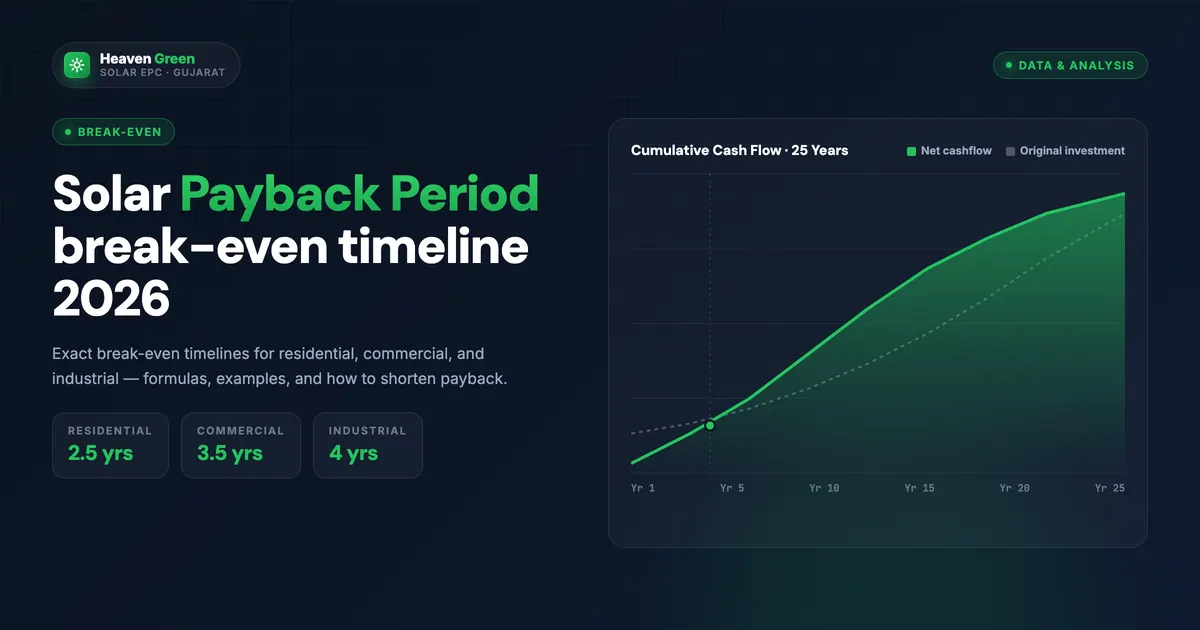
The solar payback period is the single number that matters most when deciding whether to go solar. It tells you how long it takes for your electricity bill savings to equal your initial investment. After that point, every rupee your system generates is pure profit, for up to 25 years.
In India in 2026, the average payback period for a residential solar system after the PM Suryaghar subsidy is 3 to 5 years. In some cases, especially for high-bill households in states with generous tariff structures, payback happens in under 2 years. This guide explains exactly how to calculate yours.
Key takeaway. Solar payback in India in 2026 is calculated by dividing your net system cost (after PM Suryaghar subsidy of up to ₹78,000) by your annual electricity bill savings. For a 3 kW system costing ₹57,000–₹72,000 after subsidy, with annual savings of ₹30,000–₹40,000, payback is 1.5 to 2.5 years. Heaven Green Energy provides a written payback calculation specific to your bill and city before you commit to any installation.
What Is Solar Payback Period and Why Does It Matter?
The payback period is the time it takes to recover your solar installation investment through reduced electricity bills and net metering credits.
Simple payback formula:
Payback (years) = Net system cost (₹) ÷ Annual savings (₹/year)
Where:
- Net system cost = Installation cost − Central subsidy − State subsidy
- Annual savings = (Monthly bill × Solar coverage %) × 12 + Net metering credits × 12
After the payback period, your system continues operating for another 20+ years, generating essentially free electricity (your only ongoing cost is minimal maintenance, typically ₹2,000–₹5,000/year for cleaning and inspection).
This is different from a normal purchase. When you buy a refrigerator, it never pays you back, it only consumes money. Solar is the reverse: it has an upfront cost but generates returns every month for 25 years.
The distinction between “simple payback” and “discounted payback” matters when you’re being rigorous. Simple payback ignores the time value of money (₹1 saved in year 10 is worth less than ₹1 saved today). Discounted payback accounts for this. For solar in India, where tariff escalation is 8 to 10% annually, faster than most investment returns, simple payback actually understates the case for solar.
💡 Fast tip
When comparing payback periods from different installers, always ask whether they've included the PM Suryaghar subsidy (₹78,000 for 3 kW+) in the net cost. Some brochures show gross cost (before subsidy) to inflate the "investment" and make IRR look more impressive. Always work with net cost.
The Heaven Green 4-Variable Payback Calculator
Every payback calculation involves four variables. We call this the Heaven Green Solar Payback Matrix: a four-variable model that produces an accurate payback period from your actual situation, not industry averages.
Variable 1, Net system cost (₹):
System cost − PM Suryaghar subsidy − State subsidy − Any other incentives
Variable 2, Annual generation (kWh/year):
System kW × Peak sun hours × 365 × System efficiency (0.78 to 0.82)
Variable 3, Average electricity tariff avoided (₹/kWh): Use your DISCOM’s applicable domestic slab rate, typically ₹4–₹8/unit depending on state and consumption level.
Variable 4, Annual tariff escalation rate (%): Historically 8 to 12% in India. Use 8% for conservative estimates, 10% for moderate.
Full payback calculation with tariff escalation: Year 1 savings = Annual generation × Year 1 tariff Year 2 savings = Annual generation × (Year 1 tariff × 1.08) … and so on.
Cumulative savings hit the net system cost at the payback year.
This model is more accurate than simple payback because it accounts for the fact that grid electricity gets more expensive every year, making your solar savings grow annually even as panel output gently declines from degradation.
City-by-City Payback Period Comparison (3 kW System, 2026)
| City | State Tariff (₹/unit) | Monthly Bill (3BHK avg) | Annual Savings (yr 1) | Net Cost After Subsidies | Payback Period |
|---|---|---|---|---|---|
| Ahmedabad | ₹5.50–₹6.50 | ₹2,800 | ₹28,000 | ₹47,000 | 1.5 to 2 yrs |
| Surat | ₹5.50–₹6.50 | ₹3,100 | ₹30,000 | ₹47,000 | 1.5 to 2 yrs |
| Mumbai | ₹6.50–₹8.50 | ₹4,500 | ₹40,000 | ₹57,000 | 1.5 to 2 yrs |
| Pune | ₹6.00–₹7.50 | ₹4,000 | ₹36,000 | ₹57,000 | 1.5 to 2 yrs |
| Jaipur | ₹5.50–₹6.00 | ₹3,200 | ₹28,000 | ₹57,000 | 2 to 2.5 yrs |
| Delhi | ₹4.50–₹5.50 | ₹2,500 | ₹22,000 | ₹72,000 | 3 to 4 yrs |
| Bangalore | ₹5.50–₹6.50 | ₹2,800 | ₹27,000 | ₹72,000 | 2.5 to 3 yrs |
| Chennai | ₹4.50–₹5.50 | ₹2,200 | ₹20,000 | ₹72,000 | 3.5 to 4 yrs |
Net costs reflect central subsidy only (₹78,000 for 3 kW). Gujarat figures include GEDA top-up of ₹20,000. Maharashtra figures include MEDA top-up. Sources: CEA tariff schedule 2025 to 26, MNRE benchmark costs 2025 to 26.
Gujarat consistently produces India’s best solar payback periods because it combines high irradiance (5.3 to 5.5 peak sun hours/day), above-average domestic tariffs, AND state-level GEDA subsidies on top of the central scheme.
How the PM Suryaghar Subsidy Changes Your Payback
The ₹78,000 PM Suryaghar subsidy (for 3 kW+ systems) is a direct bank transfer, not a tax benefit or a rebate on a future bill. It reduces your net system cost immediately and dramatically shortens payback.
Without subsidy (3 kW system in Surat, ₹1,45,000 gross cost):
Payback = ₹1,45,000 ÷ ₹30,000/year = 4.8 years
With ₹78,000 PM Suryaghar subsidy (₹67,000 net cost):
Payback = ₹67,000 ÷ ₹30,000/year = 2.2 years
With additional GEDA top-up (₹47,000 net cost):
Payback = ₹47,000 ÷ ₹30,000/year = 1.6 years
The subsidy alone cuts payback by more than half. This is why applying for the subsidy through an MNRE-empanelled installer is non-negotiable, it’s the single biggest lever in the financial case.
The PM Suryaghar complete guide explains the application process, eligibility, and DBT timeline.
Step-by-Step: How to Calculate Your Own Payback Period
-
Find your average monthly electricity bill: average the last 3 to 6 months’ bills. Note the total units consumed (kWh) and total amount paid (₹).
-
Calculate the system size you need: divide your daily kWh consumption by your city’s peak sun hours (from the table in the 3BHK solar design guide) and multiply by 1.2.
-
Get a written installation quote: from an MNRE-empanelled installer like Heaven Green Energy. Ensure the quote separates material cost from installation labour.
-
Subtract available subsidies: ₹78,000 PM Suryaghar (if eligible for 3 kW+) plus any state scheme amount from your state authority.
-
Calculate year-1 annual savings: (Monthly bill × 0.80 coverage) × 12 months. Add any net metering credit value for surplus generation.
-
Divide net cost by year-1 savings: this gives simple payback in years.
-
Cross-check with escalation model: if you want a more accurate view, recalculate with 8% higher savings each year and see at which year cumulative savings equal net cost.
💰 Real numbers
A Surat homeowner with a ₹4,500/month electricity bill installed a 4 kW system in 2023. Net cost after subsidy: ₹62,000. Annual savings year 1: ₹43,000. Payback: 1.4 years. By the time the system is 5 years old (2028), cumulative savings will exceed ₹2.5 lakh, a 4× return on investment.
What Affects Your Payback Period Most?
-
1
Your electricity tariff, Higher tariff states (Maharashtra, Karnataka) have faster paybacks because each solar unit saves more money. Low-tariff states (some agricultural consumers at ₹1–₹2/unit) have slower paybacks.
-
2
Subsidy availability, The ₹78,000 PM Suryaghar subsidy can halve your payback period. State top-ups reduce it further.
-
3
[Solar irradiance](/glossary/solar-irradiance) in your city, Gujarat and Rajasthan have 5.3 to 5.7 peak sun hours/day; Mumbai and coastal cities have 4.5 to 5.0. Higher irradiance means more generation, faster payback.
-
4
System quality and installer, A cheap system with poor components may generate 15 to 20% less than designed, extending payback by 1 to 2 years. BIS-certified panels and IEC inverters ensure you get the generation you paid for.
-
5
Maintenance discipline, Panels cleaned monthly maintain 97 to 99% output. Panels cleaned quarterly run at 85 to 90%. A 10% output loss adds roughly 0.5 years to payback and reduces lifetime savings by ₹50,000–₹80,000.
Payback for Commercial vs. Residential Solar
Commercial and industrial (C&I) solar has different payback dynamics from residential.
| Factor | Residential | Commercial |
|---|---|---|
| Tariff (₹/unit) | ₹5–₹8 | ₹7–₹12 |
| Subsidy | PM Suryaghar ₹78,000 | No direct subsidy (AD benefit instead) |
| System size | 1 to 10 kW | 10 kW–1 MW+ |
| Typical payback | 3 to 5 years | 4 to 7 years |
| Tax benefit | None | 40% accelerated depreciation in Year 1 |
For businesses, the Accelerated Depreciation (AD) benefit under Section 32 of the Income Tax Act allows claiming 40% of the solar system cost as depreciation in Year 1 of operation, reducing taxable income. This can be more valuable than the subsidy for profitable businesses. The solar financing options guide covers AD benefits in detail.
Get your personalised payback calculation. Our team calculates exact payback for your bill and location, free, in writing, before you commit. Get your free quote →
Pros and Cons: Simple Payback vs. Full Financial Model
- Easy to understand and verify
- Requires only 3 inputs (cost, savings, tariff)
- Conservative, tariff escalation will make actual payback faster
- Accounts for tariff escalation (8 to 10%/yr)
- Includes panel degradation (0.4%/yr)
- Shows true 25-year NPV and IRR
- More accurate for large C&I investments
How Heaven Green Energy Presents Payback to Every Customer
Heaven Green Energy provides a written financial proposal for every prospective customer, not a brochure, but a spreadsheet-based calculation using your actual bill data, your city’s irradiance, current DISCOM tariffs, and applicable subsidies.
We present both simple payback and a 10-year savings projection. If the numbers don’t make sense for your situation, we tell you, and explain why. We’ve advised homeowners with very low bills or severe shading to wait or use a different approach, because a good long-term reputation matters more than closing one sale.
- Residential Solar: subsidised systems with written payback analysis included.
- Solar Calculator: see your payback estimate in 60 seconds.
- Solar Panel Cost Breakdown: what goes into the system cost line by line.
- Contact our finance team: free consultation with payback model specific to your situation.
Frequently Asked Questions
What is a good solar payback period in India?
A payback period of 3 to 5 years is the industry benchmark for a good solar investment in India. Systems with generous subsidies (PM Suryaghar + state) and high local tariffs can achieve payback in 1.5 to 2.5 years. Anything over 7 years is generally not financially compelling, investigate why the quote is expensive or the savings are projected as low.
Does the PM Suryaghar subsidy reduce my payback period?
Dramatically, yes. For a 3 kW system costing ₹1,45,000, the ₹78,000 subsidy reduces your investment by 54%. If your annual savings are ₹30,000, the payback goes from 4.8 years (gross cost) to 2.2 years (net cost). The subsidy is a direct bank transfer, not a tax credit, so it reduces your actual cash outlay, not just a notional figure.
Should I include tariff escalation in my payback calculation?
Yes. Grid electricity tariffs in India have risen 8 to 12% annually over the past decade, according to CEA historical data. A system that saves ₹30,000/year today will save ₹43,000/year in year 5 if tariffs rise 8%/year. Including escalation produces a more accurate payback period (typically 0.5 to 1 year shorter than simple payback) and a much larger 25-year savings figure.
What is the payback period for commercial solar in India?
Commercial solar (10 kW–1 MW+) typically pays back in 4 to 7 years, depending on the state electricity tariff and whether the business claims Accelerated Depreciation (AD) under Section 32 of the Income Tax Act. The AD benefit (40% in Year 1) effectively reduces the net cost of the system and can shorten payback to 3 to 5 years for profitable businesses.
How does shading or poor maintenance affect payback?
A system that generates 15% less than designed, due to shading, soiling, or inverter underperformance, takes proportionally longer to pay back. If your 3 kW system generates 340 kWh/month instead of 400 kWh/month, your annual savings drop from ₹30,000 to ₹25,500, and your payback extends by roughly 0.5 years. This is why installation quality, site selection, and maintenance discipline directly determine your financial outcome.
Can I calculate payback if I’m using a solar loan?
Yes, but you need to account for EMI payments. Compare: what you were paying in electricity bills (before solar) versus what you pay now (EMIs + reduced electricity bill). The monthly net saving is the difference. Payback from a loan perspective is when cumulative net savings (EMI period) equals zero, i.e., when the savings fully offset the loan payments. Most customers find that their monthly net saving is positive from month 1 even while paying EMIs.