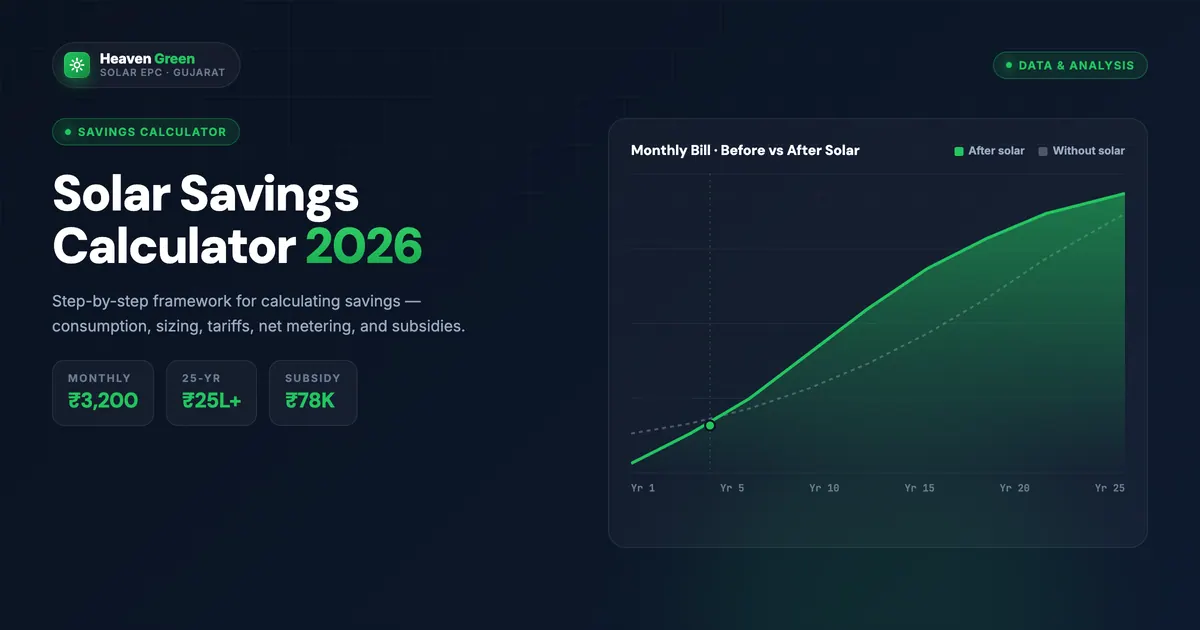
India’s average domestic electricity tariff has risen from ₹3.50/unit in 2015 to ₹5.80/unit in 2025, a 66% increase in a decade. Solar electricity, meanwhile, has become cheaper than ever to produce. The gap between what you pay for grid power and what solar costs to generate is now wider than at any point in India’s history.
For a homeowner making the solar decision in 2026, this comparison is the core financial case. What does it actually cost to produce one unit of electricity from rooftop solar, and how does that compare to what your DISCOM charges?
Key takeaway. In India in 2026, rooftop solar generates electricity at a Levelised Cost of Energy (LCOE) of ₹1.80–₹2.50 per kWh over 25 years, after accounting for all system costs and degradation. Grid electricity costs ₹5–₹9/unit for domestic consumers. Solar is 2 to 4× cheaper per unit than grid power, a difference that widens every year as grid tariffs rise and solar costs continue to fall. Heaven Green Energy installs systems that lock in this low-cost generation for 25 years.
What Is LCOE and Why Does It Matter?
Levelised Cost of Energy (LCOE) is the industry-standard metric for comparing the true cost of electricity from different sources. It accounts for the total lifetime cost of the system divided by the total lifetime energy produced.
LCOE formula:
LCOE (₹/kWh) = Total lifetime cost ÷ Total lifetime energy generated
Where total lifetime cost = upfront capital + maintenance + replacement costs.
For a rooftop solar system in India:
- Upfront cost (3 kW system): ₹1,45,000 (before subsidy)
- PM Suryaghar subsidy: −₹78,000
- State subsidy (Gujarat GEDA): −₹20,000
- Net upfront: ₹47,000
- 25-year maintenance cost: ₹1,000/year × 25 = ₹25,000
- Inverter replacement (year 12): ₹25,000
- Total lifetime cost: ₹97,000
Energy generated: 3 kW × 5.5 peak sun hrs × 365 days × 25 years × 0.78 (degradation factor) = 93,225 kWh
LCOE: ₹97,000 ÷ 93,225 kWh = ₹1.04/kWh
Even without the subsidy, the LCOE is ₹1.61/kWh (using ₹1,50,000 net cost). Compare this to the ₹5.50–₹7.00/unit you pay your DISCOM for domestic electricity in Gujarat.
💰 Real numbers
After the PM Suryaghar ₹78,000 subsidy and GEDA state top-up in Gujarat, a 3 kW rooftop solar system generates electricity at an effective LCOE of ₹1.04/kWh over 25 years, compared to ₹5.50–₹7.00/unit from UGVCL/DGVCL. Solar is 5 to 7× cheaper per unit in Gujarat when you factor in subsidies.
Grid Electricity Tariff Trends: The Rising Cost of Grid Power
Grid electricity tariffs in India have risen consistently due to fuel cost increases, transmission losses, infrastructure investment, and DISCOM financial restructuring. Understanding this trend is critical because your solar savings grow every year as the gap between solar LCOE and grid tariff widens.
| Year | National Avg Domestic Tariff (₹/unit) | YoY Change |
|---|---|---|
| 2015 | ₹3.50 | , |
| 2017 | ₹3.90 | +5.7%/yr avg |
| 2019 | ₹4.40 | +6.4%/yr avg |
| 2021 | ₹5.00 | +6.8%/yr avg |
| 2023 | ₹5.50 | +5.0%/yr avg |
| 2025 | ₹5.80 | +2.7% |
| 2030 (projected) | ₹7.80–₹9.00 | 6 to 8%/yr projected |
Source: Central Electricity Authority, Annual Tariff Reports 2015 to 2025. 2030 projection: CEEW Energy Outlook 2025.
By 2030, domestic tariffs in most Indian states are projected to reach ₹8–₹9/unit. Your solar system, installed today, generates electricity at a fixed cost of ₹1.00–₹2.50/unit for the next 25 years. The financial gap in your favour keeps widening.
City-by-City Solar vs. Grid Cost Comparison (2026)
The solar vs. grid cost advantage varies by city due to differences in local tariffs and solar irradiance.
| City | Grid Tariff (₹/unit) | Solar LCOE (₹/unit, after subsidy) | Savings Per Unit | Annual Saving (3 kW system) |
|---|---|---|---|---|
| Ahmedabad | ₹5.50–₹6.50 | ₹1.04–₹1.50 | ₹4–₹5.50 | ₹21,000–₹28,000 |
| Surat | ₹5.50–₹6.50 | ₹1.04–₹1.50 | ₹4–₹5.50 | ₹21,000–₹28,000 |
| Mumbai | ₹6.50–₹9.00 | ₹1.30–₹1.80 | ₹5–₹7 | ₹26,000–₹36,000 |
| Jaipur | ₹5.50–₹6.00 | ₹1.10–₹1.55 | ₹4–₹5 | ₹20,000–₹25,000 |
| Delhi | ₹4.50–₹6.50 | ₹1.35–₹1.90 | ₹3–₹5 | ₹16,000–₹26,000 |
| Bangalore | ₹5.00–₹7.00 | ₹1.35–₹1.85 | ₹3.50–₹5.50 | ₹18,000–₹28,000 |
| Chennai | ₹4.50–₹6.00 | ₹1.25–₹1.75 | ₹3–₹4.50 | ₹15,000–₹23,000 |
Solar LCOE range reflects systems with full subsidy (lower end) to systems without subsidy (higher end). Annual savings based on 5,250 kWh annual generation for 3 kW system with 5.0 to 5.5 peak sun hours.
The Heaven Green 25-Year Cost Model: Solar vs Grid
Rather than just comparing current costs, the most compelling comparison is over 25 years, the full panel life.
Scenario: 3 kW on-grid solar in Ahmedabad, 2026
Cumulative grid electricity cost (no solar):
- Year 1 consumption at 5.50/unit: ₹26,400/year
- Growing at 8%/year over 25 years
- Total 25-year grid cost: approximately ₹18.6 lakh
Cumulative solar cost (with PM Suryaghar + GEDA):
- Net system cost: ₹47,000
- Annual maintenance: ₹2,000 × 25 = ₹50,000
- Inverter replacement (year 12): ₹25,000
- Residual grid draw (20% of consumption not covered by solar): approximately ₹5.2 lakh
- Total 25-year solar cost: ₹6.2 lakh
25-year savings: ₹18.6L − ₹6.2L = ₹12.4 lakh
This is the Heaven Green 25-Year Solar vs Grid Cost Model: a financial tool we use in every customer proposal to show the true lifetime value of solar vs. staying on the grid.
Why Grid Tariffs Will Keep Rising
Understanding why grid tariffs rise helps you appreciate why the solar savings advantage grows over time.
Fuel cost pass-through: Thermal power stations (which generate ~60% of India’s electricity) run on coal. Coal prices are volatile. Fuel cost increases are passed through to consumers via tariff adjustments, which DISCOMs file annually with State Electricity Regulatory Commissions (SERCs).
DISCOM losses and cross-subsidies: India’s DISCOMs have accumulated significant financial losses due to below-cost agricultural tariffs and technical/commercial distribution losses. These losses are gradually being recovered through domestic tariff increases over multiple years.
Infrastructure investment: India’s transmission and distribution (T&D) infrastructure requires massive investment to accommodate renewable energy integration and improve reliability. These capital costs are recovered through the fixed and variable components of your electricity bill.
AT&C losses: Aggregate Technical and Commercial losses in India’s distribution network average 17 to 20%, per CEA’s Annual Report 2025. These losses represent electricity that is generated but not billed, a cost that compliant consumers effectively subsidise.
Solar insulates you from all of these cost pressures because your solar electricity is generated and consumed locally, no transmission, no distribution losses, no fuel cost.
See your personalised 25-year savings model. Our team builds a custom financial comparison for your home. Get your free quote →
Solar Cost Trend: Why It Keeps Falling
Solar’s LCOE has fallen by over 89% globally since 2010, according to IRENA’s Renewable Power Generation Costs 2025 report. In India specifically, rooftop solar system costs have dropped from ₹120/Wp in 2012 to ₹45–₹50/Wp in 2026 for residential systems.
The main drivers:
- Manufacturing scale: global solar panel production has grown 100× in 15 years
- Efficiency improvements: mainstream panels have gone from 16% to 22 to 24% efficiency
- Balance-of-system cost reduction: inverters, mounting structures, and cables have all become cheaper
- India’s domestic manufacturing growth (PLI scheme), reducing import dependence
The benchmark cost for a grid-connected 1 to 3 kW residential system under the MNRE benchmark for 2025 to 26 is ₹45–₹50/Wp, roughly ₹45,000–₹50,000 per kW before subsidy.
Pros and Cons of Solar vs. Grid Electricity
- LCOE of ₹1–₹2.50/unit, 2 to 5× cheaper than grid
- Fixed cost, immune to tariff hikes
- No distribution losses, generated and consumed on-site
- ₹78,000 subsidy reduces capital cost significantly
- Zero carbon emissions from generation
- Upfront capital required (₹47,000–₹1,50,000 after subsidy)
- Generates only during daylight, no night-time generation
- Seasonal variation (monsoon months produce 35 to 40% less)
- Requires roof space and DISCOM approval process
Common Questions When Comparing Solar vs. Grid
“But I still pay a grid bill after solar, isn’t that a failure?” No. After solar, you still draw from the grid at night and during monsoon periods. The bill is simply much smaller. Your goal is to maximise self-consumption during solar generation hours and use the grid as backup, not to achieve a ₹0 bill.
“What if grid electricity becomes cheaper in the future?” Extremely unlikely given India’s current tariff trajectory and DISCOM financial situation. Even if tariff growth slows to 4% annually (half the historical rate), your solar LCOE still beats the grid tariff for the full 25-year system life. The risk of tariff escalation is asymmetric, it can only go up from the DISCOM’s perspective.
“What about the export tariff, isn’t that still just ₹2–₹3/unit?” Yes, which is why maximising self-consumption (using the solar power directly rather than exporting it) is important. The financial model is strongest when most of your solar generation is directly consumed, replacing expensive grid imports at ₹5.50–₹9/unit.
How Heaven Green Energy Builds Your Cost Comparison
Every Heaven Green Energy proposal includes a 25-year solar vs. grid cost comparison built from your actual electricity bills and local DISCOM tariff. We use conservative assumptions (6% annual tariff escalation, not the historical 8 to 10%) to ensure our payback projections are achievable, not optimistic.
- Residential Solar: systems designed to maximise your solar vs. grid cost advantage.
- Solar Payback Period India Guide: the full payback calculation methodology.
- Solar Calculator: get your personalised solar vs. grid cost comparison.
- Contact our finance team: free written cost comparison, same-day callback.
Frequently Asked Questions
What is the actual cost of producing solar electricity in India in 2026?
The Levelised Cost of Energy (LCOE) for rooftop solar in India in 2026, after the PM Suryaghar subsidy, ranges from ₹1.00 to ₹2.50 per kWh over a 25-year system life. Without subsidy, LCOE is ₹1.60–₹3.00/kWh. Compare this to current domestic grid tariffs of ₹4.50–₹9/unit, solar is 2 to 5× cheaper in most Indian cities.
Will grid electricity tariffs keep rising in India?
Historical data from the Central Electricity Authority shows domestic tariffs have risen 6 to 10% annually since 2015. Given DISCOM financial restructuring, fuel cost volatility, and infrastructure investment needs, tariff escalation is expected to continue at 6 to 8%/year through 2030. Solar installed today locks in a fixed generation cost, protecting you from future tariff increases.
Is solar LCOE the same as what I pay per unit?
Not exactly. LCOE is the average cost per unit over the system’s entire 25-year life, including upfront capital and maintenance. In year 1 (after subsidy), your effective cost per solar unit is higher than LCOE (capital is being amortised). By year 5 to 6 (post-payback), the effective cost per unit drops to near-zero. LCOE is the averaged figure across all 25 years.
How does India’s solar cost compare to global benchmarks?
India’s rooftop solar LCOE (₹1.60–₹2.50/kWh without subsidy) is among the lowest in the world for utility and large-scale projects, according to IRENA’s 2025 global renewable cost report. Rooftop residential costs are slightly higher than utility-scale due to smaller order quantities, but still very competitive globally. India’s high irradiance (4.5 to 5.7 peak sun hours/day in most regions) is a major natural advantage.
What happens to my solar savings if electricity becomes cheaper?
If grid tariffs somehow decreased (extremely unlikely), your savings would shrink, but you’d still generate at near-zero marginal cost post-payback. The installed system has already been paid off and continues generating at essentially free cost. Even in a scenario of flat grid tariffs, solar’s post-payback economics are strongly positive.
Does net metering make solar more cost-competitive than LCOE suggests?
Yes, net metering significantly improves solar’s financial case. Without net metering, any surplus generation would be wasted, reducing effective generation utilisation. With net metering, even surplus units earn ₹2–₹3.50/unit export credit, bringing your blended revenue per kWh closer to the average grid tariff. For well-designed systems with 60 to 70% self-consumption, the effective savings per unit are ₹4.50–₹7/unit (a blend of avoided import cost and export credit).