A solar warranty claim in India succeeds or fails on paperwork, not on the defect itself. Across our 10,000+ installations, the homeowners who get replacements within weeks are the ones who can produce a serial number, a commissioning certificate, and monitoring screenshots on day one. The ones who wait 4 months usually cannot. This guide walks you through the exact claim process for panels and inverters in India in 2026: which warranty applies, who to contact first, what documents to attach, how long each stage takes, why claims get rejected, and how to escalate to the consumer forum if the brand refuses a valid claim.
Direct answer. To file a solar warranty claim in India, first identify the warranty type (product, performance, or workmanship), collect the serial number, invoice, and commissioning certificate, then contact your installer or the brand’s service desk with photo and monitoring evidence. Most claims resolve in 2 to 12 weeks. If rejected unfairly, escalate via the National Consumer Helpline (1915) and the Consumer Protection Act 2019. Heaven Green Energy files and tracks manufacturer claims on behalf of every customer we install for.
Before you start, make sure you understand which of the three warranties your system carries. Our parent guide on solar warranty types explained covers the coverage terms; this post covers the claim process itself.
Product Warranty Claim vs Performance Warranty Claim: Which One Applies?
The warranty you claim under decides who assesses the fault, what evidence you need, and what compensation you get. Filing under the wrong warranty type is one of the top reasons Indian claims stall.
A product warranty claim covers physical manufacturing defects: delamination, junction box failure, frame corrosion, glass cracks from internal thermal stress, and burnt connectors. You prove it with photographs and the serial number. The remedy is usually a free replacement panel or inverter.
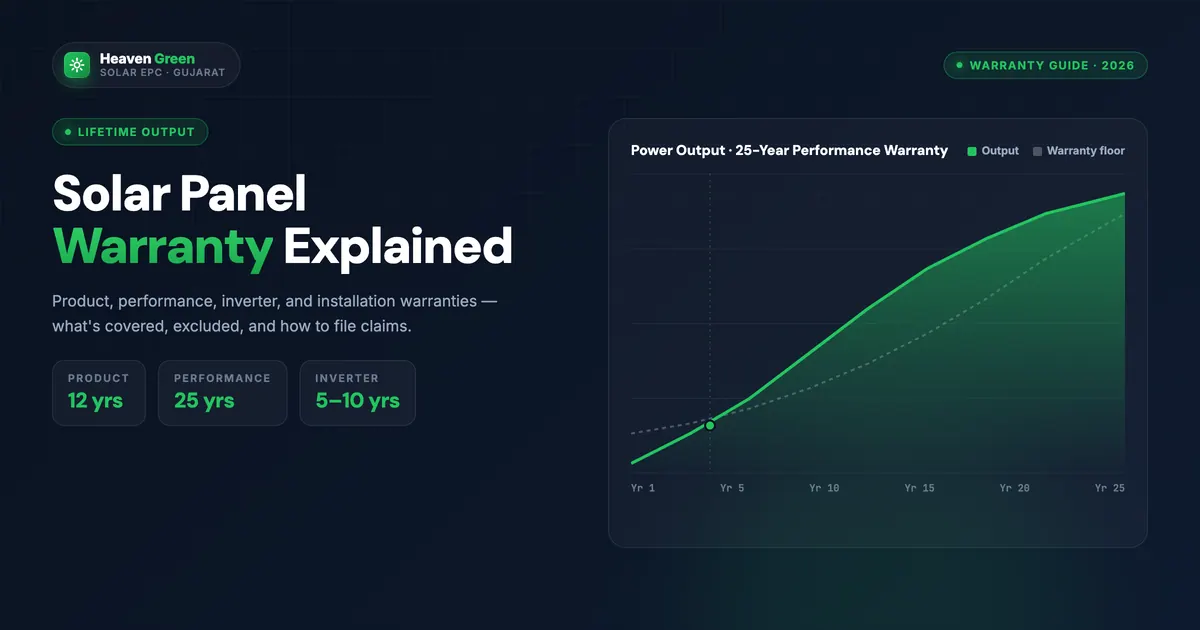
A performance warranty claim covers output that has fallen below the guaranteed level, for example below 80% of nameplate at year 25 under the standard linear warranty. You prove it with generation data or a performance ratio test, not photographs. The remedy can be a replacement, a compensating panel, or a cash settlement depending on the brand.
A workmanship warranty claim covers installation faults: roof leaks at mounting points, loose MC4 connections, failed earthing installed by the EPC. You claim this against your installer, not the manufacturer.
| Claim type | Filed against | Key evidence | Typical remedy | Standard period |
|---|---|---|---|---|
| Product (panels) | Panel manufacturer | Photos, serial number, invoice | Replacement panel | 10-15 years |
| Performance (panels) | Panel manufacturer | Generation data, PR test report | Replacement, extra panel, or credit | 25-30 years |
| Product (inverter) | Inverter manufacturer | Error codes, serial number, logs | Repair or replacement unit | 5-10 years |
| Workmanship | Your EPC installer | Photos, installation records | Free repair visit | 5 years (PM Suryaghar minimum) |
The distinction matters because brands reject misfiled claims fast. A panel showing 15% output loss with no visible defect is a performance claim. A panel with a cracked junction box is a product claim. Mixing them up gives the service desk an easy reason to bounce your file back. For degradation-specific claim thresholds, read our post on the solar panel degradation warranty truth.
The Claim-Ready File: Documents You Need Before You File
Every successful claim we have processed at Heaven Green Energy started with a complete documentation pack. We call it The Claim-Ready File, six records that answer every question a manufacturer’s service desk will ask. Homeowners who maintain this file resolve claims in weeks. Homeowners who do not spend months reconstructing paperwork.
The six components of The Claim-Ready File:
- Purchase invoice from your installer, showing system size, component models, and date. This proves the purchase channel and date.
- Warranty cards or certificates for panels, inverter, and structure, with registration confirmation where the brand requires it. Adani Solar, for example, expects warranty registration at installation; our Adani Solar warranty guide explains that process.
- Serial number register for every panel and the inverter. Panel serials are on the back sheet or frame. Photograph them at installation because ladders and rooftops get less accessible every year.
- Commissioning certificate and net meter documents from your DISCOM. This anchors the official start date of your warranty clock.
- Earthing and surge protection proof, meaning photos of the earthing pits, earth resistance readings, and the SPD (surge protection device) in your distribution box. Homeowners on X repeatedly report claims rejected for “improper earthing” or “missing SPD” even when the brand’s own dealer did the installation. This one photo set kills that rejection reason.
- Monitoring evidence: screenshots from your inverter app showing the error code, the output drop, or the dead unit, with dates visible.
⚠️ Watch out
Never let a technician take the failed inverter or panel away without a written job sheet noting the serial number, the fault, and the date. Homeowners on X report brands later claiming they never received the unit. A signed pickup receipt is your only proof.
Store all six in one cloud folder and one physical file. If your panels are genuine and registered, verification is simple; our guide to verify genuine Adani panels shows the serial-check process that also confirms warranty registration status.
Who Should You Contact First: Installer or Brand?
Contact your installer first if they are still active and the fault might be installation-related. Contact the brand directly if the installer is unresponsive, has shut down, or the fault is clearly a manufacturing defect. Getting this routing wrong costs you weeks.
Your installer is the right first call for three situations. First, any fault within the workmanship warranty period, typically 5 years for MNRE-empanelled installers under the PM Suryaghar guidelines. Second, performance complaints, because the installer can rule out shading, soiling, and inverter settings before the manufacturer gets involved. Third, any claim where you want help, because a good EPC files manufacturer claims for you and knows each brand’s evidence format.
The brand is the right first call when the installer is gone or unresponsive, when the defect is visibly a manufacturing failure, or when the inverter brand runs its own service network (most do). Panel manufacturers like Adani Solar, Waaree, and Tata Power Solar handle claims through regional service teams. Inverter brands handle claims through their apps and toll-free lines.
| Situation | First contact | Why |
|---|---|---|
| Roof leak at mounting point | Installer | Workmanship warranty, installer’s liability |
| Inverter dead, error code showing | Inverter brand service app | Brand owns repair or replacement |
| Panel junction box burnt | Installer first, brand next | Installer files the product claim faster |
| Output 20% below expectation | Installer | Rule out soiling and shading first |
| Installer company closed | Brand directly | Warranty attaches to the equipment |
| Installer blaming brand, brand blaming installer | Both, in writing | Creates a paper trail for escalation |
Verdict. Default to the installer when they are responsive, because they carry the workmanship warranty and the claim relationships. The moment they go silent for more than 7 days, go direct to the brand in writing and keep every email.
If your installer has vanished entirely, the claim path changes. Read our guide on what to do when your solar installer abandoned your project, and then approach the panel and inverter brands directly with your Claim-Ready File.
Facing an unresponsive installer or a stalled claim? Our service team handles warranty claims for systems across Gujarat, including systems we did not install. Request a callback.
How to File a Solar Warranty Claim Step by Step
The claim process for panels and inverters in India follows the same eight steps regardless of brand. The only variables are the portal or email you submit to and the assessment timeline.
- Identify the warranty type. Product, performance, or workmanship. Use the table in the first section of this post.
- Assemble The Claim-Ready File. Invoice, warranty card, serial numbers, commissioning certificate, earthing and SPD photos, monitoring evidence.
- Raise a written ticket. Use the brand’s official channel: service app (Sungrow iSolarCloud, Growatt ShinePhone, Huawei FusionSolar), toll-free number, or the warranty email on the warranty card. Always get a ticket or complaint number. Verbal complaints on a phone call do not exist when you escalate later.
- Send the evidence pack within 24 hours. Serial numbers, dated photos, error-code screenshots, and a one-paragraph fault description saying when you first noticed the problem.
- Record the inspection. The brand or its service partner schedules a site visit, typically within 7-15 days. Be present. Ask the technician to write findings on the job sheet, and photograph the job sheet.
- Get the assessment in writing. Approval, rejection with reason, or request for more evidence. If the technician says “approved” verbally, ask for the confirmation email before they leave.
- Confirm the remedy and timeline in writing. Replacement unit model, expected delivery date, and who pays for labour, transport, and reinstallation. Most brands cover the part but charge or delegate the labour.
- Verify and close. Test the replacement for 7 full days before closing the ticket. Homeowners on X report replacement inverters failing within hours; closing the ticket early restarts your queue position.
💡 Fast tip
Write every claim email as if a consumer forum judge will read it later: dates, ticket numbers, technician names, and what was promised. Most claims never reach a forum, but the ones that do are won on exactly this record.
For inverter faults, basic troubleshooting before you file can either fix the issue or strengthen your evidence. The QBits Energy guide to solar inverter troubleshooting walks through error codes and reset steps that service desks will ask about first. If you need replacement equipment outside warranty, our solar inverter product range and solar module range list BIS-certified options with current warranty terms.
How Long Does a Solar Warranty Claim Take?
A clean, fully documented claim takes 2 to 6 weeks for panels and 1 to 4 weeks for inverters. A claim with missing documents, a disputed fault cause, or a stock-out of the replacement part takes 1 to 4 months, which matches what Indian homeowners report publicly.
The stages and their realistic durations:
| Stage | Clean claim | Disputed or documented poorly |
|---|---|---|
| Ticket to first response | 2-5 days | 7-15 days |
| Site inspection | 7-15 days | 3-6 weeks |
| Assessment decision | 1-2 weeks | 4-8 weeks |
| Replacement delivery | 1-3 weeks | 1-3 months (stock-out) |
| Total | 2-6 weeks | 3-6 months |
Complaints on X show the pattern clearly: inverter tickets sitting unanswered for 13-15 days, replacements stuck on “stock unavailability” for a month, and a few cases open for 2 to 4 months. Almost every stalled complaint we reviewed had one thing in common: no written ticket number or no serial number in the first submission. The clock at most brands does not start until your evidence pack is complete.
An AMC (annual maintenance contract) changes this math because your AMC provider files and chases the claim for you. See solar AMC cost and what a solar AMC includes for how claim assistance is bundled.
Why Do Solar Warranty Claims Get Rejected?
Claims get rejected for a short, predictable list of reasons. Homeowner complaints on X and our own service experience converge on the same five causes.
-
1
Missing or failed earthing. The single most cited rejection reason in Indian inverter claims. Brands treat earthing faults as installation errors, which pushes the claim out of product warranty. Keep your earth resistance test report and pit photos.
-
2
No surge protection device (SPD). Voltage surge damage is excluded in most inverter warranties. If your ACDB has no SPD, the brand calls the failure an "external cause" and may charge you up to 80% of the unit cost for repair, a figure homeowners on X report verbatim.
-
3
Unregistered or unverifiable warranty. Some brands require registration within 30-90 days of installation. If your installer never registered the panels, the brand's system shows nothing to claim against.
-
4
Physical damage filed as a manufacturing defect. Hail cracks, monkey damage, and falling branches are insurance claims, not warranty claims. Brands reject these fast, and they are right to.
-
5
Tampering or unauthorised repair. Opening the inverter, altering the serial label, or a local electrician's repair attempt voids coverage instantly under every major brand's terms.
Two of these five (earthing and SPD) are install-quality issues, which is why your choice of installer decides your claim experience years later. The BIS portal lets you verify that your panel model holds IS 14286 certification, which is also a precondition for PM Suryaghar subsidy and strengthens any defect claim. And prevention beats claims: the annual solar maintenance checklist from QBits Energy covers the earthing and SPD checks that keep your warranty valid.
Escalation: From Brand Support to the Consumer Forum
When a brand rejects a claim you believe is valid, or goes silent for more than 30 days, India gives you a clear escalation ladder under the Consumer Protection Act 2019. Warranty refusal without valid justification is a deficiency in service, and solar consumers win these cases.
- Written grievance to the brand’s nodal or grievance officer. Send a formal email citing your ticket numbers, attaching your full evidence pack, and giving 15 days to resolve. Most large brands have a published grievance escalation email.
- National Consumer Helpline (NCH), 1915. File at consumerhelpline.gov.in or call 1915. NCH mediates directly with the company, and many brands settle here to avoid forum cases. Complaints on X show homeowners tagging Jago Grahak Jago and getting movement within days of an NCH filing.
- E-Daakhil filing at the District Consumer Commission. For claims up to ₹50 lakh, the District Commission has jurisdiction, and you can file online from home via the e-Daakhil portal. Court fees are nominal, and you do not need a lawyer for straightforward warranty disputes. Press reports on X include a consumer court ordering a solar firm to pay ₹25,265 compensation for a failed installation.
- MNRE or DISCOM complaint for subsidised systems. If your system was installed under PM Suryaghar by an empanelled vendor, a complaint to the MNRE grievance channel or your DISCOM adds regulatory pressure, because empanelment can be suspended for service failures.
📘 Regulation note
Under the Consumer Protection Act 2019, consumer commissions must attempt to resolve complaints within 3 months (5 months if product testing is needed). Keep every ticket number, email, and job sheet; the entire case is decided on your written record. File within 2 years of the cause of action.
One honest caveat: escalation works when your claim is genuinely valid and well documented. If the brand’s rejection reason is real, for example genuine surge damage with no SPD installed, a consumer forum will reach the same conclusion. Spend your escalation energy on claims where the evidence is on your side.
How Heaven Green Energy Helps
Heaven Green Energy treats warranty claims as part of the installation, not an afterthought. Every system we commission gets a registered warranty, a serial number register archived in our customer database, earthing test reports, and SPDs fitted as standard in every ACDB we build. When a panel or inverter fails at year 7, you call one number, +91 63904 05060, and our service team files and chases the manufacturer claim for you, including the evidence pack and the replacement scheduling. We also assist owners of systems we did not install, because a stalled claim usually just needs the documentation assembled properly.
- Residential Solar: 5-year workmanship warranty, registered equipment warranties, and lifetime claim assistance on every installation.
- Solar Inverters: BIS-certified inverters with 5-10 year warranties and active India service networks.
- Solar Modules: Tier 1 panels with 25-30 year performance warranties, registered within 48 hours of commissioning.
- Contact our service team: claim assistance, fault diagnosis, and AMC plans for existing solar owners.
Want a claim filed for you? Send us your invoice and a photo of the fault. Our team responds within 24 hours with the claim path and the documents needed. Start your claim request.
Frequently Asked Questions
Can I claim a solar panel warranty without the original invoice?
It is difficult but not always impossible. The invoice is the primary proof of purchase date and channel. Without it, brands can sometimes verify the installation through the serial number registration record, provided the installer registered the warranty at commissioning. This is one more reason to confirm registration in the brand’s system in the first month. If neither invoice nor registration exists, your claim depends entirely on the brand’s goodwill, and most will refuse.
How long do I have to file a warranty claim after a fault appears?
File within 30 days of noticing the fault. Most warranty terms do not specify a claim window within the coverage period, but delays hurt you in two ways. Secondary damage spreads, a small junction box fault becomes a burnt connector, and the brand can argue the delay worsened the failure. For consumer forum cases, the limitation period is 2 years from the cause of action under the Consumer Protection Act 2019.
What if my installer has shut down? Can I still claim?
Yes. Panel and inverter warranties are issued by the manufacturers and attach to the equipment, not to the installer. Contact the brand directly with your Claim-Ready File. What you lose is the workmanship warranty and the claim assistance, which is why installer longevity matters at purchase time. Our guide on what to do when your solar installer abandons you covers the full recovery path.
Does a warranty replacement come with a fresh warranty period?
Usually not. Most brands continue the original warranty from the original installation date, so a panel replaced at year 8 carries the remaining years of the initial warranty. A few brands offer a short fresh warranty on the replacement unit itself, commonly 1-2 years. Get the replacement warranty terms in writing before you accept the remedy.
Will the brand charge me for labour or transport on a warranty replacement?
Often yes. Most panel and inverter warranties cover the part, while labour, transport, and reinstallation are either chargeable or delegated to a local service partner. Clarify this in writing at the assessment stage. If your installer holds a workmanship warranty or you have an AMC, they may absorb the labour cost.
Can I file a consumer forum complaint online for a solar warranty dispute?
Yes. The e-Daakhil portal lets you file at the District Consumer Commission fully online, including fee payment and video hearings. You need your complaint summary, evidence pack, and the opposite party’s registered address. District Commissions handle claims up to ₹50 lakh, which covers every residential solar dispute. NCH (1915) is worth trying first because it is faster and free.
Does home insurance cover what the warranty rejects?
Sometimes. Standard warranties exclude physical damage from hail, storms, floods, fire, and theft, which is exactly what a home insurance policy with a solar equipment add-on covers. If your claim was rejected as an “act of nature,” ask your home insurer whether the installed system is covered. The premium for adding rooftop solar to a home policy is typically modest relative to a ₹1.5-3 lakh system value.
What is the single most important thing to do at installation to protect future claims?
Photograph every panel serial number and the earthing installation on commissioning day. Those two records answer the two questions that decide most Indian claims: which exact unit failed, and whether the electrical installation met the warranty conditions. Everything else, invoice, warranty card, commissioning certificate, your installer should hand you in a handover file. If they do not, ask for it in writing that week.