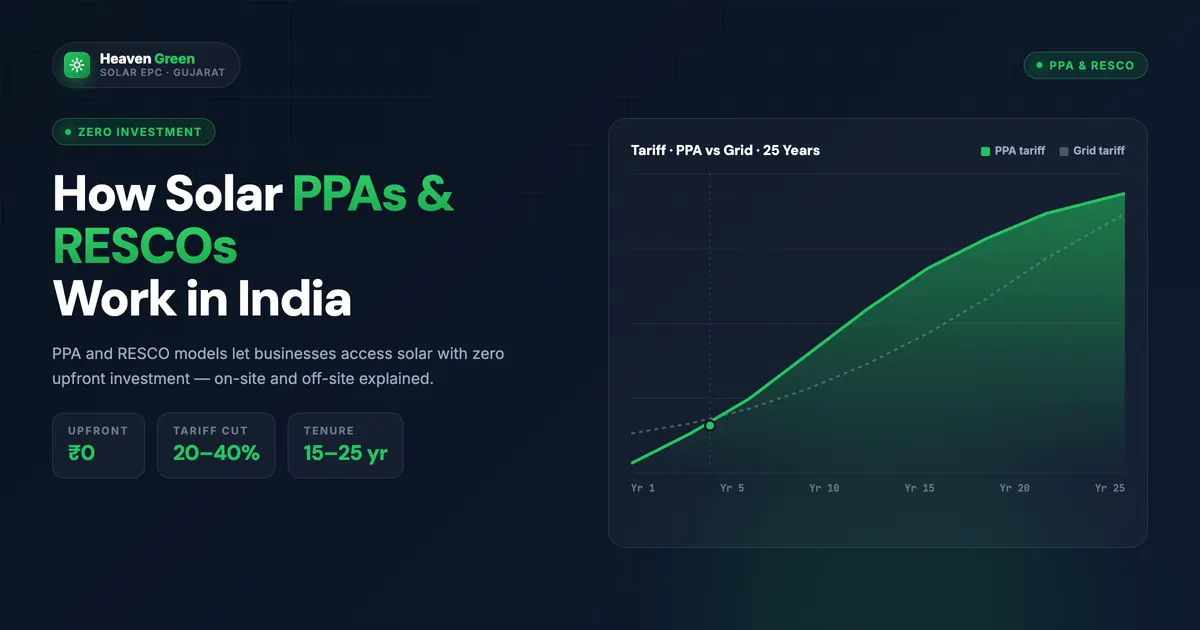
The single biggest reason businesses and homeowners delay going solar is the upfront capital requirement. A 100 kW industrial system costs ₹45 to 55 lakh, and there is no central capital subsidy for commercial and industrial rooftops. Most SMEs and hospitals don’t have that sitting in a current account. The good news: you don’t need to. India’s OPEX (Operational Expenditure) and PPA (Power Purchase Agreement) models let you install solar at zero down payment: you simply pay for the electricity you use at a fixed per-unit rate, typically lower than your DISCOM tariff.
Key takeaway. Zero down payment solar in India works through OPEX/PPA models where a developer (RESCO) installs the system at their cost and you pay ₹3.50–₹5.50 per kWh for 15 to 25 years, usually 15 to 30% below your current electricity tariff. Heaven Green Energy offers OPEX arrangements for commercial and industrial clients in Gujarat. Residential buyers can cut upfront cost with the PM Surya Ghar subsidy and a PSU-bank solar loan.
This guide covers how OPEX and PPA contracts are structured, what rates to expect, what the fine print says, and how to decide whether zero-capex solar is right for your situation.
How Zero Down Payment Solar Works: The OPEX / RESCO Model
In a traditional CAPEX solar model, you buy the system outright (or with a loan) and own it from day one. In the OPEX model, a developer, formally called a RESCO (Renewable Energy Service Company), installs the solar plant on your roof or land at their own expense. You sign a PPA (Power Purchase Agreement) specifying:
- The PPA rate (₹ per kWh you will pay)
- The contract term (typically 15 to 25 years)
- Annual escalation (if any, usually 0 to 3% per year or zero-escalation contracts)
- Metering and billing arrangements
- End-of-contract options (buyout, renewal, removal)
The RESCO recovers its investment through the PPA payments over the contract term. You get solar power at below-market rates without spending anything upfront. For a detailed explanation of how PPA and RESCO structures work in India, see our solar PPA and RESCO guide.
The glossary definition of OPEX model distinguishes it from CAPEX: in OPEX, the asset stays on the developer’s balance sheet; in CAPEX, it is on yours.
Typical PPA Rates in India 2026
PPA rates vary by project size, location, roof conditions, system specification, and developer’s cost of capital. Here are indicative 2026 market rates:
| Project Type | System Size | Typical PPA Rate | DISCOM Grid Rate | Savings vs. Grid |
|---|---|---|---|---|
| Industrial (LT) | 100 to 500 kW | ₹3.50–₹4.50/kWh | ₹7–₹9/kWh | 40 to 55% |
| Commercial (office/hospital) | 20 to 100 kW | ₹4.00–₹5.00/kWh | ₹7–₹9/kWh | 35 to 50% |
| Residential (group housing) | 20 to 50 kW | ₹4.50–₹5.50/kWh | ₹5–₹7/kWh | 15 to 30% |
| Agricultural feeders (PM-KUSUM C, feeder level) | Feeder-scale plants | Developer sells to the DISCOM | Govt subsidised | Scheme period ended 31 Mar 2026; awaits PM-KUSUM 2.0 |
Indicative market ranges from project quotes, not a published survey. Actual rates vary by project and developer.
Industrial buyers save the most in absolute rupee terms, a 100 kW plant at ₹4.00 PPA rate vs. ₹8.00 grid saves ₹4.00/kWh × 10,000 kWh/month = ₹40,000 per month in electricity costs, with zero capital outlay.
The Zero-Capex Solar Decision Framework
At Heaven Green Energy, we use the Zero-Capex Suitability Test to help clients decide whether OPEX/PPA or CAPEX is better for their specific situation. Five questions determine the answer:
Scoring: 0 “yes” to the pro-CAPEX questions → go OPEX. 3 or more → CAPEX is better. 1 to 2 → model both with your CA.
What the PPA Contract Must Include
A legitimate PPA is a multi-page legal document. Watch for these critical clauses:
OPEX vs. CAPEX: Full Comparison
| Factor | OPEX / PPA | CAPEX (Owned) |
|---|---|---|
| Upfront cost | ₹0 | ₹40–₹60 lakh (100 kW) |
| Savings per unit | 35 to 55% below grid | 75 to 90% (near-zero marginal cost) |
| System ownership | RESCO | You |
| AD tax benefit | RESCO claims it | You claim it |
| GST ITC | RESCO benefits | You benefit |
| O&M responsibility | RESCO | You (or paid AMC) |
| Balance sheet impact | Off-balance-sheet | Adds asset + liability |
| End-of-life ownership | Transfer or remove | You own and upgrade |
| Best for | Low-capital SMEs, tenants | Profitable businesses, owners |
Verdict. OPEX is ideal when capital is the primary constraint and you don’t need AD tax benefit. CAPEX (with a loan if needed) delivers better long-term returns for profitable businesses that own their premises.
Residential Zero Down Payment Solar: What’s Available?
For homeowners, true zero-down-payment solar is less common than for commercial buyers because household roof systems are smaller and the PPA economics are tighter for the developer. However, a few routes exist:
PSU-bank solar loans under PM Surya Ghar: public sector banks lend for home rooftop solar on scheme terms. SBI, for example, charges 5.75% up to ₹2 lakh and 7.90% from ₹2 lakh to ₹6 lakh, over up to 120 months, with nil processing fee and a minimum 10% margin. A ₹2 lakh loan at 5.75% over 120 months works out to an EMI of about ₹2,200, and the subsidy is credited to the loan account, which cuts the outstanding balance.
PM Suryaghar subsidy + bank loan: the central subsidy (up to ₹78,000) covers roughly 35 to 45% of a typical 3 kW system’s cost; check whether your state adds a top-up (Gujarat does not). Because PSU-bank loans need a minimum margin (10% at SBI) and the subsidy is credited only after DISCOM inspection, your upfront cash comes down to that margin rather than zero. The PM Suryaghar portal is where you apply, choose a registered vendor and add your loan details. See our PM Suryaghar complete guide for how to stack these.
Group housing / RWA solar: residential societies with 50+ units can access OPEX arrangements similar to commercial projects, with PPA rates of ₹4.50–₹5.50 per kWh.
Pros and Cons of Zero Down Payment OPEX Solar
- Zero upfront cost, immediate electricity savings from day one
- All O&M is the developer's problem
- Balance sheet stays clean, off-balance-sheet financing
- Fixed or predictable electricity cost for 15 to 25 years
- You don't own the asset, no AD or ITC benefit
- Long contract term (15 to 25 years) reduces flexibility
- Total cost over life of contract may exceed CAPEX approach
- Developer credit risk, what if the RESCO goes bankrupt?
How Heaven Green Energy Helps with OPEX Arrangements
Heaven Green Energy structures OPEX/PPA arrangements for commercial and industrial clients across Gujarat, including hospitals, hotels, textile mills, and educational institutions. Our contracts include guaranteed performance clauses, zero-escalation PPA rates, and comprehensive O&M coverage for the full contract term.
- Commercial Solar: OPEX and CAPEX modelling with side-by-side NPV comparison for your project.
- Industrial Solar EPC: zero-capex arrangements for 100 kW+ with 25-year performance commitment.
- Solar Calculator: model OPEX savings vs. CAPEX payback for your exact consumption profile.
- Learn about hidden financing costs: understand the total cost of both models before deciding.
Contact our team at +91 63904 05060 or request a callback for a zero-capex feasibility assessment.
Frequently Asked Questions
Is zero down payment solar really free in India?
It is not free, you pay for the electricity you use at a PPA rate of ₹3.50–₹5.50/kWh. What costs ₹0 is the upfront installation, equipment, and maintenance. The developer recoups their investment through your PPA payments over 15 to 25 years. The benefit is that your PPA rate is typically 15 to 55% below what your DISCOM charges, depending on the segment, so you pay less than you did before.
What is the difference between OPEX, PPA, and RESCO?
These three terms are often used interchangeably. RESCO (Renewable Energy Service Company) is the type of entity that provides the service. OPEX describes the financial structure where you treat solar as an operational expense rather than capital investment. PPA (Power Purchase Agreement) is the legal contract that governs the arrangement, it specifies the rate, term, and obligations. All three describe the same zero-capex solar model from different angles.
Who owns the solar panels in a PPA arrangement?
The developer (RESCO) owns the solar panels for the entire duration of the PPA contract. This is why the developer claims Accelerated Depreciation, not you. At contract end, some agreements allow you to buy the system at fair market value; others require the RESCO to remove the equipment. Negotiate the end-of-life clause carefully.
Is OPEX solar available for residential homes in India?
Pure OPEX/RESCO for individual homes is uncommon due to the small system size making the economics tight for developers. However, group housing societies (50+ units) can access OPEX arrangements. For individual homeowners, a combination of PM Suryaghar subsidy (up to ₹78,000) and a PSU-bank solar loan with nil processing fee brings the upfront cost down to the loan margin (a minimum of 10% at SBI).
What happens if the RESCO company goes bankrupt?
This is the key risk in OPEX solar. Best protection: (1) insist on a performance bond or escrow in the PPA, (2) ensure the equipment warranty (25 years from manufacturer) is assigned to you in the contract, and (3) choose a financially stable, established RESCO with a track record. Note that MNRE’s PM Surya Ghar subsidy guidelines do not cover RESCO models; those are dealt with separately. Heaven Green Energy has been operating since 2017 with over 10,000 installations and no project abandonment.
Can I switch from OPEX to CAPEX mid-contract?
Most PPA contracts allow buyout, you pay the RESCO the net present value of the remaining PPA payments and take ownership of the system. This is called the “buyout option.” Many contracts specify the buyout price formula at Year 5, Year 10, and Year 15. If you believe electricity prices will spike, buying out the PPA early can be financially wise. Check your specific contract terms.
How do I compare OPEX vs. CAPEX financially?
Calculate the NPV (Net Present Value) of both options over a 25-year horizon. CAPEX NPV = total savings minus system cost minus financing cost minus O&M cost. OPEX NPV = difference between PPA rate and DISCOM rate times estimated generation. Use our solar calculator or consult our project finance team for a full NPV comparison specific to your location and consumption.