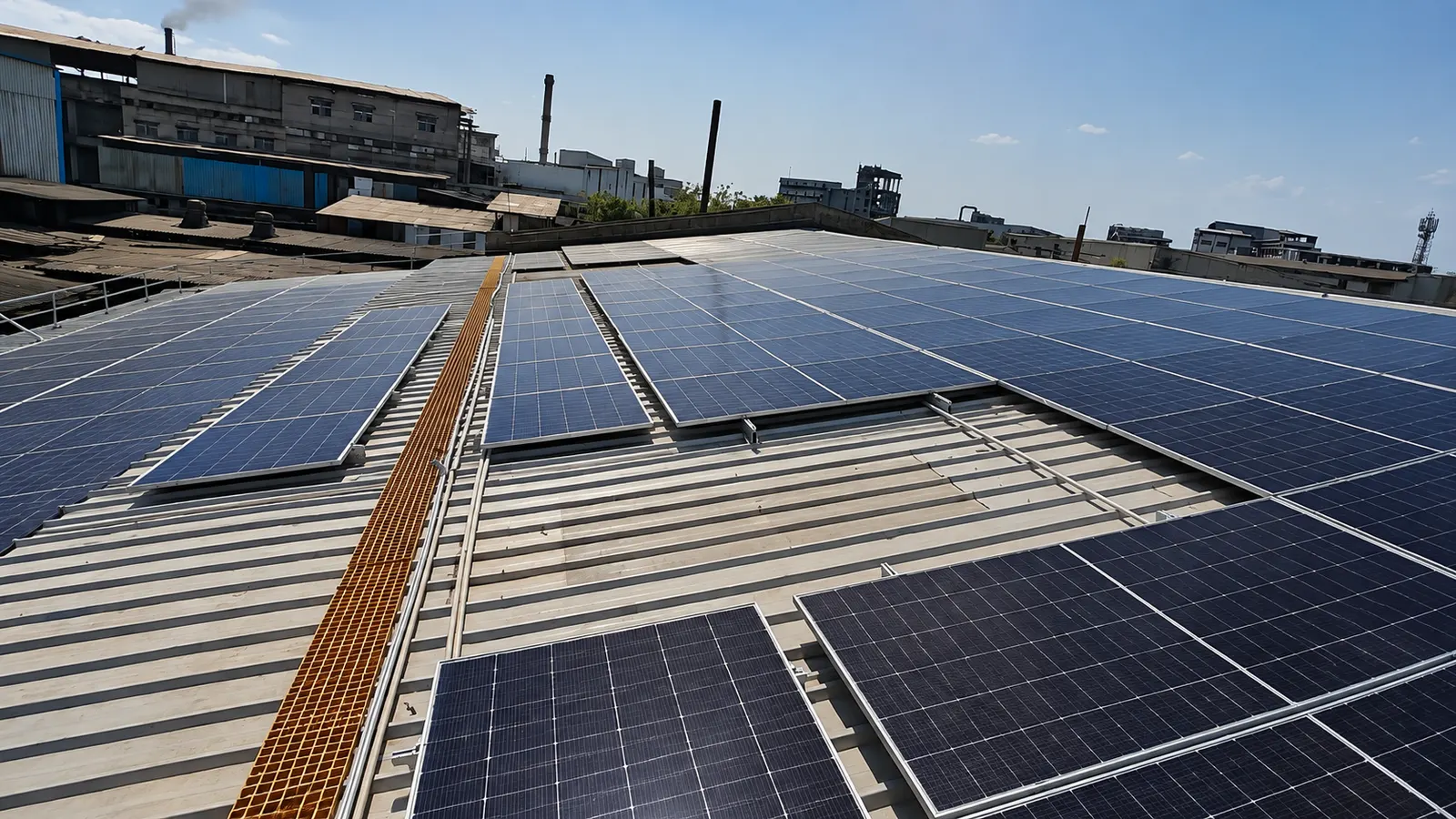
What zero export means at a factory connection
Every moment, the factory's load and the solar plant's available output change. Suppose the machines demand 80 kW while the array could produce 50 kW. The factory can consume that solar output and draw the remainder from the grid. If demand then falls to 30 kW while the array could produce 50 kW, a zero-export control system must tell the inverters to reduce their output, or send excess to a properly designed storage or controllable load. Without such a response, power can flow through the point of common coupling towards the utility network.
The control objective belongs at the grid connection point, not at an individual inverter display. A factory may have several inverters, an existing generator and multiple distribution boards. A controller reading only one feeder could miss export on another. The electrical designer has to identify the actual connection point, current-transformer direction, metering location and all generation sources on the single-line diagram. The SMA Energy Data Manager documentation describes closed-loop active-power control based on measurements at the point of interconnection; Fronius's installation guidance likewise explains export limitation using a smart meter. These examples illustrate the mechanism. They do not establish that Heaven Green uses either brand or that every model supports the same control.
Zero export also does not mean zero grid import. A plant can import at night, during cloud cover, when machinery exceeds solar output, or when the controller deliberately limits output. Nor does it automatically keep factory lights running during an outage. A conventional grid-tied inverter disconnects under loss of grid unless a separately engineered backup arrangement is approved and installed. The CEA rooftop solar safety guidance explains why anti-islanding and isolation matter.
The Gujarat rule that changes this conversation
The Gujarat Electricity Regulatory Commission notified the Grid Interactive Distributed Renewable Energy Sources Regulations, 2026 on 30 October 2026. The notification repeals the 2016 rooftop regulations and amendments for its defined scope. Its Statement of Reasons directly discusses behind-the-meter and zero-export proposals. The Commission did not establish a separate zero-export metering category. It says grid-connected systems that consume all output on site remain electrically connected, and that net metering covers the possibility of no injection in a billing cycle.
The Commission's explanation is unusually clear on the practical consequence: a no-export design still follows the applicable installed-capacity rules, DISCOM approval, anti-islanding, inverter standards, CEA rules and other technical requirements. There is no export credit when nothing is exported during a billing cycle. A controller setting is therefore not a substitute for the regulated connection process. A factory should ask the EPC to name the current rule, the distribution licensee, proposed arrangement and application status in the proposal.
A plant already commissioned, one with a pending application, or one connected through another commercial arrangement may have a different legal history. The operative notification, amendment status, DISCOM procedure and individual sanction must be checked before a design is submitted. We deliberately give no universal capacity cap, fee, export tariff or approval deadline here. Those facts depend on the arrangement and live documents.
Why a factory might still choose no-export control
Avoiding export can be a sensible engineering or commercial choice even when it does not avoid approval. A factory may have substantial daytime self-consumption, limited appetite for surplus settlement, a connection constraint, or an operating policy that favours using electricity on site. An existing diesel generator, captive source or complex distribution network can also make the control study more important. None of these conditions proves that zero export is required. The right answer follows the sanctioned connection, current utility requirements, site design and economic comparison.
| Situation to investigate | Why control may be considered | What the decision still needs |
|---|---|---|
| Strong daytime base load | Much of the available PV could be used on site | Interval load profile, generation model, outage and holiday pattern |
| Frequent low-load periods | Surplus may appear when production pauses | Expected curtailment or storage/use alternatives |
| Existing generator or other onsite generation | Sources can interact at the common connection | Complete SLD, generator operating modes and protection review |
| A site that prefers no injection | Controller can enforce an operational limit | DISCOM-approved arrangement and fail-safe test |
| Export-credit value is uncertain | Self-use and export alternatives may have different economics | Current GERC rules, bill tariff, commercial model and tax review |
The table is a screening aid, not an assertion about Heaven Green's installations or a promise that a controller will be accepted. The plant's engineering team should decide whether a smaller array, export-enabled arrangement, storage, scheduled load, or zero-export control is best. One solution rarely wins under every shift pattern.
How the controller, meter and inverters work together
A typical control loop measures net active power at the grid connection point. When the meter sees import, the controller can allow inverters to produce up to the amount permitted by their settings and current sunlight. As import approaches zero, it reduces their active-power setpoint to maintain a margin against accidental export. The inverters then curtail PV output. The exact meter, controller and communication method depend on the chosen equipment and electrical design.
An important design detail is the direction of the current transformers. If their polarity is reversed or they are mounted around the wrong conductor, the controller can interpret export as import. A second is the location: measuring one sub-board when several feeders meet at the main connection produces an incomplete picture. A third is the response to lost communications. A controller that loses its meter reading should not simply let the inverters run at full output. The manufacturer-specific fail-safe mode, timeout and fallback setpoint must be designed and demonstrated.
SMA's limited-export installation manual documents meter communication, safety offset and a timeout response. SMA's zero-export planning guide identifies compatible components and configuration requirements for its own systems. These are primary equipment references, not a universal wiring recipe. The EPC must use the exact inverter and controller manuals selected for the project and show how all units coordinate. A line in a quote saying “zero-export device included” is not enough to judge whether the design works.
The electrical file should include a one-line diagram that marks the utility meter, controller sensing point, inverter AC connection, breakers, protection, any generator, and the factory loads. It should also show who can change export settings and how changes are logged. A dashboard screenshot can help operations, but it is secondary to a verified commissioning test and the actual meter data.
Size from the minimum useful load, not the biggest roof
Factory solar is often sized from roof area or the maximum demand on a bill. A zero-export design needs a more careful question: what load is actually present when the sun is available, including weekends, lunch breaks, maintenance days and seasonal slow periods? The largest recorded demand may occur at night or during a short process peak. It does not tell you how much midday PV the site can continuously absorb.
Start with interval import data for a representative period, if the meter and utility make it available. Mark the calendar: production shifts, scheduled shutdowns, holidays, seasonal process changes and future machinery. Build an hourly or finer generation estimate with weather and shading assumptions. Compare that potential PV curve with the measured demand curve, then simulate the controller limit. Where the available PV exceeds load, the surplus is curtailed unless a separate designed use exists. A model should distinguish available PV, PV actually produced, on-site consumption, grid import and curtailed energy. Treating them all as “generation” hides the cost of no export.
Here is an illustrative instant, deliberately not a project estimate. At one moment, factory demand is 40 kW and the array could provide 55 kW. Ignoring losses and control margin, on-site consumption could be 40 kW, grid import could approach zero and 15 kW of potential PV output would have to be curtailed. One hour at those steady conditions would correspond to up to 15 kWh of curtailed potential. Real load and sunlight vary throughout the hour, and the controller needs a margin and reaction time. The illustration is a dimensional check, not a savings calculation.
| Indicative moment | Factory demand | Available PV | PV usable without export, before margin/losses | Potential curtailed output |
|---|---|---|---|---|
| Production running | 80 kW | 50 kW | 50 kW | 0 kW |
| Production reduced | 40 kW | 55 kW | 40 kW | 15 kW |
| Plant mostly idle | 10 kW | 55 kW | 10 kW | 45 kW |
All numbers in this table are hypothetical instantaneous values; they are not measured Heaven Green results or a proposed system size. The purpose is to show why a plant with a large roof can still suffer substantial curtailment on low-load days. An actual proposal should show its interval dataset and the resulting annual curtailed-energy estimate. If the proposed controller is expected to operate close to zero import, ask how its chosen margin and transient behaviour were modelled.
Compare the alternatives before buying a controller
Zero export is not the only way to handle potential surplus. A smaller PV system may produce less curtailed energy. An export-enabled arrangement may let some surplus earn whatever settlement is available under the current rules. Storage may shift usable energy, but adds equipment, controls and cost, and cannot be assumed to improve the return without a model. A process load, chilled-water system or other controllable demand may be scheduled into solar hours where operations allow. The chosen option should survive a comparison across weekdays, low-load days and future changes in production.
A practical alternatives table contains at least four columns: expected on-site PV use, expected curtailed or exported energy, connection and control requirements, and the assumptions behind the commercial case. It should also note which items are still awaiting DISCOM or engineer confirmation. Do not compare a zero-export case using one generation model with an export case using a different irradiance or roof layout. A fair comparison changes the control arrangement while holding the physical site inputs consistent.
The cost side requires the actual electricity bill, not a generic per-unit value. Tariff energy charges, demand charges, time-of-day terms and other bill components can behave differently. Solar may change imported energy while leaving fixed or demand-related charges in place. We do not publish a standard Heaven Green price, savings percentage or payback number here; the plan's claims ledger holds those until verified client facts and project inputs exist. Ask for a model that separately lists energy, non-energy charges, taxes, maintenance and control-system scope.
What to ask for in an EPC proposal
A useful zero-export proposal is an engineering package, not just an inverter quote. It should show the data used to size the array, the proposed point of common coupling, the meter and CT location, the inverter/controller compatibility, a control narrative, fail-safe behaviour, and an acceptance test. It must also say which approvals and metering arrangement are assumed. If the installation is on a metal shed, roof and structural evidence remain necessary; export control does not solve roof loading, wind or access issues.
| Proposal evidence | Question to ask the bidder | Why it matters |
|---|---|---|
| Load dataset | Which interval period includes weekends and low-production days? | Finds likely curtailment periods |
| Simulation | How much energy is produced, consumed on site and curtailed? | Prevents “available generation” from being sold as used energy |
| Single-line diagram | Where is the actual grid connection and sensing point? | Determines whether export is measured at the right place |
| Equipment schedule | Which exact inverter, meter, CT and controller models communicate? | Compatibility is model-specific |
| Control narrative | What happens on meter loss, communications failure and sudden load drop? | Tests fail-safe behaviour |
| Regulatory basis | Which 2026 GERC clauses and DISCOM procedure govern this connection? | Prevents an invalid “no approval required” assumption |
| Test plan | What will be measured and recorded at commissioning? | Turns the design intention into evidence |
Ask who owns the controller settings after handover. A future inverter replacement, firmware update or factory electrical alteration can change the system's behaviour. The maintenance documentation should identify the approved settings, access credentials and change-control responsibility. A plant owner needs an operating system that remains understandable after the installation team leaves.
Commissioning tests that establish the control works
The tests should be written before installation. With the plant safely configured, an engineer verifies meter polarity, communication, inverter setpoint response and data timestamps. The test should include steady daytime load, a controlled load reduction, a communications interruption and the configured fallback. It should record power at the point of common coupling with an instrument appropriate to the scheme and compare it with inverter and controller logs. The final method and acceptance threshold belong to the project engineer, equipment manuals and utility's conditions; this page does not claim a universal response time or tolerance.
Transient behaviour matters. When a large machine stops, the controller cannot change physical inverter output before it detects the change and sends a command. A sufficiently conservative margin and suitable hardware can reduce the risk of brief unintended flow, but the required performance is design-specific. A website promise of “absolute zero export at every millisecond” would be misleading. The engineering objective is to meet the sanctioned export limit and test it under relevant site conditions.
Keep the test record, meter configuration, CT details, firmware versions, controller parameter backup and final SLD. If the utility or safety inspector requires an additional witness or test certificate, plan for it. The 2026 GERC regulations refer to CEA safety and connectivity standards. The CEA register lists a BESS-focused 2026 amendment to the 2023 electrical-safety regulations, effective 1 April 2027. The project engineer should check the requirements in force on the project date.
What zero export does not solve
It does not eliminate the grid connection. The system is still electrically coupled to the factory network and, through it, to the distribution system. The Commission's 2026 explanation makes this explicit. It does not eliminate utility review, anti-islanding or electrical protection. It does not create backup during an outage. It does not guarantee lower demand charges, because a short plant peak can occur when PV output is low. It does not remove seasonal underuse or curtailment. It also does not grant an exemption from roof safety, fire access or structural checks.
These limits are useful during procurement. If a vendor suggests a controller removes every approval, ask for the relevant regulator clause and utility confirmation. If another vendor promises no curtailed energy, ask for the interval model on Sunday, maintenance shutdown and holiday scenarios. If a vendor calls the system “off grid,” check whether the inverter and factory remain connected to the utility. Words in a sales document can obscure materially different electrical arrangements.
The existing industrial solar service page describes the wider EPC route, and the commercial solar service page covers non-factory buyers. Before either becomes a publishing destination for this page, their inherited HOLD and REMOVE claims need cleanup.
A sensible project sequence
First, confirm the factory's connection, utility, meter and current regulatory route. Second, collect twelve bills and interval load data, including low-load periods. Third, survey the roof and electrical distribution system. Fourth, compare no-export control against an appropriately designed export or smaller-system case. Fifth, select exact inverter, meter and controller models and prepare the SLD, calculations and control narrative. Sixth, submit the applicable application and obtain the required decisions before work that depends on them. Seventh, install and commission against a witnessed test plan. Finally, hand over the settings, monitoring and change-control records.
This order avoids a common procurement mistake: buying a controller to solve an undefined problem. The data may show that a modest array needs little curtailment, or that the factory's weekend load is too low for the initially proposed capacity. It may reveal a connection or generator issue that changes the controller choice. The value of the analysis is the decision it makes possible, not an impressive number on a brochure.
Get a load-based proposal for my plant. A proposal should state the current GERC and DISCOM basis, the expected self-consumption and curtailment, and the exact equipment and test scope. Any conclusion about your plant requires its own data and approval review.