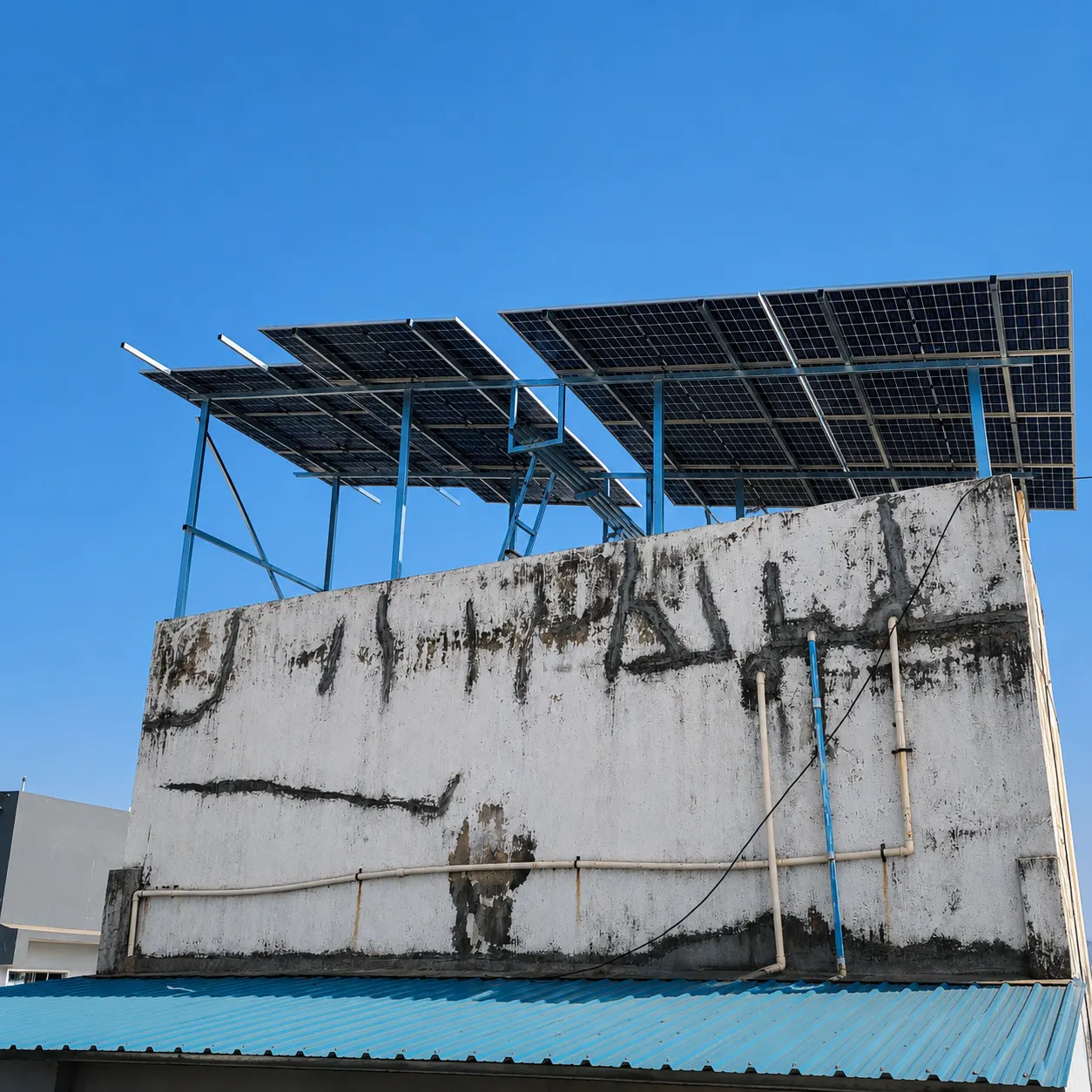
If a Gujarat home exports more solar electricity than it imports during a billing cycle, what happens to the extra units? The answer depends on the home’s approved arrangement and commissioning documents. The unit value is not the household’s retail electricity slab. Gujarat’s regulator sets a separate surplus purchase rule, and the licensee administering the connection applies it. That distinction matters most when a proposed system is larger than the home’s daytime and billing-cycle use.
Direct answer. Gujarat’s published DRES instrument signed 30 October 2026 provides residential billing-cycle set-off without banking charges, followed by purchase of remaining surplus at ₹2.25/kWh or a later GERC-specified rate. Its commencement depends on Gazette notification. Existing accounts may cite earlier terms, including the 2022 first-five-year provision discussed below; obtain the DISCOM’s applicable rate and start date before projecting receipts.
What changed in the instrument published on 30 October 2026?
DRES Regulations, Notification 11 of 2026, clause 9.1.5, publishes the residential export rules. It provides full billing-cycle set-off and no residential banking charge. The surplus rate is ₹2.25/kWh unless the Commission sets another rate. It also provides for remaining bill credit from the previous financial year to reach the designated bank account within 30 days. Under clause 1.2, commencement depends on Official Gazette notification. The signed website publication date alone does not show how an older agreement is treated.
The 2026 clause does not repeat the 2022 first-five-year step-down wording. The sections below explain that older published clause for checking an account whose approved terms use it. Do not automatically apply the 2022 five-year formula to a new application, or automatically rewrite an existing account from a new blog date. Ask the licensee to identify the applicable instrument, commissioning date and communicated purchase rate.
What is the Gujarat residential solar export rate today?
The governing starting point is GERC’s Net Metering Rooftop Solar PV Grid Interactive Systems Third Amendment, Notification 02 of 2022 dated 31 May 2022. Torrent Power hosts a copy of the regulator’s notification. Clause 9.1.3 says residential energy accounting occurs on a billing-cycle basis. For self-owned systems and SURYA Gujarat scheme consumers, surplus injected after set-off is purchased at ₹2.25 per unit for the first five years from project commissioning. For the remaining term, it refers to 75% of the simple average of tariffs discovered and contracted in the preceding six-month period for specified GUVNL non-park solar projects.
That clause is more precise than saying all exported units earn ₹2.25. First, the rate applies to surplus after the billing-cycle set-off, not every unit the inverter makes and not necessarily every unit exported at one instant. Second, the first-five-year period is tied to commissioning. Third, older or different arrangements can have their own agreement and applicable rule. A residential third-party-sale system has a separate formula in the 2022 amendment. The homeowner should read the approved scheme and connection documents before applying the self-owned rate.
The GERC renewable-energy regulation index lists the older rooftop rules and the DRES instrument signed 30 October 2026. The Fifth Amendment, Notification 10 of 2025, gazetted 3 November 2025 removes the need for a separate written connectivity agreement for PM Surya Ghar systems. The DISCOM must still tell the consumer when the agreement starts and which surplus purchase rate applies. It must record receipt of that notice. Keep the notice with your solar records.
This is a Gujarat residential explanation as of 30 October 2026. It is not a guarantee that the rate on every existing meter is the same. Ask the DISCOM to identify the clause and commissioning date used on the specific account. The net-metering glossary explains the basic import-export mechanism, while the Gujarat solar regulations guide tracks the wider regulatory context.
| Residential route | Surplus treatment in Notification 02/2022 | What to verify |
|---|---|---|
| Self-owned net metering | ₹2.25/unit for first five years, then stated GUVNL formula | Commissioning date and communicated rate |
| Residential third-party sale | Separate GUVNL-linked formula | Approved agreement and applicable term |
| Gross metering | Separate purchase rule for total generation | Whether the system is actually gross-metered |
The table summarises the dated 2022 notification. Later project-specific orders or agreements should be checked before a bill model is finalized.
Do DGVCL, UGVCL, MGVCL, PGVCL and Torrent use different rates?
These are separate licensees, but GERC’s rooftop net-metering rule covers Gujarat. The 2022 residential clause does not set five separate retail export rates. The licensee on the home’s bill manages the account under the relevant rule and agreement. Use that licensee’s records. A rate quoted for another home may come from different connection terms.
| Gujarat licensee | Where to check the household rate | Regulatory starting point |
|---|---|---|
| DGVCL | Connection communication and bill | GERC Notification 02/2022, clause 9.1.3 |
| UGVCL | Connection communication and bill | GERC Notification 02/2022, clause 9.1.3 |
| MGVCL | Connection communication and bill | GERC Notification 02/2022, clause 9.1.3 |
| PGVCL | Connection communication and bill | GERC Notification 02/2022, clause 9.1.3 |
| Torrent Power, applicable area | Connection communication and bill | GERC Notification 02/2022, clause 9.1.3 |
The GERC retail tariff orders dated 25 March 2026 identifies the state-owned DISCOMs and Torrent Power’s Ahmedabad, Gandhinagar and Surat license areas for retail tariff orders. A retail tariff order governs what the consumer pays for imports. It should not be confused with the separate rooftop surplus purchase rule. A home in Surat may have DGVCL or Torrent service depending on its actual address; the bill is the reliable identifier.
For a new PM Surya Ghar system, keep the DISCOM’s written or electronic rate notice. The 2025 fifth amendment calls for the rate and start date to be communicated. For an older system, keep its signed connectivity or power-purchase papers. Check whether a later change applies prospectively. A search result saying “DGVCL pays ₹2.25” cannot establish the rate for another ownership model or commissioning date.
The household should also distinguish the rate from payment timing. The regulator’s clause identifies a purchase rate and billing-cycle energy accounting. How the credit or payment appears on a particular bill, and whether a remaining payable amount is transferred to a bank account, depends on the licensee’s approved billing process and consumer details. Ask for the actual bill ledger or written licensee procedure. Do not assume a PM Surya Ghar subsidy transfer and surplus-energy payment use the same process.
Use the DGVCL PM Surya Ghar guide for that licensee’s application context. Torrent customers should use the licensee named on their bill. If the bill and commissioning communication disagree, raise a written billing query with the licensee and attach both documents.
How are import, export and surplus calculated on the bill?
A bidirectional meter records grid import and export. The inverter reports total solar generation. When the home uses solar power directly, generation is higher than export. The 2022 residential provision sets off eligible exports against consumption in the same billing cycle. It then purchases eligible surplus. Fixed charges, taxes and other bill items can remain.
Use a labelled hypothetical example. Suppose the inverter generates 450 units during a billing cycle. The home uses 200 of those units directly while the sun is out, exports 250 and imports 180 from the grid during other periods. The inverter shows 450; the meter shows 250 export and 180 import. The net export after the simplified billing-cycle set-off is 70 units. At an assumed applicable ₹2.25 surplus purchase rate confirmed for this hypothetical account, the surplus value would be ₹157.50. The figure is arithmetic, not a real bill or payment promise. Actual billing can reflect meter intervals, adjustments and approved terms.
The home’s total consumption in the example is 380 units: 200 served directly by solar and 180 imported. It would be wrong to say all 450 generated units were sold to the DISCOM. It would also be wrong to value the 70-unit surplus at the retail slab just because some imported units had a higher marginal price. Direct use, billing-cycle set-off and purchased surplus are distinct value routes. The solar and electricity bill slabs guide explains why an energy-charge line can change without all other bill lines disappearing.
An even simpler example helps: if import is 300 units and export is 200 units in a billing cycle, there is net import of 100 units under a clear net-metering calculation. The homeowner pays the applicable energy charge on the net import, plus other applicable charges. There is no purchased surplus in that example, even though 200 units physically crossed the export register. This is why a meter photograph showing exports does not prove a payment is due.
The GERC 2022 amendment says residential consumers pay no banking charge on solar power consumed under that provision. This differs from open-access banking for industrial plants. Do not add an industrial open-access banking charge to an ordinary home net-metered bill.
Bill check
Read inverter generation, meter import, meter export and purchased surplus as four separate quantities. The purchase rate applies only to the eligible surplus under the account's agreement.
Keep meter readings with dates at the start and end of each billing cycle. They make a disputed line easier for the DISCOM to investigate.
Is the settlement monthly, annual or a bank transfer?
For the residential route described in GERC Notification 02/2022, clause 9.1.3 states billing-cycle energy accounting. A billing cycle may not align exactly with a calendar month, so match the dates on the utility bill rather than adding a January inverter report to a February bill. The same clause describes purchase of surplus after set-off during that billing period. It is not the same as a promise to carry unused units without limit until a year-end payout.
The bill should disclose import, export and adjustment lines sufficiently for the consumer to follow them. A homeowner can request a written explanation if the purchase credit or payment is not visible. The 2025 Fifth Amendment, Notification 10/2025 strengthens the evidence trail for PM Surya Ghar systems by requiring a receipt that states the commencement date and applicable surplus purchase rate. Keep that receipt, the commissioning record and the first net-metered bills together.
Avoid a universal statement that “the DISCOM deposits every month’s solar payment in the bank.” The regulator’s purchase obligation and the licensee’s payment or bill-credit mechanics are related but not identical. Some statements or portals may show a credit against charges before any separate remittance. The household should inspect its bill and ask the licensee how a positive surplus balance is settled for its connection. If bank details are required, verify them directly through the official consumer channel. Do not share account information with a third party claiming to release solar export money.
The DGVCL solar process post and net-metering-in-India guide provide background, but the current bill is the primary evidence of a consumer’s accounting. The retail electricity rate can change by tariff order without changing the words of the export regulation. Conversely, a change in surplus purchase rules may not alter every retail slab. Keep those instruments distinct when comparing bills across years.
Illustrative ledger: a household has 50 eligible surplus units in one billing cycle and a stated purchase rate of ₹2.25 per unit. The calculated purchase value is ₹112.50. The next question is where that ₹112.50 appears in the licensee’s approved statement and whether any other bill amount is netted against it. A screenshot of the inverter cannot answer that. Ask for the bill line or account ledger and retain the response.
If the applicable agreement uses the 2022 five-year clause and the system has been running for more than five years, do not assume the ₹2.25 first-period rate continues. The 2022 clause states a later GUVNL-linked formula. The applicable rate should be confirmed from the agreement and current communication rather than guessed from an old article.
What if an existing agreement uses the 2022 five-year provision?
For an account under that older clause, the first five years run from commissioning. GERC Notification 02/2022 makes that date important. Use the commissioning certificate or DISCOM record, not the date on a blog or a recent bill. If the system was expanded or its agreement changed, ask which start date and purchase rule now apply. Get the answer in writing. An inverter installation sticker cannot settle it.
The 2022 amendment uses a formula after five years. It takes 75% of a simple average of tariffs discovered and contracted by GUVNL. The rule specifies a preceding six-month window and non-park solar projects. This does not give one permanent rupee rate. Check the home’s agreement and the relevant GUVNL declaration. If a bill uses an unexplained rate, ask for the period and calculation.
This matters for a long-term comparison of proposals. A model that uses ₹2.25 for every surplus unit for the whole plant life would ignore the published change after the first period. A model that uses today’s GUVNL-linked value from the first day would ignore the initial period for an eligible self-owned system. The EPC should show the tariff basis by period and keep export income separate from avoided grid purchases. A homeowner should be especially cautious if the quote’s financial case depends heavily on surplus sales rather than on electricity used in the home.
The rule also has a separate residential third-party-sale provision. If a company owns the system and sells power to the homeowner, the purchase formula and contract structure can differ from a self-owned PM Surya Ghar system. The label “rooftop solar” does not answer who owns the asset. Ask who invoices whom, who receives export compensation and what happens at the end of the agreement. The net-metering-in-India guide explains the broader concepts, but the signed Gujarat agreement controls the account.
Keep a digital folder with the approval, commissioning date, rate notice and later DISCOM letters. A future owner may need it to understand the bill. If a valid order changes the rate, those records let the owner update the bill model without rebuilding the history from memory.
Why does oversizing a home system often reduce its value?
Solar electricity used in the home at the time of generation can avoid buying a matching grid unit. Eligible surplus beyond the billing-cycle set-off is purchased under a separate rule. Those values may differ. If a system produces far more electricity than the household uses, a larger share can fall into the surplus purchase category. The extra modules still cost money and occupy roof space, so adding capacity solely to maximise exports needs a separate economic case.
This does not mean the smallest possible array is always best. A family may expect more daytime cooling, an EV or another meter’s change in future use. A roof may have a particularly good orientation and the export arrangement may make some surplus reasonable. The correct size follows a forecast of consumption by month and time, sanctioned load, physical roof constraints and the approved settlement terms. The home system-size guide gives the sizing method, while the solar calculator is an initial planning aid.
Illustrative sizing comparison: suppose a home imports 300 units per billing cycle before solar. A smaller hypothetical array generates 260 units, most of which the household uses or offsets within the cycle. A larger hypothetical array generates 430 units, but 130 units remain eligible surplus after all valid set-off. The first 300 units and the final 130 do not necessarily have the same rupee value. This example simplifies timing and assumes no load growth; it does not promise a return, payback period or rate for a real system.
The roof also has limits. More modules may require a load extension, different inverter design or additional structure. A shaded row added to reach a round kW number can yield less than the model assumes. The sanctioned-load mismatch guide explains why an approval issue can delay or change the design. Ask the EPC for at least two capacity cases with direct-use, export and bill-line assumptions shown separately.
Under the GERC Fifth Amendment dated 3 November 2025, a PM Surya Ghar consumer should receive the rate before relying on an export-value model. The quote should use that rate. If it is not yet confirmed, label it as an assumption.
Sizing check
Ask for the value of direct use and eligible purchased surplus in separate rows. A larger inverter output does not automatically mean a proportionally larger bill benefit.
The aim is a capacity that fits the household’s actual connection and intended use, not a design that assumes every exported unit receives the retail rate.
How can you verify a DGVCL or Torrent solar payment?
Start with the consumer number and the actual licensee on the bill. Then collect the commissioning record, connectivity agreement or the 2025 amendment communication, two consecutive bills and meter readings at their cycle boundaries. Write down the stated surplus purchase rate and the date from which it applies. If the bill shows a different rate, ask the licensee to identify the regulation and agreement used for that account.
Check the arithmetic in sequence. Verify opening and closing import readings, opening and closing export readings, the units set off, eligible surplus units, rate and purchase value. The inverter’s total generation is a separate control figure; it will normally exceed export when the home uses solar power directly. The solar bill still high guide helps diagnose a bill that does not match expectations. The solar monitoring guide helps check whether generation itself is normal.
If the calculation looks wrong, send a written complaint through the licensee’s official billing channel. Attach the documents and your calculation. Ask for a corrected ledger. The GERC consumer regulations index lists the service rules and grievance routes. Follow the current licensee and regulator process if the first response does not resolve the issue.
Do not confuse export purchase with the PM Surya Ghar capital subsidy. The subsidy is a separate programme and bank-transfer process; the export rate is an electricity settlement term. Heaven Green Energy files PM Surya Ghar and DISCOM paperwork for its customers, but the homeowner should retain and verify the official approvals and payment account details. The PM Surya Ghar Gujarat guide covers the application path.
Use a simple checklist:
- Identify the licensee. Read DGVCL, UGVCL, MGVCL, PGVCL or Torrent from the bill.
- Find the rate document. Locate the agreement or 2025 amendment communication.
- Match billing dates. Use the meter readings for the same cycle.
- Calculate surplus. Apply the approved set-off before the purchase rate.
- Locate the value. Find the bill credit or payment ledger entry.
- Raise a written query. Attach readings and the dated rate document if they differ.
The checklist is useful whether the household receives a credit line or a separate remittance. It turns a vague “DGVCL solar payment missing” complaint into a testable billing question.
What should a proposal say about surplus electricity?
A home proposal should name the licensee, connection category and ownership model. It should show the meter arrangement, assumed commissioning date and export purchase rule. Where the older self-owned rate applies, cite GERC Notification 02/2022 and its first-five-year limit. Note the later formula too. The final agreement or DISCOM notice controls the account. A general claim that exports earn the import rate is not enough.
Show monthly generation, expected direct use, meter export, billing-cycle set-off and eligible purchased surplus separately. Add the assumed retail tariff and charges that remain. If the household’s hourly load is unknown, present a range of direct-use scenarios as assumptions rather than one certain saving figure. The solar bill and slabs guide gives the bill context; the net-metering glossary defines the settlement language.
The EPC should also explain what happens if the sanctioned load must change or the approved system capacity differs from the quote. A model built for a larger system should not be used after the DISCOM approves a smaller one. The roof layout and generation forecast should be revised together. The household should keep the final as-built capacity and metering document with the proposal.
| Proposal field | Reviewable evidence |
|---|---|
| Licensee and connection | Latest electricity bill |
| Export rule | GERC notification and account communication |
| Solar units | Monthly AC model with roof inputs |
| Bill result | Direct use, set-off, surplus and remaining charges |
The table is a purchase checklist. It helps prevent a common modelling error: multiplying all generation by one attractive retail unit rate. That approach overstates the value of units that fall into the surplus purchase category and ignores any charges that survive solar.
Ask the EPC to show a second, smaller system case if the first one exports a large share. A right-sized system may better fit the roof and load even when it generates fewer total units. The decision should follow the account’s actual rate and household plans, not an internet-wide export number.
Request a home solar estimate: Send your bill and roof details through the residential solar enquiry. Ask for direct-use and surplus units to be modelled separately under your licensee’s documented rate.
Direct-use value
- Offsets eligible imports when produced
- Depends on the actual household load
- Can reduce exported surplus
Export limits
- Rate follows the current order
- Settlement depends on the licensee
- Oversizing needs a separate model
How Heaven Green Energy helps frame the Bill Review
For a new home system, bring recent bills, the consumer number and roof photos. Add the sanctioned load and a note on daytime use. For an existing system, also bring the commissioning record, DISCOM notice, inverter report and meter readings. Heaven Green Energy files PM Surya Ghar and DISCOM paperwork for its customers. Keep copies of the official records, including the surplus rate notice.
The relevant routes are:
- Residential solar for the primary home site-visit enquiry.
- Solar calculator for an initial capacity comparison.
- Net-metering glossary for the settlement terminology.
The first review should identify which units the home uses directly and which are exported. Then the applicable billing-cycle set-off and purchased surplus can be modelled. The bill should retain remaining fixed and other charges. If the connection is under an older arrangement, the agreement and commissioning date should be checked before applying the 2022 rate. If the project is under PM Surya Ghar, the DISCOM’s rate communication under the 2025 amendment is an important record.
Use the residential solar route to compare solar with the home’s real use. Check the estimate’s assumptions. If much of the output would be exported, compare a smaller system too. After commissioning, match inverter output with meter imports and exports. Ask the licensee to explain any bill line that you cannot account for.
These dates identify the cited rules, not a promise that every existing agreement has the same purchase rate. The controlling account document should always be checked.
Keep a sample bill calculation with the proposal. It should show the assumed self-used units, imported units, exported units and any purchased surplus under the applicable licensee order. After commissioning, compare that model with the first full billing cycle and record any difference in the meter registers or settlement line. This gives the homeowner a concrete question for the DISCOM if the amount looks wrong.
Frequently asked questions
What is the solar export unit price in Gujarat?
Under GERC Notification 02/2022, eligible surplus from a self-owned residential net-metered system is purchased at ₹2.25 per unit for the first five years from commissioning, then under a stated GUVNL-linked formula. The rate on a particular connection should be confirmed from its agreement or DISCOM communication.
Does DGVCL pay for every unit my inverter generates?
No. The inverter reports total generation. Some electricity can be used directly at home, and exported energy is set off against imports under the approved billing-cycle arrangement. Only eligible surplus after that calculation falls under the purchase clause. Read the meter and bill with the inverter report.
Do Torrent Power homes get a different Gujarat rule?
GERC’s rooftop rule covers Gujarat licensee areas, including Torrent’s Gujarat service area. Check the home’s approved arrangement and rate notice. Another home may have a different ownership model or older agreement.
Is surplus settled at the end of the year?
The cited 2022 residential clause specifies billing-cycle energy accounting and purchase of eligible surplus after that cycle’s set-off. Use the dates on the bill and the current agreement. A calendar-year summary of inverter generation is not the same as the licensee’s billing ledger.
Will the export value be sent to my bank account?
The regulation establishes a purchase rule; the account’s bill and licensee process show how the credit or payment is posted. Ask the licensee for its current procedure and verify any bank details through an official channel. Do not confuse this with the separate PM Surya Ghar subsidy transfer.
Why might a larger system earn less per extra unit?
The added generation may become eligible purchased surplus after bill set-off rather than directly used electricity. Those value routes can differ. Compare at least two capacities using the home’s daytime load, approved export terms and full bill structure before choosing a system size.
This guide describes the published rules as checked on 30 October 2026. The applicable connection document and any later regulator change should be reviewed before a financial decision.