Start with the bill holder and the roof holder
Write three names on one sheet: electricity consumer, legal holder of the roof, and proposed owner of the solar plant. Sometimes they are one entity. Sometimes a knitting workshop rents a floor, the landlord owns the shed and a separate company holds the electricity account. Do not assume these roles are identical because the business operates under one trading name. The GERC 2026 model application, Annexure II-A asks for the service connection, tariff, legal possession of the proposed installation location and system ownership model. The regulation says a DRES owner must own, lease or lawfully possess the installation location, or have valid legal authority to install and operate there. That is the point to resolve before final system sizing. GERC 2026, Regulation 8.1.
If the knitting business rents the floor, ask to see the lease and a written roof-access arrangement. The document should cover the intended installation area, access for construction and maintenance, roof repairs, equipment ownership, insurance allocation and what happens if the tenant leaves. This is a practical contract checklist, not a statement that a particular form of landlord consent automatically satisfies DGVCL or Torrent Power. The owner and their advisers should check the actual lease and the licensee's approved procedure. A short lease and a long-lived rooftop asset can be a poor combination unless the exit terms are explicit.
| Arrangement to check | Evidence needed before design | Question for the agreement |
|---|---|---|
| Knitting business owns roof and meter | Title/possession record, bill, roof drawing | Are all project rights with one entity? |
| Tenant has its own meter but landlord owns roof | Bill, lease, written roof authority | Who may install, access, repair and remove the plant? |
| Several units share one roof | Meter map, ownership/association documents | Which connection receives the approved benefit? |
| Property owner holds the meter, tenant pays internally | Utility bill and commercial agreement | What is the tenant actually allowed to claim or pay for? |
| Multiple meters in one building | Consumer numbers and tariff categories | Is one roof feeding one account or an approved group arrangement? |
The table does not conclude that any arrangement is eligible. It shows the documents a buyer needs to uncover the real question. Do not buy modules for a rented floor based only on a verbal statement that “the roof is available.”
What uses electricity in a circular knitting unit?
Circular knitting machines are not a single standard load. Model, diameter, gauge, feeder count, drive and auxiliary features differ. Terrot's circular knitting product range lists several machine types with different diameters, feeds and configurations; its SL4 technical sheet identifies a drive and ancillary devices for one model. Those documents help identify what must be included in a machine inventory. They do not establish a power figure for a Surat workshop that has different machines, maintenance condition or operating speed.
The factory's supply also serves lighting, ventilation, air compressors, yarn handling and any finishing or packing equipment at the same meter. The owner may run the machines one shift, two shifts, or across the night. A system sized from installed machine motors can overshoot daytime use if half the machines are idle, or undershoot it if substantial auxiliary load is omitted. Ask the plant electrician for panel labels and a measured demand trace, and pair that with a production diary. A 12-month bill history reveals seasonality and maximum demand, but interval data reveals when solar generation would coincide with actual use.
| Load source | Why it needs a separate line | Best first evidence |
|---|---|---|
| Circular knitting machines | Number running and operating speed change by order | Machine list plus shift log |
| Compressed air and ancillary systems | May cycle independently of machines | Compressor/panel readings |
| Ventilation and environmental control | May operate before or after a knitting shift | BMS or switchboard schedule |
| Lighting and small services | Can remain on during a production pause | Meter or panel survey |
| Finishing, inspection and packing | May share the same connection with different hours | Production and electrical layout |
This is a measurement plan, not a claim that every knitting unit has every item. A site survey should remove rows that do not apply and add the actual equipment. The result should be a weekday and weekly-load profile with the hours clearly labelled.
Match the roof's daylight to the knitting schedule
Solar output rises and falls during daylight. A workshop that finishes at 5 pm has a different direct-use opportunity from one that continues knitting into the night. If it closes one or two days a week, generation on those days may be exported. Ask the EPC team to show projected solar output and observed grid demand on the same hourly or meter-interval scale. A smooth monthly average can hide a low-load lunch break or a stop-start order pattern.
The proposal should show direct self-consumption, export, and remaining grid import as separate quantities. Under the GERC 2026 regulations, a non-residential consumer using net metering can adjust export against import in the same billing cycle only up to 30% of the total energy drawn from the licensee in that period, subject to applicable banking charges. Excess export beyond the permitted adjustment lapses under that provision. Time-of-day rules also affect adjustment. The roof's largest possible module count may therefore be a poor commercial size for a shop whose weekend load is small. GERC 2026, Regulation 9.1.5–9.1.9.
The 2026 rule offers several metering arrangements beyond net metering, including net billing, gross, group and virtual metering, each with eligibility and connection conditions. A shared building may prompt a question about group or virtual metering, but those terms are not a shortcut that lets one tenant allocate energy freely to any account. The same licensee, tariff category, legal relationships, physical arrangement and approved agreement can matter. The model must start with the actual meters and owners rather than an assumed “shared rooftop credit.” GERC 2026, Regulations 3, 8.5–8.6.
Will a small LT connection accept the system?
Many workshop owners think of their connection only as “three-phase.” The electricity bill and supply agreement carry the details that matter: licensee, tariff category, sanctioned load or contract demand, supply voltage and consumer number. The proposed solar design has an AC inverter capacity and a DC module capacity; those numbers are not interchangeable. The GERC 2026 model application asks for both, plus metering choice and whether capacity exceeds the sanctioned or contracted level. For new systems, the utility carries out technical feasibility analysis, subject to the regulation's specific rules for smaller applications. A bill and roof sketch are therefore the starting inputs, not final permission.
If the knitting business has one meter for a leased floor and the landlord has a separate meter for common services, decide which meter the solar plant will legally connect to before drawing the single line diagram. The electrical tie-in and the energy beneficiary must match the approved application. A cable routed across another tenancy or a roof shared with equipment owned by a third party can introduce rights and safety issues. Use an electrical engineer and the licensee's approved procedure to resolve the physical connection rather than relying on a salesperson's sketch.
The 2026 rule also requires suitable anti-islanding protection for a grid-interactive system and includes registration, drawing, meter and commissioning steps. It does not mean a knitting workshop can energise a system when the modules are mounted. Energy injected before formal commissioning is treated as inadvertent or lapsed, without compensation. Plan the commissioning sequence and the factory's electrical isolation window with the plant electrician. GERC 2026, Regulations 5–7 and 9.
Roof and access: a compact unit still needs a safe project
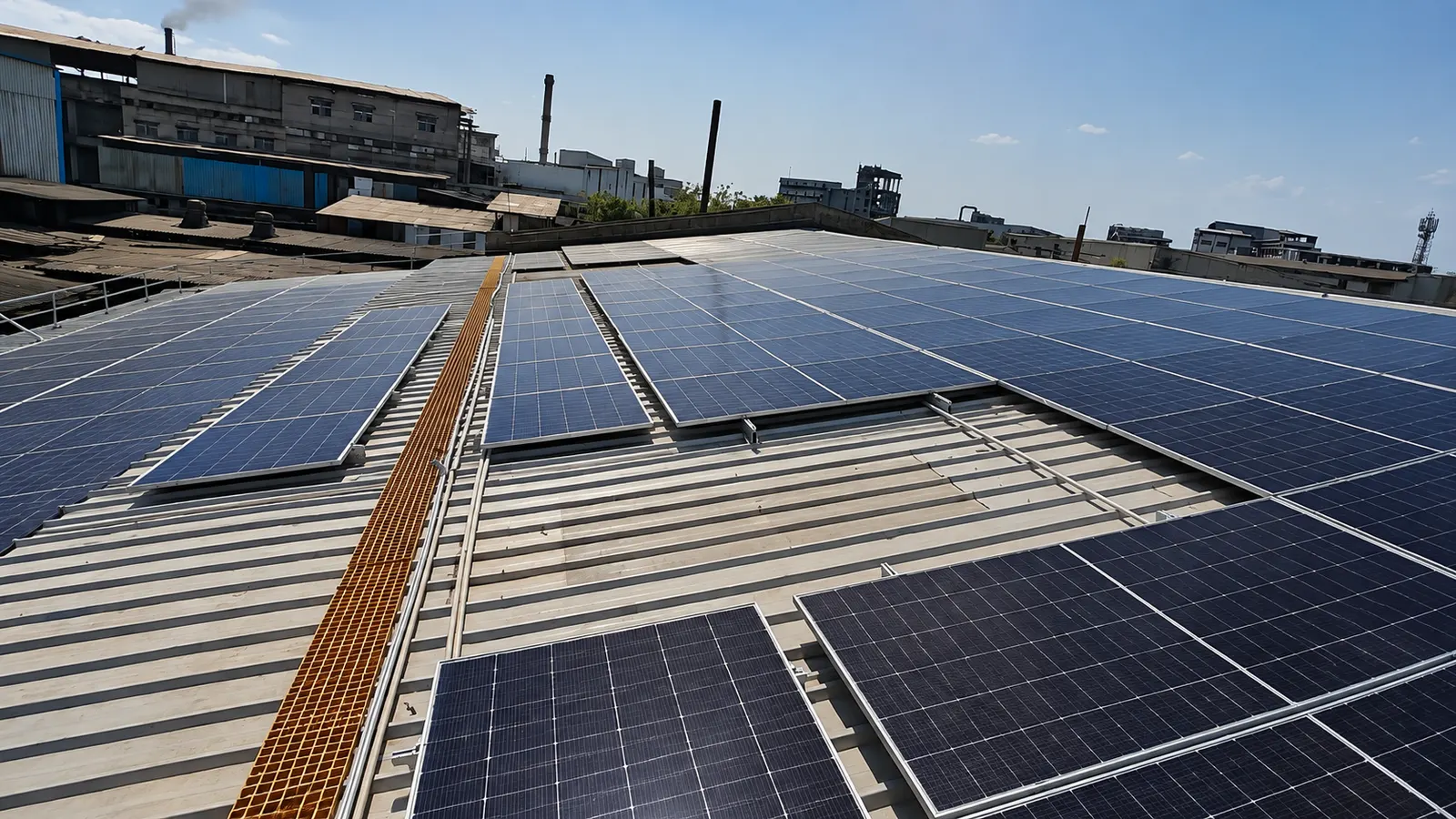
Knitting units can occupy an RCC building, a metal shed, or part of a multi-tenant structure. A roof survey should establish which surfaces are actually within the owner's or tenant's rights and which are physically usable. For a metal shed, a structural engineer should inspect sheet profile, purlins, trusses and wind-load path; for an RCC roof, the engineer should check waterproofing, existing equipment, access and the load path. Neither a photograph nor an area estimate is a structural approval. Skylights, water tanks, ventilation, fire access and neighbouring roof use also consume area.
The installation needs safe cable routing from roof to electrical point. In a small workshop, a route through another tenant's floor or a busy loading aisle may be impractical even when the roof itself is large. Plan access for future inspection and cleaning. If a landlord controls the roof, maintenance rights must last as long as the system is meant to operate. A proposal that omits this can look cheaper than one that includes a workable access route. The design should also record who restores waterproofing or roofing after mounting work.
| Physical check | Decision it answers | Owner of evidence |
|---|---|---|
| Roof-rights boundary | Can this business lawfully install here? | Owner/tenant and legal documents |
| Structural condition | Can the roof and supports take the selected system? | Structural engineer |
| Usable area and shading | How much generation area remains? | Measured survey and layout |
| Cable route and tie-in | Can the plant connect to the intended meter safely? | Electrical designer and factory electrician |
| Access, waterproofing, fire routes | Can the plant be maintained without obstructing the building? | Building owner and project team |
This table is deliberately not a list of guaranteed approvals. The actual roof and electrical design must be checked by the relevant professionals and authorities. If the available roof is small or legally unavailable, a smaller system or no on-site roof project may be the correct result.
How to compare two proposals for the same knitting unit
Ask both EPCs to use the same 12-month bills, the same meter, the same machine schedule and the same roof-rights documents. One quote may be based on a roof's gross square metres while another removes skylights and access paths. One may assume all solar generation is used inside; another may distinguish closed days and export. The two headline kW figures are not comparable unless the assumptions are visible.
Request an input sheet with the chosen metering route, AC/DC sizes, roof exclusions, generation estimate, direct-use estimate, export estimate and remaining grid import. Ask which utility and electrical-authority tasks are included, who pays official estimates or meter costs, and which roof or landlord documents remain open. Any output from a calculation is indicative until the bill, survey and connection terms are confirmed. A good proposal does not need an invented production rate or a generic “Surat knitting savings” percentage to explain its basis.
If the building also has texturising, dyeing or garment equipment on the same connection, it is a mixed-use plant for sizing purposes. This page addresses the knitting decision, but the meter data must include everything behind that connection. The industrial solar service page explains the broader factory design and utility route. Sector-specific supporting guides can be linked when they are live; do not make this page a collection of generic textile articles.
Common questions from a knitting-floor owner
We rent only the top floor. Can the solar plant be ours?
Possibly, if the business has valid legal authority to install and operate on the roof and the electricity/ownership arrangement is properly documented. The 2026 Gujarat rule recognises owned, leased and other lawful possession, but it does not override the building's lease. Obtain a written agreement covering access, repairs, ownership and end-of-lease removal, then check the licensee's procedure for the proposed meter. GERC 2026, Regulation 8.1.
Can the landlord's roof feed our own meter?
The answer depends on the legal and electrical arrangement, the connection locations and the approved metering option. Do not run a cable or assume a credit before the account, roof rights and single line diagram are assessed. The utility must approve the grid connection and metering route.
Can we size solar from the number of circular knitting machines?
The machine count starts the inventory but does not measure simultaneous demand. Different models, operating speed, auxiliaries and shifts change the profile. Use the actual bill and interval demand, or arrange a monitored load study before fixing the AC size.
Will it run the machines in a power cut?
A standard grid-interactive solar inverter must isolate when grid supply is unavailable to protect the system and workers. Backup operation requires a different design with the appropriate equipment and protection; it is not implied by a rooftop solar quotation. GERC 2026 definition of DRES and technical conditions.
Is the roof automatically good because it is new?
No. A newer roof still needs a measured layout, load-path and access review. Module loads, mounting system, wind conditions, equipment already on the roof and waterproofing details must be considered for this site.
Make the first enquiry about the real building
Heaven Green Energy is a Surat solar company founded in 2017. To start a knitting-unit review, share the licensee and tariff from your bill, recent monthly units, one representative week of machine operation, the floor and roof ownership arrangement, and a roof plan or photographs. If you have interval-meter data, include it. We can then frame a load-based proposal with the open roof-rights and utility questions clearly marked.
Get a load-based proposal for my plant through the industrial form, call +91 63904 05060, or message the site details on WhatsApp. Send consumer numbers and lease documents privately, not in a public comment. The proposal should answer where the solar power goes, who may use the roof, and which approvals are still required before anyone orders equipment.