Separate process heat from electrical load
Textile processing combines several energy uses that are often grouped under one word, “power”. Dyeing and washing may need hot water or steam. Drying and finishing may need heated air. At the same time, machines need electricity for motors, circulation pumps, fans, drives, compressors, lighting and controls. Rooftop photovoltaic modules produce electricity, so a solar proposal should first identify which loads are electrical and when they run. A boiler fuel bill is not interchangeable with an electricity bill.
The Bureau of Energy Efficiency's textile-sector mapping report estimated that, for the Surat textile cluster in its 2022 assessment, thermal energy accounted for about 95% of the cluster's total energy and electrical energy about 5% on an energy-equivalent basis. It identified jet dyeing machines, stenters, air compressors, motors, water circulation and process pumps among electrical uses. These figures describe a modelled cluster aggregate, not an average bill or solar opportunity for a particular processing house. A plant with a different product mix, machine age, captive generation or heat source can look very different. BEE textile sector report, Surat cluster section.
That 95/5 split is a useful warning against a misleading sales statement. A rooftop PV system may lower purchased electricity, but it does not directly eliminate the much larger thermal-fuel requirement implied by that cluster study. If a proposal claims that solar will “cover the whole process energy”, ask it to show separate electrical and thermal baselines and the technology that addresses each. For a plant considering solar thermal, waste-heat recovery or boiler efficiency as well, those are separate scopes that can be evaluated alongside PV rather than silently included in a PV result.
| Processing-house function | Energy question to ask | Solar PV relevance |
|---|---|---|
| Jet or soft-flow dyeing | What electrical motors and pumps run, and when is heat supplied? | Can offset matching electrical demand; does not supply steam by itself |
| Stenter or drying line | What do fans, conveyors and controls draw during daylight? What supplies heat? | Can offset electrical portion while running; heat source remains separate |
| Air compression | Does compressor load follow shifts or run continuously? | May match daytime output, subject to actual meter profile |
| Water circulation and ETP | Are pumps and blowers continuous, batch or night-heavy? | Needs interval matching; monthly totals hide the pattern |
| Boiler and thermic-fluid systems | Which fuels and auxiliary electrical loads are involved? | PV addresses auxiliaries, not fuel combustion without a separate electrification design |
Source and limit: The equipment categories come from the BEE textile mapping study and Surat cluster manual. The “solar relevance” column is engineering inference about electricity versus heat; each plant needs measured data and an approved design.
Size to production hours, not just to roof area
Processing houses can have different shifts across orders, colours, fabrics and seasons. Even within a plant, the dyeing department, stenter line, compressor room and ETP may not start and stop together. A monthly electricity bill can tell you the total grid energy and tariff category, but it cannot reveal a quiet Sunday afternoon or a high-output weekday when most of the solar is used directly.
The goal is to compare the factory's grid import before solar with a realistic hourly solar-production estimate. The model should show what the plant uses directly, what it still imports and what it may export. Inputs include usable roof area, orientation, shading, module/inverter choices, temperature and other losses. NREL PVWatts describes how PV estimates depend on location and system assumptions; the actual model should use the inspected site and disclose its own assumptions. A single annual kWh forecast cannot answer the self-use question for a batch process.
Gujarat's 2026 rule makes that distinction commercial as well as technical. Under net metering for a non-residential consumer, exported energy adjusted against grid imports in a billing period is limited to 30% of the energy imported in that period, subject to applicable banking charges; excess export beyond the adjustment limit lapses. This does not mean a processing house cannot install rooftop solar or must choose one fixed size. It means an EPC should not value every exported unit as though it cancels a retail unit without checking the chosen arrangement and actual bill. GERC Regulation 9.1.5.
Consider a purely illustrative question, with no assumed rupee rate: if the line runs during the day on five days but the roof produces on seven, what happens to the weekend output? The answer depends on the plant's other loads, the solar model, the meter and the settlement route. A good proposal shows at least one normal production day and one low-load day, not just an annual average. It also checks demand charges, time-of-use and other bill heads rather than promising the whole bill will disappear. The current GERC rule says other charges such as fixed or demand charges remain payable where applicable even with excess generation. GERC Regulation 9.1.9.
For a factory with an HT connection, the point of connection and protection design can influence the cost and outage plan. An LT-connected processing unit has a different supply and meter arrangement. The proposal must use the actual tariff code and licensee from the bill, not assume that every Surat or Jetpur processing house is on the same utility. DGVCL, Torrent Power and PGVCL can each be relevant in different Gujarat service areas; the bill settles the question for the particular site. Do not use a tariff screenshot from a nearby industrial estate as a substitute.
Inspect the processing-house roof as a working surface
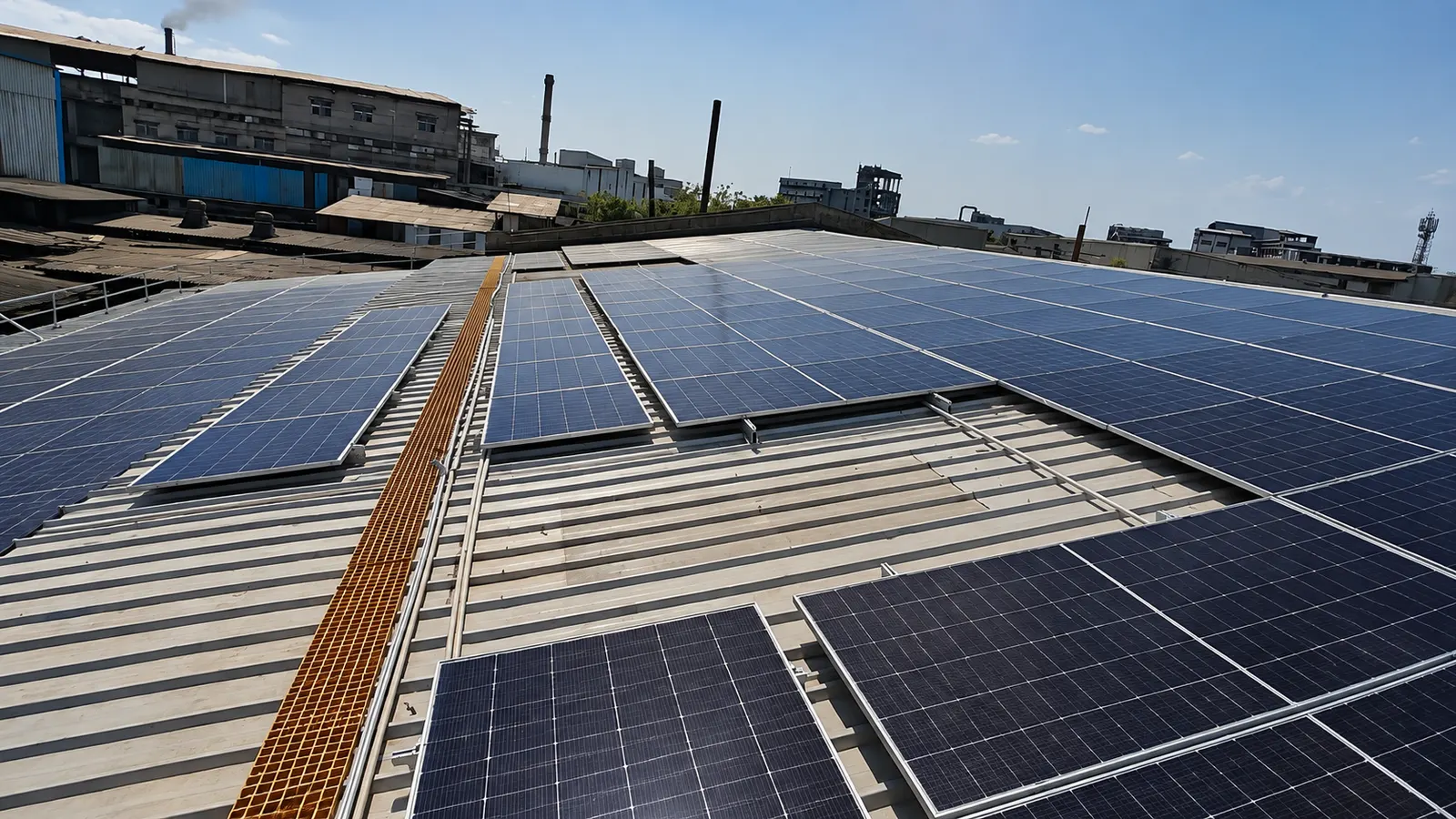
A process-house roof is an operating asset, not an empty sheet of metal. It may carry exhaust ducts, vents, smoke outlets, skylights, water lines, cable trays and maintenance access. It may also be exposed to lint, dust, soot, steam or chemical fumes depending on the machinery and fuel used on site. These are survey questions, not universal claims that every textile roof has the same contamination or corrosion rate. The roof plan should mark each relevant outlet and a safe route for cleaning and inspection.
Start with structural condition. Ask who owns the shed, when it was built or altered, and whether structural drawings and repair records exist. A qualified engineer should review sheet condition, purlins, rafters, load path and wind actions before the EPC fixes an array layout. A roof that looks large from above may have weak bays, repeated leaks or areas where access is not safe. The US Department of Energy's commercial rooftop guidance identifies structural strength, age and wind exposure as general PV roof-suitability issues; the actual Gujarat design requires local standards and the appointed engineer's sign-off.
Next, ask how mounting details handle the sheet profile and process environment. A standing-seam clamp, trapezoidal-sheet bracket and older corrugated-roof connection are not interchangeable. The design should show where forces enter the supporting structure, how water tightness is maintained and how incompatible materials are separated. If fumes or soot reach the roof, the module, cable and mounting choices and cleaning method should be reviewed for that exposure. Do not accept a fixed cleaning frequency or “self-cleaning panel” claim from a brochure without site evidence.
Put operations alongside the roof drawing. If a stenter vent or boiler flue is near a candidate array, ask the EPC to consider shade, deposit, access and corrosion. If workers need to reach a smoke outlet, do not block the path with modules. If the roof needs repair before solar, price and schedule that work separately.
Plan installation around production
Mounting work and the final electrical tie-in need different controls. Some rooftop tasks may proceed while a processing line operates if the site safety plan and method allow it. The correct sequence depends on the plant's SLD, switchgear, permit-to-work system and production priorities. A blanket “no production interruption” promise would be irresponsible without that assessment.
Ask the EPC to identify which roof blocks can be accessed, where materials will be staged and how crews will avoid process outlets and fragile zones. For electrical work, mark the exact board and isolation point, who authorises the outage, the window available, and the contingency if the work runs longer. If the plant has DG supply or critical ETP loads, include those in the switching plan. The proposal should show who owns each permit and inspection, not simply say “site coordination included”.
There is also a commissioning sequence. The 2026 GERC regulation sets an application and technical-feasibility framework and refers to meter, protection and inspection evidence. Its activity chart mentions Chief Electrical Inspector installation charging approval whenever applicable. The project engineer and relevant distribution licensee must identify the actual approvals for the chosen capacity and voltage. A public sector page cannot declare every processing house exempt or subject to the same CEIG route. GERC Regulations 5–7 and activity chart.
| Project question | Why it matters in a processing house | Evidence to request |
|---|---|---|
| What runs during daylight? | Batch and shift changes alter direct solar use | Interval import and production schedule |
| Which heat uses are being confused with electricity? | PV does not directly replace boiler fuel | Separate utility and fuel records |
| What reaches the roof? | Vents, lint, soot, steam and fumes affect layout and maintenance | Roof plan, outlet map and safe photos |
| Can the shed carry the designed array? | Mounting loads and wind actions use the structure | Named engineer's calculation and sign-off |
| Where will solar connect? | Metering and shutdown scope follow the electrical boundary | Current SLD and proposed marked SLD |
| Who owns utility and inspection steps? | Approval and commissioning depend on documents | Responsibility register and current licensee process |
The table is a question map. It is without invented “typical” plant numbers. The BEE cluster studies explain why the questions matter, but the facility's own documents determine the answer.
What should be in a textile-processing proposal?
Ask for a roof layout showing usable area, excluded zones and access; the proposed module and inverter models; DC kWp and AC kW; and the structural review deliverable. Ask for a marked SLD with the tie-in, transformer or main-board impacts, protection, isolation and meter positions. The energy model should show hourly or interval output, direct use and export under at least normal and low-load conditions. It should state the weather source, system losses and uncertainty.
On the commercial side, request the utility and tariff code used, the current metering mechanism, external fees or strengthening estimates, tax assumptions, named warranty providers, O&M scope, and what is excluded. Do not compare two bids by a rupees-per-kWp headline if one includes roof repair or meter work and the other does not.
The proposal should also name what cannot be promised yet: final roof capacity before structural sign-off, final export treatment before the utility route is settled, and a price or schedule before connection and roof work are understood. That is not a weakness. It lets the plant head decide which investigations to fund and prevents a change order from appearing as a surprise after the plant has arranged a shutdown.
For a processing house with several roof blocks, compare layout choices on their own merits. A distant block may have better sun but a longer cable path and more complicated roof access. A block near the electrical room may have a vent or weak structure. The final choice belongs to an integrated structural, electrical and operations review. A roof photograph alone cannot settle it.
Questions from dyeing and printing units
Will PV replace our boiler fuel? Standard rooftop PV makes electricity. It does not directly create the steam or process heat used in dyeing and finishing. The BEE cluster report distinguishes thermal and electrical energy for this reason. A separate electrification or solar-thermal project would need its own engineering and economics. BEE textile sector report.
Can we size from the monthly electricity bill? It is a starting baseline, but a process house's shifts, batch cycles and closures matter. Ask for interval data and a production calendar to estimate direct self-use and export. A monthly total alone cannot show those patterns.
Will soot or steam make panels unsuitable? Not automatically. The actual outlet location, deposit type, cleaning access and material exposure need a roof survey. An EPC should show how those findings change layout, equipment selection and maintenance, rather than assume a universal penalty or cleaning schedule.
Must production stop for installation? The answer depends on the roof-access plan and electrical tie-in. Roof work may be staged, while the connection can need an isolation window. The EPC should mark the board, permit and outage dependency in the method statement before any promise is made.
Can every Gujarat processing house use net metering? The 2026 regulation lists eligible arrangements and conditions, but technical feasibility and the distribution licensee's process still apply. The proposed capacity, contract demand and meter scheme must be checked for the actual service connection. GERC Notification 11/2026.
Can I inspect a textile installation before deciding? Ask for a reference whose owner permits disclosure or a site visit. We do not identify a customer project on this page, and the BEE research cited above is an independent sector study, not our project record.
Request a proposal based on your processing house
The useful starting pack is the latest 12 electricity bills, the tariff and utility name, any interval data, a production schedule, roof photos or drawings, and the current SLD. Include notes about vents, soot, steam, leaks, leased roof rights and available shutdown windows. Those facts allow Heaven Green Energy to discuss the right next survey and a load-based solar proposal without pretending that all dyeing and printing houses use the same capacity.
Get a load-based proposal for my plant. Use the industrial enquiry form or call +91 63904 05060. See industrial rooftop solar for the wider factory process. The BEE sector figures on this page describe 2022 cluster analysis; your plant's bills and surveys determine your own project.