Solar panel installation in Junagadh.

Heaven Green Energy sizes your array against the units printed on your PGVCL bill, installs it on a structure engineered for Girnar-belt wind and rain, files your net-metering application with Paschim Gujarat Vij, and claims the ₹78,000 central subsidy for you. We are an authorised Adani Solar distributor and a PM Surya Ghar empanelled vendor.

Authorised Adani Solar distributorPM Surya Ghar subsidy claimed for youPGVCL net metering filed on your behalfFree survey, zero advance payment

Get your free Junagadh solar quote

Share your last PGVCL bill and your pin code. An engineer calls back with a system size, a cost after subsidy and a payback figure, usually within two working hours.

Free site survey. No advance payment.

Prefer to talk? +91 63904 05060

Distribution licensee
PGVCL (Paschim Gujarat Vij)
Junagadh circle, not Torrent Power or DGVCL
Regulator
GERC
Writes the rooftop and net-metering rules for Gujarat
Solar resource
About 5.5 peak sun hours
Saurashtra sits near the top of the Indian range
Generation
4 to 4.5 units per kW daily
Annual average across all seasons
Central subsidy
Up to ₹78,000
Residential consumers at 3 kW and above
Typical payback
3.5 to 5 years
Residential on-grid, before any tariff rise

The short answer

A 3 kW rooftop system in Junagadh costs roughly ₹1.80 lakh to ₹2.25 lakh before subsidy and ₹1.02 lakh to ₹1.47 lakh once the ₹78,000 PM Surya Ghar grant lands. Every installed kilowatt yields 4 to 4.5 units daily here. Paschim Gujarat Vij Company Limited, PGVCL, is the distribution licensee for Junagadh. Residential payback typically falls between three and a half and five years.

Last reviewed 18 September 2026 · Heaven Green Energy engineering team

Price, size and savings

Find your bill. Read across.

Here is the price, stated plainly rather than parked behind a callback. Locate your monthly bill in the first column, then read across for the size that fits it, the units it should make, the shadow-free roof it needs and what it costs once the subsidy is deducted.

Indicative Junagadh market ranges, 2026
Your monthly bill System Generates Roof needed Cost after subsidy Payback
Up to ₹1,800 2 kW A compact 1–2 BHK with light air-conditioning use 240–270units/month ~200 sq ft ₹65,000 – ₹95,000 ₹1.25 lakh–₹1.55 lakh before ₹60,000 subsidy 3.5–4.5 years
₹2,000–₹3,500 3 kW Best value The largest system that still earns the full ₹78,000 360–405units/month ~300 sq ft ₹1.02 lakh – ₹1.47 lakh ₹1.80 lakh–₹2.25 lakh before ₹78,000 subsidy 3.5–4.5 years
₹3,500–₹6,000 5 kW A 3 BHK running two ACs through a 40°C Junagadh May 600–675units/month ~500 sq ft ₹2.07 lakh – ₹2.67 lakh ₹2.85 lakh–₹3.45 lakh before ₹78,000 subsidy 4–5 years
₹6,000–₹13,000 10 kW Bungalows off College Road, clinics, showrooms and small hotels 1,200–1,350units/month 700–1,000 sq ft ₹4.42 lakh – ₹5.52 lakh ₹5.20 lakh–₹6.30 lakh before ₹78,000 subsidy 4–5 years
Above ₹13,000 25 kW+ Oil mills, ginning units and cold stores claiming depreciation 3,000–3,400units/month Site-specific ₹10.75 lakh – ₹13.50 lakh ₹10.75 lakh–₹13.50 lakh, no subsidy 3–4.5 years

These are indicative Junagadh market ranges for 2026, covering Tier-1 modules, a branded inverter, a galvanised mounting structure, protection gear and installation labour. They are not a Heaven Green Energy quotation and no quotation is implied. Subsidy figures are the central PM Surya Ghar amounts published on pmsuryaghar.gov.in. Generation assumes a shadow-free, broadly south-facing roof.

The subsidy stops climbing at 3 kW. PM Surya Ghar pays ₹30,000 for each of the first two kilowatts and ₹18,000 for the third. Above that it pays nothing. So the grant covers about a third of a 3 kW system and roughly an eighth of a 10 kW one. If your bill sits on the boundary between 3 kW and 5 kW, the smaller array returns more rupees for every rupee you spend, and the larger one only wins if your consumption genuinely supports it.

A cheap Junagadh quote is rarely cheap in the panel. It is cheap in galvanising thickness, cable cross-section, earthing pits, surge protection and the wind-load design of the mounting structure. Those are the parts nobody photographs and the parts that fail first. Ask every vendor for a written Bill of Materials listing make, model and quantity for each item. Without that sheet you are comparing two prices, not two systems.

One warning specific to this city. Junagadh roofs pick up dust from the groundnut and cotton yards, the Dolatpara industrial belt and eight rainless months, and the older walled-city lanes around Kalva Chowk and Nava Nagarwada put water tanks and neighbouring parapets straight across low roofs. Get shading checked on site before you accept any rating on paper.

Why there is no rupee saving in that table

The table quotes no rupee saving, on purpose. What a generated unit is worth to you depends on the tariff slab you personally sit in, and that is printed on your own PGVCL bill. A domestic connection in Joshipura and a shop on Jawahar Road do not value the same unit identically. Bring your last bill to the free survey and we will work your figure out in front of you, using your slab rather than a state average. Prefer to work it out yourself first? Put your bill into our solar savings calculator. No phone number required.

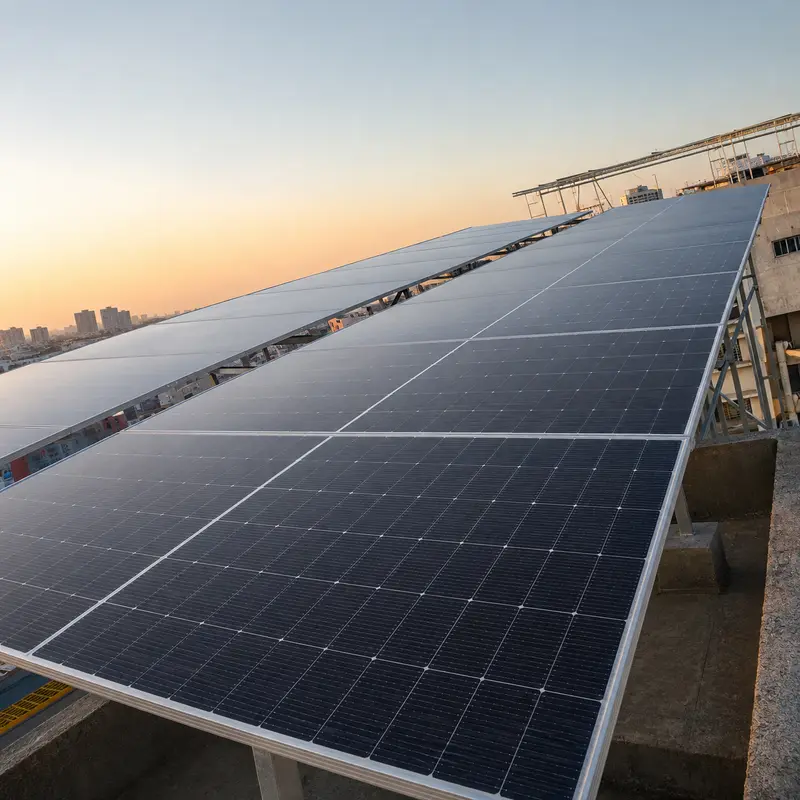
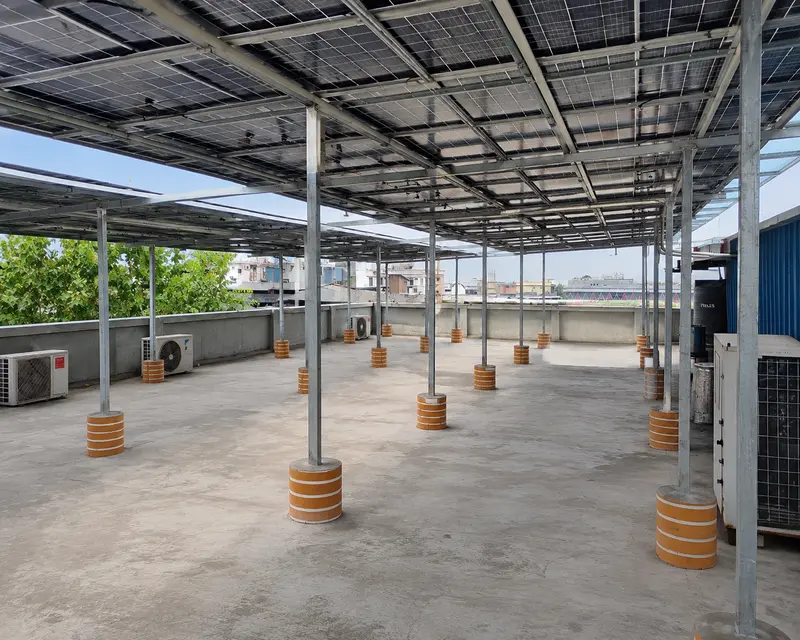
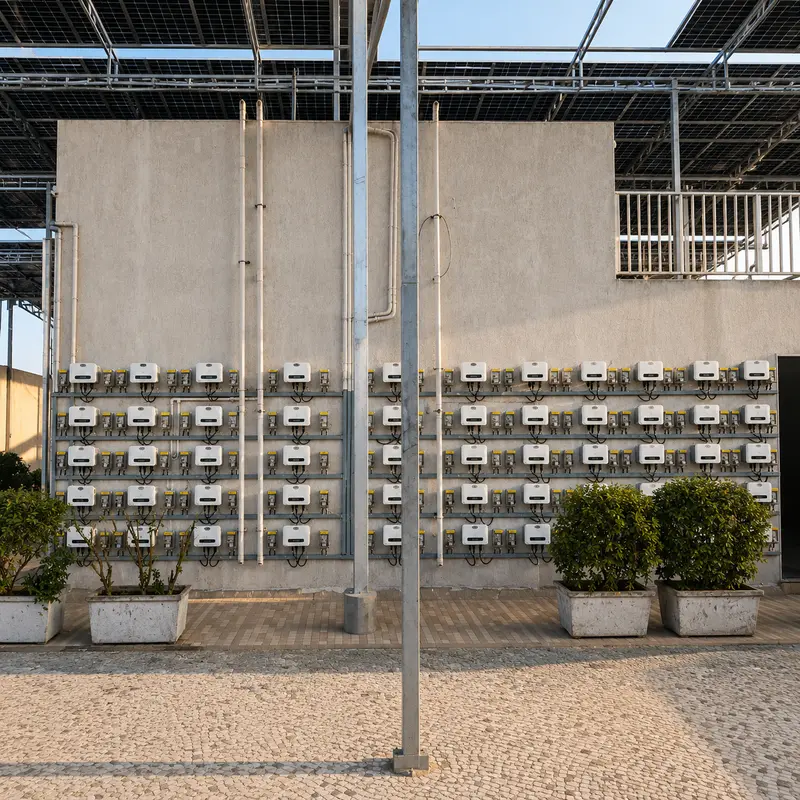
This is what we actually build.

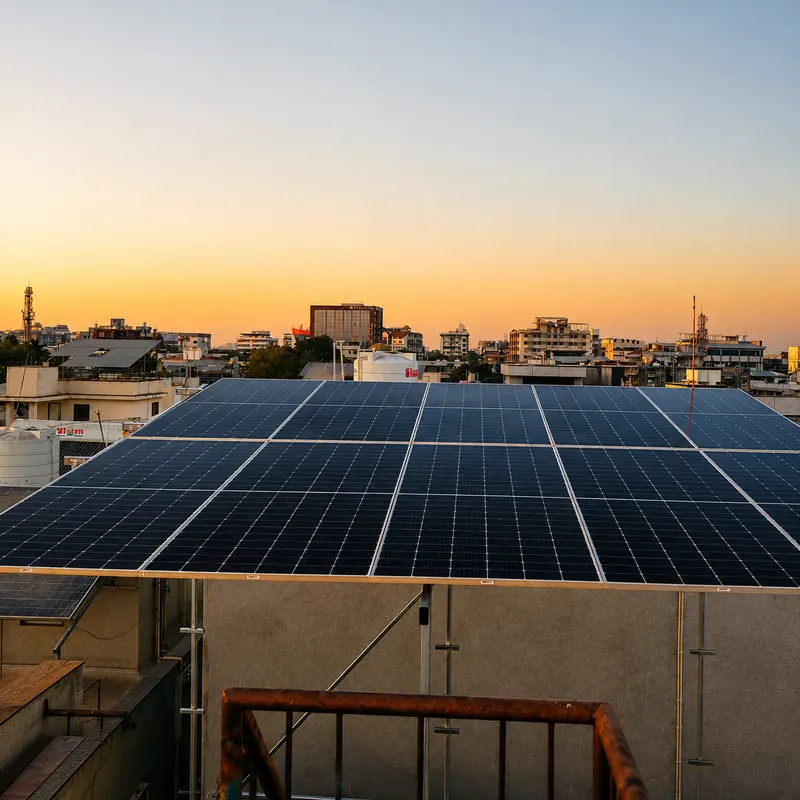
Heaven Green Energy installations across India. Not stock photography, and not renders. Your Junagadh system is built to the same specification.

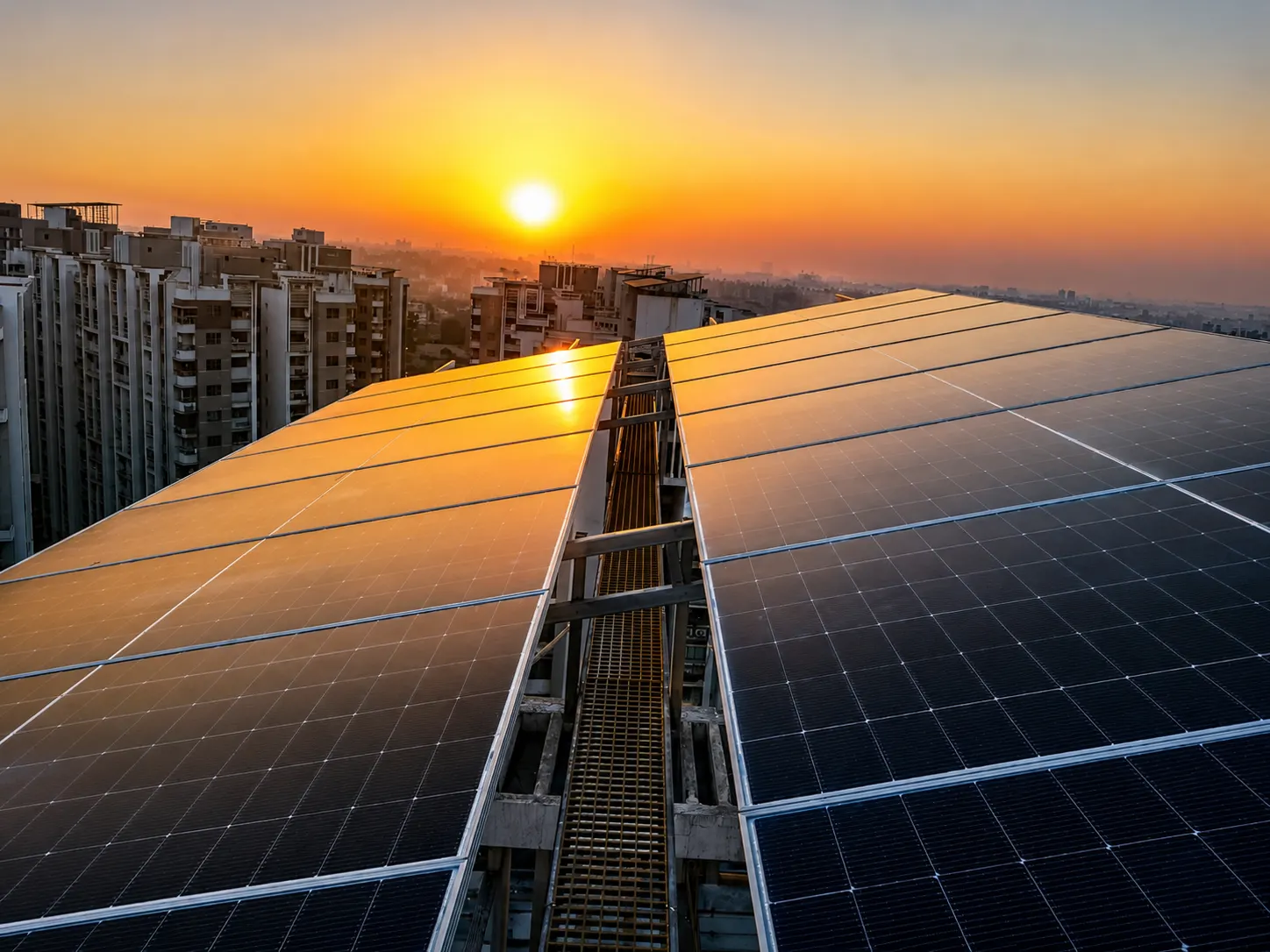
Rooftop solar array photographed against a city skyline at sunset
Residential rooftop
Long row of solar modules on a commercial building rooftop photographed at sunrise
Commercial rooftop
Elevated solar canopy structure mounted above a terrace, leaving the floor below usable
Elevated structure
Wall of dozens of string inverters mounted in neat rows at a large solar installation
Electricals

PM Surya Ghar Muft Bijli Yojana

₹78,000

Maximum central subsidy for a residential rooftop system.

  • ₹30,000 per kW for the first 2 kW
  • ₹18,000 for the 3rd kW
  • Nothing paid above 3 kW
  • Credited directly to your bank account
  • We file the entire claim for you
How the subsidy works

Five steps, and we run four of them.

There is no separate Junagadh subsidy and no Gujarat top-up riding on the central scheme. PM Surya Ghar is national, so the money is the same here as in Rajkot or Chennai. What differs by city is the utility that processes your file, and in Junagadh that is PGVCL. Five stages, in order.

1

Register on the national portal

You register at pmsuryaghar.gov.in with your PGVCL consumer number, mobile number, Aadhaar and address. We sit with you through it. A consumer number that does not match PGVCL's own record is the commonest reason a Saurashtra application stalls before it starts.

2

Apply for feasibility and pick your vendor

PGVCL checks your proposed capacity against your sanctioned load and the local network, then clears it. You choose an empanelled vendor from the portal list. Heaven Green Energy is empanelled, so your application maps to us directly with no side arrangement.

3

Install only once approval is in hand

Installing ahead of feasibility approval is how households forfeit the grant outright. After clearance we supply Adani modules with traceable serial numbers and hand over the Bill of Materials and the full warranty schedule on commissioning day.

4

Inspection and bidirectional meter

A PGVCL officer inspects the installation, and the sub-division replaces your meter with a bidirectional one. That generates the commissioning certificate on the portal. Our engineer attends, so questions get settled on the roof rather than by email a week later.

5

Claim filed, money credited to you

We file the subsidy claim as soon as the certificate issues, and the government credits your bank account directly. The money never passes through us. Treat any Junagadh vendor offering to collect the subsidy on your behalf as a reason to walk.

If you are a business, this section does not apply

PM Surya Ghar covers residential consumers only. An oil mill at Dolatpara, a ginning unit, a hotel on Girnar Road or a trading firm cannot claim it. Businesses instead claim accelerated depreciation on the solar asset, which for a profitable taxpayer is usually worth more than the residential grant would have been.

PGVCL (Paschim Gujarat Vij)

Net metering: who you actually file with.

Net metering is where Junagadh pages go wrong most often, and naming the wrong licensee costs you every export credit you were counting on.

Junagadh is supplied by Paschim Gujarat Vij Company Limited (PGVCL), a GUVNL subsidiary incorporated in 2003 and run from Rajkot. Junagadh district is one of the twelve districts in its licence area, alongside Rajkot, Jamnagar, Porbandar, Amreli, Bhavnagar, Botad, Surendranagar, Morbi, Devbhumi Dwarka, Gir Somnath and Kutch. PGVCL runs a Junagadh circle with its own divisional and sub-divisional offices, and your file belongs to the sub-division that reads your meter.

Gujarat has four state distribution companies plus a private licensee, and they are not interchangeable. Torrent Power distributes in Ahmedabad and Surat city, DGVCL in south Gujarat, MGVCL in the central districts and UGVCL in the north. None of them touches a Junagadh connection. A vendor who writes DGVCL or Torrent on your paperwork has sent your application to a counter that cannot act on it.

The commercial terms come from the Gujarat Electricity Regulatory Commission (GERC), not from the licensee and certainly not from us. Under the state rooftop framework your sanctioned load caps your system size, every consumer category may apply, and exported units are credited against imported units rather than paid to you as cash. So two lines on your bill decide the array: units consumed and sanctioned load in kilowatts. If you want more capacity than your load permits, the load enhancement goes in first. We check both before quoting.
1

Application to your sub-division

Consumer details, sanctioned load, proposed rating, single-line diagram and site layout go to your PGVCL sub-division office in Junagadh with the registration fee.

Filed by us
2

Technical feasibility

PGVCL verifies transformer headroom and feeder capacity against your proposed rating, then issues the feasibility approval that makes installation legal.

PGVCL
3

Installation and test report

We install, earth and commission the array, then file the test report and completion documents so the meter visit can be scheduled without a second round of paperwork.

Filed by us
4

Inspection and meter change

Our engineer attends the inspection. PGVCL swaps in the bidirectional meter and your export credits begin appearing from the following billing cycle.

Us, then PGVCL
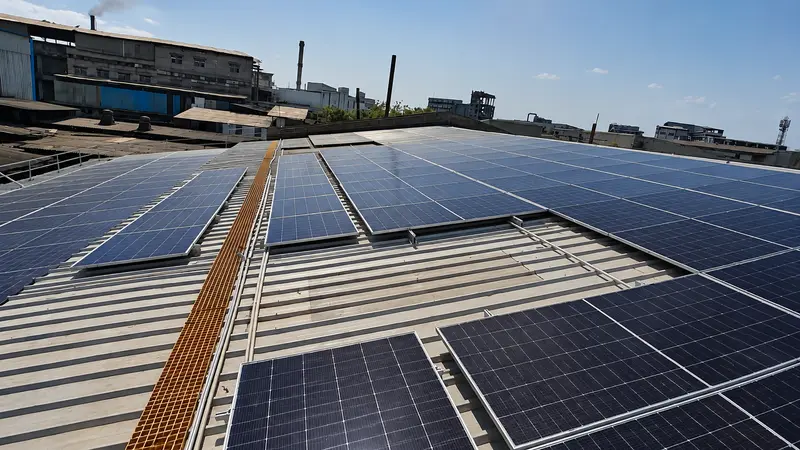
Solar panels installed flush on a corrugated metal factory roof with industrial buildings behind
Not a home?

Solar for Junagadh's businesses.

Not a home? Junagadh runs on agro-processing, and the arithmetic on a mill shed is nothing like the one on a bungalow slab.

Junagadh is the leading groundnut district in Gujarat, and the processing sits close to the city: expeller and solvent-extraction oil mills, cotton ginning and pressing, cattle feed, cold stores handling Gir Kesar mango, surgical cotton and food packing. Most of it clusters at Dolatpara, Udyognagar, the GIDC estate, the marketing yard on Rajkot Road, Khamdhrol, Galiyavada and the Junagadh bypass, with hotels and hospitals on College Road and the Girnar approach on the same high-tariff side of the tariff schedule.

These consumers cannot claim PM Surya Ghar. They claim accelerated depreciation on the solar asset, which for a profitable taxpayer usually beats the residential grant, and it can sit on top of a zero down payment structure so the instalment stays under the bill the array removes.

  • Mill and ginning sheds need a structural and wind-load check before any capacity is quoted.
  • Capacity is capped against sanctioned load, so load enhancement may have to come first.
  • Oil-cake and cotton-lint dust belongs in the AMC as a written cleaning frequency, not an assumption.
Why us

Why Junagadh customers choose Heaven Green Energy

Since 2017 we have completed more than 10,000 installations across Gujarat, a large share of them on PGVCL connections across Saurashtra.

We own the PGVCL paperworkPortal registration, sub-division application, feasibility, inspection and the subsidy claim are ours to chase. You sign where required. Nobody hands you a form and a sub-division address and calls that service.
Adani modules, Qbits invertersWe are an authorised Adani Solar distributor and we manufacture our Qbits inverters ourselves. Serial numbers are traceable and the warranty chain leads back to a company, not to a trader who changes brand every quarter.
Survey before ratingAn engineer measures your usable shadow-free roof, checks the slab or shed and plans cable routes before quoting capacity. A rating pulled off your bill alone ignores the tank, the parapet and the neighbour's terrace.
The quote is the whole quoteOne document lists modules, inverter, structure, cable, earthing, protection and labour with quantities. No advance payment, and no line item that reappears as an extra once the structure is already on your roof.

Where we are based

Heaven Green Energy is headquartered at Mota Varachha, Surat, and that is our only office. We serve Junagadh and the wider Saurashtra region through our channel partner network and field engineering team, who run the surveys, supervise the installation and handle PGVCL coordination on the ground. We would rather you knew that before you signed than after. There is no Junagadh branch and no local counter to walk into.

How we work

From first call to a spinning net meter.

Four stages take you from the first call to your first export credit on a PGVCL bill.

01

Call and bill review

We read units, tariff category and sanctioned load off your PGVCL bill, then give you an indicative capacity and cost band before anyone travels.

Same day
02

Free site survey

An engineer measures shadow-free roof area, checks the structure, plans the cable run and picks a shaded, ventilated position for the inverter.

1–3 days
03

Paperwork and approval

Portal registration, PGVCL application and feasibility approval. The wait depends on your sub-division's queue, so we tell you where the file is.

2–5 weeks
04

Install, inspect, commission

Structure, modules, inverter, earthing and protection go up, then the PGVCL inspection, the bidirectional meter and the commissioning certificate.

2–4 days on site

What Junagadh weather does to a solar system

Junagadh sits in a hot semi-arid belt at the foot of Girnar, which gives it fierce sunlight, a wetter monsoon than most of Saurashtra and eight dry months in between. Good for generation, hard on hardware. Three design consequences follow.

Eight dry months of agricultural dust

January averages barely any rain here and nothing meaningful falls between October and May. Field dust off the surrounding talukas, lint from the ginning season and traffic dust along the bypass settle on glass continuously and cut output before anything else does. Soiling is the largest avoidable loss on a Junagadh roof. We set cleaning frequency by where your building actually stands, not by a standard AMC clause.

A heavy, concentrated monsoon

Junagadh takes roughly 650 to 750 mm a year, most of it between June and September, and July alone averages around 228 mm. Girnar lifts the rain-bearing wind, so squalls arrive hard and fast. That argues for galvanised structures anchored properly, sealed and gasketed cable entries, and earthing that has been tested rather than assumed. Weak structures fail in the first violent spell, not in year ten.

Forty-degree Mays and heat derating

May is the hottest month, with average highs near 39 to 40°C and peaks above that. Module output drops as cell temperature climbs, so the mounting decides how much you keep: enough clearance under the array for air to move and no heat pocket trapped against a flat slab. An inverter left on a west wall in full afternoon sun derates too. We place it shaded and ventilated.

Service area

Areas of Junagadh we install in.

We survey and install across Junagadh city and the surrounding talukas. These are the areas we are asked about most, grouped by part of the city with their pin codes.

Walled city and central Junagadh Pin 362001

Talav Gate · Kalva Chowk · Motibaug · Kadiyavad · Mullawada · Nava Nagarwada · Vanzari Chowk · Chokshi Bazar · Chandi Bazar · Jawahar Road · Dhal Road · Kajivada Road · Maliwada Road · Sindhi Para

Gandhigram, College Road and Girnar side Pin 362001

Gandhigram · College Road · Girnar Road · Datar Road · Bilkha Road · Sardar Baug · Bahauddin College area · Junagadh Agricultural University campus · Railway Station area · Meghani Nagar · Rajmoti Society · Lilashah Society · Sainik Society · Karmchari Nagar

Joshipura and the western belt Pin 362002

Joshipura · Zanzarda Road · Zanzarda · Khalilpur · Kailash Nagar · Subhash Nagar · Khwaja Nagar · Bapunagar Main Road · Adarsh Nagar · Shanteshwar Road · Nandanvan Road · Krishna Park Road · Gangotri Nagar · Junagadh Bypass Road

Dolatpara industrial belt and Timbavadi Pin 362037 and 362015

Dolatpara · Udyognagar · Galiyavada · Khamdhrol · Saragvada · Indreshvar · Marketing Yard, Rajkot Road · Timbavadi · Vijapur · Plasva · Ivnagar · Sodvadar · Sagdividi · Ghudvadar

Customers

Real customers, real cities.

These are real Heaven Green Energy customers, each shown with the city the system was actually installed in. We do not relabel a review to whichever city page you happen to be reading.

★★★★★
10 kW on our farmhouse with battery backup. No more relying on the unreliable rural grid. Their AMC visits are on schedule, panels stay clean.
Hardik Solanki
Residential · Junagadh · 10 kW
★★★★★
Compared 5 vendors, Heaven Green's quote was the most transparent. No hidden fees. Adani panels installed on schedule, structure is solid.
Kiran Trivedi
Residential · Rajkot · 4 kW
★★★★★
PM Kusum scheme, 7.5 HP solar pump. Diesel cost zero now. Their team coordinated with the Krishi office for the subsidy file end-to-end.
Bharatbhai Chaudhari
Agriculture · Banaskantha · 7.5 HP
Before you sign

Six things to check on any Junagadh quote.

Including ours. Take this list to every vendor you speak to.

Questions

Solar in Junagadh: every question answered.

17 questions Junagadh buyers actually search for, including the ones competing pages leave out. Grouped so you can skip to what you need.

Cost & subsidy

What does a solar panel system cost in Junagadh in 2026?
A 3 kW rooftop system runs roughly ₹1.80 lakh to ₹2.25 lakh before subsidy, or ₹1.02 lakh to ₹1.47 lakh after the ₹78,000 grant. A 5 kW system runs ₹2.85 lakh to ₹3.45 lakh before subsidy. These are indicative market ranges for the city, not a quotation.
How much Junagadh solar subsidy can I actually receive?
Up to ₹78,000. The scheme pays ₹30,000 for each of the first two kilowatts and ₹18,000 for the third, then nothing beyond 3 kW. It is a central scheme, so the amount is identical in Junagadh, Rajkot and anywhere else. Residential consumers only.
Is there an extra Gujarat state subsidy on top of PM Surya Ghar?
No. Gujarat adds no state top-up to the central residential scheme, so anyone in Junagadh promising a bonus state grant is either confused or selling. The ₹78,000 ceiling is the whole subsidy available to a household, credited directly by the government.
Can I buy rooftop solar in Junagadh without paying anything upfront?
Yes. We work on zero advance payment, and finance through our partners converts the system into an EMI that usually sits below the bill the array removes. Businesses can combine that structure with accelerated depreciation on the asset.

Net metering & DISCOM

Which electricity company handles net metering in Junagadh?
Paschim Gujarat Vij Company Limited, PGVCL, through its Junagadh circle offices. PGVCL is the GUVNL subsidiary for Saurashtra and Kutch. Torrent Power, DGVCL, MGVCL and UGVCL serve other parts of Gujarat and have no role in a Junagadh connection.
How long does PGVCL net metering approval take in Junagadh?
Plan for two to five weeks from application to feasibility approval, then the inspection and the bidirectional meter after installation. The exact wait depends on your sub-division's queue. We file the paperwork and follow it up rather than handing it to you.
What happens to the units I export to the PGVCL grid?
Under the GERC framework, exported units are credited against the units you import, so your bill nets off rather than paying you cash each month. Surplus left at the end of the settlement period is treated per the Commission's prevailing rooftop order.
Can my system be bigger than my sanctioned load?
No. Gujarat caps rooftop capacity against your sanctioned load, so a 3 kW sanctioned connection cannot carry a 6 kW array. If you need more, the load enhancement application goes to PGVCL first. We check your sanctioned load before quoting any capacity.

Sizing & performance

How many units will a solar system generate in Junagadh?
About 4 to 4.5 units per installed kilowatt per day as an annual average, on roughly 5.5 peak sun hours. That puts a 3 kW array at 360 to 405 units a month and a 5 kW array at 600 to 675 units, assuming a shadow-free roof.
What size system suits my Junagadh electricity bill?
Read units, not rupees. A bill of ₹2,000 to ₹3,500 usually points at 3 kW, ₹3,500 to ₹6,000 at 5 kW, and ₹6,000 to ₹13,000 at 10 kW. Your sanctioned load and usable roof area decide the final number at survey.
How much roof area do I need in Junagadh?
Around 300 sq ft of shadow-free roof for 3 kW and about 500 sq ft for 5 kW. Shadow-free is the operative word in the older lanes, where water tanks, parapets and a neighbour's terrace can clip the array for hours each day.
Does monsoon and dust ruin generation here?
Neither is fatal, both are real. Junagadh takes most of its 650 to 750 mm in four months, which costs some output but washes the glass. The bigger loss is the long dry season, when farm and industrial dust builds up unless cleaning is scheduled.

Installation & service

How long does installation take in Junagadh?
Two to four days on site for a residential system once approvals are in place. The full timeline, including portal registration, PGVCL feasibility, inspection and meter change, normally runs four to eight weeks from your first call.
Who maintains the system after commissioning?
We do, under an AMC with a cleaning frequency written into it rather than left vague. Panels need washing, connections need checking and the inverter needs monitoring. In a dusty agro-processing district, skipping cleaning is the commonest cause of lost output.
Will the structure survive Junagadh wind and monsoon squalls?
It is designed to. We use galvanised structures anchored for local wind loads, with sealed cable entries and tested earthing. Cheap structures fail in the first heavy spell off Girnar, which is why the steel specification belongs in your Bill of Materials.

About Heaven Green

Does Heaven Green Energy have an office in Junagadh?
No. Our only office is at Mota Varachha, Surat. We serve Junagadh through our channel partner network and field engineering team, who run surveys, supervise installation and coordinate with PGVCL locally. We say so upfront instead of implying a branch that does not exist.
What equipment do you install and who backs the warranty?
Adani Solar modules, as an authorised distributor, with Qbits inverters that we manufacture ourselves. Serial numbers are traceable and the warranty chain leads back to named manufacturers. You receive the full warranty schedule on commissioning day.
Nearby

We also install around Junagadh.

Every city we cover is listed in the solar by location directory.

Free Junagadh site survey No advance payment, no obligation Get my quote
Call WhatsApp