Price, size and savings Find your bill. Read across.
Most Rajkot solar pages hide the price behind a callback form or quote a national average that ignores Saurashtra installer density. One table settles it. Find your monthly bill on the left and read across for system size, generation, roof area needed and the cost after subsidy.
Indicative Rajkot market ranges for 2026, covering Tier-1 modules, a branded inverter, galvanised structure, protection and installation. These are market ranges, not a Heaven Green quotation. Subsidy figures are the central PM Surya Ghar amounts published on pmsuryaghar.gov.in. Generation assumes a shadow-free, roughly south-facing roof.
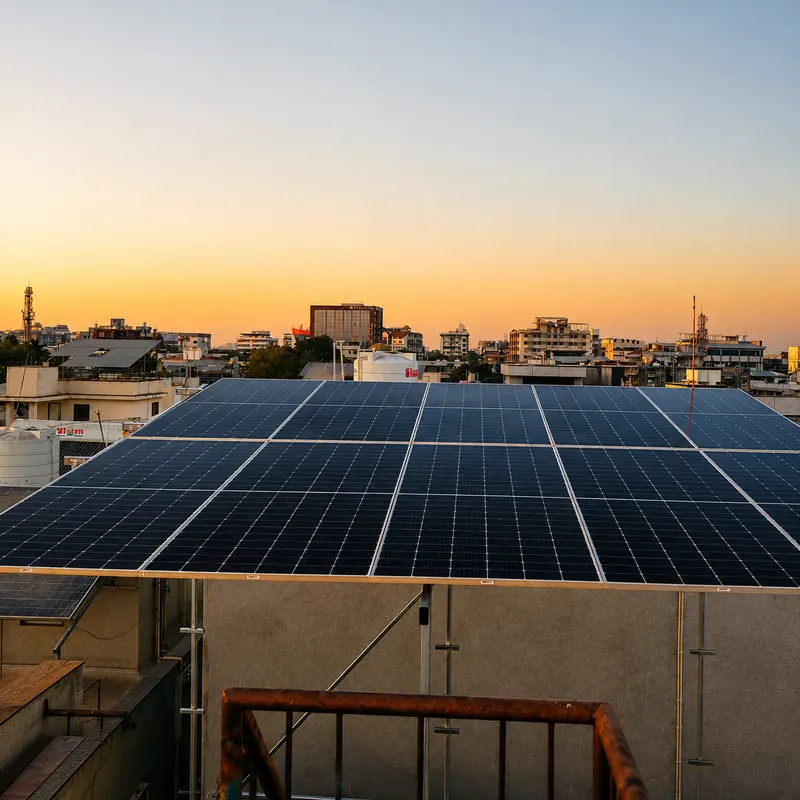
Size against units, not rupees. Read the units figure off your last PGVCL bill rather than the amount, because units are what a system cancels and the tariff is not yours to control. Shadow-free is the operative phrase in the roof column. On a Bhaktinagar or Rajputpara terrace, a water tank or a neighbour's parapet stealing two hours of morning sun costs more output than most buyers expect, and an elevated structure earns its extra steel. Measure the usable area on site before you agree a size, not from a satellite image.
The 3 kW cliff is real. PM Surya Ghar pays ₹30,000 per kW for the first two kilowatts and ₹18,000 for the third, then nothing. So the subsidy covers 35 to 43% of a 3 kW system but only 12 to 15% of a 10 kW one. If your bill sits on the border, 3 kW wins on rupees returned per rupee spent.
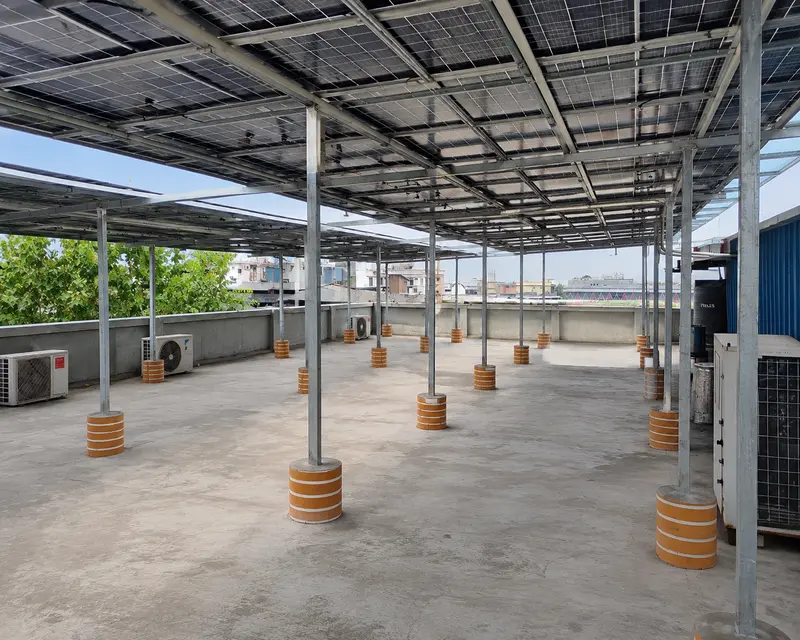
A cheap Rajkot quote is cheap in the structure, not the panels. This is a city that makes castings and machine tools, so ask the question you would ask a supplier: galvanising thickness, section size, fastener grade, cable gauge, earthing and surge protection. Those items separate the bottom of each band from the top, and they decide whether the array survives a June squall off the Arabian Sea. Demand a written Bill of Materials with make, model and quantity.
One warning specific to this city. Rajkot has a dense local fabrication trade, so some quotes arrive with a locally welded mild-steel structure and a thin coat of paint instead of a hot-dip galvanised one. It looks identical on day one and costs twenty to thirty thousand rupees less. Three monsoons later the joints are rusting and the array is carrying corrosion into its own mounting rails, which no module warranty covers. Ask which it is, in writing, and ask for the coating specification. The same applies to the earthing pit: one strip pushed into dry Saurashtra soil is not an earthing system.
Why there is no rupee saving in that table
There is no rupee saving in that table on purpose. The rupee figure depends on the PGVCL slab rate you personally pay, which is printed on your own bill and differs between consumers and categories. Guessing it would be dishonest. Bring your last bill to the free survey and we work the exact number out with you, in front of you. Two neighbours in Mavdi with identical roofs and identical systems can save different amounts simply because one draws more units in the top slab. That is a billing fact, not a sales variable. Prefer to work it out yourself first? Put your bill into our
solar savings calculator. No phone number required.