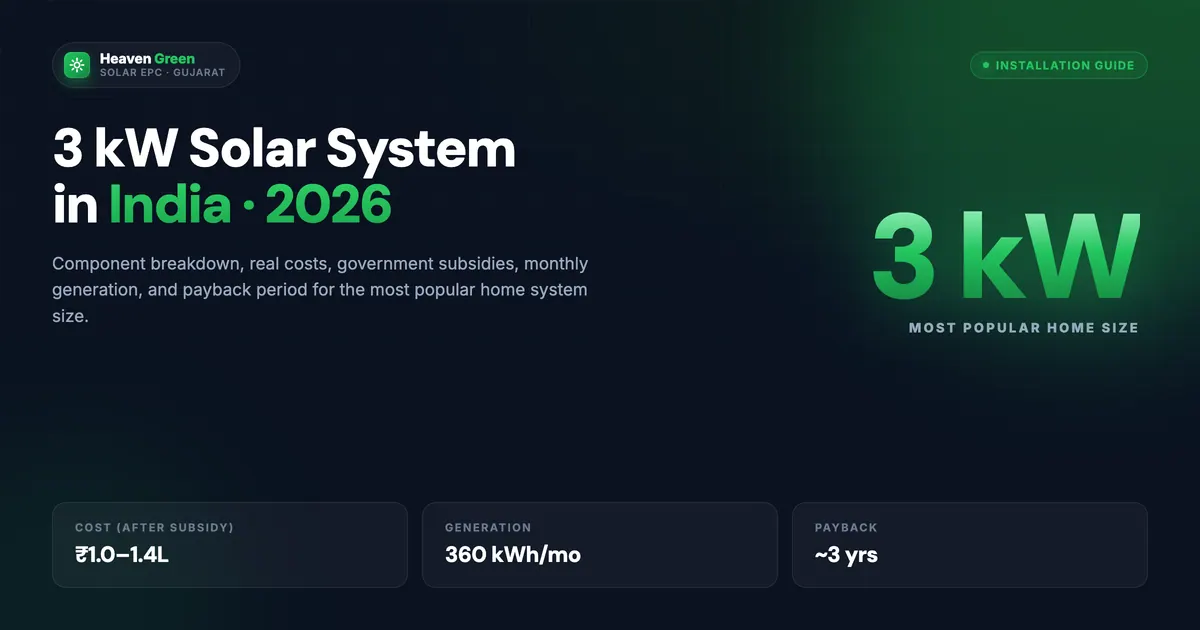
The single most common question we get on a residential site visit in 2026 is simple, should I install a 3 kW, 5 kW, or 10 kW home solar system? All three sizes are popular because they cover the bulk of Indian homes: 3 kW is the subsidy sweet spot at ₹78,000 maximum central subsidy under PM Suryaghar, 5 kW is the standard mid-tier choice for households running two air-conditioners and an inverter fridge, and 10 kW is the largest size that gets deemed DISCOM feasibility approval, usually picked by villas, bungalows, and homes with EV (Electric Vehicle) charging or a pool pump.
Picking the wrong size costs you money in two directions. Go too small and you cap your subsidy claim and leave generation potential on the roof; go too large and the system exports surplus units that get credited at a regulator-set rate well below retail (₹2.25/unit in Gujarat), instead of saving the retail tariff at ₹7–₹8/kWh. This guide compares all three sizes head-to-head across cost, generation, payback, and roof footprint, and gives you a 4-input sizing matrix to land on the right number for your home.
Direct answer. For most Indian homes in 2026, a 3 kW system is the optimal size, it captures the full ₹78,000 PM Suryaghar subsidy, fits a sanctioned load of 3 kW, generates ~375 kWh/month, and pays back in about 3.5 to 4 years. Pick a 5 kW if your bill exceeds ₹4,500/month or you run two ACs. Pick 10 kW only if your bill crosses ₹7,500/month, you have a villa-sized roof, and your sanctioned load supports it.
If your bill, roof, and budget all agree on a number, your sizing decision is settled in five minutes. Most of the friction comes from one of those three inputs pulling against the others, that is the case the matrix below is designed for.
How to Choose Home Solar Size, The Bill-to-kW Rule
Before opening any calculator, run the bill-to-kW thumb rule we use across Gujarat, Rajasthan, and Maharashtra installations: divide your average monthly electricity bill by ₹1,000. The result is the kW size that will offset roughly all of your consumption.
- ₹1,800 / 1,000 ≈ 1.8 → round up to 2 kW (you’ll qualify for ₹60,000 subsidy).
- ₹3,000 / 1,000 = 3.0 → 3 kW (hits the ₹78,000 subsidy ceiling).
- ₹4,500 / 1,000 ≈ 4.5 → 5 kW, or stay at 3 kW and accept a partial offset, because every kW above 3 is unsubsidised.
- ₹6,500 / 1,000 ≈ 6.5 → round up to 7 kW or step to 10 kW if EV/pool is planned.
The thumb rule works because Indian residential tariffs cluster around ₹6.50–₹7.50/kWh in the upper slabs (where solar saves the most), and a kWp (kilowatt-peak) of solar generates roughly 1,400 to 1,650 kWh per year depending on city. That works out to ~₹9,000–₹12,500 in annual savings per kW installed, a monthly bill offset of roughly ₹750–₹1,050 per kW, so ₹1,000/kW is a round anchor. The size bands in the matrix below are wider than this rule because the subsidy stops at 3 kW: many homes with bills up to ₹4,500 still choose 3 kW. For city-specific numbers, see our home solar system size guide.
The thumb rule has two boundary cases worth flagging. First, if your upper-slab tariff is low (around ₹4–₹5/kWh), each kW offsets less of the bill, so the divisor drops to about ₹600/kW and your bill-implied size is larger. Second, if your tariff is flat rather than slab-based, the marginal kWh you save is at the average tariff, so redo the sum with your own per-unit rate: monthly bill divided by (that rate × about 125 kWh per kW).
The Home Solar Sizing Matrix, Bill, Roof, Budget, Sanctioned Load
This is the named framework we use on every Heaven Green site visit, The Home Solar Sizing Matrix. It pivots around four inputs, in this order: monthly bill, roof area, budget, sanctioned load. Whichever input is the most constrained sets your ceiling, there is no benefit to optimising for one and ignoring the others.
| Input | What it controls | 3 kW | 5 kW | 10 kW |
|---|---|---|---|---|
| Monthly bill (avg) | Right-sizes generation to consumption | ₹2,500–₹4,500 | ₹4,500–₹7,500 | ₹7,500–₹15,000 |
| Shadow-free roof area | Hard physical ceiling on panel count | ~300 sqft | ~500 sqft | ~1,000 sqft |
| All-in budget (post-subsidy) | Cash you actually deploy | ₹87K–₹1.07L | ₹1.82L–₹2.07L | ₹4.52L–₹5.72L |
| Sanctioned load on bill | DISCOM ceiling in some states (not Gujarat residential) | 3 kW min | 5 kW min | 10 kW min |
How to read the matrix. If your monthly bill says 5 kW but your roof can only host 3 kW of panels, you install 3 kW, there is no workaround. If the roof fits 10 kW but your sanctioned load is 3 kW and your state caps solar at sanctioned load, you either downsize to 3 kW or file for a load enhancement before applying (15 to 25 days, separate DISCOM workflow); in Gujarat, residential rooftop solar is allowed irrespective of sanctioned load. Budget is the easiest constraint to relax because PM Suryaghar loans from public sector banks cover up to ₹2 lakh without collateral (SBI charges 5.75%), explained in our PM Suryaghar complete guide.
Roof area is the constraint most homeowners underestimate. Modern N-type TOPCon panels at 580 to 620 Wp need ~100 sqft per kW including walkway and shadow buffers, older 540 Wp PERC panels needed 110 to 120 sqft per kW. South-facing slope or open terrace is non-negotiable for the full nameplate output.
Quick sanity check. Pull your last three electricity bills, average them, divide by ₹1,000, that gives your “bill kW”. Then measure your shadow-free roof in sqft and divide by 100, that gives your “roof kW”. The smaller of the two is your installable size. If both agree, you’ve got an easy install. If they disagree by more than 2 kW, book a site survey before ordering anything.
3 kW Home Solar, Best Fit, Cost, Generation, Subsidy
The 3 kW system is the subsidy sweet spot in India and one of the most common sizes under PM Suryaghar. It hits the ₹78,000 maximum central subsidy, fits a 3 kW sanctioned load, and lands a payback of about 3.5 to 4 years in every major city on the assumptions below.
Best fit. Monthly bill ₹2,500–₹4,500. Two- or three-bedroom home with 1 inverter AC, refrigerator, washing machine, ceiling fans, LED lighting, and one TV. Typical consumption profile: 400 to 500 kWh/month. Roof area available: 300+ sqft shadow-free.
Cost. ₹1.65–₹1.85 lakh all-in (panels, inverter, structure, AC/DC cabling, earthing, net meter coordination, GST). After ₹78,000 PM Suryaghar subsidy, out-of-pocket is ₹87,000–₹1,07,000.
Generation. ~375 kWh/month average across India, about 4,200 to 4,950 kWh/year depending on city. Specifics vary by city, the table in §Generation, Savings, and Payback by City breaks this down.
Subsidy math. ₹30,000 for the first kW + ₹30,000 for the second kW + ₹18,000 for the third kW = ₹78,000. Going from 3 kW to 4 kW adds zero subsidy because the ₹78,000 cap kicks in at exactly 3 kW. This is why 3 kW is the densest rupee-of-subsidy-per-rupee-spent option, for a fuller breakdown of the scheme mechanics, see this PM Suryaghar Yojana guide.
Payback. About 42 to 50 months across India, Jaipur and Ahmedabad on the lower end, Mumbai on the higher end. For a working example, see Suryaghar for a 3-AC home.
Loan affordability. Under PM Suryaghar’s collateral-free loan window, public sector banks finance up to ₹2 lakh for residential rooftop (SBI charges 5.75%). For a 3 kW system, the post-subsidy ₹97,000 financed over 5 years at 5.75% works out to an EMI of ~₹1,860/month, roughly the bill saving you generate. From month one your net cash position is close to neutral, and from month 61 you keep the full saving, about ₹1,900–₹2,300/month at today’s tariffs, for the remaining 20 years of panel life. That is why 3 kW is the most accessible PM Suryaghar size for first-time solar buyers: zero net outflow during the loan tenure, with full ownership of the asset.
5 kW Home Solar, Best Fit, Cost, Generation
The 5 kW system is the standard upgrade for homes that overshoot the 3 kW subsidy ceiling. The subsidy is still capped at ₹78,000, so the extra 2 kW costs you full retail, but the generation jump (~625 kWh/month) handles two ACs, an inverter fridge, and an electric water heater comfortably.
Best fit. Monthly bill ₹4,500–₹7,500. Three- or four-bedroom home with 2 inverter ACs running 6 to 8 hours/day, refrigerator, washing machine, geyser, induction cooktop, ceiling fans, LED lighting, and a small home office setup. Typical consumption: 650 to 800 kWh/month. Roof area required: 500+ sqft shadow-free.
Cost. ₹2.60–₹2.85 lakh all-in. After ₹78,000 PM Suryaghar subsidy, out-of-pocket is ₹1,82,000–₹2,07,000. Per-kW cost is lower than 3 kW because the inverter, structure, and BOS (Balance of System) costs scale sub-linearly.
Generation. ~625 kWh/month average. A well-orientated 5 kW system in Jaipur or Ahmedabad will produce closer to 660 to 690 kWh/month; the same system in Mumbai produces closer to 580 kWh/month because of higher cloud cover and humidity.
Subsidy math. Still capped at ₹78,000, the extra 2 kW above the 3 kW threshold is full-price. Effective per-kW cost: about ₹29,000–₹36,000 (subsidised portion) for the first 3 kW, about ₹48,000–₹50,000 for the next 2 kW. The payback math still works because the 2 extra kW carry the same per-rupee energy return, they just don’t carry subsidy.
Payback. About 52 to 61 months across most cities. The extra capacity pays back slower than the 3 kW sweet spot, at or just past the 5-year mark. For a deeper ROI build, see how to calculate solar ROI. Over 25 years at the same generation profile and today’s tariffs, a 5 kW system delivers cumulative savings of roughly ₹9 to ₹11 lakh, about 5x the post-subsidy investment, before any tariff increases.
Sizing your home accurately matters more than the brand of panels. Our 60-second solar calculator takes your bill, pin code, and roof type and outputs the right size with subsidy, savings, and payback. Talk to a Heaven Green advisor →
10 kW Home Solar, Best Fit, Cost, Generation, Net Metering Constraints
The 10 kW system is the largest size with deemed approval: under the Electricity (Rights of Consumers) Rules, rooftop applications up to 10 kW are treated as technically feasible without a DISCOM study. It is not a national net metering (NMM) cap. Gujarat’s GERC regulations allow net metering from 1 kW to 1,000 kW, and residential systems irrespective of sanctioned load, so a villa that can host 15 to 20 kW can go bigger; above 10 kW it simply goes through a feasibility study.
Best fit. Monthly bill ₹7,500–₹15,000. Villa, bungalow, or large independent house with 3+ ACs running long hours, large refrigerator + deep freezer, dishwasher, geyser, induction cooktop, swimming pool pump, EV charger (3.3 kW or 7.2 kW), and a home theatre or workshop. Typical consumption: 1,200 to 1,600 kWh/month. Roof area required: 1,000+ sqft shadow-free.
Cost. ₹5.30–₹6.50 lakh all-in. After ₹78,000 PM Suryaghar subsidy, out-of-pocket is ₹4,52,000–₹5,72,000. The ₹78,000 subsidy is still capped at the 3 kW ceiling, it does not scale with system size for individual residential consumers.
Generation. ~1,250 kWh/month average. With Jaipur or Ahmedabad irradiance, expect 1,315 to 1,375 kWh/month. With Mumbai or Bengaluru irradiance, expect 1,170 to 1,250 kWh/month.
Approval constraint. The 10 kW line comes from the Electricity (Rights of Consumers) Rules, repeated in MNRE’s PM Surya Ghar guidelines: applications up to 10 kW are deemed technically feasible. Net metering limits themselves are set by each state regulator, and Gujarat allows net metering up to 1,000 kW. State DISCOM processes for net metering approval vary, see this state-by-state DISCOM net metering breakdown for the documentation each utility expects. Above 10 kW, expect a DISCOM feasibility study and check whether your state applies net metering, net billing or gross metering at that size; in Gujarat, gross metering above 10 kW is an option, not a requirement.
Sanctioned load constraint. Rules differ by state. In Gujarat, residential rooftop solar is allowed irrespective of sanctioned load. In Maharashtra, for systems up to 10 kW the DISCOM itself carries out any load enhancement needed. Where your state caps solar at the sanctioned load, 10 kW solar needs 10 kW sanctioned; most villas already have 7 to 10 kW for the AC and pump loads, so verify on your bill and file any load enhancement in parallel with the PM Suryaghar application.
Payback. About 59 to 70 months. Longer than 3 kW or 5 kW because the per-kW subsidy cushion thins out, but still well inside the 25-year panel warranty. The bigger driver of 10 kW economics is consumption profile, homes that self-consume 70%+ of generation (EV charging, pool, daytime cooking) sit at the shorter end; export-heavy profiles drift longer. For villa-specific sizing, see Suryaghar for a villa or bungalow.
Generation, Savings, and Payback by City
City-level numbers matter because PSH (Peak Sun Hours) varies meaningfully across India. Typical values: Jaipur at 5.7 to 6.2 PSH/day, Ahmedabad at 5.5 to 5.9, Bengaluru at 5.0 to 5.4, Chennai at 5.1 to 5.5, and Mumbai at 4.6 to 5.1, the cloudiest of the major metros.
Annual generation by city (kWh / year)
| City | PSH/day | 3 kW | 5 kW | 10 kW |
|---|---|---|---|---|
| Jaipur | 5.7 to 6.2 | 4,950 | 8,250 | 16,500 |
| Ahmedabad | 5.5 to 5.9 | 4,740 | 7,900 | 15,800 |
| Bengaluru | 5.0 to 5.4 | 4,500 | 7,500 | 15,000 |
| Chennai | 5.1 to 5.5 | 4,560 | 7,600 | 15,200 |
| Mumbai | 4.6 to 5.1 | 4,200 | 7,000 | 14,000 |
Assumptions: 75% performance ratio, modern TOPCon panels, south-facing, 10° tilt, annual degradation factored at 0.5%.
Cost breakdown, what you actually pay
| Line item | 3 kW | 5 kW | 10 kW |
|---|---|---|---|
| Panels (ALMM tier-1) | ₹78,000 | ₹1,30,000 | ₹2,60,000 |
| Inverter (BIS-certified) | ₹28,000 | ₹42,000 | ₹78,000 |
| Mounting structure | ₹18,000 | ₹30,000 | ₹60,000 |
| AC/DC cabling + BOS | ₹14,000 | ₹22,000 | ₹42,000 |
| Earthing + lightning arrestor | ₹8,000 | ₹10,000 | ₹14,000 |
| Net meter + DISCOM coordination | ₹6,000 | ₹6,000 | ₹8,000 |
| Installation + GST | ₹23,000 | ₹35,000 | ₹68,000 |
| All-in (pre-subsidy) | ₹1,75,000 | ₹2,75,000 | ₹5,30,000 |
| PM Suryaghar subsidy | (₹78,000) | (₹78,000) | (₹78,000) |
| Net out-of-pocket | ₹97,000 | ₹1,97,000 | ₹4,52,000 |
ALMM = Approved List of Models and Manufacturers (mandatory for subsidy eligibility under MNRE rules).
Match your monthly bill to system size
| Monthly bill (avg) | Recommended size | Why |
|---|---|---|
| ₹1,500–₹2,500 | 2 kW | Subsidy ₹60,000 |
| ₹2,500–₹4,500 | 3 kW | Hits ₹78,000 subsidy cap; payback 42 to 50 mo |
| ₹4,500–₹7,500 | 5 kW | Two-AC homes; payback 52 to 61 mo |
| ₹7,500–₹10,500 | 7 kW | Subsidy capped at ₹78,000 |
| ₹10,500–₹15,000 | 10 kW | Villas/EV homes; payback 59 to 70 mo |
| Above ₹15,000 | Above 10 kW, or 10 kW + storage | DISCOM feasibility study above 10 kW; check state rules |
Payback by city and size (months, post-subsidy)
| City | 3 kW payback | 5 kW payback | 10 kW payback |
|---|---|---|---|
| Jaipur | 42 mo | 52 mo | 59 mo |
| Ahmedabad | 44 mo | 54 mo | 62 mo |
| Bengaluru | 47 mo | 57 mo | 65 mo |
| Chennai | 46 mo | 56 mo | 64 mo |
| Mumbai | 50 mo | 61 mo | 70 mo |
Assumptions: net cost from the cost table above, year-one generation from the city table, blended retail tariff of ₹7/kWh, 60% self-consumption, 40% net export at ~₹3.35/kWh (Gujarat pays ₹2.25/unit for surplus, which lengthens payback slightly), simple payback on year-one savings. For a city-specific recalculation against your actual bill, use the Heaven Green solar calculator or the methodology in our solar payback period guide.
Common Sizing Mistakes Buyers Make
We see the same six errors in roughly 70% of the pre-installation conversations we have. Each one is avoidable with a 10-minute check before signing the quotation.
-
1
Sizing on summer bills only. Summer AC load inflates the bill; winter consumption is half. Use the 12-month average, not May–June peaks. Oversizing by 30% is the most common error.
-
2
Picking 4 kW instead of 3 kW. The ₹78,000 subsidy ceiling sits at 3 kW. Choosing 4 kW costs the same per-kW as 3 kW but adds zero extra subsidy, you pay full retail for the fourth kW.
-
3
Ignoring sanctioned load on the bill. In states that cap solar at sanctioned load, a 5 kW system on a 3 kW connection gets rejected at DISCOM feasibility (Gujarat residential consumers are exempt). See our [sanctioned load mismatch fix guide](/blog/suryaghar-sanctioned-load-mismatch) for the exact rejection reasons and paperwork. File the load enhancement first, 15 to 25 days, and submit Suryaghar after.
-
4
Skipping a shadow study. A water tank, parapet, or neighbouring building can cut output by 15 to 25%. Site survey before order, not after delivery.
-
5
Going above 10 kW without checking state rules. Above 10 kW you lose deemed feasibility approval, and some states switch larger systems to net billing or gross metering, where exports earn far less than the retail ~₹7/kWh. Gujarat keeps net metering up to 1,000 kW, so check your own state before sizing up.
-
6
Sizing for future EV without verifying timeline. If the EV is two years away, install for current load now and add an extension array later, extra capacity sitting idle erodes payback by 4 to 6 months. If the EV purchase is confirmed, our [EV-ready Suryaghar sizing math](/blog/suryaghar-with-ev-charging) walks through the load addition.
3 vs 5 vs 10 kW, Side-by-Side Verdict
The pros and cons table below collapses the full comparison into a single view. Use it as the final sanity check before signing.
| Dimension | 3 kW | 5 kW | 10 kW |
|---|---|---|---|
| All-in cost (pre-subsidy) | ₹1.65 to 1.85 L | ₹2.60 to 2.85 L | ₹5.30 to 6.50 L |
| Net out-of-pocket | ₹87K–₹1.07L | ₹1.82–₹2.07L | ₹4.52–₹5.72L |
| Subsidy captured | ₹78,000 (full) | ₹78,000 (capped) | ₹78,000 (capped) |
| Generation/month | ~375 kWh | ~625 kWh | ~1,250 kWh |
| Roof needed | ~300 sqft | ~500 sqft | ~1,000 sqft |
| Sanctioned load | 3 kW | 5 kW | 10 kW |
| Bill range fit | ₹2,500 to 4,500 | ₹4,500 to 7,500 | ₹7,500 to 15,000 |
| Payback (avg) | 42 to 50 mo | 52 to 61 mo | 59 to 70 mo |
| NMM eligibility | Yes | Yes | Yes |
Pros and cons summary
- Pro Full ₹78K subsidy density
- Pro Lowest absolute payback
- Pro Default sanctioned load fits
- Con Caps generation at ~375 kWh
- Con Tight for 2-AC homes
- Pro Handles 2 ACs comfortably
- Pro Sub-linear BOS cost
- Pro ~625 kWh/month buffer
- Con Subsidy stays at ₹78K
- Con Needs 5 kW sanctioned load
- Pro Full villa/EV/pool coverage
- Pro Largest size with deemed approval
- Pro ~1,250 kWh/month generation
- Con Subsidy density lowest
- Con Payback drifts to 5 to 6 yrs
Verdict. Pick 3 kW unless something specific pushes you up, a bill consistently above ₹4,500/month, a confirmed second AC, or a villa-scale roof. The subsidy is densest at 3 kW, the payback is shortest, and the sanctioned load almost always matches by default. Step to 5 kW when consumption truly demands it. Step to 10 kW only when the bill, roof, and sanctioned load all unambiguously support it.
How Heaven Green Energy Sizes Home Solar
Heaven Green Energy is MNRE-empanelled and operates across Gujarat, Rajasthan, Maharashtra, Karnataka, and Tamil Nadu. We’re ranked #1 on the PM Suryaghar national portal. Sizing every project follows the same 4-input matrix above, applied to your actual bill, roof, budget, and sanctioned load.
What you get when you book a site survey:
- 12-month bill analysis with seasonal correction (avoids summer-only sizing errors).
- Drone or measured-roof shadow study with hourly irradiance modelling.
- Three quotation tiers, 3 kW, 5 kW, 10 kW, with side-by-side payback so you can pick.
- ALMM-listed Adani Solar panels and BIS-certified QBits inverters as standard.
- End-to-end PM Suryaghar paperwork, portal submission, DISCOM feasibility, net meter inspection, DBT (Direct Benefit Transfer) tracking.
- 25-year performance support with O&M (Operations & Maintenance) contracts.
Explore the services that match your project:
- Residential Solar: 1 to 10 kW rooftop systems with full PM Suryaghar handling.
- Solar Calculator: see the right size for your bill in 60 seconds.
- Contact us: free site visit and quotation.
Why sizing accuracy matters more than brand selection. Across the residential installations we have completed in 2025, the single biggest predictor of customer satisfaction at the 12-month mark was sizing accuracy, not panel brand. A correctly sized 3 kW system on a ₹3,200/month bill outperforms an oversized 5 kW system on the same bill, because the 5 kW exports roughly a quarter of its generation as surplus at the low surplus rate (₹2.25/unit in Gujarat), eroding the payback math. We tier every quotation around the matrix output and never push a larger size unless the bill, roof, and sanctioned load all support it. If your bill grows in two or three years (a new EV, a second AC), we add a tied-in expansion array rather than oversizing upfront, it preserves the subsidy efficiency on the original system and keeps your cash deployment matched to your actual load curve.
Frequently Asked Questions
Is a 3 kW solar system enough for an average Indian home?
Yes, for a two- or three-bedroom home with one inverter AC, refrigerator, washing machine, ceiling fans, and LED lighting, a 3 kW system generates ~375 kWh/month, which covers most of a typical 400 to 500 kWh month. The ₹78,000 PM Suryaghar subsidy makes 3 kW the densest rupee-of-subsidy-per-rupee-spent option. Homes with two ACs running long hours should step up to 5 kW.
Why does the PM Suryaghar subsidy stop at ₹78,000?
The MNRE subsidy formula is ₹30,000/kW for the first 2 kW plus ₹18,000/kW for the third kW, summing to ₹78,000 at exactly 3 kW. Beyond 3 kW, no additional central subsidy applies for individual residential consumers. The effect is to spread a limited subsidy budget across more households rather than concentrate it in larger installations.
Can I install 10 kW solar on a residential connection?
Yes. 10 kW is the largest size that gets deemed DISCOM feasibility approval under the Electricity (Rights of Consumers) Rules; it is not a net metering cap, and Gujarat allows net metering up to 1,000 kW. You’ll need ~1,000 sqft of shadow-free roof, ~₹4.52–₹5.72 lakh post-subsidy, and, in states that cap solar at sanctioned load, 10 kW sanctioned load on your DISCOM bill (Gujarat residential consumers are exempt). Above 10 kW the DISCOM runs a feasibility study, and some states switch to net billing or gross metering.
How much roof area do I need for 3 kW vs 5 kW vs 10 kW solar?
Modern N-type TOPCon panels (580 to 620 Wp) need roughly 100 sqft per kW of shadow-free roof, including walkway and edge buffers. That’s 300 sqft for 3 kW, 500 sqft for 5 kW, and 1,000 sqft for 10 kW. Tilted mounting structures used in regions with low summer sun (like the Konkan belt) may need 10 to 15% more. Always do a site survey before ordering, a parapet or water tank in the wrong place can reduce usable area by 20%.
Does the ₹78,000 subsidy apply to 5 kW and 10 kW systems too?
Yes, the ₹78,000 subsidy applies to any system of 3 kW or larger for individual residential consumers. The amount is capped at ₹78,000; it does not scale with system size beyond 3 kW. So a 5 kW or 10 kW system gets the same ₹78,000 subsidy as a 3 kW system. RWAs and group housing societies use a separate slab, ₹18,000/kW for common-area loads.
What’s the payback period for 3 kW vs 5 kW vs 10 kW home solar in 2026?
Post-subsidy payback runs about 42 to 50 months for 3 kW, 52 to 61 months for 5 kW, and 59 to 70 months for 10 kW, depending on city. Jaipur and Ahmedabad sit at the lower end of every range because of higher peak sun hours; Mumbai sits at the higher end because of cloud cover. All three sizes pay back inside the 25-year panel warranty by a wide margin, the difference is whether you recover the cost in 3.5 years or nearly 6.
Can I upgrade from 3 kW to 5 kW or 10 kW later?
Yes, but you cannot re-claim the PM Suryaghar subsidy on the additional kW, the subsidy is one-time per consumer. The extra capacity is added at full retail cost. You’ll also need to enhance your sanctioned load with the DISCOM and update the net metering agreement. Most homeowners who anticipate higher future consumption (EV, additional AC) install the larger size upfront, the marginal economics are better than retrofitting.
Does sanctioned load on my electricity bill limit my solar size?
It depends on your state. Gujarat allows residential rooftop solar irrespective of sanctioned load, and in Maharashtra the DISCOM itself carries out any load enhancement needed for systems up to 10 kW. Where your state caps solar at the sanctioned load, a 3 kW sanctioned-load connection can install at most 3 kW, and to go higher you file a load enhancement application with your DISCOM (15 to 25 days) before submitting Suryaghar. Heaven Green coordinates load enhancement and PM Suryaghar applications in parallel to minimise total delay.