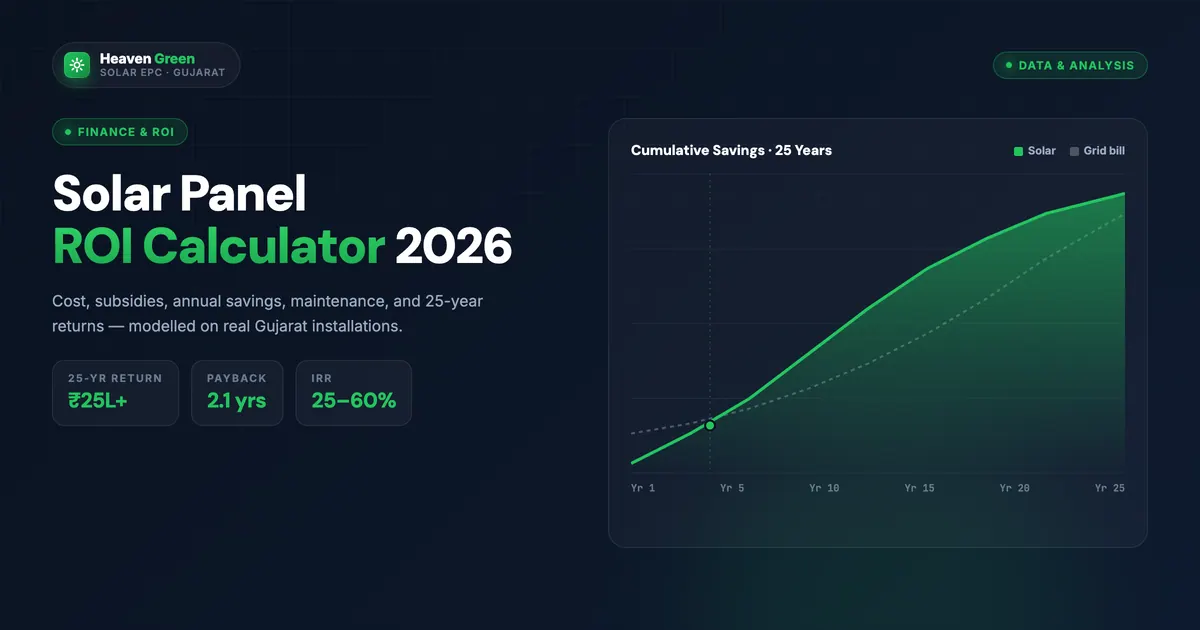
Most rooftop solar buyers in India settle for a simple payback number, installed cost divided by year-one savings, and call it a day. That figure is fine for a two-minute pitch, but it hides everything that determines whether the system actually pays back: tariff escalation, panel degradation, the timing of the PM Suryaghar Direct Benefit Transfer (DBT), Annual Maintenance Contract (AMC) fees, the inverter replacement bill in year ten, and the opportunity cost of the capital you put up front. This guide walks through a more rigorous method we use across every Heaven Green Energy proposal, the 8-Stage Solar ROI Evaluation Method, that converts a rooftop quote into a proper financial model with Net Present Value (NPV), Internal Rate of Return (IRR), discounted payback, and Levelised Cost of Energy (LCOE) numbers you can defend.
Return on Investment (ROI) for rooftop solar in 2026 is high by any benchmark, residential systems pay back in 2.5 to 4 years after subsidy and run IRRs of 22 to 30 percent, but the headline numbers vary by 40 percent depending on which inputs you use. Using the 8-stage method below removes most of that ambiguity. It takes 45 minutes the first time, 20 minutes once you have a template, and it forces every assumption out into the open so an installer cannot bury costs in a glossy brochure number.
Direct answer. Solar ROI in India 2026 is best evaluated through 8 stages, bill audit, system sizing, all-in cost, subsidy and tax treatment, tariff escalation modelling, generation degradation, AMC and inverter replacement, and the final NPV/IRR/payback calculation. Residential rooftop typically delivers a 2.5 to 4 year payback, 22 to 30 percent IRR, and LCOE of ₹2.50 to ₹3.50 per kWh over 25 years. Commercial systems pay back in 3 to 5 years after Accelerated Depreciation (AD).
If your only number so far is “the installer said 4-year payback”, read on, by the end of this guide you will have a structured way to verify or reject that claim using your own bill data and a spreadsheet.
Why Simple Payback Isn’t Enough
Simple payback is the rooftop solar industry’s lingua franca because it fits on one slide. Installed cost in the numerator, year-one savings in the denominator, and you get a number measured in years. The trouble is that this calculation answers a very narrow question, when do my undiscounted nominal cash flows equal my outlay?, and ignores almost every variable that matters over a 25-year asset life.
The first omission is tariff escalation. Indian state electricity tariffs have risen at 3 to 7 percent per year over the last decade (Central Electricity Authority data, 2024). If your system saves ₹40,000 in year one, it saves roughly ₹70,000 in year ten and over ₹1.2 lakh in year twenty at a 5 percent escalation. A simple payback calculation locks year-one savings forever and underestimates total return by 40 to 60 percent.
The second omission is degradation. Tier-1 panels on the Approved List of Models and Manufacturers (ALMM) lose 0.4 to 0.55 percent of output per year, so a 5 kWp system producing 7,500 kWh in year one produces closer to 6,650 kWh in year 25. Simple payback ignores this, fine over 4 years, not fine over 25.
The third omission is the time value of money. A rupee saved in year ten is not worth a rupee paid up front today. If you borrowed at 9 percent to install solar, every future savings flow should be discounted back to today at that rate. Doing so converts payback into discounted payback (longer) and produces an NPV figure that tells you whether the project beats your cost of capital.
The fourth omission is AMC and inverter replacement. A residential AMC runs ₹500 to ₹1,000 per kW per year. The string inverter installed today will almost certainly be replaced in year 10 to year 12 at roughly ₹6 to ₹10 per Wp of inverter capacity. Neither cost appears in a simple payback figure.
The fifth omission is LCOE. Levelised Cost of Energy converts the total lifetime cost (capital plus AMC plus replacement, all discounted) into a flat ₹ per kWh figure that you can compare like-for-like against grid tariffs. Rooftop solar’s LCOE in India sits at ₹2.50 to ₹3.80 per kWh, well below every state retail tariff, and that comparison is the single cleanest way to explain rooftop solar economics to a CFO or a sceptical spouse.
For a deeper treatment of payback specifically, see our solar payback period explainer and the parent piece on how to calculate solar ROI. The method that follows extends both with NPV, IRR, and LCOE.
The 8-Stage Solar ROI Evaluation Method
This is the framework we use on every Heaven Green Energy proposal, eight sequential stages, each with a specific input, output, and the data source it draws from. Skip any stage and your final NPV figure is unreliable. The whole flow lives in one spreadsheet with a single page of inputs and a 25-year cash flow model on the second tab.
| Stage | Input | Output | Time |
|---|---|---|---|
| 1. Bill audit | 12 months of DISCOM bills | kWh/month, slab mix, weighted tariff | 20 min |
| 2. System sizing | Bill + sanctioned load + roof area | kWp recommended | 10 min |
| 3. All-in cost | Vendor quotes, BoM | Total installed ₹ | 30 min |
| 4. Subsidy & tax | Eligibility, depreciation status | Net investment ₹ | 15 min |
| 5. Tariff escalation | State tariff history (CEA, MNRE) | Annual % escalation | 10 min |
| 6. Generation degradation | Panel datasheet, ALMM tier | Annual % degradation | 5 min |
| 7. AMC + replacement | AMC quote, inverter datasheet | Yearly OPEX schedule | 15 min |
| 8. NPV / IRR / LCOE | All of the above + discount rate | Final ROI figures | 20 min |
The discount rate used in Stage 8 is the single most consequential assumption. For residential buyers using cash or a home loan, 8 percent is realistic, it matches IREDA-approved residential solar loan rates of 7.5 to 9 percent. For commercial buyers, 11 to 12 percent reflects a typical weighted average cost of capital. Push the rate higher and NPV falls; push it lower and NPV rises. Always report the rate alongside the NPV number.
Stage 1: Bill Audit (12 Months, Slab-Weighted Tariff)
Pull 12 monthly bills from your DISCOM portal, full 12 months, not just the summer months, so you capture seasonality. From each bill extract three numbers: units consumed (kWh), energy charge (slab-by-slab), and total billed amount including fixed charges and electricity duty.
Compute a slab-weighted tariff: total annual energy charge divided by total annual kWh. This is the single most common error in self-built ROI models. Most buyers use the marginal slab rate (the top slab they hit) which overstates savings, or the average tariff (total bill divided by total kWh) which understates it because fixed charges do not vary with solar. The correct number is the energy-charge weighted average, typically ₹6.40 to ₹7.80 per kWh for a Jaipur 3-BHK, ₹8 to ₹11 per kWh for a Bengaluru flat. Solar offsets your highest slabs first, so for sizing purposes the upper-quartile slab rate is also useful, but the financial model uses the slab-weighted figure.
Stage 2: System Sizing (Bill-to-kWp + Sanctioned Load + Roof)
Three constraints govern sizing. First, your annual consumption divided by the local annual generation per kWp gives the kWp needed for 100 percent offset (typically 1,400 to 1,700 kWh per kWp per year in India). Second, your sanctioned load, printed on the bill, is the maximum capacity the DISCOM will sanction without a load enhancement. Third, available shade-free roof area at roughly 100 square feet per kWp.
The right answer is the minimum of these three constraints, then trimmed for PM Suryaghar subsidy economics, 3 kW is the residential sweet spot because the subsidy caps at ₹78,000 there. For a deeper sizing comparison across the most common residential bands, see 3 kW vs 5 kW vs 10 kW home solar 2026.
Stage 3: All-In Cost (Modules + Inverter + BoS + Civil + EPC Margin)
The number a vendor quotes you should be a complete Bill of Materials (BoM). Insist on a line-item breakdown:
- Modules: model, tier (ALMM list), wattage, count, ₹/Wp
- Inverter: make, model, kW capacity, MPPT count, warranty terms
- Balance of System (BoS): DC cables, AC cables, combiner box, surge protection, isolators
- Mounting structure: galvanised steel or aluminium, hot-dip vs paint
- Civil work: concrete foundations, walkway, earthing pits
- Net meter and metering panel: if not bundled in DISCOM application
- Installation, transport, commissioning labour
- EPC margin and GST
A clean residential 5 kWp BoM in 2026 comes to ₹2.5 to ₹3.0 lakh before subsidy. Anything materially below that range is using off-list panels, undersized inverters, or a thin structure that will rust in five monsoons, see the cost driver list in our solar panel cost breakdown and the comparison of capex versus opex models in OPEX vs CAPEX which is better.
Stage 4: Subsidy and Tax Treatment (Suryaghar or AD)
Two paths exist depending on consumer category. Residential consumers up to 10 kW claim the PM Suryaghar central subsidy, ₹30,000 for 1 kW, ₹60,000 for 2 kW, ₹78,000 for 3 kW and above. Some states stack an additional state subsidy on top. Subsidy is released via DBT to the Aadhaar-linked bank account within 30 days of net meter commissioning, which means the buyer funds the full system cost first and recovers the subsidy 60 to 90 days later. Model this timing, it is real working capital lost for two months.
Commercial and industrial buyers do not get PM Suryaghar. Instead they claim Accelerated Depreciation (AD), 40 percent of the asset value in year one under Section 32 of the Income Tax Act, plus the remaining 60 percent over subsequent years on a written-down value basis. For a profitable company in the 25 to 30 percent tax bracket, this produces a year-one tax saving of roughly 10 to 12 percent of the system cost. For the full accounting treatment and how to maximise the benefit, see our accelerated depreciation solar guide.
Stage 5: Tariff Escalation (3 to 5 Percent Annual)
Pull at least 10 years of retail tariff history for your state from the Central Electricity Authority or the state electricity regulator. Compute the compound annual growth rate (CAGR). National averages sit at 4.2 to 5.1 percent. Use 3 percent for a conservative scenario, 5 percent for a base case, 7 percent for an upside scenario. Always run the model under all three.
The choice matters more than most buyers realise. At 3 percent escalation a 5 kWp Gujarat system saves around ₹17 lakh over 25 years; at 7 percent it saves over ₹28 lakh. Both numbers are plausible, fuel surcharges and renewable purchase obligations push tariffs upward, but cross-subsidy reform can compress them. Reporting one number without the sensitivity is bad practice.
Stage 6: Generation Degradation (0.4 to 0.55 Percent Annual)
Pull the linear performance warranty from the panel datasheet. ALMM tier-1 mono PERC modules guarantee at least 84.8 percent output in year 25, which implies a 0.55 percent annual linear degradation cap. Real-world data from the CEEW solar performance studies shows actual degradation of 0.40 to 0.50 percent for well-installed tier-1 systems in Indian conditions. Use 0.5 percent as a base case.
Apply degradation multiplicatively in the model, year n generation equals year-1 generation multiplied by (1 minus degradation rate) raised to (n minus 1). The cumulative effect over 25 years is an output reduction of 11 to 12 percent, which is meaningful but not catastrophic.
Stage 7: AMC and Inverter Replacement
Annual Maintenance Contract pricing in India runs ₹500 to ₹1,000 per kW per year for residential and ₹400 to ₹700 per kW per year for commercial (volume discount). The AMC covers panel cleaning four to six times a year, inverter health checks, monitoring portal access, and minor repairs. Self-cleaning is possible but most owners contract this out after year three.
The inverter is the only major component that needs replacing inside the panel life. String inverters from reputable Indian and global brands carry 5 to 10 year manufacturer warranties; budget for replacement in year 10 to year 12 at ₹6 to ₹10 per Wp of inverter capacity, roughly ₹35,000 to ₹50,000 for a 5 kW residential system in 2036 nominal terms. Microinverters and hybrid inverters cost more but warrant longer. Either way, model this as a one-time year-10-or-12 OPEX line.
Stage 8: NPV, IRR, Discounted Payback, LCOE
Build a 25-row spreadsheet. Column A is year 0 to year 25. Column B is the cash flow for that year (negative in year 0 for the net investment, positive in subsequent years for savings minus AMC, with a negative bump in year 10 or 12 for inverter replacement). Compute four outputs.
Net Present Value (NPV) at your chosen discount rate using Excel’s =NPV(rate, range) plus the year-0 investment. A positive NPV at 8 percent (residential) or 12 percent (commercial) means the project beats your cost of capital.
Internal Rate of Return (IRR) using =IRR(range). This is the discount rate at which NPV equals zero, effectively the project’s intrinsic return. Healthy residential IRRs sit at 22 to 30 percent; healthy commercial IRRs at 18 to 25 percent.
Discounted payback: the year at which the cumulative discounted cash flow first turns positive. Always longer than simple payback. For a 3 kW residential system, simple payback might be 3 years and discounted payback 3.5 years at 8 percent.
LCOE = (Sum of discounted total costs over 25 years) divided by (Sum of discounted kWh generated over 25 years). Express in ₹ per kWh and compare directly against your slab-weighted tariff. A ratio of 0.4 to 0.5 (LCOE roughly half of tariff) is a normal, healthy rooftop project.
Stage-by-Stage Residential 5 kW Example
A worked example clarifies the method. Consider a Jaipur household, JVVNL consumer, 3-BHK, monthly bill of ₹4,800, 12-month consumption of 7,800 kWh, sanctioned load of 5 kW, 600 sq ft of shade-free south-facing roof. The buyer is paying cash, so the discount rate is the home loan interest rate they would otherwise pay down, 8 percent flat.
| Stage | Input | Output |
|---|---|---|
| 1. Bill audit | 7,800 kWh/yr, slabs 2 to 4 | Weighted tariff ₹6.85/kWh |
| 2. Sizing | Annual offset target + 5 kW load | 5 kWp recommended |
| 3. All-in cost | 5 kWp tier-1 BoM | ₹2,75,000 |
| 4. Subsidy & tax | PM Suryaghar 3 kW+ cap | ₹78,000 subsidy → net ₹1,97,000 |
| 5. Tariff escalation | JVVNL 10-yr CAGR | 5% base case |
| 6. Degradation | Tier-1 ALMM mono PERC | 0.5% per year |
| 7. AMC + replacement | ₹700/kW/yr; year-11 inverter | ₹3,500/yr; ₹42,000 in Y11 |
| 8. NPV / IRR / payback | 8% discount rate | NPV ₹6.8 L, IRR 28%, payback 3.2 yr |
Year-one generation: 5 kWp × 5.7 PSH × 365 × 0.78 PR = 8,116 kWh. At a slab-weighted tariff of ₹6.85 and a 65 percent self-consumption rate (the rest exported at JVVNL’s ₹3.35/kWh APPC rate), year-one savings come to ₹45,200. Net of ₹3,500 AMC, year-one net cash flow is ₹41,700.
Project this 25 years forward with 5 percent tariff escalation, 0.5 percent degradation, AMC inflating at 4 percent, and a ₹42,000 inverter replacement in year 11. The 25-year nominal savings total roughly ₹19.2 lakh. Discounted at 8 percent, NPV is ₹6.8 lakh. IRR is 28 percent. Discounted payback is 3.2 years. LCOE works out to ₹2.95 per kWh, well under half the JVVNL retail tariff. The project is solidly bankable on every metric.
The model output flips one thing the back-of-envelope view misses: the inverter replacement in year 11 cuts roughly ₹42,000 from the discounted savings stream, but because that cost is 11 years out, its present value at 8 percent discount is only ₹18,000, barely 3 percent of NPV. Inverter replacement is real but not catastrophic. The same is not true for AMC: ₹3,500 per year inflating at 4 percent, summed across 25 years and discounted, comes to roughly ₹60,000 in present-value terms, a bigger drag on NPV than the inverter swap. AMC is the quiet OPEX line that matters most.
A second observation worth noting: the year-1 subsidy timing. If we model the ₹78,000 DBT as arriving in month 4 after commissioning rather than at purchase, the buyer floats ₹78,000 of working capital for 90 days. At 8 percent that costs roughly ₹1,500 in lost interest, small, but it is the kind of detail that distinguishes a defensible model from a brochure number. In our actual customer spreadsheets we always model the DBT explicitly so the buyer knows the working capital requirement before they commission rather than after.
Stage-by-Stage Commercial 100 kW Example
A medium manufacturer in Pune, MSEDCL HT-II consumer, uses 18,000 kWh per month with an industrial tariff of ₹9.40 per kWh. Sanctioned demand 150 kVA, available roof 12,000 sq ft. The company is in the 25 percent corporate tax bracket and treats solar as a capital project with a 12 percent weighted average cost of capital.
| Stage | Input | Output |
|---|---|---|
| 1. Bill audit | 216,000 kWh/yr, HT-II | Effective tariff ₹9.40/kWh |
| 2. Sizing | Annual offset + roof + demand | 100 kWp recommended |
| 3. All-in cost | 100 kWp commercial EPC | ₹45,00,000 |
| 4. Subsidy & tax | AD 40% Y1 + balance WDV | Y1 tax saving ₹4,50,000 |
| 5. Tariff escalation | MSEDCL HT history | 4.5% base case |
| 6. Degradation | Tier-1 ALMM bifacial | 0.5% per year |
| 7. AMC + replacement | ₹550/kW/yr; year-12 inverter | ₹55,000/yr; ₹7L in Y12 |
| 8. NPV / IRR / payback | 12% discount rate | NPV ₹1.4 Cr, IRR 22%, payback 4.1 yr |
Year-one generation: 100 kWp × 5.4 PSH × 365 × 0.79 PR = 155,700 kWh. At ₹9.40 per kWh with 90 percent self-consumption (export of 10 percent at APPC ₹3.20), year-one gross savings are ₹13.6 lakh. Add the year-one tax shield from AD: 40 percent of ₹45 lakh equals ₹18 lakh deductible, generating ₹4.5 lakh in tax savings at the 25 percent rate. Net year-one cash flow is ₹17.5 lakh (savings plus tax shield minus AMC). Effective payback drops to 4.1 years.
Projected over 25 years at 4.5 percent tariff escalation and 0.5 percent degradation, with the residual AD tax shield in years 2 to 8 and the inverter replacement in year 12, the NPV at 12 percent is ₹1.4 crore. IRR is 22 percent. LCOE is ₹3.40 per kWh, a 64 percent discount to the grid tariff, and the company locks in 25 years of hedged energy cost. For a larger utility-scale comparison, our 1 MW solar plant cost and ROI guide walks through the same NPV/IRR method at 10x this capacity. For a structured walkthrough of the capex-versus-opex decision specifically for businesses, see our decision tree for solar buyers.
Mid-CTA, get a custom ROI model. Heaven Green Energy builds a stage-by-stage NPV/IRR/LCOE model for every commercial proposal. Send us your last 12 bills and we return the full spreadsheet within 48 hours. Request your custom ROI model →
Sensitivity: How Tariff Escalation Changes ROI
A single point estimate hides risk. Run the model under three tariff escalation scenarios and the picture sharpens considerably, the same logic behind why solar insulates buyers from tariff hikes.
| Scenario | Annual tariff escalation | 25-yr nominal savings (5 kW res) | NPV @ 8% | IRR | Payback |
|---|---|---|---|---|---|
| Low | 3% | ₹14.2 L | ₹4.6 L | 23% | 3.6 yr |
| Base | 5% | ₹19.2 L | ₹6.8 L | 28% | 3.2 yr |
| High | 7% | ₹26.0 L | ₹9.7 L | 33% | 2.9 yr |
| Stress (1%) | 1% | ₹10.5 L | ₹2.9 L | 18% | 4.2 yr |
Even under the stress scenario, 1 percent annual tariff growth, a level of escalation India has not actually experienced in any rolling decade, residential rooftop with PM Suryaghar subsidy still produces a positive NPV and an 18 percent IRR. That asymmetry is what makes rooftop solar a uniquely defensive infrastructure investment: the downside case still wins.
Tip, model three scenarios
When you present an ROI figure to a spouse, board, or finance team, always include three rows, low (3% escalation), base (5%), high (7%). A single number is too easy to argue with. Three numbers force the conversation onto which scenario is realistic, not whether the model is right.
For state-by-state tariff history that feeds this sensitivity, the most reliable public sources are the Ministry of New and Renewable Energy annual reports, the Indian Renewable Energy Development Agency (IREDA) sector studies, and the Council on Energy, Environment and Water (CEEW) state tariff trackers.
A second-order sensitivity worth running is the discount rate. At a 6 percent discount rate (a low cost of capital, perhaps a pensioner buyer with no debt), NPV on the 5 kW base case rises to ₹8.1 lakh. At 10 percent (a buyer with a higher home loan rate), it falls to ₹5.6 lakh. The project remains positive across the entire realistic discount rate range, which is the test you actually care about. A project that flips negative when the discount rate moves from 8 to 9 percent is too marginal to commit to, rooftop solar in India 2026 does not exhibit that fragility.
Combine the two sensitivities, tariff escalation on one axis, discount rate on the other, and you get a nine-cell grid that captures almost the entire range of plausible 25-year outcomes. We attach this grid to every Heaven Green Energy commercial proposal because it converts the conversation from “what is the IRR?” to “under what scenario does this not work?”. The honest answer for residential PM Suryaghar projects is “essentially none of them”, every combination of 1 to 7 percent escalation and 6 to 12 percent discount produces positive NPV and a payback under 5 years.
Common ROI Evaluation Mistakes
We see the same six errors in spreadsheets buyers send us for review. Each one inflates or deflates the apparent return by 10 to 40 percent.
-
1
Using a flat ₹6/kWh tariff. Substitute the slab-weighted average from your actual bills. Flat-rate models understate savings for high-bill homes by 15 to 25 percent.
-
2
Ignoring tariff escalation. A 5 percent annual escalation doubles your year-15 savings versus a flat-tariff model. Skipping this single line undercounts 25-year savings by 40 to 60 percent.
-
3
Ignoring degradation. 0.5 percent per year compounds to 11 percent lost output by year 25. Ignoring degradation overstates lifetime kWh and IRR by 5 to 7 percent.
-
4
Skipping AMC and inverter replacement. Roughly ₹2 to ₹3 lakh of lifetime OPEX disappears from sloppy models. The number is small annually but material over 25 years.
-
5
Treating subsidy as instantaneous. PM Suryaghar DBT arrives 60 to 90 days after commissioning. Model it as a year-1 inflow, not as a price reduction at purchase, if you want the working capital picture to be correct.
-
6
Picking the wrong discount rate. Using a 4 percent discount rate for a residential model when you're actually paying 8.5 percent on a home loan inflates NPV by 60 to 80 percent. Use your real cost of capital.
Watch out, vendor IRR claims
If an installer quotes you an IRR of 45 percent or higher on a residential system, ask to see the model. Real residential post-subsidy IRRs sit in the 22 to 30 percent band. Anything materially above this is either using a zero discount rate, ignoring AMC and replacement, assuming 8 percent tariff escalation, or all three. Demand to see the spreadsheet.
Simple Payback vs NPV Method, When Each Is OK
Both methods have a place. Simple payback is fine for an initial screen, under 5 years means worth investigating, over 8 years means probably not, but it should not be the basis for the final purchase decision. NPV plus IRR plus LCOE is the proper financial frame.
- Takes 60 seconds with a calculator
- Easy to explain to non-financial buyers
- Useful first screen for go/no-go
- No spreadsheet needed
- Ignores tariff escalation
- Ignores degradation
- Ignores AMC and replacement OPEX
- Ignores the time value of money
- Cannot compare against alternative investments
- Captures tariff escalation and degradation
- Reflects time value of money
- Comparable against FD, MF, REIT returns
- Sensitivity-testable
- CFO and bank-acceptable
- Needs a spreadsheet
- Harder to explain in two sentences
- Discount rate choice is contestable
- Garbage-in inputs still produce garbage-out
Verdict. Use simple payback for the first cut, if a 3 kW PM Suryaghar system pays back in under 4 years on a back-of-envelope basis, it is worth investigating further. Then run the full 8-stage NPV/IRR/LCOE model before signing. The full model takes 45 minutes the first time and is the only way to defend the decision against any of the six common mistakes above.
A useful intermediate position: ask your installer for their NPV and LCOE figures and the discount rate they used. If the salesperson cannot answer those three questions, you are dealing with an installer who has not built the model. That is not by itself a deal-breaker, many good EPC operators run on simple payback alone, but it means the model has to come from your side. Either request that Heaven Green Energy or another senior EPC partner build it for you, or build it yourself using the 8-stage method here. Either path is fine; what is not fine is signing on a single-number simple-payback claim without a discounted view.
For commercial buyers there is no intermediate position. NPV, IRR, and LCOE are non-negotiable because the project will be audited by a finance team, a board, or a lender, all of whom will demand the discounted view. Build the full model from day one and present it alongside the simple-payback figure rather than instead of it. Both numbers belong on the slide.
How Heaven Green Energy Calculates Customer ROI
Every Heaven Green Energy proposal, residential or commercial, ships with the full 8-stage model attached. We do not give customers a one-line payback number on a slide and ask them to sign. We deliver a 25-year cash flow spreadsheet with all eight stage inputs visible, three tariff escalation scenarios, NPV and IRR at the buyer’s actual cost of capital, LCOE, and the underlying generation model with hourly profiles for self-consumption ratio.
What our model includes by default:
- Bill audit worksheet: 12 months of consumption parsed from your DISCOM bills, slab-weighted tariff derived
- Sizing decision: three-way constraint (consumption, sanctioned load, roof) with the recommended kWp
- Itemised BoM: module model and tier, inverter make/model, BoS components, structure grade, civil scope
- Subsidy flow: PM Suryaghar DBT timing modelled at 60 days post-commissioning; commercial AD schedule modelled across 8 years
- Tariff escalation: three scenarios with state-specific 10-year CAGR as base case
- Degradation: datasheet-anchored linear decline applied to year-on-year generation
- AMC and inverter replacement: full 25-year OPEX schedule with year-11 or year-12 inverter swap budgeted
- Final outputs: NPV, IRR, simple payback, discounted payback, LCOE
For the services that turn this model into a working rooftop system:
- Residential Solar: 1 to 10 kW systems with PM Suryaghar subsidy handled end-to-end
- Commercial Solar: 25 kW to 1 MW systems with full AD modelling and finance structuring
- Solar Calculator: fast online estimate using your bill and pincode
- Contact us: request a full 8-stage spreadsheet for your specific site
For a related but lighter-touch tool, our calculate solar ROI guide walks through a 6-step version of the model for buyers who want a faster pass. The solar payback period piece zooms in on the payback calculation alone.
Frequently Asked Questions
What is the difference between simple payback and discounted payback?
Simple payback is your net investment divided by undiscounted annual savings, it ignores both tariff escalation and the time value of money. Discounted payback uses the same cash flow series but discounts each future year’s saving back to today’s rupees at your cost of capital (typically 8 percent for residential, 12 percent for commercial). Discounted payback is always longer than simple payback, usually by 4 to 8 months, and is the figure a bank or CFO will accept.
What discount rate should I use for residential solar NPV?
Use the rate you would otherwise pay on a home loan, since solar capital displaces or substitutes for it. IREDA-approved residential solar loans run 7.5 to 9 percent in 2026; standard home loans run 8.5 to 9.5 percent. 8 percent is a defensible base case. For cash buyers without any debt, use your alternative investment opportunity cost, typically 7 to 8 percent for a balanced mutual fund average over 10 years.
How do I calculate LCOE for my rooftop system?
LCOE equals the sum of all discounted lifetime costs (initial capital plus AMC, inverter replacement, and any other OPEX, all in present-value terms) divided by the sum of all discounted lifetime kWh generation. The formula is identical to the one used by the Ministry of New and Renewable Energy and IREDA for utility-scale tenders. Residential LCOE in India 2026 sits at ₹2.50 to ₹3.50 per kWh against retail tariffs of ₹6 to ₹11 per kWh, a 60 to 75 percent discount.
Should I include PM Suryaghar subsidy as a year-0 deduction or a year-1 inflow?
Technically as a year-1 inflow because the Direct Benefit Transfer arrives 60 to 90 days after net meter commissioning, not at purchase. In practice, modelling it as a year-0 deduction is simpler and changes NPV by less than 2 percent at any reasonable discount rate. For working capital planning, meaning you need to actually fund the full system cost up front, model it explicitly as a year-1 inflow so the financing requirement is correct.
How much does ignoring tariff escalation actually distort my ROI estimate?
At 5 percent annual escalation (the Indian base case), ignoring escalation undercounts 25-year cumulative savings by roughly 50 percent. Year-1 savings remain the same, but year-15 savings are double the year-1 number in nominal rupees. A residential system that pays back in 3 years on a simple-payback basis might show a flat 4-year payback if you naively project year-1 savings forward without escalation. NPV at 8 percent falls by 40 percent. Always include escalation.
What is the IRR I should expect from a properly modelled residential system?
Residential post-PM-Suryaghar IRRs sit in a 22 to 30 percent band when modelled correctly with the 8-stage method. Below 22 percent suggests you have over-conservative tariff escalation, over-aggressive degradation, or a discount rate above 10 percent. Above 30 percent suggests you have under-modelled OPEX, ignored inverter replacement, or used pre-AD-tax savings without accounting for the subsidy timing. The 22 to 30 percent range is the realistic envelope.
When does opex / PPA make more sense than capex for commercial solar ROI?
If your weighted average cost of capital is above 14 percent, or if you cannot use AD because the company is not profitable, opex models (PPA, OPEX, leasing) usually beat capex on NPV terms. The PPA developer absorbs the capex at their lower cost of capital and you buy electricity at a fixed ₹ per kWh, typically 25 to 35 percent below grid. For a structured comparison of the two models against typical Indian capital costs, see our opex vs capex which is better 2026 guide.
Can I use the 8-stage method for hybrid (solar + battery) systems?
Yes, with two additions. Add the battery capital cost to stage 3, the battery replacement (typically year 8 to year 10 for lithium-ion) to stage 7, and a third “self-consumption uplift” line that captures the additional savings from time-shifting solar generation into evening peak hours. Hybrid LCOEs in India 2026 sit at ₹4.50 to ₹6.50 per kWh, higher than grid-tied solar but still under retail tariffs in most ToD-billed commercial categories.