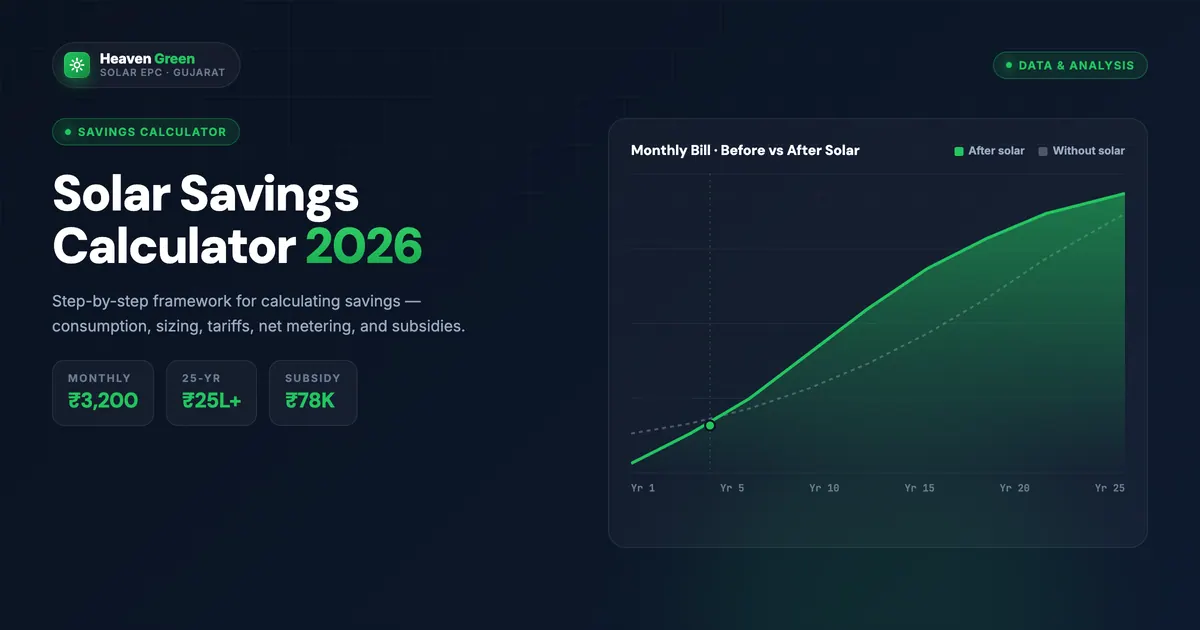
Solar panels are a 25-year financial decision. Before you spend ₹1 to 3 lakh on a rooftop installation, you deserve a completely honest answer to one question: is this actually worth it for your specific situation?
The short answer for most Indian homeowners in 2026 is yes, emphatically. But the longer answer involves real numbers, honest caveats, and a few scenarios where solar either doesn’t make sense or needs a different approach.
Electricity tariffs in India tend to rise over time. Solar panels lock in your generation cost at near zero for 25 years. That asymmetry, rising grid costs versus fixed solar cost, is what makes rooftop solar such a compelling financial case in 2026, and it’s the same math behind how solar insulates homeowners from tariff hikes year after year.
Key takeaway. For a typical Indian homeowner paying ₹2,000–₹6,000 per month in electricity bills, a 3 to 5 kW rooftop solar system pays back in 3 to 5 years after the PM Suryaghar subsidy of ₹78,000. After payback, the system generates near-free electricity for another 20+ years. Heaven Green Energy’s customers across Gujarat and Maharashtra are saving ₹18,000–₹60,000 annually after their systems are paid off.
This analysis covers the real numbers, not the optimistic projections in brochures, but the actual costs, savings, and payback calculations based on current DISCOM tariffs and MNRE benchmark prices.
The Real Costs of Going Solar in India 2026
Let’s start with what you actually pay, before and after subsidies.
Indicative system costs in 2026 (grid-connected, residential, before subsidy):
- 1 kW: ₹45,000–₹50,000
- 3 kW: ₹1,35,000–₹1,50,000
- 5 kW: ₹2,10,000–₹2,40,000
These sit close to the MNRE benchmark costs for PM Suryaghar (₹50,000/kW for the first 2 kW and ₹45,000 for each additional kW, fixed from 13 February 2024), which MNRE uses to set the subsidy. Market quotes for quality installations with BIS-certified panels and inverters can run higher.
After PM Suryaghar subsidy:
- 1 kW: ₹15,000–₹20,000 out of pocket
- 3 kW: ₹57,000–₹72,000 out of pocket
- 5 kW: ₹1,32,000–₹1,62,000 out of pocket
Additional state subsidies: In Gujarat, MGVCL’s PM Suryaghar subsidy sheet lists only the central amount, so do not count on a state top-up there. If a state scheme exists where you live, confirm it on the state nodal agency’s current notice before you budget for it. See how to stack central and state subsidies for the full picture.
The Solar Worth-It Calculator: Real Numbers by Bill Size
The simplest way to determine whether solar is worth it for you is to map your current monthly bill to a system size, then calculate savings and payback.
| Monthly Bill | Recommended System | Net Cost After ₹78K Subsidy | Annual Savings | Payback Period |
|---|---|---|---|---|
| ₹1,000–₹1,500 | 1 kW | ₹15,000–₹20,000 | ₹8,000–₹12,000 | 1.5 to 2.5 yrs |
| ₹1,500–₹3,000 | 2 kW | ₹42,000–₹52,000 | ₹15,000–₹25,000 | 2 to 3 yrs |
| ₹3,000–₹5,000 | 3 kW | ₹57,000–₹72,000 | ₹26,000–₹33,000 | 2 to 3 yrs |
| ₹5,000–₹8,000 | 4 to 5 kW | ₹80,000–₹1,20,000 | ₹34,000–₹55,000 | 2 to 3 yrs |
| ₹8,000–₹15,000 | 6 to 10 kW | ₹1,30,000–₹2,20,000 | ₹51,000–₹1,09,000 | 2 to 2.5 yrs |
Year-one savings assume about 1,560 kWh of generation per kW per year in Gujarat, valued at ₹5.50–₹7.00/unit, before any tariff escalation.
For most homeowners with bills over ₹2,000/month, the payback period after subsidy is about 3 years or less. That is remarkable, especially when you factor in that the panel generates power for 25 years. See the solar payback period explained guide for the full methodology.
When Does Solar NOT Make Sense?
This is the part most solar companies skip. Honesty here is what separates a trustworthy installer from a pushy salesperson.
Solar may not be worth it if:
-
You pay less than ₹800/month in electricity: The payback period stretches to 6 to 8 years, and the financial case becomes marginal. You’d be better off investing that capital elsewhere.
-
You’re renting and moving within 3 years: Solar is a property-fixed asset. The payback hasn’t happened yet in 3 years. Unless your landlord reimburses you or you can negotiate it into the lease terms, the investment doesn’t pay off in a short tenancy.
-
Your roof needs major civil repairs: If your roof needs ₹50,000–₹1,00,000 in waterproofing and structural repairs, add that to your solar payback calculation. The combined investment may push payback beyond 7 years.
-
You have severe, unavoidable permanent shading: If a multi-storey building to your south permanently shades your roof from 10 am to 3 pm all year, no system design will overcome that loss.
-
You’re in a state with very low DISCOM tariffs: States with highly subsidised electricity (some agricultural and below-poverty-line consumers) have very low effective tariffs, ₹1–₹2/unit. Solar savings are proportionally small.
⚠️ Watch out
Any installer who tells you solar is a great investment regardless of your electricity bill, roof condition, or tariff situation is not giving you honest advice. Ask your installer to show you the payback calculation specific to your bill and location before signing anything.
The 25-Year Financial Model: Does the Maths Work?
Let’s do the honest 25-year calculation for a typical 3BHK home in Ahmedabad with a ₹3,500/month electricity bill.
Setup:
- System size: 3 kW
- System cost before subsidy: ₹1,45,000
- PM Suryaghar subsidy: ₹78,000
- Net out-of-pocket cost: ₹67,000
Annual savings calculation (year 1):
- Monthly bill: ₹3,500
- Solar coverage: 80% = ₹2,800/month saved
- Annual savings: ₹33,600
Payback period: ₹67,000 ÷ ₹33,600/year = 2.0 years
25-year savings (with 8% annual tariff escalation):
- Year 1 savings: ₹33,600
- Year 5 savings: ₹45,700 (tariff has risen)
- Year 10 savings: ₹67,200
- Year 25 savings: ₹2,13,000
- Total 25-year savings: approximately ₹24.6 lakh, or about ₹23 lakh allowing for 0.4% annual panel degradation
That’s roughly a 35× return on a ₹67,000 investment. Even a conservative calculation with 4% tariff escalation and 10% system downtime produces about ₹12 lakh in total savings.
The solar payback period India guide shows similar calculations with sensitivity analysis for different tariff escalation scenarios.
Comparison: Solar vs. Grid-Only vs. Solar with Battery
| Option | 25-Year Electricity Cost | Capital Investment | Net 25-Year Benefit |
|---|---|---|---|
| Grid-only (no solar) | About ₹31 lakh | ₹0 | ₹0 baseline |
| 3 kW on-grid solar (after subsidy) | About ₹6–₹8 lakh | ₹67,000–₹72,000 | About ₹22–₹24 lakh saved |
| 3 kW solar + 5 kWh battery | Similar to on-grid | ₹1,50,000–₹2,20,000 | Lower than on-grid, by the battery and its replacement cost |
| Solar PPA (no ownership) | Depends on the PPA tariff | ₹0 | Smaller than owning the system |
For the ₹3,500/month Ahmedabad home above. Grid costs assume 8% annual tariff escalation. Solar assumes 0.4% annual degradation, 80% bill offset.
On-grid solar without batteries delivers the best return on capital. Adding battery storage improves backup coverage but reduces net savings because batteries add ₹60,000–₹1,50,000 in capital and need replacement after 8 to 12 years. The right choice depends on your grid reliability and whether you need backup.
See your exact numbers. Use our free solar calculator, enter your monthly bill and location to get a customised payback calculation in 60 seconds.
Honest Pros and Cons of Going Solar in India 2026
- 50 to 80% bill reduction from day one of generation
- ₹78,000 central subsidy reduces payback to 1.5 to 4 years in most cases
- 25-year panel warranty provides assured generation period
- Rising grid tariffs increase solar savings every year
- [Net metering](/glossary/net-metering) credits surplus units (in Gujarat, surplus left after each billing cycle is bought at ₹2.25/unit)
- Can add to resale appeal in urban markets
- Grid-tied system provides no backup during outages
- ₹1.5–₹3 lakh upfront investment needed (the subsidy is credited after commissioning)
- Monsoon months produce 30 to 40% less than peak season
- Subsidy + net metering process takes 60 to 90 days
- Roof must be structurally sound and shadow-free
Verdict. Solar is worth it for the vast majority of Indian homeowners paying more than ₹1,500/month in electricity bills. The combination of the PM Suryaghar subsidy, rising grid tariffs, and falling panel costs makes 2026 one of the best years to go solar. The only scenarios where it’s marginal are very low bills, severe shading, or short tenancy.
How Heaven Green Energy Makes the Decision Easy
Heaven Green Energy provides every prospective customer with a written financial proposal, including exact payback period, 25-year savings model, and subsidy eligibility, before any commitment is required. You don’t need to trust our word for it; you can verify the numbers against your actual electricity bill.
We have completed over 10,000 installations across Gujarat, Maharashtra, Rajasthan, and beyond. Our MNRE empanelment means you can claim the full PM Suryaghar subsidy through us, with all documentation handled end-to-end.
- Residential Solar: complete rooftop solar systems with full subsidy handling.
- Solar Calculator: get your personalised payback calculation in 60 seconds.
- Going Solar in India: Complete Guide: everything you need to know before switching.
- Contact our team: free consultation, no obligation; a solar advisor responds within 2 hours on business days.
Frequently Asked Questions
Is rooftop solar worth it if I pay only ₹1,000/month in electricity?
At ₹1,000/month, solar is marginally worth it. A 1 kW system costing ₹15,000–₹20,000 after subsidy would save ₹700–₹800/month, giving a payback of 1.5 to 2.5 years. However, the absolute savings are small (₹8,000–₹10,000/year), and if your bill is primarily composed of a flat monthly charge (minimum demand charge), solar may not reduce it. Get a detailed quote before deciding.
Does solar add value to my home when I sell it?
Yes, in most Indian urban markets. A solar installation that has been commissioned and is generating 300 to 400 kWh/month can add to a property’s appeal and resale value, though there is no reliable Indian data on the exact premium. Buyers in cities like Ahmedabad and Pune are increasingly aware of the ongoing savings solar provides, and factor it into offers. Having the monitoring data history and subsidy documentation handy makes the solar asset easy to demonstrate to a buyer, and following the right process for selling a home with solar installed protects that value.
What happens to my solar system after 25 years?
After 25 years, the panels are still generating power, at roughly 80 to 85% of their original nameplate capacity (Adani’s current PERC warranty guarantees 84.8% at year 25; older warranties promised 80%). Most homeowners in that situation either continue using the panels (which are now fully paid off and producing near-free power), upgrade to newer higher-efficiency panels, or sell the old panels for scrap recycling. The inverter typically needs replacement at year 10 to 12; panels outlast the inverter, as covered in our solar panel lifespan guide.
Is solar worth it in states with frequent power cuts?
In states with 4 to 8 hours of daily power cuts, standard grid-tied solar actually shuts down during outages (a mandatory safety feature to prevent back-feeding the grid). If you want solar AND backup, you need a hybrid inverter system with battery storage, which costs ₹60,000–₹1,50,000 more. In areas with very frequent cuts, the hybrid system pays back on both the bill savings and the backup value (avoided generator costs and inconvenience).
How reliable is the PM Suryaghar subsidy? Will it be available next year?
PM Suryaghar is a flagship central government scheme with an outlay of ₹75,021 crore for 1 crore rooftop solar systems, and MNRE’s guidelines set its implementation period to 31 March 2027. By March 2026, 26.2 lakh homes had installed systems under it. What happens after March 2027 depends on a government decision, so check the national portal for current status. Waiting to apply is a risk: DISCOM net metering queues grow longer over time.
Can I get a loan for solar if I can’t pay upfront?
Yes. Public sector banks offer PM Suryaghar rooftop solar loans through the national portal (SBI, for example, at 5.75% for loans up to ₹2 lakh and 7.90% for ₹2 to 6 lakh, over up to 120 months, with no processing fee). IREDA does not lend to households. If your system is financed, the subsidy is transferred to your loan account when you redeem the e-token, and MNRE processes it within 15 days of DISCOM approval, reducing your outstanding balance by up to ₹78,000. See the solar financing options guide for the full lending landscape.