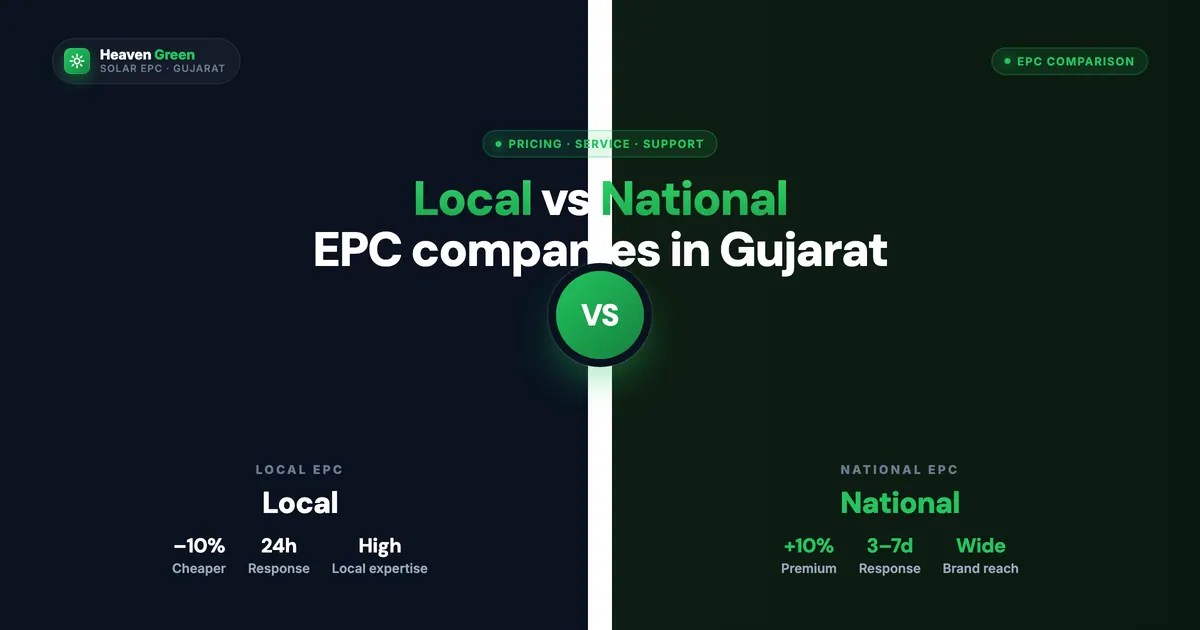
The rooftop solar market in India is split between two very different worlds. On one side you have local installers, neighbourhood electricians, small two-man teams, and regional traders who quote ₹20,000 to 30,000 less than everyone else. On the other side you have branded EPC companies, registered on the PM Surya Ghar national portal, insured, and with an after-sales team you can call on Year 3.
Both will bolt panels to your roof. Only one of them will still be answering your calls in Year 4.
This article gives you a genuine 5-year total cost of ownership (TCO) framework for both options, so you can decide with numbers rather than gut feeling.
Key Takeaway
Local installers quote ₹30,000 to 60,000 less upfront but the 5-year TCO gap narrows, or reverses, once you count unresolved warranty claims, underperforming systems, and a second technician visit to fix the first install. Branded EPCs carry a real premium, but it typically pays back within 18 to 24 months through higher generation and zero troubleshooting friction.
The Heaven Green 5-Year TCO Framework
Every solar installation comparison should be run through five cost layers across a 60-month ownership window:
- Year 0 capital cost: what you pay on day one
- Generation delta: the ₹ value of electricity you lose from a sub-optimal install
- Warranty recovery: did you actually get the replacement panel or inverter, or just a promise?
- Maintenance friction: time, money, and stress to fix what went wrong
- Net metering accuracy: are you being credited correctly by your DISCOM?
Run a local installer quote and a branded EPC quote through all five layers. The result usually surprises homeowners who assumed the cheaper quote meant cheaper solar.
What “Local Installer” Really Means in 2026
The term covers a wide spectrum:
- Tier 3 traders: Buy whatever modules they can source cheapest that week. No ALMM compliance check. No written output warranty. Invoice says “solar panels 300W × 10” and nothing else.
- Tier 2 regional dealers: Authorised resellers for one or two brands (e.g., Luminous or Waaree regional distributors). Slightly more accountable. Some offer 1-year workmanship warranty in writing.
- Tier 1 local EPCs: Small but portal-registered firms (registered on the PM Surya Ghar national portal). Use ALMM-listed modules. Handle net metering paperwork. Essentially a mini version of a branded EPC, but with a thinner service bench.
Most quotes labelled “local” in the ₹40,000-cheaper bracket come from Tier 3 or Tier 2. Tier 1 local EPCs are genuinely competitive with branded players on quality; the price difference narrows to ₹10,000 to 15,000 at most.
Internal Resource: See our full guide on how to choose a solar installer in India for the 7-question scorecard that separates Tier 1 from Tier 3 instantly.
What “Branded EPC” Means
A branded EPC (Engineering, Procurement, Construction) company for residential solar typically means:
- Vendor registration on the PM Surya Ghar national portal (verify it on pmsuryaghar.gov.in)
- Uses only ALMM-listed modules (mandatory for PM Suryaghar subsidy)
- Employs certified electrical engineers on every project
- Issues a written workmanship warranty of 5 years minimum
- Has a dedicated after-sales team and ticket system
- Handles DISCOM net metering applications end-to-end
Heaven Green Energy falls in this category. So do several other Gujarat-based EPCs and national players including Tata Power Solar, Adani Solar’s rooftop division, and Waaree Energies’ installation arm, all of whom bring strong engineering credentials and tier-1 module supply chains to residential projects.
Year 0: The Upfront Cost Gap
For a 5 kWp grid-tied residential system in Gujarat (2026 benchmark):
| Cost Component | Local Installer (Tier 2) | Branded EPC |
|---|---|---|
| Solar panels (5 kWp Mono PERC) | ₹1,25,000 | ₹1,40,000 |
| [String inverter](/glossary/string-inverter) (5 kW) | ₹28,000 | ₹35,000 |
| Mounting structure (GI/aluminium) | ₹18,000 | ₹22,000 |
| DC/AC cables + earthing + MCB | ₹9,000 | ₹12,000 |
| Net meter application + DISCOM fees | ₹4,000 | ₹5,000 |
| Installation labour | ₹8,000 | ₹14,000 |
| Total before subsidy | ₹1,92,000 | ₹2,28,000 |
| PM Suryaghar subsidy (3 kWp slab) | ₹0 (not ALMM-listed)* | −₹78,000 |
| Net out-of-pocket (Year 0) | ₹1,92,000 | ₹1,50,000 |
Most Tier 2/3 local installers use non-ALMM panels or cannot process PM Suryaghar subsidy paperwork. The ₹78,000 subsidy you lose is worth more than the ₹36,000 you saved on the quote.
This is the single biggest hidden cost of local installers. If you are eligible for PM Suryaghar subsidy, a branded EPC is almost always cheaper net of subsidy than a local installer’s headline quote.
Year 1 to 5: The Generation Delta
A 5 kWp system in Gujarat should generate approximately 6,750 to 7,250 kWh/year under ideal conditions. The gap between a well-installed and poorly-installed system is real and measurable:
| Factor | Good Install | Poor Install | Annual ₹ Loss |
|---|---|---|---|
| Tilt angle optimised for latitude | 22°–25° | Flat (0°–5°) | ₹4,200 |
| Shading analysis done before install | Yes | No | ₹3,500 to 8,000 |
| DC wiring losses (cable sizing) | <2% | 4 to 6% | ₹2,800 |
| Panel matched (same Isc, Voc strings) | Yes | Mixed batches | ₹1,500 |
| Inverter correctly sized (1.1 to 1.2× DC) | Yes | Undersized | ₹3,000 |
Conservative total annual generation loss from a poor install: ₹15,000 to 18,000/year. Over 5 years, that is ₹75,000 to 90,000 in lost electricity savings, on top of whatever upfront difference existed. Undersized or mismatched inverters are a recurring culprit here; QBits Energy’s guide to solar inverter sizing walks through how to get the DC-to-AC oversizing ratio right instead of the “undersized” scenario in the table above.
Warranty: The Paper Promise Problem
Solar panels carry 25-year performance warranties. Inverters carry 5 to 10 year product warranties. These warranties are only as good as the company standing behind them.
Scenario 1, Local Tier 3 installer, Year 3 panel failure:
You call the number on the invoice. It is disconnected. The brand written on the panel is a Chinese OEM not on ALMM. There is no Indian importer registered. You are left filing a consumer forum complaint that takes 18 months to resolve, if ever.
Scenario 2, Branded EPC, Year 3 panel failure:
You raise a ticket through the EPC’s service portal or WhatsApp. They contact the brand’s warranty cell (Waaree, Tata, Adani, all have structured India-based warranty teams). A replacement is shipped within 4 to 8 weeks. Labour cost covered under workmanship warranty.
The measurable cost difference: ₹8,000 to 25,000 per unresolved warranty claim (replacement panel cost + labour + lost generation during downtime). Branded EPCs typically resolve warranty claims faster and more reliably than local Tier 3 installers, many of which have no formal claims process.
Pros and Cons: Local Installer vs Branded EPC
Local Installer, Advantages
- Lower headline quote
- Faster installation timeline
- Flexible payment terms
- Good for off-grid/rural sites where subsidy is not applicable
- Tier 1 locals are genuinely competitive
Local Installer, Risks
- Subsidy ineligible (non-ALMM panels)
- Shading and tilt errors common
- No structured warranty resolution
- Net metering delays if paperwork unfamiliar
- Company may not exist in Year 3
Branded EPC, Advantages
- Subsidy eligible (ALMM-listed panels)
- 5-year workmanship warranty in writing
- Structured after-sales team
- Net metering handled end-to-end
- Usually cheaper net-of-subsidy
Branded EPC, Risks
- Higher headline quote (before subsidy)
- May upsell unnecessary add-ons
- Larger firms have slower residential response time
- Less flexibility on payment schedule
5-Year Total Cost of Ownership: Side by Side
Combining all five cost layers for a 5 kWp residential system in Gujarat:
| Cost Layer | Local Tier 2 Installer | Branded EPC |
|---|---|---|
| Year 0 net cost (after subsidy) | ₹1,92,000 | ₹1,50,000 |
| 5-year generation loss (poor install) | ₹75,000 | ₹0 |
| Unresolved warranty claim (1 panel avg) | ₹12,000 | ₹0 |
| AMC / maintenance calls | ₹15,000 | ₹8,000 |
| Inverter re-configuration or re-wiring | ₹8,000 | ₹0 |
| 5-Year Total Cost of Ownership | ₹3,02,000 | ₹1,58,000 |
The branded EPC is ₹1,44,000 cheaper over 5 years despite a higher upfront headline quote. This gap widens further if you factor in the PM Suryaghar subsidy eligibility difference.
When a Local Installer Is the Right Choice
Not every situation favours a branded EPC. Local installers make sense when:
- Off-grid or rural site: No PM Suryaghar subsidy anyway (not grid-tied), no DISCOM net metering involved. A Tier 1 local installer with good references is fine.
- Battery backup only: You want a small 1 to 2 kWp off-grid system for backup power. The subsidy chain does not apply.
- Budget-constrained emergency install: Agricultural pump, small shop, no subsidy eligibility. Speed and cost matter more.
- You know the installer personally: A Tier 1 local EPC where you can verify quality, visit previous installs, and meet the engineer directly is often excellent value.
What you should never do is choose a local installer for a grid-tied residential system purely on price without checking ALMM compliance and net metering capability. You will almost certainly cost yourself more money.
How to Evaluate Any Installer (Local or Branded)
Before signing any contract, ask these five questions (for a deeper checklist, see our 12-point installer credibility scorecard):
Internal Resource: Use our solar quote reading guide to decode every line item before you sign, whether local or branded.
The Hidden Cost Nobody Talks About: Your Time
Beyond money, factor in the hours you will spend:
- Chasing an unresponsive local installer about a warranty claim: 10 to 20 hours over 3 to 6 months
- Finding a second technician to fix wiring errors from the first install: 5 to 8 hours
- Arguing with your DISCOM about a net meter that was never properly commissioned: 8 to 15 hours
A branded EPC with a structured service desk absorbs most of this. Your time has value. At even ₹500/hour, the 35 hours of friction from a poorly managed install costs ₹17,500 in time alone.
Verdict: Which Should You Choose?
Verdict
For any grid-tied residential or commercial system where PM Suryaghar or state subsidy applies, choose a branded EPC. The net-of-subsidy cost is lower, the 5-year TCO is significantly lower, and you get working warranty resolution. For off-grid, rural, or small backup systems where subsidy does not apply, a well-vetted Tier 1 local EPC with written warranties and ALMM panels is perfectly acceptable.
The ₹40,000 quote difference that made the local installer look attractive on paper almost always disappears once you count the subsidy you cannot claim, the generation you lose from a sub-optimal install, and the one warranty call that never gets resolved.
How Heaven Green Energy Fits In
Heaven Green Energy operates as a full-service branded EPC in Gujarat. We:
- Use only ALMM-listed Adani Solar panels, as an authorised Channel Partner of Adani Green Energy
- Handle PM Suryaghar subsidy applications end-to-end for every eligible customer
- Issue a written 5-year workmanship warranty on every installation
- Provide post-install monitoring and annual check-up under our AMC programme
- → Our solar EPC services, what's included in every project
- → 7-question installer scorecard, use it on us, too
- → How to negotiate a solar quote, get the best price from any EPC
- → Calculate your solar ROI, run the TCO numbers for your site
- → Residential solar, home system options and pricing
- → Solar savings calculator, estimate your payback period
Get a free site assessment. We will visit your roof, run a shade analysis, and give you a line-item quote you can compare against any local installer. Contact us →
Frequently Asked Questions
Q1: Is a local solar installer always worse than a branded EPC?
No. A Tier 1 local EPC that is registered on the PM Surya Ghar national portal, uses ALMM panels, and provides written warranties is functionally equivalent to a national branded player. The problem is that most “cheap” local quotes come from Tier 2 to 3 operators who cut corners on panels, wiring, and after-sales. The 5-year TCO framework helps you identify which category you are dealing with.
Q2: Can I claim PM Suryaghar subsidy if I use a local installer?
Only if the local installer uses ALMM-listed modules and is empanelled on the PM Suryaghar vendor registry. Most Tier 2 to 3 local installers are not. This is the single biggest reason branded EPCs often cost less net of subsidy despite higher headline quotes.
Q3: What is a fair workmanship warranty period?
Five years minimum from any serious installer. Some branded EPCs offer 7 to 10 years. This covers structural integrity (mounts, roof penetrations), electrical connections, and inverter commissioning, not panel performance (that is the manufacturer’s separate 25-year warranty).
Q4: What if my local installer closes down in Year 2?
If your panels are ALMM-listed from a reputable brand (Waaree, Tata, Adani), you can contact the brand’s warranty department directly. The panel warranty survives the installer. The workmanship warranty is gone, however. This is why choosing a stable, registered installer matters, not just the panel brand. See our guide on what to do when your solar installer disappears for the recovery steps.
Q5: How do I verify that an installer is registered on the PM Surya Ghar portal?
Go to pmsuryaghar.gov.in, open the registered-vendor list for your state and DISCOM, and search by company name. Every legitimate installer will happily give you their number; those who hesitate are a warning sign.