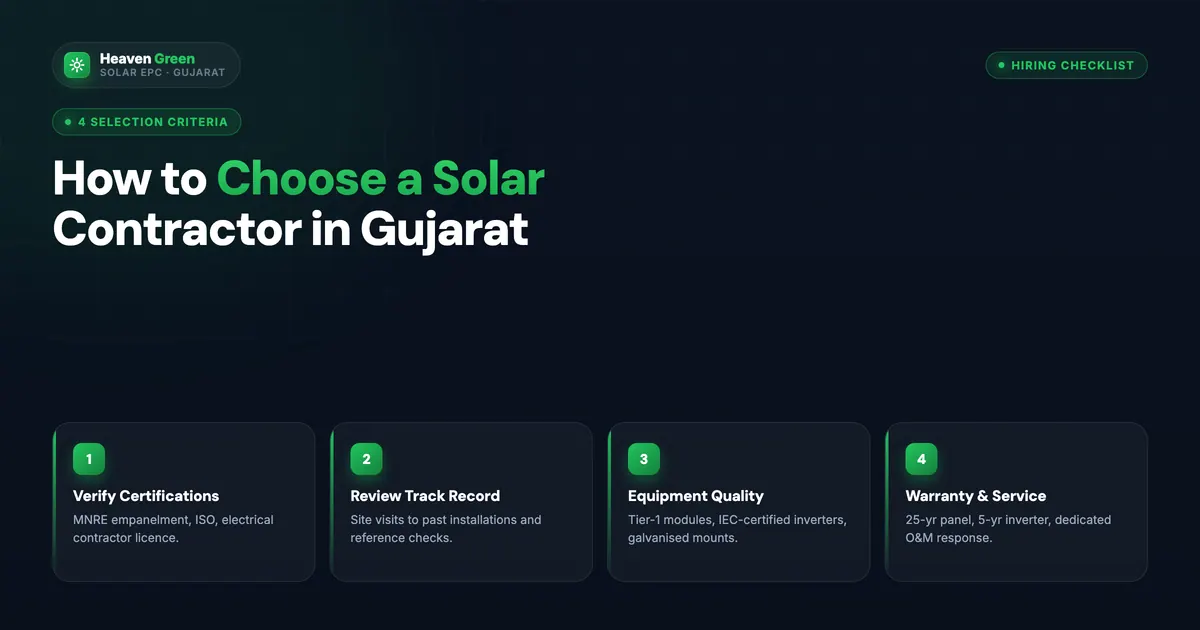
The most expensive solar mistake Indian buyers make is not overpaying for panels, it is hiring the wrong installer. A quality installer using average panels will outperform a poor installer using premium panels every time. Poor installation leads to generation losses of 15 to 25%, subsidy disqualification, warranty voids, and systems that fail in year 3. Getting the installer selection right is the single highest-leverage decision in your solar journey.
Key takeaway. In India’s 2026 solar market, the key qualification for a residential installer is registration as a vendor on the PM Suryaghar national portal, without it, you lose your ₹78,000 subsidy. For commercial buyers, a track record of 50+ installations in your system-size category matters more than brand name or price. Ask these 7 questions before signing any solar contract.
This guide distils 10,000+ installation learnings from Heaven Green Energy’s operations across Gujarat and 25+ cities into a practical checklist you can use in the next 48 hours.
Why Installer Quality Matters More Than Panel Brand
A solar system’s real-world performance depends on four installation-controlled factors: panel orientation and tilt angle, string configuration and cable sizing, inverter placement and ventilation, and net metering connection quality. Poor decisions in any one of these can reduce annual generation by 10 to 20%.
- Incorrect tilt angle: A panel installed at 5° instead of 15° in Ahmedabad loses approximately 7% annual yield.
- Undersized DC cables: Resistive losses in undersized cables can waste 3 to 5% of generated power.
- Poor string configuration: Connecting mismatched panels in a string causes mismatch losses of 5 to 15%.
- Bad inverter placement: An inverter in direct sun or an uncooled enclosure runs at higher temperatures, reducing efficiency and shortening lifespan.
These are all installer errors, not equipment errors. The equipment manufacturer’s warranty does not cover installer-caused losses. You absorb them for 25 years.
For a detailed breakdown of what goes into installation quality, see our guide on choosing a solar contractor and our overview of local vs national solar EPC companies.
Question 1: Are You a Registered Vendor on the PM Suryaghar Portal?
This is the non-negotiable first question. If you are a residential buyer, your ₹78,000 PM Suryaghar subsidy is contingent on using a vendor registered on the pmsuryaghar.gov.in national portal; MNRE’s guidelines say the scheme is implemented only through such vendors. An unregistered installer, regardless of how cheap or experienced they claim to be, will cost you the entire subsidy.
How to verify: Log in to pmsuryaghar.gov.in and search for the installer’s name in the registered vendor list for your state and DISCOM. An “MNRE empanelment certificate” is not the test; that wording comes from the older Phase-II programme, and the portal listing is what counts.
Commercial and industrial rooftops do not get PM Suryaghar subsidy, so portal registration matters less there; check the installer’s electrical contractor licence, DISCOM net-metering track record and references instead. For state schemes, check the relevant state agency (GEDA for Gujarat, MAHAURJA for Maharashtra, RRECL for Rajasthan).
Question 2: How Many Installations Have You Completed in My System-Size Category?
Experience in your size category matters. An installer who has done 500 residential 3 to 5 kWp installations but has never installed a 100 kWp commercial system is not the right choice for your factory. Conversely, an industrial-only EPC that has never navigated residential DISCOM net metering may struggle with your home system.
Ask specifically:
- “How many systems have you installed in the – kW range?”
- “Can you provide 3 references from customers with similar systems in my area?”
- “What is the oldest system you have installed that is still operating, and what is its current performance ratio?”
A credible installer answers these questions with specific numbers and offers references without hesitation. Our separate 12-point installer credibility scorecard walks through how to weigh these answers if you want a more granular evaluation than the checklist below.
💡 Fast tip
Ask for the installer's oldest operational installation and request a site visit. Seeing a 5-year-old system still generating at spec tells you more about quality than any brochure or review.
Question 3: Who Manufactures Your Panels and Are They ALMM-Listed?
You should not accept vague answers like “we use quality panels” or “ISO-certified.” Ask for:
- The exact panel manufacturer and model number
- Confirmation that the model is on the current MNRE ALMM (Approved List of Models and Manufacturers) list
- The datasheet showing efficiency, temperature coefficient, and warranty terms
ALMM compliance is mandatory for PM Suryaghar subsidy eligibility. An installer quoting non-ALMM panels either does not know this requirement (a red flag) or is deliberately cutting costs at your expense.
For panel technology comparison, see our Mono PERC vs TOPCon vs HJT guide.
Question 4: What Is the Exact Inverter Make and Model?
The inverter is the brain of your solar system. A low-quality inverter or an incorrectly sized one will limit your system’s output regardless of how good the panels are.
Ask for:
- The inverter brand, model, and rated kVA/kW
- Confirmation it is a Pure Sine Wave MPPT inverter (not modified sine wave or PWM)
- The efficiency rating (should be ≥95% for MPPT solar inverters)
- Whether it supports net metering export to DISCOM (if you need net metering)
- The inverter warranty period (minimum 2 years; 5 years for dedicated solar inverters is standard from quality brands)
For inverter selection guidance, see our guide on choosing the right solar inverter. If you want the MPPT and efficiency-rating jargon on a quote decoded line by line, QBits Energy’s guide to decoding inverter specifications is a useful companion reference.
Question 5: Do You Handle Net Metering Registration With DISCOM?
Net metering, receiving credit for surplus power exported to the DISCOM grid, is essential for maximising your solar ROI. But net metering registration is a separate process from installation. Not all installers handle it, and delays in net metering activation can cost you months of export credits.
Ask:
- “Do you handle the net metering application with DISCOM on my behalf?”
- “What is your typical timeline from installation to net meter activation?”
- “Are there any additional charges for net metering coordination?”
The average timeline from installation completion to net meter activation in Gujarat is 15 to 45 days. Installers with strong DISCOM relationships (UGVCL, DGVCL, MGVCL, PGVCL) resolve this faster; see our state-by-state PM Suryaghar Gujarat DISCOM guide for what each utility’s process actually looks like. Heaven Green Energy handles net metering registration as standard in every residential installation.
Question 6: What Does Your Post-Installation Service Include?
A solar system’s first 5 years have the highest probability of minor issues, inverter settings drift, string fuse trips, panel soiling accumulates. An installer who disappears after commissioning leaves you managing these alone.
Ask for:
- Annual Maintenance Contract (AMC) terms and pricing
- Response time commitment for breakdowns
- Monitoring system included, does the installation include IoT-based generation monitoring?
- Panel cleaning schedule and method
- What happens if a panel or inverter requires warranty replacement, who manages the manufacturer claim?
Quality installers include a 1-year warranty period on their workmanship in addition to equipment warranties, and offer structured AMC packages beyond year 1. Our full breakdown of what a solar AMC should and should not cover is a useful checklist to compare against whatever the installer proposes.
Question 7: Can You Show Me the Site Survey Report Before I Sign?
A responsible installer does a proper site survey before quoting. The survey should cover:
- Roof orientation, tilt, and available area
- Shading analysis (trees, neighbouring buildings, water tanks)
- Existing electrical load and sanctioned connection capacity
- Structural assessment of the roof for panel mounting
- Proposed system layout with panel arrangement
If an installer provides a quote without visiting your site or after a 5-minute rooftop look, they are guessing. An unvisited quote is not a reliable quote. Heaven Designs’ site survey and land feasibility service outlines what a properly documented survey covers if you want to check your installer’s report against a professional baseline.
Get a free site assessment. A solar advisor responds within 2 hours on business days, then our engineers visit and send a detailed site survey report before any commitment from you. Get your free quote →
The 7-Question Installer Scorecard
We developed this evaluation tool, The Heaven Green Installer Scorecard: to help buyers compare installers objectively. Score each installer 1 to 5 on each question:
| Question | Max score | Your installer 1 | Your installer 2 |
|---|---|---|---|
| PM Suryaghar portal registration confirmed | 5 | __ | __ |
| Relevant installations (≥50 in your category) | 5 | __ | __ |
| ALMM panels confirmed by model number | 5 | __ | __ |
| Pure sine wave MPPT inverter specified | 5 | __ | __ |
| Net metering handling included | 5 | __ | __ |
| AMC and monitoring offered | 5 | __ | __ |
| Site survey report provided before quote | 5 | __ | __ |
| Total | 35 | __ | __ |
A score below 25 is a warning sign. Below 20, walk away.
Common Red Flags to Avoid
-
1
Quote delivered within hours of inquiry with no site visit, a system sized without seeing your roof is guesswork. Accurate sizing requires measuring usable area and analysing shading.
-
2
Price quote 20 to 30% below every other installer, solar installation has known cost floors. A dramatically lower quote usually means non-ALMM panels, undersized inverter, sub-grade mounting structures, or no post-installation support. See our full list of warning signs in suspiciously cheap solar quotes for more detail.
-
3
Refuses to confirm ALMM panel compliance in writing, any installer using ALMM panels will confirm this without hesitation. Hesitation means non-compliance.
-
4
No contract or a single-page vague agreement, a professional solar installation contract covers system specifications, brand and model of all components, installation timeline, subsidy processing, warranty terms, and AMC. A one-page "agreement" is inadequate.
Pros and Cons: Choosing a Local Installer vs Established EPC
- PM Suryaghar portal registration confirmed, subsidy fully protected
- Structured AMC, IoT monitoring, warranty management
- Track record verifiable with hundreds of references
- Net metering handled as standard service
- May not be registered on the PM Suryaghar portal, subsidy at risk
- No structured service after installation
- May use non-ALMM panels to undercut price
- No company-backed warranty resolution
How Heaven Green Energy Helps
Heaven Green Energy is MNRE-empanelled, GEDA-empanelled, and has completed 10,000+ installations across Gujarat and 25+ cities. Our pre-sales process includes a mandatory site survey, detailed written proposal with exact brand and model specifications, and a structured contract covering all 25 years of warranty obligations.
- Residential solar systems: 1 to 10 kWp with PM Suryaghar subsidy, net metering, and AMC.
- Commercial solar systems: 10 to 100 kWp with ROI documentation and GEDA empanelment.
- About Heaven Green Energy: our track record, team, and MNRE empanelment details.
- Solar calculator: get a system size and savings estimate in 60 seconds.
For the full cost-comparison between local and national EPCs over 5 years, read our local installer vs branded EPC 5-year cost analysis.
Frequently Asked Questions
What is the most important thing to check when choosing a solar installer in India?
Registration as a vendor on the PM Suryaghar national portal is the single most important check for residential buyers, without it, you lose ₹78,000 in subsidy. For commercial buyers, a track record of 50+ completed installations in your system size range is the key criterion. Registration can be verified independently on pmsuryaghar.gov.in.
How do I verify if a solar installer is registered for PM Suryaghar?
Visit pmsuryaghar.gov.in and search for the installer in the registered vendor list for your state and DISCOM. For state schemes, check the GEDA website for Gujarat, MAHAURJA for Maharashtra, or RRECL for Rajasthan. An “MNRE empanelment” certificate is Phase-II wording; the portal listing is what decides subsidy eligibility.
How many quotes should I get before choosing a solar installer?
Get at least three quotes from different installers before deciding. Compare them on system size, brand and model of panels and inverter, installation timeline, post-installation warranty, and AMC terms, not just price. Use our how to read a solar quote guide to understand what each line means.
Is a cheaper solar installer always a risk?
Not always, but a dramatically cheaper quote (20 to 30% below market) is usually a red flag. It typically means non-ALMM panels, undersized inverter, sub-grade mounting structures, or no post-installation service. A modest 5 to 10% price difference between comparable installers often reflects differences in panel brand or inverter specification rather than installation quality.
Should I choose a local solar installer or a national EPC company?
A local installer with genuine PM Suryaghar portal registration, 100+ completed installations, and structured AMC is a valid choice. A national EPC with the same credentials is not automatically better, though larger companies often have stronger warranty management and faster service response. The 7 questions in this guide apply equally to both; use them to evaluate whoever you are considering.
What should a solar installation contract include?
A complete solar installation contract covers: exact brand and model of panels, inverter, mounting structure, and cables; system size (kWp); installation timeline and milestones; PM Suryaghar subsidy processing responsibility; equipment warranty periods and claim process (see our breakdown of product, performance, and workmanship warranty types if the terminology is unfamiliar); workmanship warranty (minimum 1 year); AMC terms; net metering application responsibility; and payment schedule tied to milestones. Anything less is an incomplete contract.