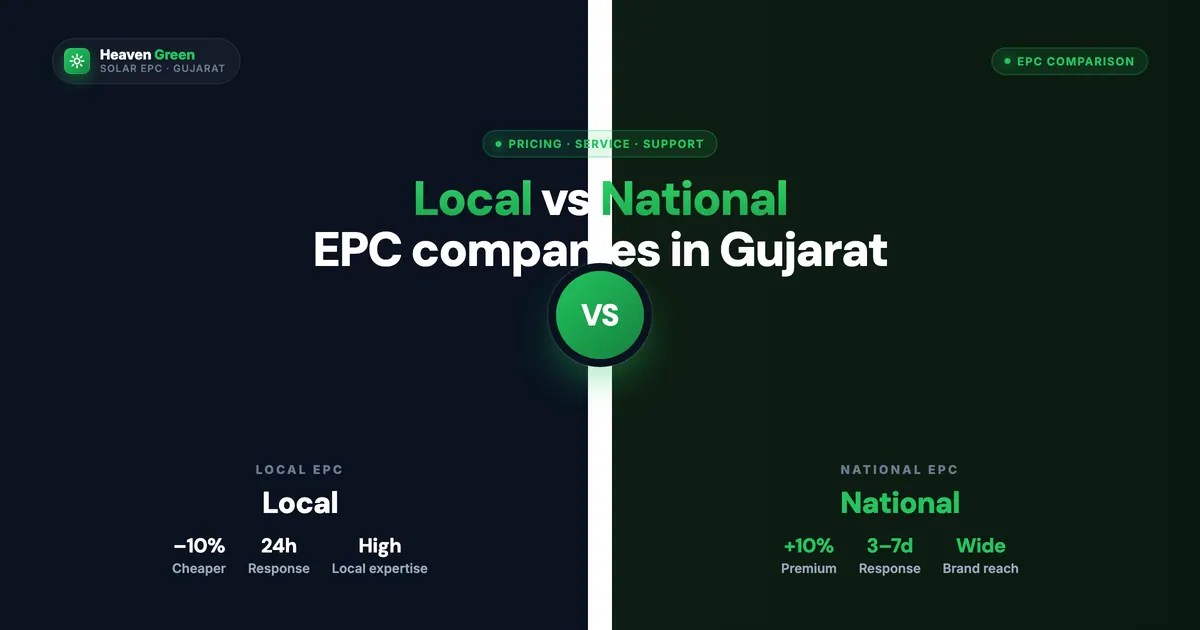
You received two quotes. One is ₹15,000–₹20,000 cheaper. It comes from a small local installer who promises the same panels, the same output, and the same result, just at a lower price.
The question is not whether the quote is cheaper today. The question is what that quote actually costs you over five years.
This post breaks down exactly that, using a proprietary three-bucket framework that accounts for every rupee, installation day one, subsidies, net metering income, and generation performance. The numbers consistently show that the cheaper quote is the more expensive choice.
The true 5-year cost of a budget local installer is often ₹40,000–₹80,000 higher than a branded EPC, even when the day-one quote is ₹15,000–₹20,000 cheaper. The difference comes from three sources: lost PM Suryaghar subsidy (₹78,000 for 3 kW+), foregone net metering export income, and underperformance from non-ALMM panels. A branded EPC like Heaven Green Energy, MNRE-approved, GEDA-empanelled, with 10,000+ installations, includes all three protections in its scope of work.
Why the Quoted Price Is Not the Real Price
Solar is a 25-year asset. Comparing it by day-one installation cost alone is like comparing two cars by looking only at the sticker price, ignoring service costs, fuel efficiency, and resale value.
When homeowners and SME owners evaluate quotes, they typically compare:
- ₹ per kW installed
- Panel brand (if mentioned)
- Inverter brand (if mentioned)
- System capacity
What they almost never compare, because quotes don’t show it, is:
- Whether the installer is on the DISCOM’s empanelled vendor list (required for PM Suryaghar subsidy)
- Whether the panels are ALMM-listed (required for government-scheme eligibility)
- Whether net metering application is included in the scope
- Whether the inverter carries a BIS/IEC certification
- What after-sales support structure exists
These omissions are where the real cost gap lives.
⚠️ Watch out
A quote that does not explicitly mention ALMM panel model numbers, BIS inverter certification, and PM Suryaghar empanelment status is incomplete, regardless of how attractive the ₹/kW figure looks. You cannot claim PM Suryaghar subsidy unless your installer is on your DISCOM's approved vendor list.
The 5-Year True Cost of Solar Ownership Calculator
This is Heaven Green Energy’s proprietary framework for evaluating any solar quote, not just ours. It organises every cost and loss into three buckets over a 60-month window.
Bucket 1: Upfront Installation Cost
This is the number in the quote. For a typical 3 kW residential system in Gujarat in 2026:
| Installer Type | Price Range per kW | 3 kW Total (Before Subsidy) |
|---|---|---|
| Local installer (budget) | ₹50,000–₹70,000 | ₹1,50,000–₹2,10,000 |
| Branded EPC (Heaven Green, Tata Power Solar, SUNSURE) | ₹65,000–₹85,000 | ₹1,95,000–₹2,55,000 |
| Typical Day-1 Gap | ₹15,000–₹20,000/kW | ₹45,000–₹60,000 for 3 kW |
So the local installer saves you ₹45,000–₹60,000 on day one for a 3 kW system. That is real money, and it is the number that makes the local quote attractive.
Now let us look at what that saving actually costs you.
Bucket 2: Lost Subsidy + Lost Net Metering Income
Lost PM Suryaghar Subsidy
The PM Suryaghar Muft Bijli Yojana offers central government subsidies of:
- ₹30,000 for 1 kW
- ₹60,000 for 2 kW
- ₹78,000 for 3 kW and above
To claim this subsidy, your installer must be empanelled on your DISCOM’s PM Suryaghar vendor portal. According to pmsuryaghar.gov.in, only registered and DISCOM-approved vendors can file subsidy applications on behalf of customers. Many small local installers are not registered on these portals, either because they are unaware of the process, lack the documentation, or have not invested in the registration.
If your installer is not empanelled: you forfeit the entire ₹78,000 subsidy for a 3 kW system.
A branded EPC operating at scale, like Heaven Green Energy, which is GEDA-empanelled and has handled thousands of PM Suryaghar applications, manages the full subsidy application process. For our complete guide to this scheme, see PM Suryaghar: Complete Guide 2026.
Lost Net Metering Export Income
Net metering allows you to export surplus solar generation to the grid and earn credits against your electricity bill. In Gujarat, the GERC feed-in tariff for residential net metering is approximately ₹2.25–₹3.50 per unit exported (varies by DISCOM and year).
A 3 kW system in Ahmedabad generating ~4,500 units per year typically exports 20 to 35% of generation (900 to 1,575 units/year) if the household does not consume all of it during the day. At ₹3/unit, that is ₹2,700–₹4,725 per year, or ₹13,500–₹23,625 over 5 years.
Filing the net metering application requires submitting technical documents to the DISCOM, coordinating a site inspection, and getting the bidirectional meter installed. Many local installers in India explicitly exclude this from their scope, telling customers it is “your responsibility to coordinate with the DISCOM.” For detailed guidance on this process, see Net Metering in India.
If net metering is not filed: the solar system runs without export, surplus energy is wasted, and you lose ₹13,500–₹23,625 over 5 years.
Bucket 2 combined loss: ₹78,000 (subsidy) + ₹13,500–₹23,625 (net metering) = ₹91,500–₹1,01,625
Bucket 3: Underperformance Cost
This is the hardest cost to see, because it is invisible. You never know how much energy a different system would have generated.
Non-ALMM panels
The Ministry of New and Renewable Energy maintains the Approved List of Models and Manufacturers (ALMM list on mnre.gov.in). Only ALMM-listed panels qualify for government scheme eligibility, and crucially, these panels undergo regular quality audits. Budget local installers sometimes source panels from outside the ALMM list, imported Chinese panels without BIS certification, or panels from manufacturers not audited for quality claims.
The performance gap: ALMM-listed panels from verified Tier-1 manufacturers (Adani Solar, Waaree, Tata Power Solar) reliably deliver 20 to 22% efficiency with less than 0.5% annual degradation in the first 5 years. Non-ALMM budget panels from unverified sources can underperform by 8 to 15% in real-world conditions and degrade faster.
For a 3 kW system targeting 4,500 units/year:
- 10% underperformance = 450 fewer units/year
- 15% underperformance = 675 fewer units/year
- Over 5 years at ₹8/unit (avoided grid purchase): ₹18,000–₹27,000 lost
Non-BIS certified inverters
BIS certification (bis.gov.in) verifies that inverters meet Indian grid safety and efficiency standards. Non-BIS inverters, often cheaper Chinese units, may have lower conversion efficiency (92 to 94% vs 97 to 98% for BIS-certified units) and higher failure rates in Indian ambient conditions.
Inverter efficiency loss alone can cost 2 to 3% of annual generation. Over 5 years on a 3 kW system: ₹5,400–₹8,100 in additional lost generation. For a full breakdown of the BIS and IEC standards inverters must meet in India, see Solar Inverter Regulations India 2026: BIS & IEC Compliance.
For more on panel quality criteria, see How to Choose Solar Modules.
Improper string sizing
Branded EPCs perform detailed string sizing calculations, matching panel configuration to inverter MPPT input ranges, accounting for Gujarat’s temperature profiles (panels reach 55 to 65°C in summer), and cable sizing for minimum resistive losses. Local installers without engineering staff may skip these calculations.
String sizing errors can cause 5 to 12% chronic underperformance. On a 3 kW system, that is another ₹10,800–₹25,920 in lost generation value over 5 years.
Bucket 3 combined loss: ₹34,200–₹61,020
The 5-Year True Cost Summary
| Cost Bucket | Local Installer (Budget) | Branded EPC | 5-Year Gap |
|---|---|---|---|
| Bucket 1: Day-one installation (3 kW) | ₹1,65,000 | ₹2,10,000 | -₹45,000 (local cheaper) |
| Bucket 2: Lost subsidy | ₹78,000 | ₹0 | +₹78,000 |
| Bucket 2: Lost net metering | ₹18,000–₹23,625 | ₹0 | +₹18,000–₹23,625 |
| Bucket 3: Underperformance | ₹34,200–₹61,020 | ₹0–₹5,000 | +₹29,200–₹56,020 |
| 5-Year True Cost Difference | ₹80,200–₹1,12,645 more expensive |
The ₹45,000 day-one saving costs you ₹80,000–₹1,12,000 over five years. That is a -177% to -250% return on the “saving.”
Equipment Quality: ALMM vs Non-ALMM, BIS vs Non-BIS
Understanding what branded EPCs actually specify in their BOQ (Bill of Quantities) explains why the cost is higher on day one, and lower over five years. For the certification standards referenced throughout this comparison, see Solar Quality Certifications India: BIS, IEC, ALMM Explained.
What a Branded EPC Specifies
- Panels: ALMM-listed, Tier-1 manufacturer (Adani Solar, Waaree Energies, Tata Power Solar), with datasheet-verified efficiency of 20 to 22%, temperature coefficient better than -0.35%/°C
- Inverter: BIS-certified, IEC 62109 compliant, with grid-tie protection features required under CEA (Technical Standards) Regulations
- Mounting structure: Hot-dip galvanised (HDG) steel or anodised aluminium, load-rated for Gujarat wind zones
- Cables: XLPE-insulated DC cables rated for 1000V, UV-resistant
- String sizing: Engineered to DISCOM specifications, shade analysis performed
What a Budget Local Installer May Specify
- Panels: “400W mono panel”, no manufacturer name, no ALMM number, no datasheet
- Inverter: Brand name that may not appear on BIS certification database
- Mounting: “GI structure”, no specification of wall thickness, coating quality, or wind load rating
- Cables: Unspecified gauge and insulation rating
For a detailed breakdown of what to look for in a quote, see Solar Panel Cost Breakdown and Solar Panel Warranty Explained.
According to Bridge to India’s India Solar Market Outlook 2026, quality-related system underperformance accounts for 12 to 18% of rooftop solar complaints in India, the majority of which relate to non-standard equipment procurement.
💡 Fast tip
Before signing any solar contract, go to mnre.gov.in and search the ALMM list for the exact panel model number specified in your quote. If the model is not on the list, the panels are not ALMM-certified and you will not qualify for PM Suryaghar subsidy. This takes 2 minutes and can save you ₹78,000.
PM Suryaghar Subsidy: Who Can Actually Get It for You
The PM Suryaghar Muft Bijli Yojana is India’s flagship rooftop solar subsidy scheme for residential consumers. As of 2026, it has disbursed subsidies to over 1.3 million households nationwide (MNRE data).
How the Empanelment Process Works
To participate, an installer must:
- Register on the National Portal for Rooftop Solar (pmsuryaghar.gov.in)
- Get empanelled with each DISCOM they operate in
- Submit credentials, GST registration, and experience documentation
- Maintain compliance with DISCOM quality audits
Why Many Local Installers Are Not Empanelled
The empanelment process requires documentation that informal operators may not have: GST registration, a track record of completed installations, and technical staff credentials. Additionally, each DISCOM has its own empanelment process, an installer who is empanelled with UGVCL may not be empanelled with MGVCL.
Heaven Green Energy is GEDA-empanelled and works with all four major Gujarat DISCOMs. When you install with us, we:
- File the PM Suryaghar application on your behalf
- Coordinate the DISCOM technical inspection
- Track subsidy disbursement and follow up on delays
- Handle all documentation, Aadhaar, bank account linking, electricity bill, property documents
For a complete walkthrough of the subsidy process, see PM Suryaghar Complete Guide 2026.
5 Red Flags in a Local Installer Quote
Before signing any solar contract, verify these five items. If any are missing or unclear, ask directly, and if you do not get a clear answer, walk away.
1. Installer not on the DISCOM’s PM Suryaghar empanelled vendor list
Check at pmsuryaghar.gov.in. Search by state → Gujarat → your DISCOM. If your installer’s company name does not appear, you cannot claim the ₹78,000 subsidy, regardless of what they tell you. For a step-by-step walkthrough of this check, see How to Verify a PM Suryaghar Vendor Before You Sign.
2. No ALMM-listed panel model specified in the quote
The quote must name the specific panel model (e.g., “Waaree WS-540 Mono PERC”). Verify this model on the ALMM list at mnre.gov.in. Vague descriptions like “440W poly panel” or “Tier-1 panel” are not verifiable and may indicate non-ALMM sourcing.
3. No BIS/IEC-certified inverter model specified
The inverter model must be named. Verify BIS certification at bis.gov.in. Grid-connected solar inverters in India must comply with IEC 62109 and the CEA (Technical Standards for Connectivity) Regulations 2010. An uncertified inverter can cause DISCOM to reject your net metering application.
4. Net metering application “not included” in scope
Net metering application filing requires technical drawings, meter room access, and DISCOM coordination. If the quote scope explicitly excludes this, or if the installer says “you handle it”, you may end up with a solar system that cannot export power to the grid, permanently losing export income.
5. No registered company / no GST number
A legitimate solar EPC operating in India must have a GST registration. Ask for the GSTIN and verify it at the GST portal. An unregistered installer cannot provide you with a valid tax invoice, cannot be held accountable under consumer protection law, and has no legal existence to honour a warranty claim.
Warranty Response Time: A Critical Differentiator
Solar panels carry 25-year linear power warranties from the manufacturer. But the manufacturer’s warranty is only as accessible as your installer’s after-sales support.
The Warranty Chain
When a panel underperforms or an inverter fails, the path to resolution is:
Customer → Installer → Manufacturer → Resolution
If the installer no longer exists (very common with small local operators after 2 to 3 years), you are left to deal with the manufacturer directly, often based in another city or state, with no local presence in Gujarat.
Branded EPCs maintain dedicated service teams. At Heaven Green Energy, our AMC (Annual Maintenance Contract) provides:
| Service Element | Heaven Green AMC | Typical Local Installer |
|---|---|---|
| Response time (fault reporting) | 24 to 48 hours | Best effort / unknown |
| Annual preventive maintenance visits | 1 to 2 per year included | Not included |
| Panel cleaning coordination | Yes | No |
| DISCOM compliance updates | Yes | Rarely |
| Warranty claim coordination | Yes, we liaise with manufacturer | Customer manages |
| 5-year AMC cost | ₹10,000–₹25,000 | N/A (service may not exist) |
The AMC cost is real, ₹10,000–₹25,000 over 5 years. But it replaces emergency repair costs that can run ₹8,000–₹15,000 per incident, and it ensures the system consistently performs at rated output. For further reading, see Common Mistakes EPC Companies Make in Rooftop Solar.
Get a free site assessment. A solar advisor responds within 2 hours on business days, and our engineers visit sites across Ahmedabad, Surat, Rajkot, Vadodara, and Morbi and provide a detailed generation estimate with full subsidy scope. Get your free quote →
Pros and Cons: Local Budget Installer vs Branded EPC
- Lower day-one quoted price (₹50,000–₹70,000/kW)
- May offer faster installation timelines in some cases
- Some established local operators are fully empanelled and reliable
- Often not empanelled, forfeits ₹78,000 PM Suryaghar subsidy
- May use non-ALMM panels, ineligible for subsidies and quality-unverified
- Net metering often excluded from scope
- No dedicated after-sales team, warranty claims become your problem
- Non-BIS inverters may be rejected by DISCOM for net metering
- Higher 5-year true cost by ₹80,000–₹1,12,000
- DISCOM-empanelled, full PM Suryaghar subsidy (₹78,000 for 3 kW)
- ALMM-listed panels, verified quality and subsidy eligibility
- Net metering application included in scope
- Dedicated AMC team with 24 to 48 hour response time
- Engineering-grade string sizing and design
- Lower 5-year true cost by ₹80,000–₹1,12,000
- Higher day-one quoted price (₹65,000–₹85,000/kW)
- May have longer project pipeline in peak seasons
How to Verify a Quote Before You Sign
Here is a step-by-step checklist to run on any solar quote you receive.
-
Verify DISCOM empanelment: Go to pmsuryaghar.gov.in, select your state and DISCOM, and confirm the installer’s company name appears on the approved vendor list.
-
Verify ALMM panel listing: Find the exact panel model in the quote. Go to mnre.gov.in and search the ALMM list. Confirm the model is listed.
-
Verify BIS inverter certification: Find the inverter model. Search the BIS product certification database at bis.gov.in. Confirm the model holds valid certification.
-
Confirm net metering is in scope: Look for explicit mention of “net metering application filing” in the scope of work. If absent, ask the installer to confirm in writing that they will file the application and coordinate the DISCOM inspection.
-
Verify GST registration: Ask for the company’s GSTIN and verify at the GST portal (gst.gov.in). The company name and state on the certificate should match what the installer represents.
-
Check references: Ask for 2 to 3 recent installations in your city. Contact those customers and ask specifically: did you receive the PM Suryaghar subsidy, is net metering active, and has the installer responded to any after-sales requests?
-
Review the warranty documentation: The quote should specify panel product warranty (minimum 10 years), panel linear power warranty (25 years), inverter warranty (minimum 5 years), and installation workmanship warranty. For more on what these cover, see Solar Panel Warranty Explained.
For a deeper look at how to evaluate installers, see How to Choose a Solar Contractor.
💡 Fast tip
Use our Solar Calculator to estimate your expected generation, savings, and payback period before comparing quotes. Having a clear expected output number makes it much easier to evaluate whether a budget system is genuinely delivering the same performance as a certified one.
How Heaven Green Energy Handles the Full Scope
Heaven Green Energy is an MNRE-approved solar EPC with 10,000+ completed installations across Gujarat. We are GEDA-empanelled and operate in Ahmedabad, Surat, Rajkot, Vadodara, and Morbi.
Our standard scope for every residential installation includes:
- Site assessment: Roof structural check, shadow analysis, tilt optimisation, grid supply review
- Engineering design: String sizing, single-line diagram, DISCOM-compliant layout
- Equipment specification: ALMM-listed panels, BIS-certified inverter, load-rated mounting structure
- Installation: Trained installation team, safety compliance, cable management
- PM Suryaghar subsidy application: Portal registration, document submission, inspection coordination, disbursement tracking
- Net metering application: DISCOM filing, bidirectional meter coordination
- Commissioning and handover: System testing, generation monitoring setup, customer training
- AMC options: Annual maintenance contracts covering cleaning, inspection, and warranty claim management
How Heaven Green Energy Can Help
- Residential Solar: full PM Suryaghar subsidy handling, 3 to 10 kW systems with net metering filing included.
- Commercial Solar: 10 to 100 kW with ROI modelling, accelerated depreciation advisory, and long-term AMC.
- Contact us: free site assessment across all five Gujarat cities.
Get a free site assessment. A solar advisor responds within 2 hours on business days. Get your free quote →
FAQ
What is the PM Suryaghar subsidy amount for a 3 kW system in 2026?
The PM Suryaghar Muft Bijli Yojana provides ₹78,000 for systems of 3 kW and above for residential consumers. For smaller systems, the subsidy is ₹30,000 for 1 kW and ₹60,000 for 2 kW. To receive this subsidy, your installer must be on your DISCOM’s empanelled vendor list, without that, no subsidy can be claimed regardless of system size or panel quality.
How do I check if my solar installer is empanelled for PM Suryaghar?
Go to pmsuryaghar.gov.in, navigate to the “Vendor” section, and select Gujarat as your state and your DISCOM (DGVCL, MGVCL, UGVCL, or PGVCL). The portal shows a searchable list of all approved vendors. If your installer’s company name does not appear, they are not empanelled.
What is ALMM and why does it matter for solar panels?
ALMM stands for Approved List of Models and Manufacturers, maintained by MNRE. Only panels on this list are eligible for government scheme benefits including PM Suryaghar subsidy. Additionally, ALMM-listed panels come from manufacturers that undergo periodic quality audits, providing assurance that efficiency and warranty claims are backed by verified testing. Non-ALMM panels may be cheaper but carry no quality guarantee and make you ineligible for central subsidies.
What is BIS certification for solar inverters?
BIS (Bureau of Indian Standards) certification confirms that a solar inverter meets Indian safety and performance standards, specifically IEC 62109 (safety of power converters for use in photovoltaic power systems). BIS-certified inverters are required under CEA Technical Standards for grid-connected solar systems in India. Many DISCOMs require BIS certification as a condition for net metering approval, a non-certified inverter may cause your net metering application to be rejected.
Why do some local installers not file net metering applications?
Net metering application requires technical drawings, proof of BIS-certified equipment, and a formal application to the DISCOM followed by a meter inspection. Many small local installers either lack the technical capability to prepare the documentation, are unfamiliar with the DISCOM-specific process, or simply exclude it to keep their quoted price low. The result is a solar system that cannot export surplus power, permanently losing export income for the customer.
How much does a 5-year AMC cost for a 3 kW residential system?
With a professional EPC like Heaven Green Energy, a 5-year AMC for a 3 kW residential system typically costs ₹10,000–₹25,000 depending on scope (cleaning frequency, number of inspections, remote monitoring). This replaces out-of-pocket repair costs, which can run ₹8,000–₹15,000 per incident for inverter faults or panel replacement coordination.
Is the ₹65,000–₹85,000/kW price range for branded EPCs post-subsidy or pre-subsidy?
That is the installation price per kW before subsidy deduction. After applying the PM Suryaghar subsidy of ₹78,000 for a 3 kW system, the effective post-subsidy cost for a 3 kW system from a branded EPC comes down to approximately ₹1,17,000–₹1,77,000 total, significantly lower than the pre-subsidy figures.
What happens if a local installer closes down after my installation?
If the installer business ceases to operate, you lose access to warranty service, panel replacement coordination, and ongoing maintenance. You would need to hire a new EPC for any servicing, at market rates. This is a real risk with small operators; see Solar Installer Disappeared: What to Do in India for recovery steps. Established EPCs with 10,000+ installations and a fixed physical office have greater business continuity. For further guidance, see our post on Common Mistakes EPC Companies Make in Rooftop Solar.
Can I claim PM Suryaghar subsidy after installation if my installer was not empanelled?
No. The subsidy claim must be initiated through the DISCOM portal by an empanelled vendor before or at the time of installation. It cannot be claimed retroactively by switching to a new installer after the system is already commissioned. This makes verifying empanelment before signing any contract absolutely essential.