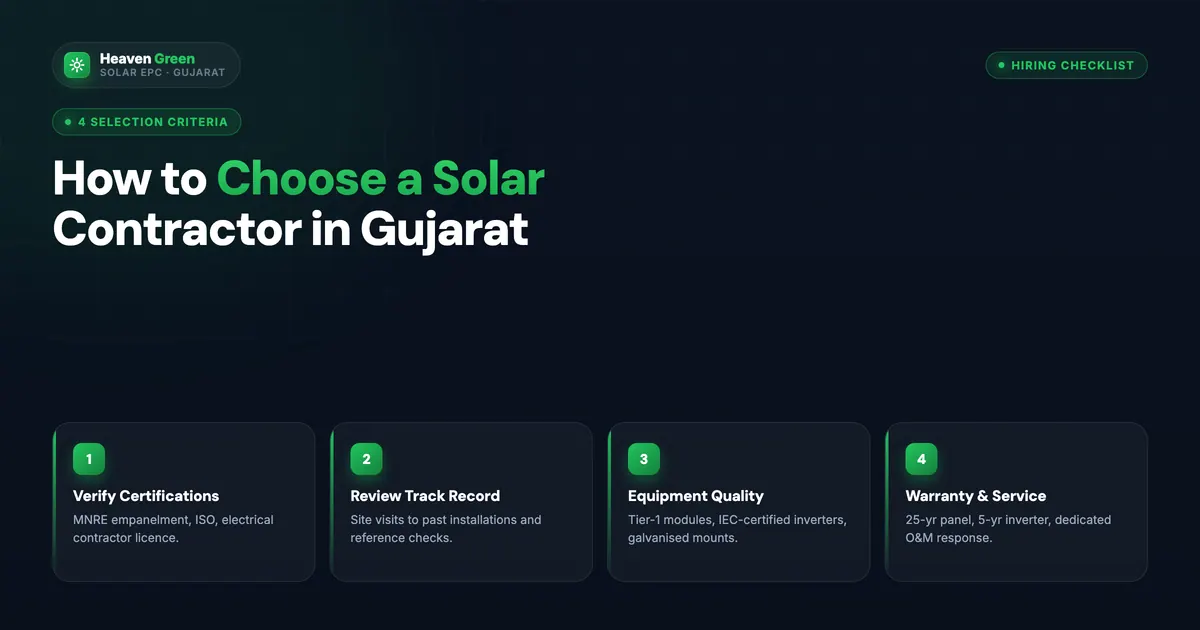
Choosing a solar installer is a 25-year commitment, the company you sign with today will affect your electricity savings, your warranty claims, and your system performance for the next two decades. Yet most buyers spend more time choosing a refrigerator than a solar contractor. The good news: fifteen targeted questions, asked before signing any agreement, will separate credible installers from those who will disappear after they cash your cheque.
Key takeaway. The 15 questions in this guide cover five critical areas: legal compliance (PM Surya Ghar portal vendor registration, GSTIN), technical quality (panel ALMM listing, inverter BIS certification), financial transparency (payment terms, GST breakup), warranty reliability (manufacturer vs. company warranty), and post-installation support (AMC, monitoring access). A solar installer who cannot or will not answer all 15 questions clearly is not the right partner. Heaven Green Energy provides written answers to all 15 before any contract is signed.
Ask every question in writing (by email or WhatsApp) and keep the responses. Verbal promises are meaningless after installation, only written commitments matter.
Why These 15 Questions Matter
India’s solar market in 2026 has over 10,000 registered installers and another 50,000 informal operators. Some of the informal ones do excellent work. Many do not. The PM Suryaghar programme, with its subsidy of up to ₹78,000, has attracted a new wave of opportunistic installers who file the subsidy paperwork but deliver substandard systems.
Before we get to the questions, one prerequisite check: verify that the installer is a vendor registered on the PM Surya Ghar national portal at pmsuryaghar.gov.in. MNRE’s guidelines say the scheme is implemented only through portal-registered vendors, so if they’re not listed you cannot select them for a PM Suryaghar subsidy application. Any other question becomes secondary.
For a broader framework on evaluating contractors, see our how to choose a solar contractor guide and red flags in a solar quote articles.
The 15 Questions Framework: Five Categories
Category 1, Legal and Compliance Questions
Question 1: Are you a registered vendor on the PM Surya Ghar national portal for my DISCOM, and can I verify it?
This is non-negotiable for residential buyers seeking PM Suryaghar subsidy. The vendor registration must be verifiable on the official portal. An installer who can’t provide this or says “it’s being processed” should be avoided for any subsidy-linked installation.
Heaven Green Energy’s MNRE empanelment covers all four Gujarat DISCOMs, UGVCL, DGVCL, MGVCL, and PGVCL, and is published on our about page.
Question 2: What is your company’s GSTIN, and will the invoice show HSN codes for each component?
A GST-registered installer provides a legal tax invoice with HSN codes for each component (8541 for panels, 8504 for inverters). Without this, you cannot claim Input Tax Credit if you’re a GST-registered business. This also confirms the installer is operating legally and not evading tax.
Question 3: How many systems has your company installed in the last 24 months, and can you provide 3 customer references?
An established installer should have a verifiable installation track record. Ask for references in your city or district, not vague “we’ve done 500 installations” claims. Call the references and ask specifically about commissioning timeline, documentation quality, and any post-installation issues.
Category 2, Technical Quality Questions
Question 4: Is the proposed solar panel model on the MNRE ALMM list? Can you show me the ALMM reference number?
The Approved List of Models and Manufacturers (ALMM) is maintained by MNRE. Using a non-ALMM panel disqualifies you from PM Suryaghar subsidy. Always confirm the exact panel model is on this list. This also ensures the panel meets minimum quality standards for the Indian market.
Question 5: What is the BIS certification number for the panels and the inverter?
Indian solar panels must carry BIS certification under IS 14286 (for solar PV modules). Inverters must carry IS 16221 Part 1 and Part 2 certification. Ask for the BIS R-number, this is verifiable at bis.gov.in. Any panel or inverter without a BIS number is non-compliant and potentially unsafe.
Question 6: What is the efficiency rating and the degradation warranty of the panel you’re proposing?
Module efficiency tells you how much electricity you get per square foot. A 20%+ efficiency panel (TOPCon or mono PERC) is the standard in 2026. The degradation warranty should guarantee: no more than 2% loss in Year 1 and no more than 0.55% per year thereafter, reaching at least 80.6% output at Year 25. Anything worse than this is below industry standard.
Question 7: What is the DC cable specification, and does it comply with IS 694?
DC cables in solar systems carry high-voltage direct current. They must be UV-resistant, double-insulated, and rated for the system’s open-circuit voltage. The cable must comply with IS 694 / IEC 60227. Ask for the cable cross-section (typically 4 mm² or 6 mm²) and the brand. Our solar cables guide explains why this matters.
Category 3, Financial Transparency Questions
Question 8: Can you provide a component-wise price breakup with GST at the correct HSN rate?
As established in our GST on solar guide, panels attract 5% GST, batteries 18%, and a supply-and-install contract about 8.9% blended (70% of the value at 5%, 30% at 18%). The quote must show this breakup. A single-line “₹2,50,000 + GST” quote is unacceptable, what is the GST on? At what rate?
Question 9: What is the payment milestone schedule?
The standard is: 30 to 40% advance, 50% on material delivery to site, 10% on commissioning. Never pay more than 40% before materials arrive at your premises. An installer asking for 70%+ upfront is a financial risk.
Question 10: Are there any hidden costs, DISCOM fees, net meter charges, panel cleaning equipment?
Net metering application fees, bidirectional meter deposit (typically ₹5,000–₹15,000), earthing, and lightning arrester costs are sometimes excluded from quotes and billed separately. Ask explicitly what is and is not included in the quoted price.
Category 4, Warranty and Reliability Questions
Question 11: How do I claim the panel manufacturer’s warranty if a panel fails in Year 8?
The answer should be: “We provide you with the manufacturer warranty card at commissioning. If a panel fails, you contact the manufacturer (or we assist you) and the manufacturer dispatches a replacement.” If the answer is “you contact us and we’ll handle it,” without any mention of the manufacturer warranty card or process, it suggests there is no genuine manufacturer warranty.
Question 12: What is your workmanship warranty, and is it in writing?
A legitimate installer offers 2 to 5 years of workmanship warranty on installation quality, covering any issues with mounting structure, cable connections, or inverter wiring. This must be in the contract, signed and stamped.
Question 13: Will you handle the DISCOM net metering application, and what is your track record for approval timelines?
Net metering application, site inspection coordination, and bidirectional meter commissioning involve significant DISCOM coordination. An experienced installer knows the local DISCOM process, timeline, and likely bottlenecks. In Gujarat, UGVCL typically processes net metering in 30 to 60 days. You can verify net metering regulations on the MNRE net metering guidelines page. An installer who cannot give you a realistic timeline has not done this before.
Category 5, Post-Installation Support Questions
Question 14: What remote monitoring does the system come with, and can I access it on my phone?
All modern solar systems include inverter-based monitoring via a mobile app (Sungrow iSolarCloud, SMA Sunny Portal, Havells Solar App, etc.). The monitoring should show daily/monthly generation, instantaneous power, and fault alerts. An installer who offers no monitoring or installs an inverter with no monitoring portal is providing an inferior product.
Question 15: What annual maintenance does the system need, and do you offer an AMC contract after Year 1?
Solar needs annual cleaning (or more in dusty environments), connection checks, and inverter servicing. Ask about the Annual Maintenance Contract (AMC) rates and what it covers. See our solar AMC cost guide for fair pricing benchmarks. A first-year AMC should ideally be included in the project cost; paid AMC after Year 1 typically costs ₹3,000–₹6,000 per kW per year for comprehensive coverage.
How to Evaluate the Answers: The 15-Point Installer Scorecard
After asking all 15 questions, score each answer:
- Clear, written, verifiable answer = 1 point
- Vague, verbal-only, or “we’ll get back to you” = 0 points
An installer who scores 13 to 15 is credible and worth proceeding with. An installer who scores 10 to 12 has gaps that need to be resolved before signing. Below 10, look elsewhere.
| Score Range | Interpretation | Action |
|---|---|---|
| 13 to 15 | High-confidence installer | Request final quote and references |
| 10 to 12 | Gaps present | Clarify missing points in writing |
| 7 to 9 | Significant concerns | Seek alternative installers |
| Below 7 | Reject | Do not proceed |
Common Questions Buyers Ask That Are Less Important
The two questions buyers ask most frequently, “How many kW should I install?” and “Which panels are best?”, are actually less important than the 15 questions above. A trustworthy installer will give you an honest answer to system sizing based on your actual consumption data, not oversell capacity for a higher contract value. Panel brand comparisons matter much less than confirming the proposed panel is ALMM-listed and has a genuine manufacturer warranty.
Pros and Cons of Spending More Time on Installer Selection
- PM Suryaghar subsidy secured, up to ₹78,000
- Genuine 25-year manufacturer warranties in your hands
- Higher generation performance, right-sized system
- GST ITC claimable, correct invoice structure
- Subsidy forfeited, non-ALMM panels disqualify application
- Inverter failure in Year 4, ₹40,000–₹80,000 replacement
- No warranty recourse if panels degrade excessively
- Oversized system, paying for capacity you can't use
How Heaven Green Energy Answers All 15 Questions
See our full installer credibility evaluation guide for additional vetting criteria beyond these 15 questions. Heaven Green Energy provides written answers to all 15 questions upfront in our standard quotation package. Our proposal includes: MNRE empanelment certificate, ALMM panel verification, BIS certificate copies, manufacturer warranty card sample, HSN-code GST breakup, milestone payment schedule, net metering coordination commitment, and first-year AMC terms.
- Residential Solar: PM Suryaghar-compliant installation with full documentation.
- Commercial Solar: GST-compliant invoices for ITC claims.
- Solar Calculator: check your recommended system size before talking to any installer.
- Contact our team: get a written 15-question answer package within 48 hours of enquiry.
Get a free site assessment. Our engineers visit within 24 hours and send a complete proposal, answering all 15 questions in writing, no obligation. Get your free quote →
Frequently Asked Questions
What is the single most important question to ask a solar installer?
The most critical single question is: “Are you a registered vendor on the PM Surya Ghar national portal, and can I verify it?” The scheme is implemented only through portal-registered vendors, so without that registration you cannot select the installer for a PM Suryaghar subsidy application (worth up to ₹78,000). This one question eliminates most unqualified installers immediately.
How do I verify an installer’s work quality before hiring them?
Ask for 3 recent customer references in your city. Call them and ask specifically: (1) Was the commissioning done on the promised date? (2) Did you receive the manufacturer warranty cards? (3) Have you had any system issues, and how did the installer respond? Also ask to see photos of their past installations, cable management quality and mounting workmanship are visible indicators of overall quality.
Is it okay to hire an installer I found on Justdial or Urban Company?
Platforms like Justdial and Urban Company list installers of varying quality. Always verify PM Surya Ghar portal vendor registration independently before hiring, the platform does not verify this. Treat platform listings as a starting point for finding leads, not as a quality certification. Apply the 15-question framework regardless of where you found the installer.
Should I sign a contract or is a verbal agreement enough?
Always sign a written contract. It must include: exact component specifications (panel model, inverter model), total price and payment milestones, commissioning date commitment, warranty terms and how to claim them, scope of work (including net metering), and the dispute resolution process. A verbal agreement is unenforceable.
How long should the installation process take from contract to commissioning?
For a residential rooftop system (1 to 10 kW), the total timeline from contract signing to commissioning is typically 4 to 8 weeks. This includes: material procurement (1 to 2 weeks), installation (1 to 3 days), DISCOM net metering application (2 to 8 weeks for sanction). The DISCOM net metering timeline is the variable, Heaven Green Energy follows up with DISCOM proactively to minimise delays.
Can I use my own solar panels and hire a local installer for labour only?
You can, but it’s risky for several reasons: (1) The installer may not be a registered vendor on the PM Surya Ghar portal if they’re just doing labour. (2) Manufacturer warranties may be voided if installation is by an uncertified party. (3) For PM Suryaghar, the installer must supply ALMM-listed panels, you can’t supply your own panels separately. For a clean subsidy claim and warranty protection, use a portal-registered integrated EPC.
What happens if my solar installer closes down after installation?
This is a real risk, and it is why the manufacturer warranty (not the installer warranty) matters most. If your panels carry Adani Solar’s or Waaree’s 25-30 year performance warranty and you have the warranty card, you can approach the manufacturer directly for claims even if the installer no longer exists. For inverters, register the warranty directly with the inverter manufacturer (Sungrow, SMA, etc.) at commissioning. Read our solar installer disappeared guide for what to do if this happens to you.