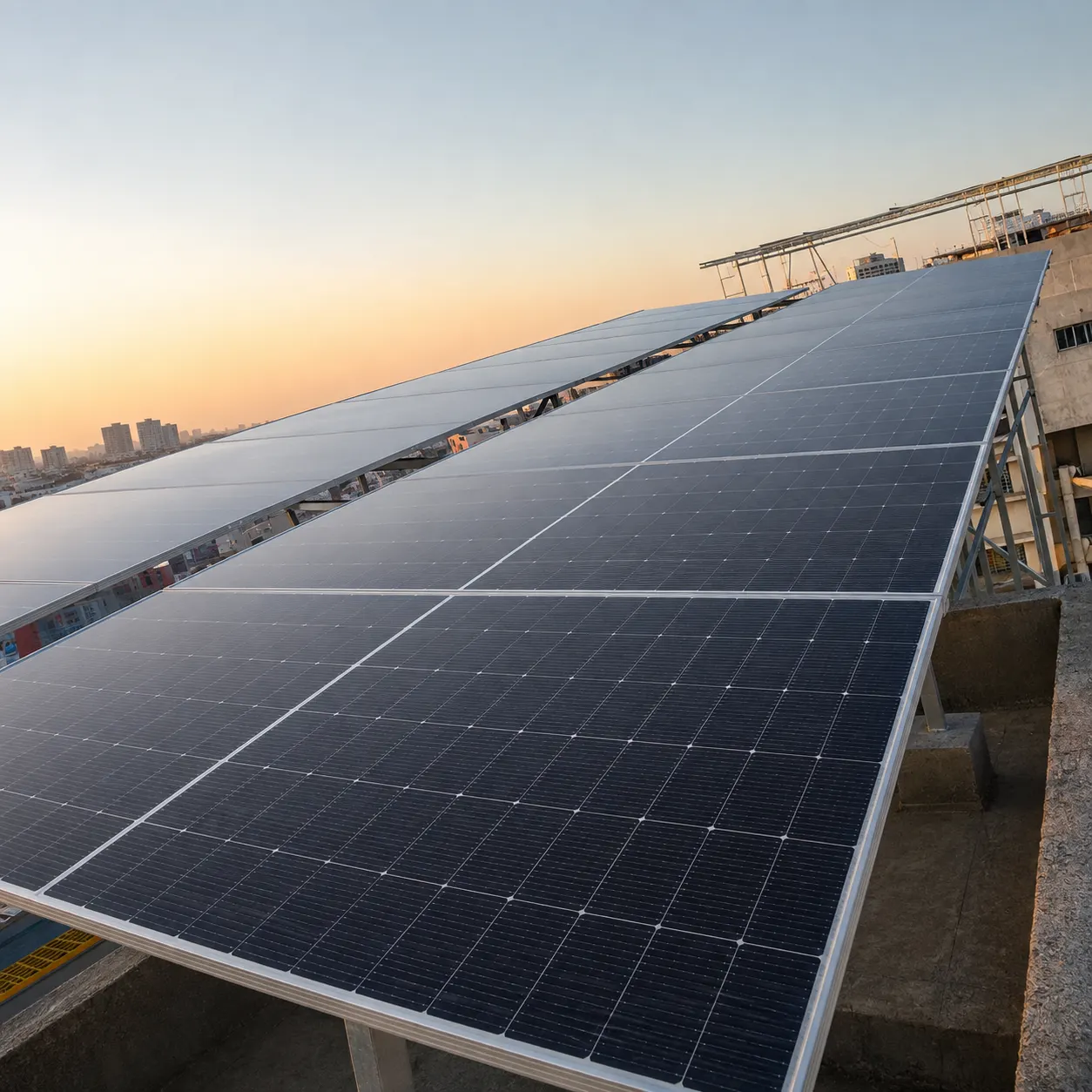
The maximum rooftop solar size on a bill is rarely just a roof-area calculation. The connection’s sanctioned load or contract demand can cap the system, but the percentage and exceptions differ between Gujarat, Maharashtra and Madhya Pradesh. A larger array may also need a load change, a different settlement method or network work. This guide shows how to find the binding limit before asking an EPC for a system size.
Direct answer. Solar capacity depends on the state, arrangement, approved connection and network. Gujarat’s 2022 amendment replaced the old 50% screen; a further DRES regulation was published on 30 October 2026 with commencement tied to Gazette notification. Maharashtra now limits net metering to the lower of 5 MW and sanctioned load/contract demand. MP retains a 500 kW net-metering ceiling plus its own load check. Confirm the applicable instrument before sizing.
What do sanctioned load and contract demand mean on a solar application?
Sanctioned load is the electrical capacity the distribution company has approved for the connection, often stated in kilowatts (kW). Contract demand is the demand the consumer has agreed to draw under the supply contract, often expressed in kilovolt-amperes (kVA) for a larger business. The terms can overlap in regulations, but the units and billing consequences differ. Read the exact field on the bill and the signed agreement. The sanctioned load glossary and contract demand glossary explain the bill labels.
The checklist checks (1) the consumer’s statutory limit, (2) the distribution network’s available capacity, and (3) the useful roof and daytime load. The lowest binding ceiling usually controls the design. A regulation may allow a size that the local transformer cannot take. A roof may hold a plant that exports too much energy to make sense. An EPC should show all three ceilings, not just one.
Start with the connection number, tariff category, ownership and intended metering arrangement. Those facts determine which published provisions apply. Do not apply an old manufacturing-MSME exception or a residential rule to every new factory application.
| Document | Field to copy | Why it matters |
|---|---|---|
| Latest bill | Sanctioned load, contract demand and tariff category | Starting point for the rule |
| Connection agreement | Approved demand and supply voltage | Confirms the legal service |
| Roof survey | Usable area, shade and structure | Physical capacity ceiling |
| Interval load record | Daytime use and export risk | Economic capacity ceiling |
Do not convert kVA to kW without stating a power-factor assumption. Some state rules name the applicable units directly. If a regulation compares solar capacity against contract demand, ask the EPC how the DISCOM treats AC inverter capacity and DC module capacity for that application. The proposed size should use the same basis as the form and approval.
How do Gujarat’s published rooftop limits differ?
Gujarat rule update, 30 October 2026. GERC has published DRES Regulations, Notification 11 of 2026, signed on 30 October 2026. Clause 1.2 makes commencement depend on notification in the Official Gazette. Confirm that commencement and the rules applicable to this application with the DISCOM before committing to a size or export value. Do not assume an existing agreement has automatically changed. The 2022 Third Amendment had already replaced the older 50% capacity screen and the 2020 settlement clauses.
Under the published 2026 DRES Regulations, clauses 8.2 and 8.3 allow all consumer categories to use net metering or net billing from 1 kW AC to 1,000 kW AC / 1,250 kWp DC. For a consumer with contract demand above 100 kW installing capacity beyond that demand, the excess requires BESS covering at least half the excess capacity for at least two hours per charging/discharging cycle per day. Supply voltage, network feasibility and approval remain separate checks. These are published provisions whose Gazette commencement must be confirmed for a live application.
The 2022 predecessor replaced Regulation 6.2. It allowed net metering from 1 to 1,000 kW and gross metering above 10 to 1,000 kW; its consumer-capacity conditions depended on residential, captive, third-party, REC or RPO use. It did not retain the blanket non-MSME 50% screen from 2020. This history matters when reviewing an existing approval.
The published 2026 DRES regulation, clause 9.1.5, allows non-residential net-metering export set-off only up to 30% of grid imports in the billing cycle, with applicable banking charges; exports beyond that limit lapse. Residential consumers have full billing-cycle set-off without banking charges, and remaining surplus is purchased at ₹2.25/kWh or a later rate specified by GERC. Clause 9.1.7 limits off-peak exports to off-peak imports, while peak exports can offset either slot. Verify commencement and the account’s applicable agreement before using these terms.
Ask the EPC for a capacity worksheet showing the rule applicable to the submission date, AC and DC ratings, supply voltage, demand, network feasibility and any BESS requirement. A ratio alone cannot establish the right project size.
What are the current Maharashtra and MP capacity screens?
Maharashtra’s 2023 First Amendment, replacing Regulation 2.1(j), limits net-metering capacity to 5 MW or contract demand/sanctioned load, whichever is lower. Other arrangements are limited to contract demand/sanctioned load. The 2024 Second Amendment adds virtual net metering and revises feasibility provisions. Use both amendments with the 2019 principal regulation.
Madhya Pradesh’s RG-39(II) rooftop regulations notified 14 March 2024 permit net metering for eligible consumers in all categories up to 500 kW, subject to sanctioned load or contract demand and other conditions. The First Amendment notified 18 June 2026 changes process provisions for PM Surya Ghar applications, including the separate agreement and certain fees; it does not itself create a new 500 kW sizing entitlement. Read both documents together for a current MP application.
The three states have different arrangement ceilings and connection conditions. A state-wide maximum is not an approved size for a particular meter. Keep the operative date, AC/DC basis, demand and technical-feasibility result on the same worksheet.
| State | First rooftop capacity check | Further condition |
|---|---|---|
| Gujarat, DRES publication dated 30 October 2026 | Net metering/net billing up to 1,000 kW AC / 1,250 kWp DC | Confirm Gazette commencement; check demand-related BESS and feasibility conditions |
| Maharashtra, 2023 amendment | Lower of 5 MW and sanctioned load/contract demand for net metering | Arrangement and feasibility |
| MP, 2024 regulation with June 2026 amendment | Net metering up to 500 kW | Own sanctioned load/contract demand and feasibility |
Use this table as a screening tool, not a final permission letter. An application can be changed by the licensee’s technical feasibility assessment, the connection agreement or a later regulator order. Ask the EPC to cite the current clause and to keep the approved system size in the project file.
What if the desired system is bigger than the approved load?
First identify which ceiling is binding. A load extension can address a sanctioned-load or contract-demand mismatch, but it cannot create more usable roof or daytime consumption. It may also change the connection voltage, tariff category, meter and protection design. The state supply codes should be checked before assuming that a small extension leaves every other condition untouched.
Gujarat’s Supply Code consolidated through September 2024 normally provides 400 V three-phase supply up to 100 kVA or kW, with an option up to 150. Maharashtra’s MERC Supply Code, 2021 uses an ordinary LT screen of 160 kW or 200 kVA. MP’s Supply Code updated through 28 March 2025 normally allows 400 V supply up to 150 kW under its conditions. These are voltage screens, not solar-size approvals.
Ask the distribution company for the load-extension process and estimate before changing the solar proposal. Common cost drivers include the service line, distribution transformer capacity, new meter or current transformers, switchgear, protection changes and deposits. The actual amount depends on the site and licensee. Avoid a proposal that assumes a load increase with no budget line or application owner.
There are alternatives. A smaller array may better match the current connection and daytime demand. Gujarat’s published DRES instrument includes a demand-related BESS condition for covered consumers exceeding their demand. An off-site supply route may be appropriate for a factory with a small roof, but it requires separate approvals and charges. The HT versus LT solar guide explains when a voltage change deserves a full factory study.
Keep the original and proposed load figures side by side in the application pack. If a quotation assumes the extension will be approved, mark the panel order and installation schedule as conditional. A failed load application can change the permitted plant size and the electrical design.
Check the approved load before buying panels. Send your latest bill, roof details and intended equipment expansion through commercial solar. Ask for the capacity screen, load-extension dependency and export treatment in the written proposal.
- ✓ Bill, roof and DISCOM cap agree.
- ✗ Sales layout exceeds the approved load or roof.
How does the same sizing question look for a home and a factory?
These two examples are illustrative and hypothetical as of 30 October 2026. They are not customer cases, prices or approvals. Their purpose is to show the calculation sequence. The final system size depends on the current regulation, technical feasibility, roof design and the specific consumer’s bill.
For a home in MP, assume a 3 kW sanctioned load and an intended 4 kW rooftop plant. MPERC’s 2024 rooftop regulation requires a capacity check against sanctioned load. The first screen therefore flags a 1 kW mismatch. The owner should ask the DISCOM whether the sanctioned load can be increased and what the current process requires. The 2026 MPERC amendment changes selected PM Surya Ghar application steps, but it is not a reason to ignore the load record. The sanctioned-load mismatch guide covers that household problem in detail.
For a Gujarat factory, assume 120 kVA contract demand and a desired 70 kW rooftop plant. Do not reject it by halving 120 to create an obsolete 60 kW limit. Confirm the applicable regulation, how the licensee compares kVA demand with AC and DC capacities, voltage, network capacity and approved size. This example identifies documents to check; it does not grant approval.
| Hypothetical item | MP home | Gujarat factory |
|---|---|---|
| Approved load or demand | 3 kW sanctioned load | 120 kVA contract demand |
| Desired solar size | 4 kW | 70 kW |
| Initial regulatory screen | Desired size exceeds approved load | No automatic 50% rejection; confirm applicable rule |
| First action | Check load update with DISCOM | Obtain current capacity and feasibility decision |
| Final permission | Subject to roof, network and approval | Subject to category, network and approval |
The home and factory should not use the same CTA or application assumptions. A home owner can review residential solar; a business buyer should use commercial solar. Neither should choose a size solely from a rule of thumb about monthly electricity spend.
How should you apply for a load increase or revised solar capacity?
Begin with the current bill and signed connection terms. The applicant should identify the exact sanctioned load or contract demand, requested new figure, supply voltage and proposed solar AC and DC capacities. A sketch of the electrical connection and roof layout helps the licensee and EPC discuss the same project. If the roof system already has an approval, ask whether the revised capacity needs a fresh or amended solar application.
Use the following sequence as a planning checklist. State and licensee portals can arrange the steps differently, so follow the current official form:
- Confirm the existing meter, tariff category and approved load on the latest bill.
- Ask the EPC to calculate the state and category-specific rooftop screen.
- Check roof area, shade, structure and daytime demand for the desired plant.
- Request a load-extension estimate or technical feasibility review if the load screen binds.
- Record the service, meter, transformer, protection and deposit implications.
- Update the solar design and proposed settlement method after the load decision.
- Submit the rooftop application with matching load and equipment details.
- Keep the written approval and commissioned capacity with the connection records.
Gujarat’s 2024 rooftop amendment activity chart shows why the technical feasibility report needs the tariff, load, feeder and transformer information. Maharashtra’s 2019 rooftop regulation expressly treats the distribution transformer’s used capacity as a constraint. These are reasons to submit a complete, consistent application. A roof quote alone cannot secure the grid capacity.
If the DISCOM approves a smaller capacity than requested, revise the layout and commercial model before signing the final equipment schedule. The change can affect inverter selection, generation and export. Keep the revised approval with the commissioning records so future expansion starts from the installed baseline.
Application check
Make the load on the solar form match the approved connection record. If the load is being revised, mark the solar design as conditional until the DISCOM confirms it.
What should a business ask an EPC before accepting the size?
Ask for a one-page capacity worksheet that cites the applicable state regulation and date. It should name the consumer category, sanctioned load or contract demand, allowed ratio or ceiling, proposed DC module capacity, AC inverter capacity, distribution transformer check and assumed settlement route. The home system-size guide shows why consumption matters; a business proposal should additionally model working hours and export value.
The EPC should distinguish three statements: “physically fits,” “permitted by the rule,” and “economically useful.” A roof can physically fit more panels than the connection permits. A permitted plant may generate much of its output on weekends when the business has little load. A smaller plant may be a sounder first stage if the factory expects a future expansion or a tariff-category change. Ask for at least a base case and a lower daytime-use case.
Check who owns the load-extension application and any network strengthening estimate. A proposal should state whether those items are included, provisional or excluded. It should also say when the plant design becomes final: before or after the DISCOM confirms the connection and meter route. A vague “subject to approvals” note leaves the buyer unable to compare two bids. The industrial solar installation guide lays out the later engineering and commissioning work.
- ✓ Bill and approved load matched
- ✓ State clause and category cited
- ✓ Roof and daytime use checked
- ✗ Capacity comes only from roof area
- ✗ Load extension has no owner
- ✗ Export is valued as full self-use
For a larger factory, the Heaven Designs electrical and CEIG drawing service shows the type of engineering drawings that may sit behind the electrical approval. That reference does not establish your permissible rooftop capacity. The regulator clause and the licensee’s approval do.
How Heaven Green Energy can help with a sizing proposal
For a business or factory proposal, start with the connection number, last several bills, sanctioned load or contract demand, roof photographs and working hours. The proposal should show the checklist: rule, network and useful roof and load. If one ceiling is uncertain, label it as an approval dependency rather than replacing it with an optimistic figure.
For Gujarat, ask which consumer category is used under GERC’s 2020 amendment and whether 15-minute settlement could apply. For Maharashtra, ask how the proposed capacity relates to sanctioned load or contract demand and the transformer limit. For MP, ask for the 2024 rule and the 18 June 2026 process amendment to be read together. These are not interchangeable state templates.
Home owners who find a bill mismatch can use the sanctioned-load mismatch guide and then review residential solar. A shop, school, warehouse or office should send its connection and daytime-use details through commercial solar. An HT factory with a larger electrical plan can also review industrial solar. Each route needs a proposal tied to its own meter and tariff.
Ask the proposer to show a smaller and larger option when the roof and connection allow it. The smaller option can be tested against current daytime use. The larger option should show the expected export, any load revision and the approval dependencies. Keep those figures on separate lines so the owner can decide which assumptions to accept. If the factory is planning new machinery, show its future load as a scenario rather than treating it as present consumption.
Request a business capacity check. Share the approved load, bills and roof details through commercial solar. Ask which state rule limits the plant, whether load extension is needed and how exports would be settled.
The solar capacity limit linked to sanctioned load is one part of a usable design. Confirm it in writing before equipment is ordered, then size the system to the actual roof and consumption pattern.
Frequently asked questions
Can solar exceed sanctioned load?
It depends on the state and metering arrangement. Gujarat’s published 2026 instrument includes conditions for capacity beyond demand, including BESS for covered consumers. Maharashtra net metering is limited to the lower of 5 MW and sanctioned load/contract demand. MP requires its own load and 500 kW checks.
Does Gujarat use a 50% limit for every business?
No. The 2022 Third Amendment replaced the older provisions. GERC published another DRES regulation on 30 October 2026; check its Gazette commencement and the instrument governing the account before sizing.
What is Maharashtra’s current published net-metering limit?
The 2023 amendment sets 5 MW or contract demand/sanctioned load, whichever is lower. Network and approved-arrangement conditions still apply.
What does MP’s June 2026 amendment change?
It changes selected PM Surya Ghar application provisions. It does not remove the principal regulation’s sanctioned-load/contract-demand check or create a new 500 kW entitlement for every connection.
Does a larger roof justify a load increase?
A roof’s physical capacity is only one input. Compare matching consumption, export treatment, voltage, network work and resulting bill charges before requesting a load increase.
What should a capacity worksheet show?
State and licensee, applicable regulation and date, consumer category, sanctioned load or demand with units, proposed AC and DC capacity, roof assessment, network feasibility, settlement and any BESS requirement.