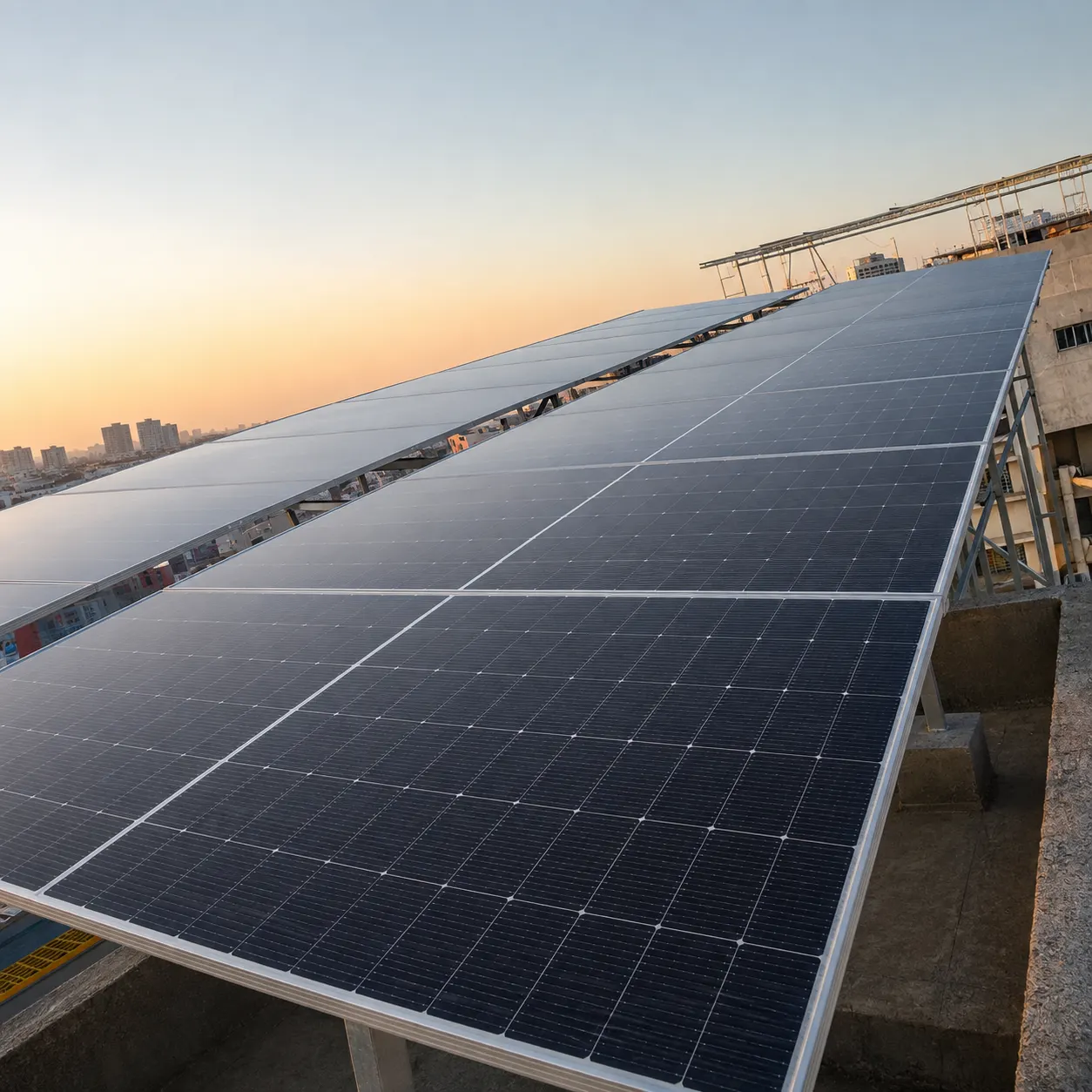
A ₹1 lakh monthly electricity bill does not identify a rooftop size. The bill may contain demand charges, fixed charges, taxes, time-of-day adjustments and reactive-energy charges as well as energy units. Two businesses paying the same amount can use very different kWh and have very different daytime loads. The first useful step is to recover the imported units and the hourly load shape from the bill and meter.
Direct answer. To size solar from a business bill, separate the energy-charge component from fixed, demand and tax lines. Use the applicable tariff to understand imported units, then compare those units with daytime consumption. Check shadow-free roof area, sanctioned load or contract demand, and export settlement before choosing a plant capacity. A rupee-to-kW thumb rule can oversize a shop with little daytime demand or undersize a factory with long production shifts.
Why does a ₹50,000 or ₹1 lakh bill not imply one solar size?
For a Gujarat net-metering proposal, also check the DRES instrument signed 30 October 2026. Its published non-residential rule caps exported-energy set-off at 30% of grid imports in the billing cycle, with applicable banking charges and lapse of exports beyond the cap. This can change the value of low-load-day surplus. Gazette commencement and the terms governing the account must be confirmed with the DISCOM; direct on-site use is a separate quantity.
The headline amount is a sum of different charges. A business might pay a large share for imported energy, or it might pay substantial demand charges while consuming fewer units. A seasonal factory’s bill can vary with production even if its approved contract demand stays fixed. A shop with air conditioning from noon to evening has a different overlap with solar than a workshop that runs only after sunset. The sanctioned-load glossary and contract-demand glossary explain two limits that a bill total alone does not reveal.
Start by locating the billing unit. A Gujarat LTMD bill may show kWh and separate reactive-energy lines. A qualifying Maharashtra business may be billed in kVAh. A utility may also show several time-of-day registers. If the bill is in kVAh, dividing the amount by a kWh rate produces the wrong unit count. The kVAh billing after solar guide explains that distinction. Even on a kWh bill, the fixed and demand components should be kept out of the energy-unit division.
The GERC DGVCL tariff order 2581/2025 dated 25 March 2026 illustrates the problem. Its LTMD schedule lists a post-paid energy charge of 460 paise per unit, but it also has demand, time-of-use and reactive-energy lines. A DGVCL Non-RGP consumer has another category schedule. Therefore, a ₹50,000 total should not simply be divided by ₹4.60 and labelled monthly units. The actual bill already states the imported units; use that number first.
The checklist has five rungs: tariff and billing unit, imported energy, daytime load, roof and connection limit, then export value. A plant size should be proposed only after each rung is checked. This method lets a buyer see why a quote differs from a calculator result without relying on an EPC’s private rule of thumb.
A business owner can prepare the first rung without an engineering survey. Collect twelve bills, note the tariff code and energy units, mark the highest and lowest production months, and obtain interval data from the meter if available. The solar calculator can frame an early discussion, but a signed proposal should use the business’s actual tariff and load data.
How do you convert a business bill into usable units?
When the bill already prints imported kWh or kVAh, read that register directly. If only a summary is available, reconstruct the energy component from the detailed bill before using a tariff rate. Separate fixed or demand charges, fuel adjustments, duties, taxes and any arrears. Then check whether the tariff’s energy charge is a flat rate, a slab, a time-of-day schedule or an apparent-energy rate. The electricity bill slabs guide shows why one average rate may hide the structure.
For a hypothetical DGVCL LTMD example, suppose a monthly total is ₹50,000 and an itemised bill shows ₹37,500 of base post-paid energy charges. At the 460 paise per kWh rate in the GERC DGVCL order of 25 March 2026, that base line corresponds to about 8,152 kWh. The remaining ₹12,500 is only an assumed bundle of other charges for this teaching example. It is not a typical DGVCL bill composition or a Heaven Green customer result.
If the bill instead shows 8,600 kWh, use 8,600 as the factual imported-unit reading and investigate why the simple calculation differs. The difference could come from ToU, fuel adjustment, reactive charges, the category, prepaid status or an incorrect assumed split. Do not force the bill to match a shortcut. A proposal should show the exact lines it has used, including any demand charge that will remain after solar.
Imported units are still not the full load. A rooftop system can serve some energy before it reaches the import meter. For a site that already has solar, add measured generation and export to reconstruct gross consumption. For a site without solar, use interval imports as a proxy for its load. Note closed days, planned expansion and seasonal changes. The goal is a twelve-month demand picture, not a single bill converted to a large round kW number.
The DGVCL 2026 LTMD schedule is useful for this example because it makes the energy line and other charge categories visible. It is not a tariff for every Gujarat business. A Maharashtra or MP buyer should use the current order for its own licensee and meter category before applying the same method.
Watch out
Do not divide the whole bill by one energy rate. Separate demand, duty and fuel-adjustment lines first.
How much daytime consumption can the roof actually offset?
A grid-connected rooftop plant produces during daylight, with its strongest output usually around the middle of the day. A business that operates from morning to evening can consume much of that output directly. A plant whose main production starts at night may export more at noon and still import heavily after sunset. The difference is visible in an interval load curve. Annual kWh alone cannot show it.
The first sizing target is often the site’s dependable daytime load, not its highest instantaneous load. Plot the lowest normal operating-day demand between roughly 9 a.m. and 4 p.m. for each season. Compare it with a proposed solar output curve. If the proposed plant exceeds load for many hours, calculate the resulting exports under the current settlement rule. If the site is planning new daytime machinery, include a separately documented future case rather than treating it as already installed.
A hypothetical workshop may import 80 kW from 10 a.m. to 4 p.m. on production days but only 15 kW on Sundays. A 70 kW rooftop plant could have strong weekday self-consumption and substantial Sunday exports. That does not automatically make it too large, but the export value and settlement period become decisive. A shop with a ₹1 lakh bill driven by evening air conditioning could need a different answer despite the same monthly amount. These figures are illustrative load profiles, not customer cases.
The MNRE National Portal rooftop FAQ, 2024 describes grid-connected rooftop components and cautions that roof area varies with module efficiency and placement. It does not replace a site-specific hourly production model. The home system-size guide explains the household method; a business needs the added daytime production and tariff checks described here.
Verdict. If the business uses most power during solar hours, a larger self-consumed plant may fit. If load is low on weekends or after a seasonal shutdown, export economics can set the practical size before roof area does.
| Sizing input | Source to check | Why it matters |
|---|---|---|
| Energy units | Complete electricity bill | Separates energy from fixed charges |
| Daytime use | Interval meter or shift log | Sets direct-use opportunity |
| Roof and connection | Site survey and sanctioned load | Caps a buildable rooftop design |
This checklist keeps the illustrative bill table separate from site-specific evidence.
What does a four-bill sizing table show?
The table below is deliberately an illustrative screening exercise, not a recommended size or a price list. It uses the GERC DGVCL LTMD post-paid base energy rate of 460 paise per kWh in order 2581/2025, dated 25 March 2026. It assumes 75% of each total bill is the base energy-charge line, 60% of the resulting monthly units can be served during useful solar hours, and a planning yield of 120 kWh per kW per month. The 75%, 60% and yield are hypothetical assumptions, not tariff facts, a government benchmark or a savings promise.
| Hypothetical monthly bill | Assumed base energy-charge line | Approximate imported kWh from that line | Assumed daytime target, 60% | Screening plant size at 120 kWh/kW-month |
|---|---|---|---|---|
| ₹25,000 | ₹18,750 | 4,076 kWh | 2,446 kWh | About 20 kW |
| ₹50,000 | ₹37,500 | 8,152 kWh | 4,891 kWh | About 41 kW |
| ₹1,00,000 | ₹75,000 | 16,304 kWh | 9,783 kWh | About 82 kW |
| ₹2,00,000 | ₹1,50,000 | 32,609 kWh | 19,565 kWh | About 163 kW |
The arithmetic is bill × 75% ÷ ₹4.60 for imported kWh, then kWh × 60% ÷ 120 for screening kW. Actual bills may have different energy shares or tariffs. A monthly plant yield is highly seasonal and site-specific. For a real size estimate, enter the bill’s actual imported units, measured daytime load and site-specific monthly generation. The rupee rows show the arithmetic only. It exists to show the method and the size of the error a rupee-only shortcut can create.
The MNRE National Portal rooftop FAQ, 2024 gives a general roof-area planning figure of about 10 square metres of shadow-free area per 1 kWp, with a warning that real area varies. At that preliminary figure, the table’s 20, 41, 82 and 163 kW sizes would imply about 200, 410, 820 and 1,630 square metres respectively. Those area figures are calculated from the FAQ’s general ratio, not surveyed roof requirements. Access aisles, obstructions, tilt, fire safety and structural design can change them.
Before using any row, check whether the site’s sanctioned load or contract demand limits solar capacity. A business with a large bill and small approved load may need a load update or a different configuration. The regulator’s rooftop rules and the DISCOM’s technical feasibility response set the permitted route, not a table based on money spent.
Screening only
The table's 75% bill split, 60% daytime share and 120 kWh monthly yield are explicit hypothetical inputs. Replace all three with measured data before requesting a final plant size.
- ✓ Energy share, day load and roof are checked.
- ✗ Monthly bill is converted directly into panel kW.
How much shadow-free roof area and electrical capacity are available?
Roof area is not just the rectangle drawn on a plan. Exclude water tanks, skylights, vents, equipment pads, unsafe edges, maintenance paths and shaded zones. A structural engineer should check the roof’s condition and mounting loads. The MNRE rooftop FAQ, 2024 uses 10 square metres per 1 kWp as a general planning figure and says actual area varies with module efficiency and placement. Treat it as a first screen, not a construction drawing.
A factory’s roof may be wide but structurally unsuitable for the proposed array without repair or reinforcement. A dense market building may have excellent daytime AC load but shared roof rights. A shop in a rented unit may need landlord consent before it can install on the terrace. The roof-strength guide and solar for tenants guide explain those constraints. They can change the feasible size even when the energy model points to a larger plant.
The electrical cap is a separate check. Gujarat, Maharashtra and MP rooftop rules use sanctioned load or contract demand with category-specific limits. The capacity-limit guide compares the three states. An EPC must confirm the consumer’s approved load, the applicable rooftop regulation, feeder or transformer feasibility, and whether an extension application is needed. A high monthly bill does not automatically grant a high rooftop export capacity.
Space around inverters and switchboards also matters. A cramped electrical room can require a different routing plan. Cable runs, earthing points, fire access and the location of the DISCOM meter affect cost and schedule. These are physical checks, not reasons to multiply a bill by an arbitrary number. Ask the EPC for a roof layout and single-line diagram that match the proposed kW and the electrical connection.
If roof space is the binding limit, compare rooftop self-consumption with other approved options such as a carport or an off-site open-access arrangement where eligible. Do not assume spare land within a factory compound uses the same approval route as a remote solar park. The industrial solar page is a relevant route for a larger site with multiple electrical options.
Why do export caps and settlement rules matter for businesses?
A plant that generates more than the business uses in a sunny hour exports the surplus if its approved meter and interconnection allow it. The exported unit may receive a credit or purchase value different from the avoided import charge. Settlement periods, carry-forward rules and category restrictions vary by state. That is why the rooftop size should be tested against low-load days, not only a busy weekday.
The GERC rooftop regulations and amendments distinguish consumer categories and capacity conditions. The MERC rooftop regulations, 2019 set Maharashtra’s net-metering and settlement framework. The MPERC rooftop regulation and 2026 amendment govern the MP application route. These are separate from the import tariff used in a bill-to-size screening table. Ask the EPC to cite the export rule for the actual licensee.
An illustrative shop is closed every Sunday but has a 100 kW rooftop plant. The plant can still generate on Sundays, when the building’s load may be small. If export receives less value than self-consumption or is constrained by the approved arrangement, those units may contribute less to the business case. A smaller plant or a shift in flexible weekday load might improve the balance. The conclusion depends on the actual tariff and contract, so a proposal should show both high and low self-consumption cases.
The same issue appears for seasonal factories. A solar plant sized for the busiest month may export heavily in a slow season. The owner should request a month-by-month import and export table, with the settlement period named. A single annual “units generated” number hides the timing. The solar ROI guide can help audit the financial logic, but business export and demand charges need their own lines.
A bill-to-size discussion should therefore end with a capacity range, not a single figure, until the roof, load profile and export approval are verified. The final kW may be lower than the number derived from annual kWh, even when the roof can physically hold more modules.
How Heaven Green Energy helps size Business Solar
Send twelve months of itemised bills, the tariff code, sanctioned load or contract demand, meter number and an interval load export if available. Add production hours, closed days, planned equipment and a roof plan or photographs. Note roof ownership and whether an existing solar system already operates on the meter. These inputs let the EPC estimate the solar overlap and identify the approvals needed before drawing a plant layout.
Ask the EPC to show the checklist in the proposal. The first page should state actual monthly units and bill components, not a made-up effective rate. The second should show daytime load and annual solar output by month. The third should show the physical roof plan and regulated capacity cap. The fourth should separate self-consumed and exported units. The financial page should retain demand, fixed and other charges that remain after solar.
- Verify the tariff code and billing unit on the current bill.
- Gather a full operating cycle of bills and any interval meter data.
- Mark weekday, weekend and seasonal daytime load.
- Check roof area, structure and connection capacity.
- Model self-consumption and export under the approved state rule.
- Compare at least two feasible plant sizes before signing.
The commercial solar page is the route for a shop, office or medium-sized business. A factory with an HT connection can use industrial solar. The solar calculator is useful for an early conversation, but the proposal should replace its assumptions with site data. Heaven Green Energy should be asked the same questions as any other EPC: which tariff, which load profile, which roof and which export rule support the proposed size?
- Itemised annual bills
- Interval daytime load
- Roof plan and ownership
- Approved load or CD
- Bill total divided by one flat rate
- No weekend or seasonal check
- Roof area assumed from satellite view
- Exports valued at retail without citation
The service routes for a site-specific review are:
- Commercial solar for a business bill and rooftop proposal.
- Industrial solar for a larger factory connection and protection review.
How should Maharashtra and MP buyers adapt this method?
Keep the five-rung sizing method, but replace every Gujarat tariff input with the applicable local order. The MERC MSEDCL review order in Case 75 of 2025, dated 25 March 2026 explains kVAh billing for HT consumers and LT consumers above 20 kW. If the business is in one of those categories, the billed apparent-energy units cannot be converted into solar kWh by dividing the total by a kWh price. The plant should obtain active and apparent energy registers, plus interval load data. Solar generation is active energy; the reactive share can change the meter-side ratio after installation.
The MPERC retail tariff order for FY 2026-27, dated 26 March 2026 did not approve the proposed HT kVAh transition for that year. An MP factory should use the current kWh tariff and its separate PF or demand provisions, then verify whether a later order changes the position. Treating an unapproved proposal as active billing would distort the unit count. The order’s time-of-day treatment can also make a daytime avoided unit worth something different from an evening import unit.
In both states, start with the consumer’s own bill. Note the licensee, category, billing period, energy register, demand line and any export credit. A Maharashtra shop on an LT category below the kVAh threshold has a different unit calculation from an HT factory. An MP industrial unit has a different tariff from a small commercial premise. The table above is a DGVCL LTMD arithmetic lesson, not a state-neutral sizing chart.
The physical questions are shared. Plot normal and low-load daytime demand, inspect the usable roof and check sanctioned load or contract demand against the state’s rooftop rule. Then compare two feasible plant capacities using the same generation and export assumptions. A contractor should show how each extra kilowatt changes self-consumption, export and grid import in every month. That marginal comparison is much more useful than finding one average rupees-per-unit figure and using it across three states.
Frequently asked questions
How much solar is needed for a ₹1 lakh monthly business bill?
There is no universal kW size. Separate the energy-charge line from demand, fixed, duty and other charges, then read actual imported units and daytime load. The article’s roughly 82 kW screening row depends on explicit hypothetical assumptions and a dated DGVCL LTMD base rate. It is not a recommendation. Roof, connection limit and export settlement can change the feasible size.
Can I divide my bill by the tariff’s per-unit rate?
Only after isolating the energy-charge component and confirming the correct billing unit, slab and time-of-day treatment. A total bill may include demand charges, reactive charges, taxes and arrears. If the meter is billed in kVAh, a kWh rate is the wrong denominator. The actual bill usually prints energy units, so use that register before reconstructing a unit count.
How much roof area does a commercial system need?
The MNRE National Portal rooftop FAQ gives about 10 square metres of shadow-free roof per 1 kWp as a general planning figure, while noting that actual area varies. A business must also allow for access, obstructions, shade, structural limits and electrical equipment. A roof survey and layout should replace the first screening number before a final proposal.
Does a large electricity bill allow a larger rooftop plant?
Not by itself. The regulator’s rooftop rules, approved sanctioned load or contract demand, connection category and DISCOM technical feasibility set capacity conditions. A bill can be high because of demand charges or an expensive tariff even when daytime energy use is modest. Check the connection record and the applicable state regulation before selecting a plant size.
Why might a smaller plant have a better business case?
A smaller plant may keep more generation within daytime self-consumption and reduce exports that settle at a different value. It may also fit the existing roof and approved connection without extra work. This is site-specific; a factory with a strong daytime base load can use a larger system effectively. Compare monthly imports and exports for at least two sizes.
What documents should I send for a commercial solar quote?
Send twelve itemised bills, tariff code, approved load or contract demand, interval meter export if available, operating hours, roof plan or photographs, and planned load changes. Note ownership or tenancy and any existing solar. Ask the EPC for a bill-component model, hourly overlap, roof layout and export settlement assumption rather than one rupee-to-kW thumb rule.