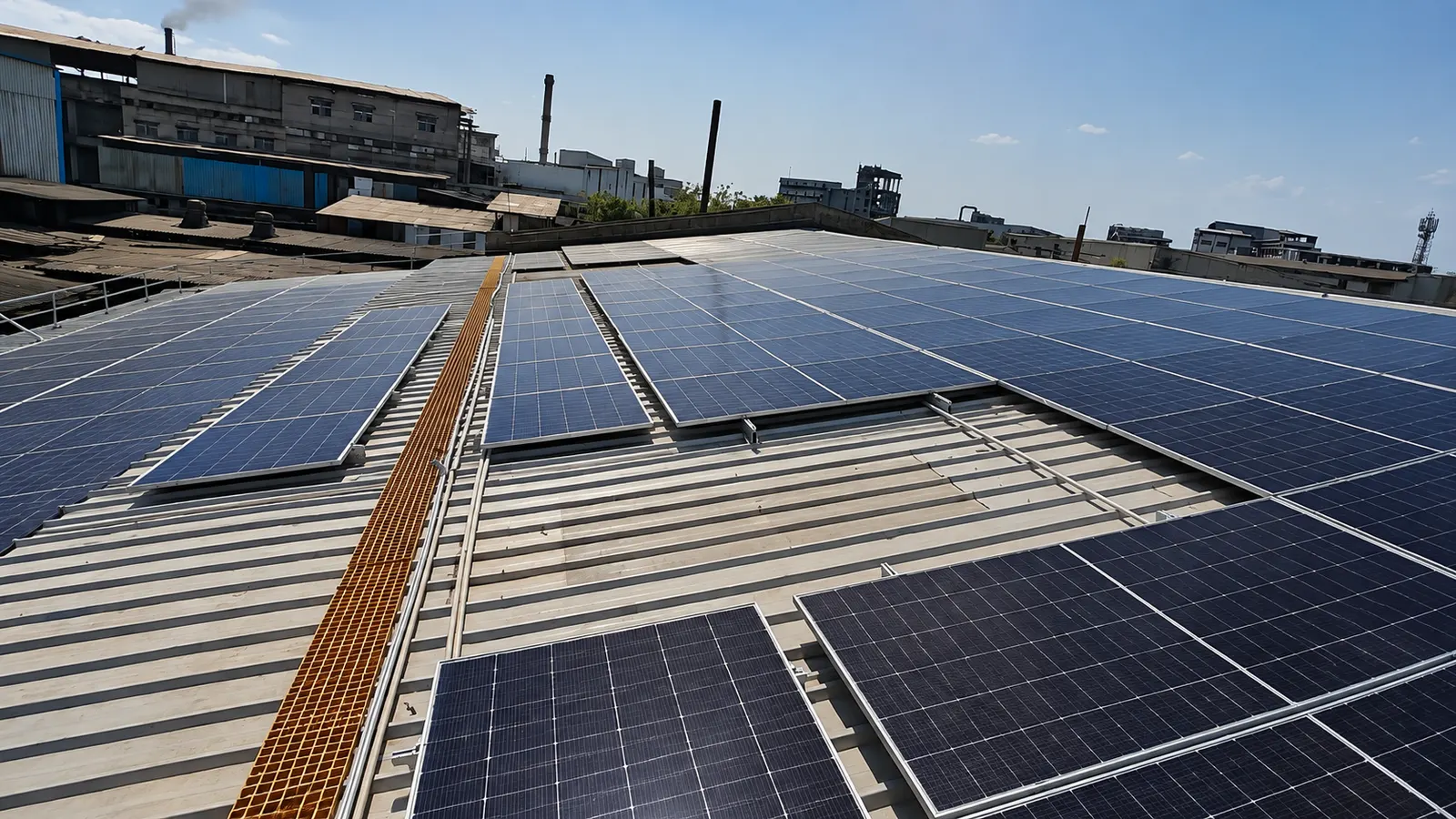
Direct answer. An HT or LT connection changes the factory’s metering, protection, approvals and bill model. The voltage threshold comes from the state supply code. Rooftop capacity follows separate solar rules. Check both before choosing a plant size. A larger roof alone is not a reason to move from LT to HT.
What does HT versus LT change for a solar buyer?
An LT consumer receives low-voltage supply, usually at the premises’ 400 V system for a larger three-phase business. An HT consumer receives supply at a higher voltage, often 11 kV, and uses a transformer to serve its low-voltage loads. The regulator’s supply code and the approved connection agreement determine the category. The HT versus LT glossary explains the electrical terms; this guide focuses on the solar decision.
Solar panels do not automatically require an HT connection. A plant can be connected to an LT bus at an HT site, with protection and metering arranged as approved by the distribution company. Maharashtra’s 2019 rooftop regulations, Regulation 6.4, expressly allow an HT consumer to connect the renewable system at its LT bus, provided the net meter is on the HT side of the consumer transformer. The arrangement matters because transformer losses and the point of measurement affect the energy account.
The checklist has four gates: supply voltage, permitted rooftop capacity, settlement method, and bill components. Passing one gate does not pass the others. A factory may have roof area for a 200 kW plant yet face a smaller capacity screen under its consumer category. Another may have an HT connection but need most generation on site during production hours because exports have a different value.
| Decision gate | LT connection | HT connection |
|---|---|---|
| Supply equipment | Low-voltage service and switchboard | HT incoming gear plus consumer transformer and LT distribution |
| Solar interface | Often at the LT board | Often at LT bus with approved HT-side metering or other approved scheme |
| Protection review | Inverter, isolation, earthing and LT coordination | Adds transformer, HT relay and interface coordination |
| Bill model | Energy and category-specific fixed or demand lines | Energy, contract demand, power factor and other HT lines may matter |
This table describes typical design questions, not a substitute for the licensee’s approved drawing. Ask the EPC to show the existing single line diagram, proposed inverter connection and settlement meter on one page. Do not infer the solar route from the label “industrial” on a bill. Some factories remain LT consumers, while commercial campuses can be HT consumers.
Where do Gujarat, Maharashtra and MP draw the LT and HT line?
The state supply code is the first document to read. In Gujarat, the GERC Supply Code consolidated through September 2024, Regulation 3.2, provides 400 V three-phase supply above 6 kW and up to 100 kVA or kW of contracted demand. It also allows an applicant or consumer to opt for LT supply up to 150 kVA or kW. Above the applicable 100 or 150 threshold, the normal route is 11 or 22 kV up to the code’s stated upper limit. Existing approved arrangements and network feasibility still require review.
Maharashtra’s MERC Supply Code, 2021, Regulation 3.2, generally places three-phase LT supply at a sanctioned load or contract demand not exceeding 160 kW or 200 kVA. It states a separate higher aggregate limit for multiple consumers in the same building or premises. Above the applicable LT limit, 11 kV is the next listed normal level. A factory should not borrow Gujarat’s 100 kVA shorthand for an MSEDCL connection.
Madhya Pradesh’s MPERC Supply Code, 2021, consolidated through 18 September 2026, Regulation 3.4, normally allows 400 V supply up to 150 kW under demand-based or sanctioned-load conditions stated there. The schedule lists 11 kV supply from 50 to 300 kVA and 33 kV from 100 to 10,000 kVA. Its ranges overlap; the code allows a technically feasible deviation with recorded reasons. Do not read an overlapping band as a universal right to choose a cheaper voltage.
| State and source date | Ordinary LT screen | First HT range relevant to many factories |
|---|---|---|
| Gujarat, GERC Supply Code consolidated September 2024 | Up to 100 kVA or kW, or up to 150 if opted | 11 or 22 kV above the applicable threshold |
| Maharashtra, MERC Supply Code 2021 | Up to 160 kW or 200 kVA for ordinary three-phase premises | 11 kV above the applicable LT limit |
| MP, MPERC Supply Code updated 18 September 2026 | 400 V up to 150 kW under the code’s conditions | 11 kV listed from 50 to 300 kVA |
Connection check
A kW limit and a kVA limit are not interchangeable without a power-factor assumption. Use the unit printed in the applicable code and on the sanctioned connection.
How much rooftop solar can each connection carry?
Gujarat rule update, 30 October 2026. GERC has published DRES Regulations, Notification 11 of 2026, signed on 30 October 2026. Clause 1.2 makes commencement depend on notification in the Official Gazette. Confirm that commencement and the rules applicable to this application with the DISCOM before committing to a size or export value. Do not assume an existing agreement has automatically changed. The 2022 Third Amendment had already replaced the older 50% capacity screen and the 2020 settlement clauses.
Under the published 2026 DRES Regulations, clauses 8.2 and 8.3 allow all consumer categories to use net metering or net billing from 1 kW AC to 1,000 kW AC / 1,250 kWp DC. For a consumer with contract demand above 100 kW installing capacity beyond that demand, the excess requires BESS covering at least half the excess capacity for at least two hours per charging/discharging cycle per day. Supply voltage, network feasibility and approval remain separate checks. These are published provisions whose Gazette commencement must be confirmed for a live application.
Before the new instrument commences, the 2022 amendment is the relevant published predecessor. It permits net-metered projects from 1 to 1,000 kW and replaces the old category-based 50% test. Its capacity and accounting conditions differ by ownership and route. Ask the licensee to identify the applicable instrument and clause rather than applying a 2020 manufacturing-MSME exception to a new quote.
Maharashtra’s 2023 First Amendment replaces the eligible-consumer definition: net-metering capacity is limited to 5 MW or the consumer’s contract demand/sanctioned load, whichever is lower. Other arrangements remain limited by contract demand/sanctioned load. Read the 2019 regulations with this amendment and the 2024 Second Amendment, which adds virtual net metering and changes feasibility provisions.
MP’s 2024 rooftop regulations, read with their June 2026 amendment, retain a 500 kW net-metering ceiling and the sanctioned-load/contract-demand check. A state-wide ceiling does not give every meter an entitlement to that size.
| State | Published size check | Connection check |
|---|---|---|
| Gujarat, 2026 DRES publication | Net metering/net billing: 1-1,000 kW AC / up to 1,250 kWp DC | Confirm Gazette commencement; BESS condition above demand for covered consumers |
| Maharashtra, 2023 amendment | Net metering: lower of 5 MW and sanctioned load/contract demand | Current feasibility and approved interconnection |
| MP, 2024 regulation with 2026 amendment | Net metering up to 500 kW | Own sanctioned load/contract demand and network feasibility |
When do net metering, net billing and open access apply?
Net metering offsets eligible imports with exports under the state’s approved accounting rules. Net billing values imported and exported energy separately. Open access is a different route for electricity supplied from a generating plant through the network, often from land away from the consuming premises. The connection voltage is one input, not the sole determinant of which mechanism applies.
The published 2026 DRES regulation, clause 9.1.5, allows non-residential net-metering export set-off only up to 30% of grid imports in the billing cycle, with applicable banking charges; exports beyond that limit lapse. Residential consumers have full billing-cycle set-off without banking charges, and remaining surplus is purchased at ₹2.25/kWh or a later rate specified by GERC. Clause 9.1.7 limits off-peak exports to off-peak imports, while peak exports can offset either slot. Verify commencement and the account’s applicable agreement before using these terms.
Maharashtra’s 2023 amendment distinguishes net metering, surplus-based net billing and gross metering. Net billing first serves on-site consumption and purchases the surplus exported to the grid; gross metering accounts for total generation separately. MP uses its own net, gross, group and virtual metering provisions. Use the approved arrangement’s precise definition in the bill model.
For an off-site project in Gujarat, GERC’s Green Energy Open Access Regulations, 2024, Regulation 9, state a 100 kW contracted-demand or sanctioned-load eligibility threshold. They permit aggregation of multiple connections in the same distribution division and state that captive consumers do not face that load limit. Approvals, network feasibility and charges still apply. An LT consumer can therefore be eligible in principle if its documented load meets the rule; HT is not an automatic prerequisite. Check the corresponding state rules outside Gujarat.
| Question | On-site rooftop route | Off-site open access route |
|---|---|---|
| Where is generation? | At the consumer premises | At a separate plant supplying through the network |
| Main approval | Rooftop connectivity and metering | Open access plus plant and network approvals |
| Export or surplus | Rooftop regulation and agreement | Time-block open access energy accounting |
| Core cost screen | Self-use and rooftop export value | Generation price plus network charges and losses |
Compare the route with the actual bill. A factory evaluating LT, HT or off-site supply can share its connection agreement and recent bills through industrial solar. Ask for separate rooftop and open access calculations before deciding plant size.
- ✓ Bill and voltage route are verified first.
- ✗ Plant size is chosen before rooftop eligibility is checked.
What changes in metering, protection and electrical inspection?
An LT rooftop job needs an approved connection point, appropriate AC and DC isolation, earthing, surge protection, inverter grid controls, generation and import/export metering as required. An HT premises adds a consumer transformer, HT incoming switchgear and protection coordination that must be reflected in the single line diagram. The Central Electricity Authority’s 2023 safety regulations and its 2013 distributed-generation connectivity standards and 2019 amendment in the CEA compendium set the national safety and interface context.
The practical question is where the meter and protection operate. For an HT factory with a low-voltage solar inverter, the inverter may connect on the LT side while the approved net meter is on the HT side, as MERC Regulation 6.4 expressly states for Maharashtra. A Gujarat or MP design must follow its own approved arrangement. Ask the engineer to show the transformer, both sides of the main breaker, anti-islanding function, export control where required, and the isolation point accessible to the distribution company.
Electrical inspector approval is a separate safety gate. Do not assume that all LT plants are exempt or that every HT plant has the same paperwork. The required drawing approval and inspection depend on the state inspectorate’s applicable voltage, capacity and installation rules. Gujarat’s 2024 rooftop amendment activity chart lists Chief Electrical Inspector approval of the single line, earthing and wiring diagrams in its process. The EPC should identify whether that step applies to the specific plant and name who submits it. Maharashtra and MP require their own inspectorate check against CEA rules and state process.
For a factory, the protection schedule should be reviewable before equipment is ordered. Ask for relay settings, inverter certificate and earthing drawings, plus a test and commissioning plan. These details are not sales brochure items. The industrial installation guide places them in the broader EPC sequence, and the solar permit guide covers Gujarat’s other approvals.
Drawing request
Ask for one diagram that marks the solar tie-in, transformer, revenue meter, protection relays and each party's isolation boundary.
How do a 75 kVA LT and 300 kVA HT factory compare?
The following is an illustrative, hypothetical energy-only comparison dated 30 October 2026. It does not calculate permitted capacity from a percentage of contract demand. The chosen sizes require their own applicable-rule, AC/DC-capacity, voltage and feasibility checks. It is not a customer project, tariff quote or savings promise.
Assume the LT site has 75 kVA contract demand and a 30 kW proposed rooftop array. Assume the HT site has 300 kVA contract demand and a 120 kW proposed array. For this illustration only, each kW produces 120 units in a sample month, all of them are used on site, and the energy-charge component displaced is ₹8 per unit. No tariff order is asserted by that ₹8 assumption. Demand charges, fixed charges, taxes, power-factor effects, outages and export settlement are excluded.
| Hypothetical comparison | 75 kVA LT unit | 300 kVA HT unit |
|---|---|---|
| Selected rooftop capacity | 30 kW | 120 kW |
| Assumed monthly generation at 120 units per kW | 3,600 units | 14,400 units |
| Assumed on-site use | 3,600 units | 14,400 units |
| Illustrative energy-charge arithmetic at ₹8 per unit | ₹28,800 | ₹115,200 |
| Fixed, demand, taxes, export and other lines | Not calculated | Not calculated |
This example compares energy output from two different plant sizes. To choose LT or HT, compare the same production plan under each feasible connection route, including the transformer, switchgear, metering and recurring bill charges. The true value depends on the current tariff category and the time of use. Gujarat’s DGVCL FY 2026-27 tariff order dated 25 March 2026 shows why a buyer must model energy and demand components separately. In Maharashtra, read MERC’s MSEDCL tariff review order dated 25 March 2026 with the underlying approved schedule. In MP, use MPERC’s FY 2026-27 retail supply tariff order. Do not transfer a rate from one state or licensee to another.
Ask the EPC to replace each hypothetical input with bill evidence and an interval-load model. If the factory shuts at noon on weekends, the on-site-use assumption falls. If the roof is partly shaded, generation falls. If the contract demand stays unchanged, a solar plant may reduce purchased energy without reducing that demand-charge line. The comparison is useful because it shows which line to verify, not because either rupee figure predicts a bill.
When is moving an LT factory to HT worth considering?
Moving to HT can be worth studying when the planned process load exceeds the applicable LT supply-code band, the distribution company requires a higher-voltage connection, or a wider electrification plan already needs a dedicated transformer. It is rarely justified solely by the hope of installing more rooftop solar. The capacity and BESS conditions must be checked separately; the factory also takes on HT infrastructure and a different bill structure.
The decision should use the whole plant expansion plan. List existing peak demand, new machinery, starting currents, spare LT capacity, transformer and switchgear needs, roof constraints, outage tolerance and the useful daytime solar share. Ask the distribution company for a load extension or voltage-change estimate. Network strengthening, service line, transformer, metering and inspection costs depend on the actual site. Do not treat a quoted HT energy rate as the full landed rate.
Compare at least three cases: retain LT and size within its approved route; extend LT if the state code and network allow; or convert to HT for the combined production and solar plan. For each, model energy charges, fixed or demand charges, power factor, time-of-day terms, metering cost, protection and future expansion. The contract demand glossary explains why a lower energy bill does not automatically lower the contracted-demand line.
- ✓ New process load presses beyond LT limits
- ✓ Transformer work is already planned
- ✓ Demand and energy tariff model is complete
- ✗ Production load fits the approved band
- ✗ Extra roof capacity will mostly export
- ✗ HT equipment cost has not been priced
The answer can differ even between two factories with the same contract demand. A day-shift metal shop and a night-shift textile unit use solar at different times. A single-story shed and a dense multistory plant have different roof-to-load ratios. Compare the complete electrical plan and bill, then choose the connection route.
How Heaven Green Energy can support a factory proposal
Start with the electricity connection, not a panel count. Provide the recent bills, sanctioned load or contract demand record, site single line diagram, transformer information, roof drawings and shift schedule. Ask the EPC to identify the supply-code band and rooftop rule that apply to the exact consumer category. The proposal should label every assumption and give the relevant regulator document and date.
For a Gujarat factory, ask which published regulation and commencement date govern the application, whether a BESS condition applies and how exports are settled. For Maharashtra, confirm the 2023 and 2024 amendments and HT-side metering if solar connects to the LT bus. For MP, check the 500 kW ceiling against the actual connection. The captive solar versus third-party PPA guide introduces off-site choices.
The proposal should separate plant design from a possible load extension or HT conversion. Include the roof survey, protection design, inspectorate route, DISCOM application, meter position and testing responsibility. If a larger off-site project is being considered, request a separate open access landed-cost model rather than treating it as an oversize rooftop option. An engineering reference such as Heaven Designs’ electrical and CEIG drawing service shows the kinds of drawings a project may need; the actual EPC scope must say which are included.
- Industrial solar: Start a factory proposal with the bill, load and site documents.
- Commercial solar: Route a smaller business premises to the commercial solar service page.
Request a connection-specific factory proposal. Share the latest bills, contract demand and roof details through industrial solar. Ask the team to show the applicable LT or HT threshold, rooftop capacity screen, meter position and settlement method before fixing plant size.
Use the HT versus LT connection solar route that fits the production load, approved network and bill model. A larger theoretical rooftop limit is useful only if the plant can use or properly credit the energy.
Frequently asked questions
Can an LT factory install rooftop solar?
Yes, subject to the applicable consumer rules, approved capacity, network feasibility and electrical design. The supply-voltage threshold and solar-capacity ceiling are different checks. Obtain a written approved size before ordering equipment.
What is Maharashtra’s net-metering ceiling?
The 2023 MERC amendment limits net metering to 5 MW or the consumer’s contract demand/sanctioned load, whichever is lower. Feasibility and other applicable conditions still apply.
Does Gujarat still use a general 50% rooftop cap?
The 2022 Third Amendment replaced the older 50% provisions. GERC also published DRES Regulations dated 30 October 2026, with commencement tied to Gazette notification. Confirm the applicable instrument and account terms with the DISCOM.
Does solar require an HT connection?
The array’s size alone does not decide the supply voltage. Check the state supply code, approved load and interconnection scheme. An HT site may connect solar on an LT bus under an approved arrangement.
Will moving to HT reduce the total bill?
A lower energy rate alone cannot establish that. Include transformer and switchgear costs, losses, demand charges, protection, inspection and network work in the comparison.
Does ordinary on-grid solar provide backup?
It normally stops supplying during a grid outage. Backup requires a separately engineered source, islanding boundary and protection scheme. Confirm operating modes and testing before relying on continuity.