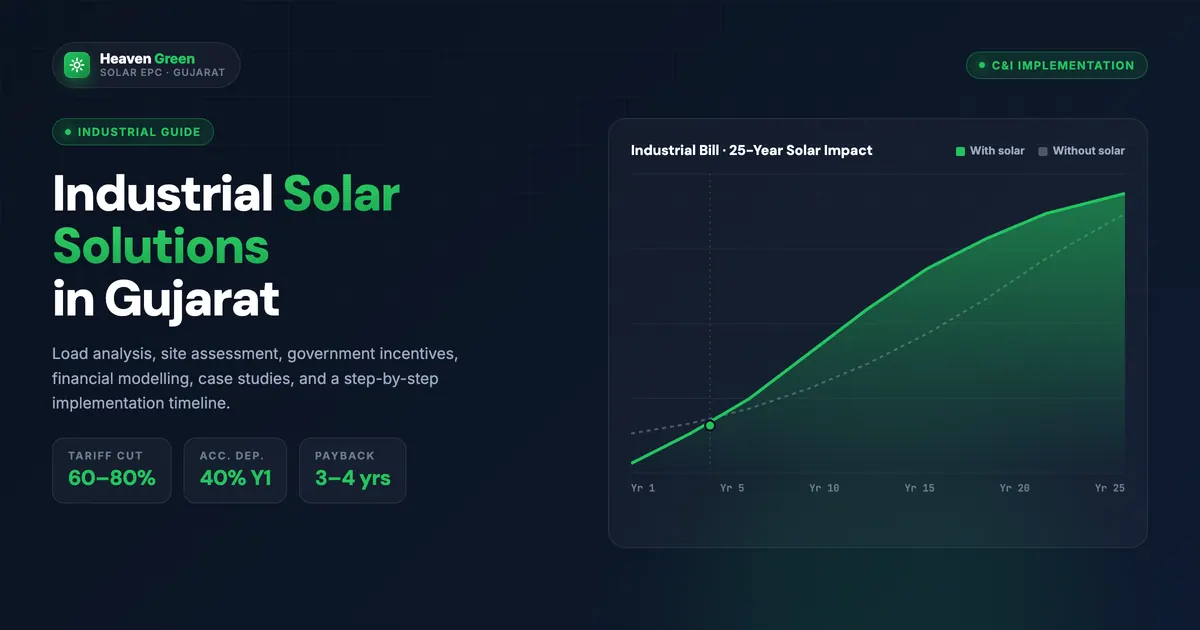
Solar for e-commerce warehouses is the fastest-growing corner of Indian commercial and industrial (C&I) solar in 2026, and the reason sits on top of every fulfillment center (FC): a pre-engineered building (PEB) shed roof of 2-5 lakh sqft with almost nothing on it. India’s warehousing stock has crossed 500 million sqft on industry estimates, and the operators filling it, Amazon, Flipkart, Delhivery, and hundreds of 3PL (third-party logistics) firms, pay HT (High Tension) industrial tariffs of ₹8-11 per kWh for power they mostly consume between 8 AM and 8 PM. A 1 MW rooftop plant on such a shed costs ₹3.7-4.1 crore and returns that capital in 3-4 years. Flipkart already runs roughly 30 MW of rooftop solar across 68 sites; Delhivery crossed 7 MW installed capacity in FY25. This is no longer a pilot technology for the sector.
Heaven Green Energy designs and builds megawatt-class rooftop solar on PEB sheds, logistics parks, and industrial roofs across Gujarat, Maharashtra, and Rajasthan. This guide is written for warehouse owners, logistics park developers, 3PL operators, and corporate sustainability heads evaluating a 500 kW-2 MW system: real 2026 costs, the leased-versus-owned building problem, the landlord-tenant split incentive, RE100 and net-zero pressure, and the payback math that decides board approval. For the sister asset class with similar economics, see our guide on solar for shopping malls and 2 MW systems.
Direct answer. A rooftop solar system of 500 kW-2 MW on an e-commerce warehouse in India costs ₹1.9-8 crore in 2026 (₹36-40 per Watt on PEB shed roofs) and generates 7.5-33 lakh kWh per year. At HT tariffs of ₹8-11/kWh with high daytime self-consumption, annual savings run ₹60 lakh-3 crore and payback lands at 3-4.5 years with the 40% Accelerated Depreciation benefit. Heaven Green Energy builds these systems on fulfillment centers and logistics parks across western India.
The sections below walk through each number and each structural and legal trap the way we handle them in an actual warehouse proposal.
Why Are E-commerce Warehouses Ideal for Rooftop Solar?
E-commerce warehouses match solar better than almost any other building type because they combine three rare features: enormous unobstructed roofs, a daytime-weighted load, and corporate owners under public pressure to decarbonise. A typical Grade A fulfillment center of 3 lakh sqft has a roof area of 2.5-3 lakh sqft after dock canopies, of which 60-75% is usable for solar. That hosts 1.5-2 MW, against 300 kW-1 MW for a high-rise hotel or hospital on the same plot size.
The load profile seals the case. Based on our audits of logistics and industrial facilities and industry-observed benchmarks for 2026:
- Lighting and ventilation: 25-35% of consumption. High-bay LEDs, turbo vents, and HVLS (high-volume low-speed) fans run through every working hour, and most FCs operate 16-24 hours a day during sale seasons.
- Material handling equipment: 20-30%. Conveyors, sorters, stackers, and dock levelers draw hard from morning inbound to evening dispatch.
- HVAC and cooling: 15-30%. Ambient FCs need ventilation more than cooling, but sort centers, mezzanine offices, and any cold or pharma zone add heavy chiller load. Cold-chain warehouses are a separate economics case; see solar for cold storage ROI.
- EV charging: 5-15% and rising. Delivery-van and forklift charging is the fastest-growing load in Indian logistics parks, and it charges in daylight between delivery runs.
The result is a daylight consumption share of 60-80%, and on 6-day or 7-day operations nearly every unit generated is self-consumed at the full retail tariff rather than exported cheap. For the general method of converting bills into system size, our 1 MW solar plant cost and ROI guide lays out the same arithmetic at megawatt scale.
What Does a 500 kW-2 MW Warehouse Solar System Cost in 2026?
Turnkey rooftop solar on a PEB shed costs ₹36-40 per Watt in 2026, all-in, including modules, inverters, structures, cabling, installation, net metering, and CEIG (Chief Electrical Inspector to Government) approvals. These figures are consistent with the benchmarks in 1 MW solar plant cost and ROI, with a small warehouse-specific premium for fall-protection systems and walkway grating that fulfillment centers with heavy roof traffic require.
Here is the sizing and cost matrix we use as the starting point for warehouse proposals, assuming 1,500-1,650 kWh generated per kWp per year in western and southern India:
| System | Shed size it fits | Usable roof needed | All-in CAPEX | Annual generation | Annual saving at ₹9/kWh | Payback with AD |
|---|---|---|---|---|---|---|
| 500 kWp | 1-1.2 lakh sqft regional FC | 32,000-38,000 sqft | ₹1.9-2.1 crore | 7.5-8.2 lakh kWh | ₹68-74 lakh | 3.5-4.5 yrs |
| 1 MW | 2-2.5 lakh sqft FC | 60,000-70,000 sqft | ₹3.7-4.1 crore | 15-16.5 lakh kWh | ₹1.35-1.5 crore | 3.2-4 yrs |
| 1.5 MW | 3-3.5 lakh sqft FC | 90,000-1.05 lakh sqft | ₹5.5-6.2 crore | 22-25 lakh kWh | ₹2-2.2 crore | 3-4 yrs |
| 2 MW | 4-5 lakh sqft mega FC or two sheds | 1.2-1.4 lakh sqft | ₹7.4-8.2 crore | 30-33 lakh kWh | ₹2.7-3 crore | 3-4 yrs |
A typical 1 MW cost build-up looks like this: modules ₹1.8-2 crore, string inverters ₹30-38 lakh, mounting structures ₹55-70 lakh, cables and balance of system ₹40-50 lakh, installation labour ₹22-28 lakh, and permits, liaison, and net metering ₹10-15 lakh. Most 2026 warehouse projects use 580-620 Wp TOPCon or bifacial modules from ALMM-listed lines; our post on bifacial solar on tin-shed factory roofs covers where the bifacial gain is real on reflective PEB sheets and where it is oversold. The 100-250 kW string inverters typical of FC roofs come from our group’s Qbits Energy commercial and industrial range, which we specify on most C&I rooftops.
💰 Real numbers
Amazon powers its roughly 1-million sqft fulfillment center at the LOGOS Devanahalli logistics park near Bengaluru with 1.6 MW of rooftop solar (LOGOS, 2024). Delhivery reported 7.0 MW of installed solar capacity at the end of FY25, up 52% from 4.6 MW a year earlier, generating 4.8 million kWh that year (Delhivery BRSR, FY25). Flipkart reports renewable energy across 68 sites with about 30 MW of rooftop solar (Flipkart Group, 2025).
PEB Shed Roofs: The Structural Check That Decides Everything
A PEB shed is not a concrete mall roof, and treating it like one is the most expensive mistake in warehouse solar. Most Indian logistics sheds built before 2020 were designed for a roof live load of 0.5-0.75 kN per square metre with no allowance for solar, and a mounted solar array with structure adds 12-18 kg per square metre (0.12-0.18 kN) plus concentrated point loads at the purlin fixings. Whether a given shed can take solar is an engineering question, not a sales question, and it must be answered before any quote is signed.
The check runs in three stages. First, pull the original PEB design drawings or commission a physical audit: purlin size and spacing, rafter spacing, sheet thickness and profile, and the design codes used. Second, run the load calculation against current wind-load provisions; sheds in coastal Gujarat and the Bay of Bengal belt sit in higher wind zones and need tighter module clamping and sometimes reduced tilt. Third, where the shed is marginal, choose between reinforcement (adding purlins or sister rafters, ₹8-15 per Watt extra), lightweight mounting rails that spread load across more fixing points, or simply capping system size to the structurally safe zones. Our group’s engineering team handles this as a standard solar structural engineering scope with STAAD reports where the original drawings are missing.
One practical note on mounting: PEB standing-seam sheets accept clamp-on non-penetrating mounts, which preserve the sheet warranty and avoid leak risk, while trapezoidal sheets usually need penetrative fixings with EPDM sealing. Ballasting is rarely the answer on PEB; the added dead load defeats the point. Our mounting structures page lists the rail and clamp families we deploy on shed roofs.
⚠️ Watch out
We have reviewed warehouse proposals where the vendor quoted full-roof coverage on a 2015 shed with no structural audit. When the landlord's insurer asked for the load certificate, the project stalled for five months and was redesigned at 40% smaller capacity. Insist on the structural report as a paid deliverable in week one, not a promise in the annexure.
Leased vs Owned: Solving the Landlord-Tenant Split Incentive
Here is the awkward truth about Indian logistics real estate: most fulfillment centers are leased. Amazon, Flipkart, and the big 3PLs rarely own their sheds; they lease from developers like IndoSpace, Welspun One, LOGOS, and ESR on 5-9 year terms. That creates the classic split incentive: the tenant pays the power bill and wants solar, but the landlord owns the roof and sees no reason to fund an asset whose savings flow to the tenant. No amount of rooftop potential fixes a project that dies in this gap.
Three structures solve it in practice:
| Structure | Who pays | How savings flow | Best for |
|---|---|---|---|
| Landlord-owned, tenant tariff | Landlord funds CAPEX, claims AD | Tenant buys solar power at ₹5-6/kWh against ₹8-11 grid; landlord earns 12-15% IRR | Long leases, institutional landlords |
| Tenant-owned with roof licence | Tenant funds CAPEX | Tenant keeps full savings; pays landlord a roof rent of ₹0.3-0.8/W/year or a small tariff share | 7+ year remaining lease, strong tenant credit |
| Third-party RESCO PPA | Developer funds and owns the plant | Tenant buys at 20-35% below grid for 15-25 years; landlord gets roof rent from developer | Short leases, neither party wants capex |
The green-lease clause is the paperwork that makes any of these durable. It should cover roof access for 25 years (with lease renewal linkage), reinstatement or buyout at lease end, insurance responsibility, and what happens to the plant if the tenant exits early. Amazon’s Devanahalli project works precisely because LOGOS, the landlord, offers solar as a park amenity; the landlord-funded model turns the roof from a liability question into a rent-earning asset. For the financing structures behind each route, see OPEX vs CAPEX for solar.
Our plain advice to 3PL operators: if your remaining lease is under 4 years, do not fund your own plant; push for a RESCO PPA or a landlord-owned tariff deal. If you have 7+ years and pay income tax, tenant-owned CAPEX wins comfortably, and the accelerated depreciation benefit alone returns 8-10% of project cost as Year 1 tax saving.
Get a free warehouse energy assessment. Send us 12 months of bills and your shed drawings or lease terms; we return a sizing memo with a roof plan and the right ownership structure within 5 working days, at no cost. Get your free quote →
The Heaven Green Warehouse Solar Fit Test
Most warehouse solar proposals we review are sized from the sanctioned contract demand (which over-builds) or from whatever fits the roof (which ignores the lease and the structure). We size FC systems with a proprietary four-check framework, the Heaven Green Warehouse Solar Fit Test: Roof, Anchor, Contract, Kilowatt-match, in that order, because each gate can kill or shrink the project before the next one matters.
- Roof: map the usable area honestly. Exclude dock canopies with north faces, skylight strips, turbo vent rows, fire-access corridors (insurers typically want 3-metre breaks), and shadow zones from adjacent sheds or parapets. On PEB sheds we use 60-70 sqft per kWp as the planning number, not the 50 sqft that works on flat concrete roofs.
- Anchor: verify structural capacity. Confirm the shed can carry 12-18 kg per square metre at the fixing points, with wind-load checks for the local zone. If the answer is partial, size to the safe zones or price reinforcement into the quote. Never skip this gate to hit a MW target.
- Contract: align ownership with the lease. Match the financing structure to the remaining lease term and the landlord’s posture using the three models in the previous section. A technically perfect 2 MW design is worthless if the lease has 3 years left and no roof clause.
- Kilowatt-match: size to daytime load, not sanctioned demand. Pull 12 months of 15-minute interval data. An FC with 2 MVA contract demand may average only 700-900 kW of daytime draw; sizing off the sanctioned figure wastes 30-40% of the capex. Check the contract demand glossary entry before renegotiating sanctioned demand after commissioning.
Applied to a 2.6-lakh sqft fulfillment center we assessed in Gujarat: contract demand 1.8 MVA, but interval data showed a daytime average of 820 kW and 68% daylight consumption share. A rule-of-thumb vendor had quoted 1.8 MW off the roof area. The Fit Test supported 1.1 MW (roof-limited zones only, after excluding skylight strips), cutting ₹2.6 crore of unnecessary capex while still covering 52% of annual consumption, with a modelled payback of 3.3 years against the vendor’s claimed 5.5.
You can run a rough first pass yourself: take 65% of your average monthly kWh as the daytime window, divide by 30 days and then by 4.5 peak sun hours, and cap the result at your usable roof area divided by 65 sqft per kWp.
Rooftop, Open Access, or Group Captive: Which Route for a Logistics Network?
For a single warehouse, behind-the-meter rooftop is almost always the first 500 kW-2 MW. For a 3PL or e-commerce operator running thirty FCs across five states, the question becomes rooftop versus open access supply from off-site solar farms, and the honest answer is that the two solve different problems.
| Dimension | Behind-the-meter rooftop | Open access / group captive | Best for |
|---|---|---|---|
| Savings per kWh | Full retail tariff avoided, ₹8-11/kWh | ₹3-5/kWh after cross-subsidy surcharge, wheeling, banking | Rooftop wins per unit |
| Scale limit | Capped by roof, 0.5-2 MW per shed | Effectively unlimited, 5-50 MW per park | Open access wins on network scale |
| Upfront capex | ₹36-40/W | Zero under PPA, or 26% equity under group captive | Capital-light operators |
| Approval load | Net metering, CEIG, structural | State open access NOC, SLDC scheduling | Depends on state |
| RE100 / ESG accounting | Direct, on-site, easiest to report | Counts, but needs contract documentation | Both work |
India added 2.8 GW of rooftop solar in the first half of 2025 alone, a 158% year-on-year jump, according to Mercom India, and C&I consumers drive a large share because grid tariffs keep rising faster than solar PPA tariffs. But state charges bite on open access: cross-subsidy surcharge of ₹1.5-2.5 per kWh plus wheeling and banking can halve the headline saving. For networks that need renewable coverage beyond what their roofs can host, the group captive solar structure is the standard escape from those surcharges, since captive status waives the cross-subsidy surcharge under the Electricity Rules.
Verdict. Build every viable rooftop first, because each behind-the-meter unit saves the full ₹8-11 retail tariff with no regulatory charge risk and reports cleanly into ESG disclosures. Add group captive or open access only for consumption beyond your aggregate roof capacity, which for a national 3PL network is exactly where the rooftop total runs out.
Payback Math for a 1 MW Fulfillment Center System
Here is the 5-year cash model for a 1 MW rooftop system at an HT tariff of ₹9 per kWh with 5% annual escalation, using the mid-case capex of ₹3.9 crore:
| Metric | 1 MW FC rooftop system |
|---|---|
| Installed CAPEX | ₹3.9 crore |
| Year 1 generation | 15.7 lakh kWh |
| Year 1 energy saving | ₹1.41 crore |
| Year 1 demand-charge saving (100 kVA shaved) | ₹4.8 lakh |
| Year 1 AD tax saving (40% on capex, 25% bracket) | ₹33-35 lakh effective |
| O&M cost per year | ₹5-6 lakh |
| 5-year cumulative net saving | ₹7.2-7.8 crore |
| Simple payback | 3-3.5 years |
| Payback without AD | 3.8-4.5 years |
| 25-year net saving | ₹32-40 crore |
Three levers decide where a specific FC lands inside these ranges. Tariff is the biggest: a warehouse in Maharashtra or Karnataka at ₹10-11 per kWh pays back a year faster than one in a ₹8 state. Self-consumption is the second: FCs running 16-24 hour operations genuinely achieve 85-95%, but a 5-day, single-shift shed can drop below 70%, at which point export rates drag the model. Accelerated Depreciation (AD) is the third: 40% AD in Year 1 under Section 32 of the Income Tax Act returns roughly 8-10% of project cost as tax saved for a profitable entity; the mechanics are in our accelerated depreciation guide and the accelerated depreciation glossary entry.
Demand charges matter more than most FC proposals admit. A warehouse on a 2 MVA connection paying ₹400 per kVA per month spends ₹96 lakh a year on demand charges alone. Solar suppresses the sunny-afternoon peak that usually sets the monthly maximum, shaving 100-200 kVA on a 1 MW plant, worth ₹5-10 lakh a year. And the carbon line writes itself into the sustainability report: a 1 MW plant offsets roughly 1,250-1,300 tonnes of CO2 per year at India’s grid emission factor of 0.82 kg per kWh (Central Electricity Authority, via cea.nic.in). Compare the economics with solar for shopping malls: malls win on tariff and HVAC coincidence, warehouses win on roof-to-load ratio and cheaper structures.
RE100 and Net-Zero: Why Your Tenants and Clients Now Demand Solar
For logistics park developers, solar has shifted from a cost line to a leasing argument. Flipkart is an RE100 member committed to 100% renewable electricity by 2030 and reports renewable energy across 68 sites with about 30 MW of rooftop solar (Flipkart Group, 2025). Amazon matched 100% of its global electricity with renewables in 2023, seven years ahead of its target (Amazon, 2024), and backs that in India with rooftop systems like the 1.6 MW Devanahalli plant and over 420 MW of announced Indian solar projects (W.Media, 2022). Delhivery scaled its solar capacity 52% in a single year to 7.0 MW in FY25 (Delhivery BRSR, FY25).
What this means for a park developer or shed owner is concrete: anchor tenants increasingly write renewable availability into RFPs and green-lease addenda. A park that can offer a solar-ready roof, or better, a live solar tariff below the grid rate, wins tenants whose own RE100 or net-zero commitments force the issue. Welspun One and IndoSpace now market solar-ready roofs and park-level solar as standard Grade A amenities for exactly this reason. The Ministry of New and Renewable Energy (MNRE) rooftop framework and state net metering rules supply the regulatory rails; the corporate commitments supply the demand.
There is also a Scope 3 angle that 3PLs should not miss. E-commerce clients increasingly ask their logistics providers to report emissions under frameworks like GLEC, and on-site solar is the cleanest documented reduction a 3PL can put in that report. A 1 MW rooftop plant at one FC is roughly 1,250 tonnes of CO2 per year that shows up in both your BRSR filing and your client’s Scope 3 inventory, which is why solar capacity has become a bid differentiator in 3PL contract renewals.
Common Mistakes Warehouse Owners and 3PLs Make With Solar
Across the warehouse and logistics proposals we have reviewed or repaired, six errors repeat:
-
1
Quoting before the structural audit. Full-roof coverage on a shed that cannot carry it leads to mid-project redesigns and insurer rejections. The load certificate is a week-one deliverable, not an afterthought.
-
2
Ignoring the lease term. A tenant-funded 25-year asset on a lease with 3 years remaining and no solar clause is a stranded investment. Match the financing structure to the lease before sizing anything.
-
3
Sizing from contract demand. Sanctioned demand overstates real daytime draw by 30-50% at most FCs. Demand 12 months of 15-minute interval data before accepting any capacity figure.
-
4
Forgetting fire corridors and insurer rules. Warehouse insurers typically require 3-metre fire-break corridors and access walkways across the roof. Layouts that ignore them get rejected at the insurance survey, after installation.
-
5
Comparing open access on the PPA sticker rate. The headline rate ignores cross-subsidy surcharge, wheeling, and banking. Compare landed cost per kWh delivered, or use group captive to waive the surcharge legally.
-
6
Accepting yield claims without a P50/P90 basis. A quote promising 1,800 kWh per kWp in a 4.5-sun-hour region is overselling by 15% or more. Ask for the simulation report and loss assumptions behind every generation figure.
📘 Regulation note
Rooftop systems on HT industrial connections register under net metering or behind-the-meter arrangements with the DISCOM, subject to state caps and transformer capacity limits. Systems above 1 MW also need CEIG safety approval before synchronisation. There is no central subsidy for industrial rooftop solar; the financial stack is 40% AD, 5% GST on equipment, and state electricity-duty waivers where available. The state-by-state DISCOM net metering guide from our group's engineering team covers the approval sequence for each state.
CAPEX, OPEX, or RESCO: How Should a Warehouse Pay for Solar?
Three structures fund warehouse solar, and the right one follows from the lease analysis and the tax position of whoever signs the cheque:
| Dimension | CAPEX (own purchase) | OPEX / RESCO PPA | Landlord-owned + tenant tariff |
|---|---|---|---|
| Upfront cost | Full, ₹36-40/W | Zero | Landlord bears it |
| Payback / saving | 3-4.5 years | 20-35% below grid from month one | Tenant saves ₹2-4/kWh; landlord earns 12-15% IRR |
| AD benefit | Owner claims 40% | Developer claims it | Landlord claims it |
| 25-year value | Highest | 50-60% of CAPEX value | Split between the parties |
| Best for | Owners and long-lease tenants with tax liability | Short leases, asset-light 3PLs | Institutional park landlords |
Our take, stated plainly: if the entity paying the bill also pays income tax and controls the roof (or a 7+ year lease), CAPEX wins and it is not close. The combination of 40% AD, 25 years of ₹8-11 per kWh savings, and 4-5% annual tariff escalation produces an unlevered project IRR above 22%. A RESCO PPA at ₹5.5-6.5 per kWh still beats the grid and suits 3PLs on shorter leases, but you surrender roughly half the lifetime value. The full tradeoff is in OPEX vs CAPEX for solar.
- ✓ Full 25-year savings and the 40% AD tax shield stay with you
- ✓ Unlevered IRR above 22% at typical HT tariffs
- ✓ Cleanest ESG and RE100 reporting: on-site, owned, metered
- ✓ Raises asset value and green-certification scores for owners
- ✗ ₹1.9-8.2 crore upfront depending on system size
- ✗ Owner carries O&M responsibility and performance risk
- ✗ Stranded-asset risk if a tenant exits before payback
- ✗ AD benefit is wasted if the paying entity has no tax liability
Ready to run the numbers on your sheds? Talk to our C&I solar engineers, we handle interval-data analysis, structural audit, lease structuring, approvals, and 25-year support as one scope. Call +91 63904 05060 or request a callback.
How Heaven Green Energy Helps Warehouses Go Solar
Warehouse projects demand a discipline generic rooftop vendors skip: structural certification on PEB sheds, layouts that survive insurer fire-corridor rules, ownership structures matched to lease terms, and documentation that stands up in a corporate ESG audit. Heaven Green Energy is an MNRE-approved channel partner with 10,000+ installations across 25+ cities, and our C&I division runs FC and logistics park projects through the Warehouse Solar Fit Test described above, with generation simulation, structural verification, DISCOM liaison, and CEIG approval handled as one scope. A 2 MW project offsets roughly 2,500 tonnes of CO2 per year at the CEA grid emission factor, and with India adding rooftop capacity at record pace (Mercom India, 2025), approved transformer capacity in industrial estates is becoming first-come, first-served.
- Industrial Solar EPC: 500 kW to 3 MW+ turnkey rooftop projects for fulfillment centers and logistics parks, with performance guarantees.
- Commercial Solar: 100-500 kW systems for smaller sheds, sort centers, and dark stores, with ROI modelling and net metering handled.
- Solar EPC services: engineering, procurement, and construction under one contract, from structural audit to CEIG sign-off.
- Solar Calculator: enter your monthly bill and see system size, savings, and payback in 60 seconds.
- Contact us: schedule a free warehouse energy assessment; we respond within 24 hours.
Frequently Asked Questions
How much does a 1 MW rooftop solar system cost for a warehouse in India?
In 2026, a 1 MW rooftop system on a PEB shed costs ₹3.7-4.1 crore all-in, at ₹36-40 per Watt. The price covers modules, string inverters, mounting structures, cabling, installation, net metering, and CEIG approval, but not structural reinforcement if the shed needs it, which adds ₹8-15 per Watt. At an HT tariff of ₹9 per kWh it saves roughly ₹1.35-1.5 crore per year and pays back in 3-4 years with the 40% Accelerated Depreciation benefit.
Can I install solar on a leased warehouse or fulfillment center?
Yes, and most large Indian FCs are leased, so this is the normal case, not the exception. Three structures work: the landlord funds the plant and sells you solar power at a below-grid tariff; you fund it under a roof licence with a small roof rent to the landlord; or a third-party RESCO developer funds it and sells both parties into a PPA. Match the structure to your remaining lease term. Under 4 years, avoid funding your own plant.
What is the payback period for warehouse rooftop solar?
With HT tariffs of ₹8-11 per kWh and 85-95% daytime self-consumption, payback is 3-4.5 years for a CAPEX purchase once the 40% Accelerated Depreciation benefit is counted, and 3.8-5 years without it. Warehouses in high-tariff states like Maharashtra and Karnataka sit at the fast end. OPEX/RESCO models need no upfront investment and save 20-35% against grid tariff from the first month, but give up roughly half the 25-year value.
Is there any government subsidy for warehouse or industrial solar?
No. The PM Suryaghar Muft Bijli Yojana subsidy applies only to residential domestic connections, not to commercial or industrial HT connections. Warehouse owners instead benefit from 40% Accelerated Depreciation under Section 32 of the Income Tax Act, 5% GST on solar equipment, and state-level waivers such as electricity-duty exemptions in some states. The MNRE website lists current schemes for commercial and institutional consumers.
How much warehouse roof area is needed per MW of solar?
Plan for 60-70 sqft of usable PEB roof per kWp after excluding skylights, turbo vents, fire corridors, and walkways, so 1 MW needs roughly 60,000-70,000 sqft of usable roof. A typical 2-2.5 lakh sqft fulfillment center has 1.2-1.6 lakh sqft of usable roof after deductions, which hosts 1.5-2 MW. Flat concrete roofs pack tighter at 50-55 sqft per kWp, but PEB sheds need wider maintenance aisles.
Can a PEB shed roof take the weight of solar panels?
Usually yes for sheds designed after 2020 with solar allowances, but older sheds need verification. A mounted solar array adds 12-18 kg per square metre plus point loads at purlin fixings, and many pre-2020 PEB sheds were designed with no solar allowance. The answer comes from the original design drawings or a physical structural audit, followed by a load calculation against local wind zones. Marginal sheds can be reinforced for ₹8-15 per Watt, or the system can be sized to the structurally safe zones.
How does warehouse solar count toward RE100 or net-zero targets?
On-site rooftop solar is the cleanest renewable source for RE100 and net-zero reporting because generation is metered at the facility and retired against its own consumption. Flipkart uses rooftop solar across 68 sites as a core part of its RE100 commitment to 100% renewable electricity by 2030. A 1 MW plant offsets roughly 1,250 tonnes of CO2 per year at India’s grid emission factor of 0.82 kg per kWh (CEA), which flows directly into BRSR filings and clients’ Scope 3 inventories.
Should a logistics network choose rooftop solar or open access power?
Rooftop first, open access for the overflow. Every behind-the-meter rooftop unit saves the full retail tariff of ₹8-11 per kWh with no regulatory charges, while open access power saves ₹3-5 per kWh after cross-subsidy surcharge, wheeling, and banking. A network of FCs typically exhausts its aggregate roof capacity well below total consumption, so operators add group captive or open access supply beyond the roofs. Group captive structures waive the cross-subsidy surcharge under the Electricity Rules, which is why they dominate network-scale procurement.