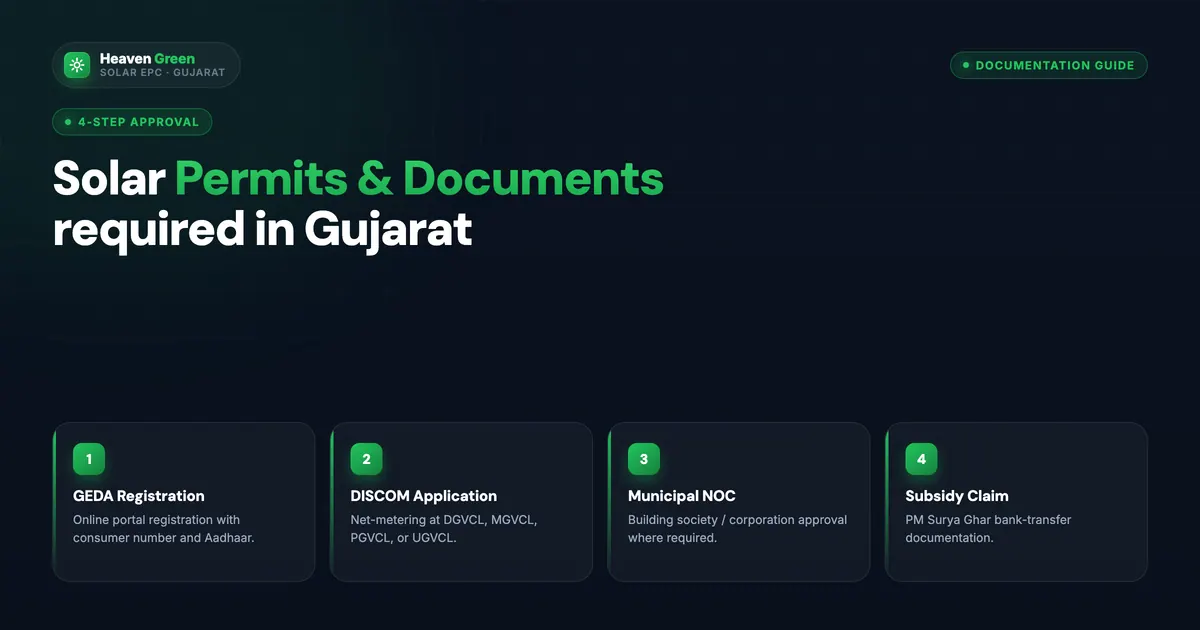
Gujarat sits at the top of India’s solar map, highest installed capacity, most solar-friendly policies, and the most structured regulatory framework for rooftop, commercial, and industrial installations. But that regulatory framework has real teeth. Miss a deadline, skip a technical standard, or install through an un-empanelled vendor, and you could lose your subsidy entitlement, face grid disconnection, or wait months for a rectification process.
This guide covers every regulation you need to know before installing solar in Gujarat in 2026: the Gujarat Solar Policy, GEDA rules, DISCOM technical requirements, net metering regulations, subsidy rules under PM Surya Ghar, DREBP scheme provisions, open access and group captive rules for commercial consumers, and the most common compliance failures we see.
Direct answer: In Gujarat, residential solar installations up to 10 kW must register through GEDA, obtain net metering approval from the relevant DISCOM (UGVCL, DGVCL, MGVCL, or PGVCL), and commission through an MNRE-empanelled vendor to qualify for central subsidy. Commercial and industrial systems above 1 MW can access open access under Gujarat Electricity Regulatory Commission (GERC) regulations, subject to wheeling and cross-subsidy surcharges. All grid-connected systems must meet CEA (Technical Standards for Connectivity) Regulations 2013.
1. Gujarat’s Solar Regulatory Framework: Key Bodies and Their Roles
Understanding who regulates what prevents applications going to the wrong authority and delays that can stretch from weeks into months.
GEDA, Gujarat Energy Development Agency
GEDA is the state nodal agency for renewable energy under the Gujarat government. For solar, GEDA’s primary roles are:
- Maintaining the approved vendor (empanelment) list for rooftop solar installers
- Coordinating state-level subsidy disbursement and application tracking through the SURYA Gujarat portal
- Administering DREBP (Distributed Renewable Energy Based Power) scheme registrations
- Publishing technical specifications for approved solar equipment
- Reporting Gujarat’s progress to MNRE on national programmes
You can read the full entry on GEDA in our glossary for a plain-English breakdown of its mandate.
GUVNL, Gujarat Urja Vikas Nigam Limited
GUVNL is the state holding company for power in Gujarat. Its direct role in rooftop solar is limited, but GUVNL sets the tariff and policy direction for grid-connected solar through its procurement and power purchase agreements. For utility-scale and large open access projects, GUVNL is the counterparty.
The Four DISCOMs, Distribution Companies
The four distribution companies are the operating agencies consumers interact with most:
| DISCOM | Coverage Area | Key Cities |
|---|---|---|
| UGVCL | North Gujarat | Ahmedabad, Gandhinagar, Mehsana, Sabarkantha, Patan |
| DGVCL | South Gujarat | Surat, Navsari, Valsad, Dang, Tapi |
| MGVCL | Central Gujarat | Vadodara, Anand, Kheda, Chhota Udaipur |
| PGVCL | West Gujarat (Saurashtra) | Rajkot, Junagadh, Jamnagar, Porbandar, Bhavnagar |
Each DISCOM handles: feasibility study for grid connectivity, net metering application processing, meter installation and commissioning, and billing under net metering.
GERC, Gujarat Electricity Regulatory Commission
GERC issues the tariff orders, open access regulations, and net metering regulations that DISCOMs must follow. The GERC is the quasi-judicial body, if a DISCOM refuses a legitimate net metering application or delays beyond prescribed timelines, GERC is the escalation authority.
MNRE, Ministry of New and Renewable Energy
At the central level, MNRE administers PM Surya Ghar Muft Bijli Yojana and maintains the national portal for subsidy applications. MNRE sets the central financial assistance (CFA) amounts and the technical specifications that empanelled vendors must follow.
2. Gujarat Solar Policy 2023: Key Provisions and Capacity Targets
The Gujarat Renewable Energy Policy (GREP), commonly called Gujarat Solar Policy 2023, is the current operative policy document for solar development in Gujarat. It supersedes the 2021 policy and runs until 2030.
Capacity Targets
The policy sets an aggregate state target of 100 GW of renewable energy capacity by 2030, with solar forming the majority share. For rooftop solar specifically, Gujarat has set a target of 3,000 MW of distributed rooftop solar, with the residential sector expected to contribute 1,200 MW under PM Surya Ghar.
Key provisions for residential consumers:
- All residential electricity consumers are eligible to install grid-connected rooftop solar
- Systems up to the sanctioned load (capped at 10 kW for LT connections) qualify for net metering
- MNRE-empanelled vendors must be used to access PM Surya Ghar central subsidy
- Application must be routed through the SURYA Gujarat portal for state coordination
- Commissioning must happen within 180 days of subsidy approval to retain eligibility
Key provisions for commercial and industrial consumers:
- C&I consumers on HT (High Tension) connections can access open access solar above 1 MW
- Group captive arrangements permitted under Gujarat Electricity Act provisions
- Third-party sale of solar power to multiple consumers within the same premises is allowed
- Wheeling charges, cross-subsidy surcharge, and scheduling charges apply to open access transactions
- Banking of solar energy (carrying forward surplus generation credits) is permitted for 30 days within a billing month
Deemed-generation provisions:
For large-scale projects, GREP 2023 includes deemed-generation provisions: if a project is ready to generate but faces grid curtailment due to DISCOM infrastructure constraints, the developer can claim compensation for lost generation at a notified rate. This matters more for utility-scale and large commercial installations than for rooftop.
Land use:
Gujarat notified a Solar Park Policy that allows agricultural land classified under certain categories to be used for ground-mount solar without change of land use (CLU) requirements, subject to the land remaining in the owner’s name and a portion being retained for agriculture. This does not apply to rooftop systems.
For a comprehensive walkthrough of the installation process itself, see our complete guide to solar installation in Gujarat.
3. Net Metering Regulations in Gujarat
Net metering is the mechanism that makes rooftop solar financially viable for most residential and small commercial consumers. Understanding the GERC net metering regulations prevents billing disputes and ensures you get full credit for the electricity you export.
Regulatory basis
The operative regulation is the GERC (Net Metering) Regulations, which align with the national CERC framework and Ministry of Power’s net metering guidelines. Industry analysis from Mercom India consistently ranks Gujarat among India’s most solar-accessible states for rooftop consumers.
For the national context, read our detailed post on net metering in India.
Capacity limits
- Residential (LT consumers): Net metering available up to 10 kW or the consumer’s sanctioned load, whichever is lower
- Commercial LT consumers: Up to the sanctioned load, subject to feeder capacity
- HT consumers (commercial/industrial): Net metering available up to 1 MW; above 1 MW, gross metering applies
- Housing societies: Aggregate capacity across all units can be registered under a single net metering arrangement
Billing mechanism
Gujarat uses a net billing approach:
- The smart bidirectional meter records both import (grid to consumer) and export (consumer to grid) in separate registers
- At the end of each billing month, exported units are adjusted against imported units at the applicable tariff
- Net surplus (export > import) is carried forward as a monetary credit, not units, to the next month
- Annual settlement: any remaining credit at year-end is paid out at the applicable feed-in tariff rate (currently around ₹2.25 to 2.50 per kWh for residential consumers)
Application process step by step
- Apply online through your DISCOM portal or the SURYA Gujarat portal with technical specifications
- DISCOM conducts a technical feasibility study (7 to 15 days)
- Receive feasibility approval and proceed with installation
- Submit commissioning request with single-line diagram, equipment test certificates, and installation photos
- DISCOM inspection visit (typically 5 to 10 days after request)
- Bidirectional net meter installed by DISCOM within 7 days of successful inspection
- Net metering agreement signed, billing starts from meter installation date
Common billing disputes and how to avoid them
The most frequent dispute is incorrect initial meter reading. On the day the net meter is installed, photograph the meter showing both registers (import and export) at their initial readings. Keep this as documentation.
The second most common issue is delayed meter installation after inspection approval. GERC regulations prescribe a 30-day maximum from application to meter installation. If your DISCOM exceeds this, file a written complaint referencing the GERC regulation, DISCOMs are responsive to formal complaints citing the specific regulation.
For deeper guidance, see our dedicated post on solar net metering in Gujarat.
4. Subsidy Regulations: PM Surya Ghar and Gujarat State Scheme
PM Surya Ghar Muft Bijli Yojana, Central Subsidy Rules
PM Surya Ghar is the central government’s primary subsidy programme for residential rooftop solar, administered by MNRE. The key regulatory points:
Subsidy amounts (2026):
- 1 kW system: ₹30,000 central financial assistance (CFA)
- 2 kW system: ₹60,000 CFA
- 3 kW and above: ₹78,000 CFA (maximum, regardless of system size)
Eligibility rules:
- Only residential consumers (not commercial or industrial)
- Active grid connection with a DISCOM
- Must install through a vendor on the MNRE National Portal’s empanelled list
- One subsidy per electricity consumer account (not per property)
- Cannot apply if you received subsidy under a previous national solar scheme within the last 7 years
- System must be commissioned within 180 days of application approval
Documentation required for subsidy:
- Aadhaar card (mandatory for DBT)
- Bank account details linked to Aadhaar
- Electricity consumer number
- Installation completion certificate from empanelled vendor
- Commissioning certificate from DISCOM
- Net metering connection letter
Disbursement: Direct Benefit Transfer (DBT) into the consumer’s Aadhaar-linked bank account, typically within 30 days of net meter commissioning verification on the national portal.
Gujarat State Additional Subsidy
Gujarat’s state government has periodically offered an additional subsidy on top of PM Surya Ghar, particularly for 1 to 3 kW residential systems. Under the SURYA Gujarat scheme:
- Additional ₹10,000 to 20,000 for systems up to 3 kW (subject to annual budget allocation)
- Available to Below Poverty Line (BPL) consumers through dedicated GEDA allocations
- Applied through GEDA rather than the national portal
State subsidy availability changes year to year depending on budget allocations. Confirm current availability with GEDA or through the SURYA Gujarat portal before planning.
Installing through an un-empanelled vendor, even if they are technically competent, permanently disqualifies you from PM Surya Ghar central subsidy on that consumer account. The system can still operate and export power, but you will not receive the ₹30,000–₹78,000 CFA. Always verify vendor empanelment on the MNRE national portal before signing any contract.
For the full subsidy application walkthrough, see our PM Surya Ghar Gujarat guide and our page on DREBP and PM KUSUM schemes.
5. DREBP Scheme: Distributed Renewable Energy Based Power Regulations
DREBP (Distributed Renewable Energy Based Power) is a Gujarat-specific scheme administered by GEDA that targets small and medium renewable energy generators, particularly solar, feeding into the local distribution grid.
Who it targets
DREBP is primarily aimed at small solar power plants (up to 1 MW) that want to sell power to the grid rather than consume it on-site. This is different from net metering (which is for self-consumption with export credit), DREBP is for dedicated power generation projects at the distribution level.
Key regulatory provisions
- Eligible capacity: 25 kW to 1 MW per project
- Project must be connected at LT or HT distribution level (not transmission level)
- Power purchase rate is fixed by GUVNL periodically, currently in the range of ₹2.65 to 3.00 per kWh for solar
- 25-year Power Purchase Agreement (PPA) with the local DISCOM
- GEDA registration mandatory before applying for DISCOM connectivity
- Projects must use BIS-certified and ALMM-listed solar modules
Application process:
- Submit application to GEDA with project proposal, site details, and financial credentials
- GEDA issues a Letter of Intent within 30 days
- Apply for grid connectivity to the relevant DISCOM within 60 days of LOI
- DISCOM conducts feasibility study and issues connectivity approval
- Complete installation and apply for commissioning
- GEDA inspection and commissioning certificate issuance
- PPA execution with DISCOM, billing starts on PPA effective date
Financial viability consideration
At current DREBP tariffs (₹2.65 to 3.00/kWh), the scheme may not offer better returns than net metering for consumers who have substantial on-site consumption at grid tariffs of ₹5 to 8/kWh. DREBP makes more sense for dedicated generation on land that has no significant on-site electricity demand.
6. Grid Connectivity Requirements and Technical Standards
Every solar installation connected to the Gujarat grid must comply with specific technical standards. These are not optional, they are conditions for DISCOM approval and ongoing connectivity.
Central Electricity Authority (CEA) Technical Standards
The CEA (Technical Standards for Connectivity of the Distributed Generation Resources) Regulations 2013, as amended, set the minimum technical requirements. Gujarat’s DISCOMs apply these uniformly. Key requirements:
- Anti-islanding protection: The inverter must automatically disconnect from the grid if grid voltage or frequency goes outside prescribed bands. This protects DISCOM line workers during outages.
- Power factor: Systems must maintain power factor above 0.95 lagging or unity, depending on connection type
- Frequency response: Inverters must operate within 49.0 to 50.5 Hz grid frequency bands and disconnect outside these limits
- Voltage range: Operation permitted between 90% and 110% of nominal voltage
- DC injection limit: Inverters must not inject more than 1% DC into the AC grid
- Surge protection: DC and AC surge protection devices (SPDs) are mandatory at both ends
Equipment approval requirements
All solar panels must be on the ALMM (Approved List of Models and Manufacturers) maintained by MNRE. This is a hard regulatory requirement, using non-ALMM panels disqualifies the installation from net metering approval and any government subsidy. See our post on DCR vs non-DCR solar panels for related context.
Inverters must carry BIS certification under IS 16221 (for string inverters) or equivalent, and must support anti-islanding to IEEE 1547 or IEC 62116 standards.
Earthing and protection
- AC earthing as per IS 3043
- DC earthing: GUVNL requires separate DC earth bus for string systems
- RCD (Residual Current Device) mandatory between inverter and mains switchboard
- Isolator switch with lockout/tagout capability at the point of grid connection
Single-line diagram submission
Every DISCOM requires a single-line diagram (SLD) showing: panel configuration, DC combiner/DCDB, inverter, ACDB, bi-directional meter, earthing connections, and protective devices. The SLD must be signed by a licensed electrical contractor or EPC company.
For full commissioning details, see our solar commissioning Gujarat guide.
DISCOM inspection failures most commonly occur due to missing or incorrect earthing, absent DC surge protection, or non-ALMM panels. Get these three elements verified by your installer before requesting the commissioning inspection, a failed first inspection adds 2 to 4 weeks to your timeline and may require a re-inspection fee.
7. Commercial and Industrial Solar Regulations: Open Access and Group Captive
Large commercial and industrial electricity consumers in Gujarat have regulatory pathways beyond net metering that can significantly reduce electricity costs. Understanding these options, and their regulatory requirements, is essential for any factory, warehouse, or large commercial establishment.
Open Access Solar
Open access allows a consumer to purchase solar power from a third-party generator, wheeling the electricity through the DISCOM’s distribution network rather than consuming self-generated power. GERC regulates open access through the GERC (Open Access in Intra-State Transmission and Distribution) Regulations.
Key thresholds and rules:
- Minimum contract demand for open access: 1 MW for intra-state open access in Gujarat
- Below 1 MW: consumers can explore group captive or net metering instead
- Application submitted to the State Transmission Utility (STU) for HT consumers
- DISCOM approval required for distribution-level wheeling
- Wheeling charges: approximately ₹0.50 to 1.20/kWh depending on voltage level and distance
- Cross-subsidy surcharge: varies by consumer category and year, set by GERC annually
- Scheduling and system operation charges apply
Open access is most financially attractive when:
- The consumer’s tariff is above ₹7/kWh (HT industrial tariff in Gujarat)
- The consumer can lock in a long-term PPA with a solar developer at ₹3 to 4/kWh
- The consumer has relatively steady load (open access is charged for contracted capacity, not just consumed units)
For a comparison of system types that affect commercial decisions, see our guide on on-grid, off-grid, and hybrid solar systems in Gujarat.
Group Captive Arrangements
Group captive allows a group of consumers to collectively own a solar generation asset and share the power output, each paying only applicable transmission and wheeling charges (not open access charges). Regulatory requirements under the Electricity Act 2003:
- Each consumer must own at least 26% equity in the captive generation plant
- Each consumer must consume at least 51% of the plant’s generation proportional to their equity
- Plant must be registered as a captive generating plant with the state electricity regulatory commission
- Annual audit required to confirm captive consumption ratio compliance
Group captive offers lower charges than third-party open access but requires equity participation, making it more suitable for industrial clusters or related businesses.
Rooftop for C&I beyond net metering limits
For commercial or industrial installations between 100 kW and 1 MW:
- Gross metering applies (not net metering), all generation is exported at the applicable tariff, all consumption is billed at full grid tariff
- Separate PPA with DISCOM for exported power
- Net metering is only available up to 100 kW for HT consumers in most DISCOMs
This means that a 500 kW factory rooftop system will operate under gross metering with a power purchase agreement, not the net billing mechanism that applies to smaller systems. Financial models are very different between the two, and the solar EPC calculator can help model both scenarios.
8. The Heaven Green Gujarat Solar Compliance Checklist
This is our proprietary pre-installation verification framework, the Heaven Green Gujarat Solar Compliance Checklist, based on the most common regulatory failures we encounter in the field. Go through each item before finalizing your system design and vendor selection.
Phase 1: Before Signing the Contract
- Verify the installer’s empanelment status on the MNRE national portal (vendor search section)
- Confirm the proposed solar panels are on MNRE’s ALMM list (available at mnre.gov.in)
- Check that the inverter carries BIS certification and supports anti-islanding per IEC 62116
- Confirm the proposed system capacity does not exceed your sanctioned load (or 10 kW for residential net metering)
- Verify your DISCOM jurisdiction (UGVCL / DGVCL / MGVCL / PGVCL) and check current feeder saturation, some feeders in high-solar-penetration areas face delays
- If in a municipal corporation area, confirm whether building permission is required (Ahmedabad, Surat, Vadodara, Rajkot usually require it)
Phase 2: Application and Approval Stage
- Register on the SURYA Gujarat / MNRE portal before installation begins, not after
- Submit the net metering application with complete documentation to avoid resubmission delays
- Do not purchase equipment before receiving feasibility approval, if the feasibility study finds issues, you may need to resize the system
- Confirm the DISCOM’s current inspection scheduling wait time, this varies by region and season
Phase 3: Installation and Commissioning
- Ensure earthing is completed per IS 3043 and verified by a licensed electrical contractor
- Install DC and AC surge protection devices on all string cables and at the ACDB
- Prepare the single-line diagram before requesting commissioning inspection
- Photograph the installation (panels, mounting, wiring, DCDB, inverter, ACDB, earthing pit) before the inspection, inspectors appreciate documentation
- Confirm the meter being installed is a bi-directional net meter, not a standard export-only meter
Phase 4: Post-Commissioning
- Photograph the initial bidirectional meter reading (both import and export registers) on commissioning day
- Submit subsidy claim on MNRE portal within 30 days of commissioning with all required documents
- Verify DBT credit within 45 days, if delayed, escalate through the MNRE Helpline (1800-180-3333)
- Keep all commissioning documents (SLD, test certificates, DISCOM agreement), required for insurance claims and future modifications
For more on the permits and approvals process, see our detailed solar permits Gujarat guide.
Ready to get your solar installation compliant from day one? Heaven Green Energy handles every regulatory step, GEDA registration, DISCOM applications, net metering commissioning, and subsidy claims. Contact our team or calculate your system size to get started.
9. How Heaven Green Energy Helps with Gujarat Solar Compliance
Navigating four DISCOMs, two government portals, multiple equipment approval lists, and varying municipal requirements is exactly what a qualified solar EPC company handles on your behalf. Here is what we do on every project:
Regulatory groundwork before design
We verify your DISCOM area, current feeder capacity, and net metering availability before recommending a system size. If your feeder is near saturation, we know, and we plan accordingly rather than starting an application that will face delays.
MNRE-empanelled vendor status
Heaven Green Energy is empanelled on the MNRE national portal. This means every residential installation through us is eligible for PM Surya Ghar central subsidy. We also maintain GEDA empanelment for state scheme eligibility.
Complete application handling
- SURYA Gujarat / MNRE portal registration and application
- DISCOM net metering application with all technical documents
- Coordination with municipal corporations where building permission is required
- GEDA DREBP registration for eligible projects
Installation to commissioning
We commission every system to CEA technical standards, ALMM-listed panels, BIS-certified inverters, IS 3043 earthing, and full protection device installation. Our commissioning reports are prepared in the format DISCOMs require, reducing inspection failure rates significantly.
Post-commissioning subsidy follow-up
We file subsidy claims on your behalf and track DBT disbursement. If there are portal issues or document gaps, we resolve them without the consumer needing to navigate government portals.
Relevant services:
- Residential solar installation
- Solar EPC services for commercial and industrial projects
- DREBP and PM KUSUM scheme guidance
10. Common Compliance Mistakes and How to Avoid Them
After handling hundreds of solar installations across Gujarat, we have documented the most frequent regulatory failures. These are the mistakes that cause subsidy loss, grid disconnection notices, or months of corrective paperwork.
Mistake 1: Starting installation before net metering application
Some installers begin physical work before filing the DISCOM net metering application. This creates two problems: if the feasibility study reveals the feeder is saturated and the capacity must be reduced, you’ve already purchased the wrong equipment; and if the DISCOM later discovers the system was installed before application, they may classify it as an unauthorized connection.
The fix: File the net metering application first. Wait for feasibility approval. Then purchase equipment and install.
Mistake 2: Using non-ALMM panels
Some cheaper imported panels are not on MNRE’s ALMM list. They may be technically good panels, but they are regulatory disqualifiers. DISCOMs in Gujarat have started verifying ALMM status during commissioning inspections.
The fix: Cross-check every panel model against the current ALMM list on mnre.gov.in before procurement.
Mistake 3: Choosing an un-empanelled installer for a subsidised system
Consumers sometimes find a lower-cost installer who is not MNRE-empanelled. The system is installed and works fine, but the subsidy application fails. ₹78,000 of central subsidy is lost permanently on that consumer account.
The fix: Verify empanelment on the MNRE portal before signing. The MNRE national portal has a vendor search function accessible without login.
Mistake 4: Incorrect earthing leading to inspection failure
Earthing failures are the single most common reason for commissioning inspection failures. Issues include: no earthing at the DC side, insufficient earth electrode depth, earth resistance above 5 ohms (DISCOM requirement), or no continuity between panel frames and the earth bus.
The fix: Have earthing tested with a calibrated earth resistance meter before requesting inspection. Target below 2 ohms for a comfortable pass margin.
Mistake 5: Oversizing relative to sanctioned load
Designing a 10 kW system for a home with a sanctioned load of 7 kW. The DISCOM will cap the net metering approval at 7 kW and require the system to be modified, adding cost and delay.
The fix: Design the system at or just below the sanctioned load. If more capacity is needed, apply for a sanctioned load enhancement with your DISCOM first, this typically takes 2 to 4 weeks.
Mistake 6: Missing the 180-day commissioning deadline
PM Surya Ghar requires commissioning within 180 days of application approval. Delays in equipment delivery, municipal permissions, or DISCOM scheduling can eat into this window quickly, especially in peak summer when commissioning queues are long.
The fix: Track the 180-day deadline from day one. If you’re approaching it and facing DISCOM scheduling delays, document the delays formally, MNRE makes allowances for delays caused by DISCOM procedural backlogs if properly documented.
Mistake 7: Not saving commissioning documents
Commissioning certificates, net metering agreements, and the initial meter reading photo are permanent documents. Consumers who lose them face problems when claiming on insurance, selling the property, or requesting system modifications.
The fix: Scan and digitally store all solar documents in a dedicated folder with redundant backup.
- Installing before DISCOM approval
- Oversizing beyond sanctioned load
- Missing 180-day commissioning window
- Incorrect earthing at first inspection
- Non-ALMM panels (permanent disqualifier)
- Un-empanelled vendor (subsidy forfeited)
- Unauthorized grid connection
- Missing commissioning documents
Frequently Asked Questions: Solar Regulations Gujarat
Q: Does Gujarat require GEDA approval before installing solar? A: For residential systems under PM Surya Ghar, you register on the MNRE national portal, GEDA coordinates at the state level but you do not submit directly to GEDA for standard residential installations. GEDA registration is required for DREBP projects and for vendors seeking empanelment on the state approved list.
Q: What is the net metering capacity limit in Gujarat for residential consumers? A: The limit is 10 kW or your sanctioned load, whichever is lower. For a home with 5 kW sanctioned load, the maximum net metering capacity is 5 kW. To install more, you would first need to increase your sanctioned load with the DISCOM.
Q: Can I get solar subsidy in Gujarat for a commercial property? A: PM Surya Ghar central subsidy (₹30,000–₹78,000) is for residential consumers only. Commercial and industrial consumers can access accelerated depreciation (40% in year one under the Income Tax Act) and may be eligible for state-level incentives under Gujarat’s industrial solar policies. Read our accelerated depreciation guide for details.
Q: How long does DISCOM net metering approval take in Gujarat? A: GERC regulations prescribe 30 days from complete application to meter installation. In practice, timelines vary: feasibility study typically takes 7 to 15 days, and inspection scheduling depends on DISCOM workload in your area. Peak season (March–May) can push total timelines to 45 to 60 days.
Q: Can I install solar if I am a tenant, not the property owner? A: Yes, but you need a No Objection Certificate (NOC) from the property owner. The net metering account will be in the electricity consumer’s name (your name), and the subsidy, if applicable, goes to you. The property owner’s consent is required because the installation is permanent and affects the building structure.
Q: What happens to net metering credits if I have more export than import in a year? A: Under GERC net metering regulations, accumulated annual credits that exceed consumption are settled in cash at the applicable feed-in tariff rate. The settlement happens at the end of the financial year. The rate is currently lower than the retail tariff you pay, so the financial model works best when solar covers 80 to 90% of your consumption rather than significant oversizing.
Q: Is open access solar available for small factories in Gujarat? A: Open access requires a minimum 1 MW contracted demand in Gujarat for intra-state open access. Small factories below this threshold can consider group captive arrangements (if they can form a qualifying captive group with other businesses) or install rooftop solar with net metering (up to 100 kW for HT connections). For capacities between 100 kW and 1 MW on HT, gross metering with a DISCOM PPA applies.
Q: Do solar panels need to face south in Gujarat to comply with regulations? A: There is no regulatory direction requirement, panels can face south, southwest, southeast, or flat. Regulations govern technical safety and grid connectivity standards, not orientation. That said, southward orientation at 10 to 25 degree tilt gives optimal generation in Gujarat’s latitude range (20 to 24°N), and your installer should justify any non-south orientation with generation modeling output.