The load behind a texturising unit is more than the spindle drive
In draw texturing, polyester filament passes through feed and draw stages, heaters, a false-twist section and winding. A machine therefore combines motor drives and process heat. Oerlikon Barmag's DTY machine brochure describes heater, drive and cooling options. This illustrates why a “machine count × motor kW” calculation misses part of the load. The brochure is not a measured consumption figure and should not be copied into a quote for a different machine. The US EPA ENERGY STAR textile efficiency guide also describes draw false-twist equipment as a motor-driven process with speed-control and cooling-fan losses. Neither source tells us how your individual line is loaded this month.
Twisting equipment can have different drives, package-build cycles and auxiliary loads from a draw-texturing line. Some sites share compressors, ventilation, lighting and material-handling equipment between halls. A unit that adds an air-texturing or heat-setting process changes the profile again. Record these loads by electrical panel and operating schedule instead of assuming all textile plants use the same energy mix. A processing house that runs stenters and dyeing equipment is not a good proxy for a TFO twisting shed; a ring-spinning mill is different again.
| Plant question | Record to request | Why it changes solar sizing |
|---|---|---|
| Which texturising or twisting machines run in daylight? | Machine list, panel labels and shift schedule | Defines likely direct daytime use |
| Are heaters, drives and auxiliaries metered separately? | Submeter or panel readings where available | Separates process base load from intermittent load |
| What runs during lunch, doffing and maintenance? | Operator schedule and interval meter data | Prevents a peak-hour estimate from standing in for the whole day |
| What runs at night? | Three-shift log or hourly import trace | Solar cannot directly cover unlit hours without another mechanism |
| When does the plant close? | Weekly and seasonal shutdown calendar | Shows whether daytime output may become export |
| Which connection supplies the roof's building? | Bill, consumer number, tariff and contract demand | Determines the metering and approval file |
This is a site-data request, not an invented load profile. The plant's actual interval readings are the evidence for a proposed system size. If interval data is unavailable, a supervised logging exercise at the relevant main panel can establish daytime and night ranges before final design. A nameplate provides a safe equipment inventory; it does not tell you the duty cycle or simultaneous demand.
Daytime energy and a 24-hour shift are different calculations
A unit operating continuously may have a convenient daytime base load for solar, but it also has many hours when the modules produce little or nothing. The system should be compared with a time series of the factory's grid draw. Match each hour or suitable meter interval to a conservative generation estimate for the site, then distinguish direct self-consumption from export. A single monthly bill gives total kWh and maximum demand; it does not tell you when those units were used.
Do not smooth all four into an average day. The normal daylight pattern tests whether solar output can be used immediately. Night tells you the continuing grid requirement. A production pause can make export rise even though the factory is “open.” A weekly closure can change the economics of an otherwise well-matched plant.
The output of this review should be a load-match table, not a percentage saving promise:
| Period | Grid demand evidence to collect | Solar question | Design consequence |
|---|---|---|---|
| Working daylight hours | Interval kW or kVA, machine schedule | How much generation can the line and auxiliaries use directly? | Set the first AC capacity range |
| Evening and night shifts | Interval import and shift records | Which load remains after solar output falls? | Keep this grid import in the model |
| Doffing, changeover or stoppage | Event times paired with meter trace | Does generation temporarily exceed site use? | Model export rather than assuming full self-consumption |
| Sunday or scheduled closure | Actual shutdown days | Where would surplus go under the selected meter arrangement? | Test smaller size or a different commercial route |
No result is supplied in the table because the client's machine list, bills and interval trace are not yet available. A proposal that fills these cells with an unexplained “typical texturising load factor” would look specific while answering the wrong plant's question.
What happens to electricity the shed cannot use?
The 2026 Gujarat DRES regulation recognises net metering, net billing, gross metering and other arrangements. They do not give exported electricity the same treatment. For a non-residential net-metering consumer, exported units can be adjusted against grid import in the same billing cycle only up to 30% of the energy drawn from the licensee, subject to applicable banking charges. Export above that permitted adjustment lapses under the provision. Time-of-day conditions also affect adjustment, and exported kWh do not erase demand charges or government levies. GERC 2026, Regulations 3 and 9.1.5–9.1.9.
This makes a shut-down Sunday material. If the textile unit has little load on the day, generation that would otherwise displace purchased grid electricity may be exported instead. The value of that export depends on the approved arrangement and current tariff. It is unsafe to multiply the full annual solar generation by the factory's retail energy rate. The proposal should show three numbers separately: estimated directly consumed solar, estimated exported solar, and remaining grid import, all in kWh over matching periods. It should also say whether the system is new under the 2026 rule or an expansion of a previously commissioned plant.
The regulation permits certain capacities up to defined AC and DC ceilings, but those are regulatory maxima rather than a promise that every transformer or feeder has space. DGVCL or the relevant licensee assesses technical feasibility from the application, including the feeder, transformer, connected generation and proposed system. A texturising unit with a large roof should still wait for connection review before ordering equipment. GERC 2026, Regulations 4.3, 5–7.
Can an older metal shed take rooftop solar?
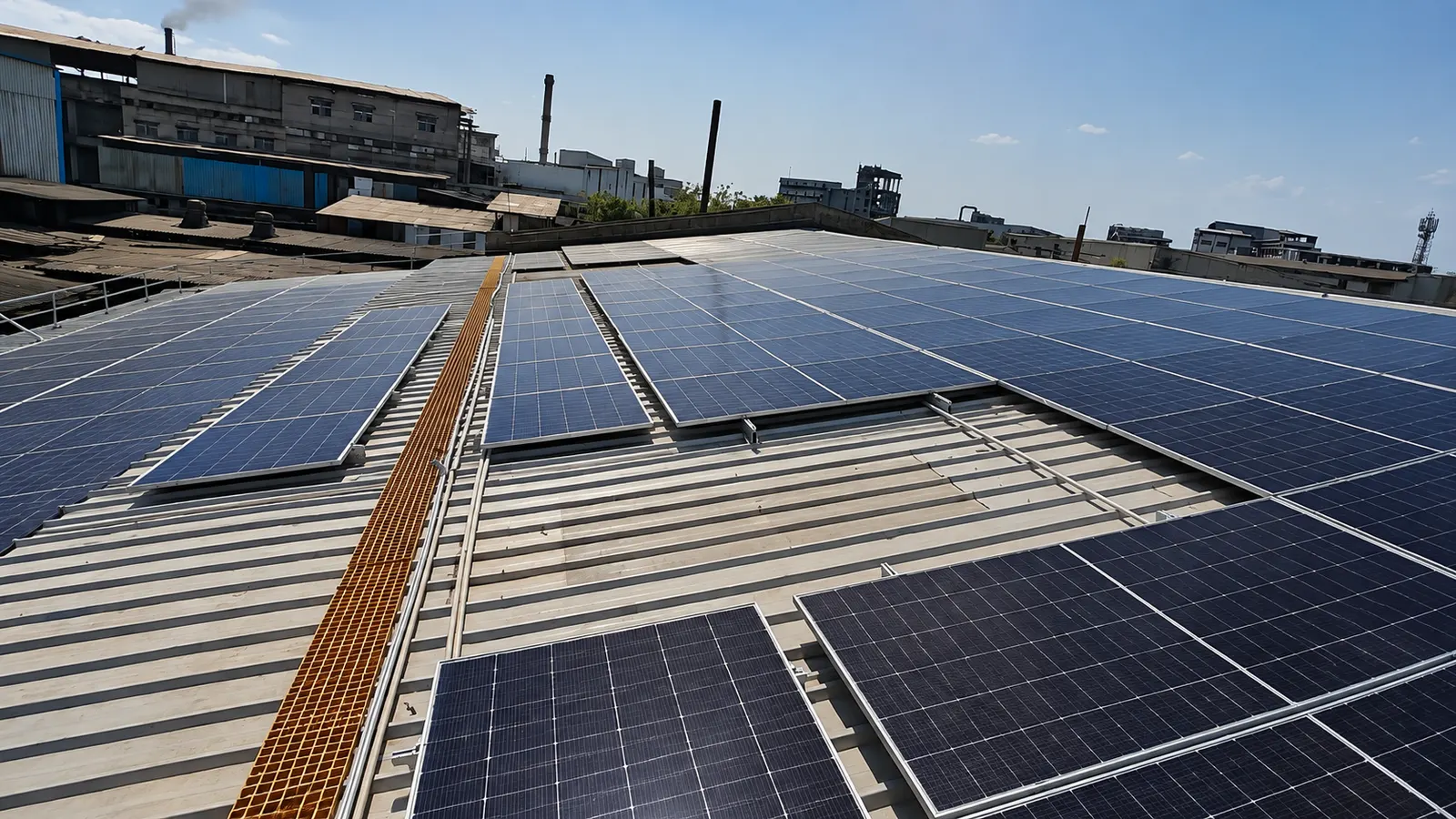
The roof is a separate constraint from the electrical load. A texturising shed may have metal sheeting over purlins and trusses; its age, corrosion, repairs, penetrations and available access path matter. A sheet that looks sound from the floor does not prove the purlins or connection details can carry the additional dead load and wind uplift. Ask for a roof survey that records sheet profile, purlin spacing, truss condition, drainage, skylights, vents and existing services. A structural engineer should decide whether the roof and support system need strengthening and who signs that decision. Do not design from a generic “solar adds X kg per square metre” figure without the actual module, mounting system, wind exposure and roof drawings.
The modules also need a safe path for inspection and cleaning without blocking extraction equipment or access to roof plant. Textile fibre and dust can accumulate on surfaces; the cleaning method and frequency should be based on the site's actual soiling, module instructions, water access and worker safety plan. Do not promise a fixed production loss or cleaning interval from a photo. The roof survey should identify discharge points and process vents before placing modules or inverters, especially where exhaust or lint can affect safe access.
| Roof and operations check | Evidence to collect | Decision it supports |
|---|---|---|
| Sheet and purlin condition | Roof drawings, photos, inspection findings | Whether the mounting location is structurally credible |
| Vent, skylight and service layout | Annotated roof plan | Where modules, cable routes and walkways can go |
| Existing corrosion or leaks | Maintenance record and close-up survey | Whether roof repairs come before solar work |
| Access for installation and cleaning | Fall-protection and access plan | Whether construction and upkeep can be done safely |
| Production and shutdown limits | Plant electrician's isolation window | Where tie-in and testing fit the shift schedule |
The table describes due diligence, not a claim that Heaven Green Energy has inspected any particular shed. If the engineer rules out rooftop loading, the correct answer can be a smaller usable area, strengthening, another roof, or no rooftop plant. A larger quotation is not the objective; a buildable and maintainable design is.
The connection file should match the factory bill
For a grid-interactive project, the utility and safety authorities need a coherent account and technical file. The GERC 2026 model application asks for the consumer number, tariff category, voltage, contracted demand, AC and DC system capacities, metering choice, roof rights, anti-islanding protection and any battery information. It also includes registration and inspection steps involving GEDA or its designated agency, the Chief Electrical Inspector where applicable and the distribution licensee. The exact current form and portal should be confirmed with the licensee before submission.
For a textile unit, it is easy to overlook a mismatch between the roof owner and the bill holder. A tenancy or separate company entity can make the consumer, building owner and solar-system owner different parties. The 2026 regulation recognises lawful possession and third-party arrangements, but the actual rights and agreements must be documented. Do not assume an informal landlord conversation is enough for installation, maintenance access or removal at lease end. GERC 2026, Regulation 8.1 and Annexure II-A.
The electrical single line diagram should identify where the inverter ties into the plant distribution system and where the meters and protection sit. Some roof work may be possible while machines run; a switchboard tie-in or protection test may require an agreed shutdown. No responsible proposal can promise “no downtime” before the connection point is designed.
How to compare two solar quotations for the same unit
Two EPC quotes can have the same kW figure and still make different assumptions about roof area, inverter AC capacity, output used on site and work included. Ask both vendors to show their input sheet. The plant owner can then compare like with like instead of comparing one rupee-per-kW headline with another.
| Ask each EPC for | What a useful answer shows |
|---|---|
| Load basis | Bill period, interval data, daytime and night schedule, missing-data assumptions |
| Roof basis | Measured usable area, structure review boundary, excluded or repair areas |
| System basis | Proposed DC kWp, inverter AC kW, layout and losses |
| Export basis | Metering route, assumed direct use and export, current rule and date |
| Connection scope | Utility submission, GEDA/CEI tasks where applicable, meters and estimates |
| Production plan | Access, cable route, shutdown and testing responsibilities |
| Handover | As-built drawing, meter and commissioning records, equipment documents |
If one quote has no interval evidence, do not treat its claimed annual self-consumption as measured. If it excludes roof strengthening or a utility estimate, do not compare its price as though those items were included. The industrial solar overview explains the broader factory process; this page stays with the texturising and twisting load match.
Questions specific to texturising and twisting units
Our machines run three shifts. Will solar cover the whole load?
No rooftop plant produces through the night without another source or storage. A three-shift schedule can support strong direct use in daylight, but the night shift remains a separate grid requirement. Model each shift and the meter arrangement before estimating how much purchased electricity changes.
Can we use connected machine kW to size the plant?
Connected kW is a useful equipment inventory, not a measured load curve. Heaters cycle, drives operate at different speeds, and machines are not always loaded or running together. Use interval data or a monitored load study to establish actual daytime demand and peak import.
Is a texturising unit the same as a spinning mill for solar design?
No. Both are textile businesses, but their process machines, heat and auxiliary loads differ. A ring-spinning guide cannot stand in for a texturising line's heater and winding profile. Use the actual plant's production and electrical records.
Will roof dust make the project unworkable?
Not automatically. The right question is what deposits on the actual roof, how it affects safe access and cleaning, and whether nearby vents or corrosion zones change equipment placement. Survey those conditions and document a maintainable layout before quoting output.
Will every charge on the bill disappear?
The proposal must separate energy imported, direct solar use, export and continuing fixed or demand charges. The 2026 non-residential net-metering rule restricts export adjustment, and the plant uses electricity when solar is not generating. A claim that all charges disappear is not a credible basis for a texturising factory decision.
Bring a week of operation into the proposal
Heaven Green Energy is a Surat solar company founded in 2017. If the interval data is available, include it. If not, the proposal should say what still needs measurement before a final system size is accepted.
Get a load-based proposal for my plant. Use the industrial enquiry form, call +91 63904 05060 or message the site details on WhatsApp. Keep bills and consumer numbers in the private enquiry route. The useful output is a proposal that shows the daytime match, the night grid requirement, the roof and connection checks, and every assumption that remains open.