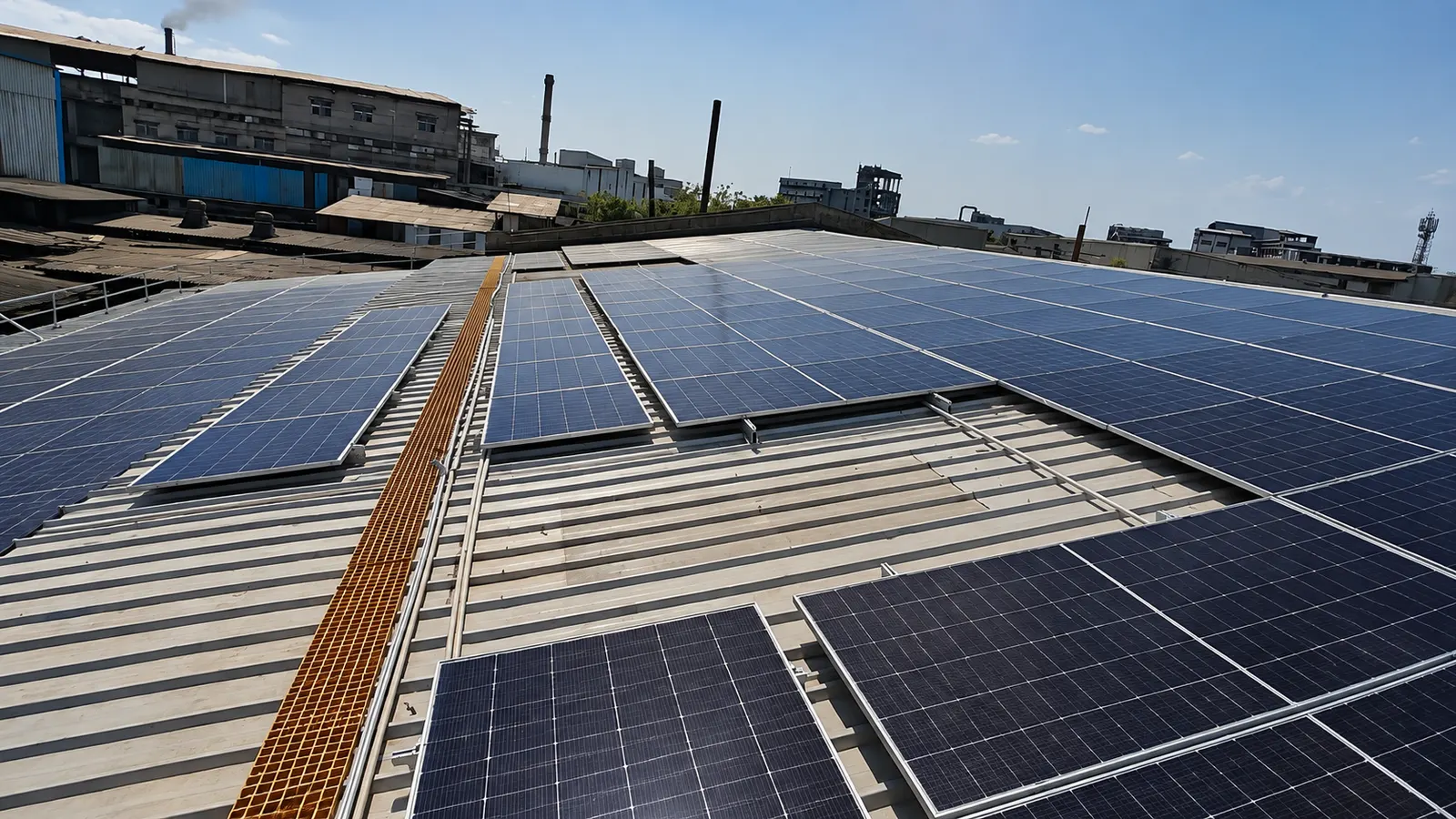
A spinning mill can operate through all three shifts, while rooftop solar produces in daylight. That mismatch does not rule solar out. It changes the size that can be used directly, the value of exports, and whether an off-site supply route is worth investigating. A bill-only calculation can hide those differences.
Direct answer. Solar for spinning mills should be sized against interval demand during sunlit production hours, then compared with an off-site open-access or captive option for the remaining load. The Gujarat DISCOM tariff schedule effective 1 April 2026 and MPERC’s order dated 26 March 2026 both make demand and time-of-day treatment relevant to this decision. Solar generation alone does not replace evening or night grid supply.
What does a spinning mill’s 24-hour load mean for rooftop solar?
For a Gujarat net-metering proposal, also check the DRES instrument signed 30 October 2026. Its published non-residential rule caps exported-energy set-off at 30% of grid imports in the billing cycle, with applicable banking charges and lapse of exports beyond the cap. This can change the value of low-load-day surplus. Gazette commencement and the terms governing the account must be confirmed with the DISCOM; direct on-site use is a separate quantity.
Spinning lines need power for preparatory machines, ring frames or other spinning equipment, winding, compressed air, humidity control, ventilation and lighting. The blend and running schedule vary from plant to plant. Some mills operate continuously; others stop machines for maintenance, labour patterns or weak orders. A roof cannot tell an EPC which of those patterns applies. The electrical meter and production records can.
Start with at least a year of complete electricity bills and, if the utility meter allows it, 15-minute or hourly import readings. Identify weekday, Sunday, holiday and seasonal loads. For each interval, separate process demand that will be present after the solar plant starts from unusual peaks and one-off shutdowns. The industrial installation guide covers the physical project sequence; a spinning mill needs a load-matching study before that sequence becomes a system size.
Rooftop solar first offsets power used at the same connection while the mill operates. A daytime baseload can make direct use substantial even when the mill runs all night. Yet a plant sized by monthly units alone can be too large if its large monthly total comes mainly from hours when solar is absent. Conversely, a line that runs reliably through the day may have room for more direct-use solar than a roof estimate suggests. Confirm what the meter records, including power factor and maximum demand, before treating either statement as a forecast.
Compare the mill’s shift-by-shift demand with usable roof capacity and the tariff on its actual bill. First map load by shift. Second estimate solar output by hour after shade, roof orientation and maintenance access. Third apply the relevant tariff and approved export arrangement to each unit. A direct-use unit, a credited export and a night-time grid unit are not interchangeable in the financial model. That distinction is more useful than a blanket claim about how much of a 24-hour bill solar can remove.
| Operating block | What the mill should measure | Rooftop-solar implication |
|---|---|---|
| Day shift | Process plus humidity and air-system load | Possible direct use of generation |
| Evening shift | Production and peak demand after sunset | Continued grid or contracted supply |
| Night shift | Production, ventilation and auxiliaries | Grid, captive or other off-site route must be assessed |
| Maintenance day | Lowest stable daytime load | Potential export and curtailment exposure |
These blocks are a modelling template, not a load profile for any named mill. The owner should replace them with meter data.
How should an HT spinning-mill bill be read before sizing?
The service voltage, contract demand and tariff category determine which charges the mill faces. The GERC tariff schedule for Gujarat state DISCOMs effective 1 April 2026 sets separate HTP categories, demand charges, energy charges and time-of-use provisions. PGVCL’s FY 2026-27 tariff order, Case 2583/2025 dated 25 March 2026 explains the adopted tariff and the daytime discount change. For a mill in Madhya Pradesh, use the MPERC retail tariff order for FY 2026-27, Petition 140/2025 dated 26 March 2026, not a Gujarat rate. MPERC’s published highlights say HT and EHT consumers continue to be billed in kWh and retain a night-time ToD rebate.
Read the last twelve bills as a set. Record energy units, maximum demand, billed demand, contract demand, power factor or related adjustment, time-of-day buckets, fixed charges, fuel adjustment and taxes. The contract-demand glossary and maximum-demand guide explain why a solar energy saving is not automatically a demand-charge saving. A cloud passing over the array or a high-load evening interval can leave the monthly recorded maximum close to its previous level.
The bill should also be checked for any textile-specific category or incentive actually applicable to that consumer. Do not assume every spinning mill receives the same category, or that a policy incentive applies because the business makes yarn. The utility account and effective tariff order decide the base case. Put any claimed concession in a separate line with its eligibility document. This keeps the proposal auditable when a policy or production pattern changes.
For a mill comparing sites in Gujarat and MP, do not copy a per-unit saving across state borders. The ToD slots, demand terms, power-factor treatment and solar export mechanism can differ. Even within one state, distribution licensee and connection category matter. A useful EPC comparison presents avoided grid energy, surviving demand charges and export value as different rows rather than quoting one blended bill-saving percentage.
The published orders are the tariff references. The mill’s current bill identifies which clauses apply to its actual account.
What share can a mill realistically cover from its own roof?
The usable roof and matching daytime load set two different ceilings. A mill may have a large electrical load but little unobstructed roof. It may also have many sheds, but part of them may be too weak, shaded, reserved for ventilation, or needed for access and fire separation. A roof survey should show each bay, covering type, structure, age, drainage, equipment, walking route and permitted mounting zone. The roof-strength guide gives the survey questions, and the old-roof decision guide explains why fragile sheets need a different plan.
Do not calculate a percentage of the mill’s total annual electricity from area alone. First estimate buildable capacity on each safe bay. Then simulate generation by month and hour. Match that output against measured daytime consumption, including downtime and shifts with fewer machines. Finally check the rooftop capacity and export rules for the connection. If a roof can take more panels than the mill can use profitably in daylight, the added export must be valued under the approved metering agreement.
Illustrative calculation, not a yield promise or an actual plant: suppose a mill imports 18,000 kWh in a representative day, of which 8,000 kWh falls during solar-generating hours. A proposed array is assumed to produce 6,000 kWh on that representative day. If the load remains above solar output in each matching interval, direct use could approach 6,000 kWh for that day. If a weekly shutdown cuts daytime demand to 1,000 kWh, the same assumed 6,000 kWh output creates up to 5,000 kWh of potential surplus before the applicable settlement or export limit is considered. The example demonstrates the need for interval modelling; it is not a generation benchmark for any mill.
Roof area also constrains operation. Cotton fibre and lint can collect near modules and cable paths. Access lanes for cleaning and inspection should be part of the layout, not an afterthought added after maximizing panel count. The owner should compare a smaller, easier-to-maintain design with a larger design using the same load and tariff assumptions. If the roof is already due for replacement, the replacement plan belongs in the project scope before solar anchoring is finalised.
Sizing check
Ask the bidder to show monthly direct use and export for both normal production and a low-output operating month. A single annual generation number cannot reveal the difference.
The solar for textile industry article covers the broader sector. A spinning mill’s continuous process makes the hourly match especially important.
When does open access or group captive complement rooftop solar?
If the safe roof cannot cover the mill’s daytime demand, an off-site plant may be worth evaluating. Open access brings power from a generator through transmission or distribution networks to the mill’s meter. Group captive is an ownership and consumption arrangement with statutory tests; it is not simply a discounted power purchase agreement. The group-captive glossary and Gujarat open-access landed-cost guide explain the charge stack. Both routes need eligibility, scheduling, losses, charges and contract risk reviewed before anyone compares per-unit prices.
The Ministry of Power’s parliamentary answer dated 3 February 2025 on the Green Energy Open Access Rules states a 100 kW contracted-demand or sanctioned-load threshold, including specified aggregation, for ordinary green open-access consumers and no load limit for captive consumers. State regulations still govern the local application, scheduling and charge process. Gujarat’s GERC Green Energy Open Access Regulations, Notification 08/2024 dated 20 February 2024 and subsequent amendments provide the state framework. MPERC lists its Green Energy Open Access Regulations, G-46 of 2023, and amendments. The mill must check the latest effective state rule and the actual drawal connection before proposing supply.
Off-site supply still has a time profile. A solar generator normally delivers in daylight; a 24-hour mill still needs another source for dark hours unless its procurement includes a separate firming arrangement. Banking may shift some credited energy under a state rule, but it carries conditions and charges and should not be treated as unlimited storage. A time-of-day tariff can also make a delivered unit worth a different amount at different hours. The EPC model should show generation, scheduled delivery, banking if permitted, losses and all applicable network charges, not just a quoted generator tariff.
| Route | Physical fit | Main commercial test | Contract question |
|---|---|---|---|
| Rooftop self-use | Safe roof and daytime mill load | Hourly direct use versus export | Who owns and maintains the plant? |
| Third-party open access | Eligible drawal connection and off-site supply | Landed delivered cost after charges and losses | Who bears regulatory and curtailment changes? |
| Group captive | Valid ownership and consumption structure | Delivered cost plus compliance obligations | Who monitors captive tests and exit rights? |
This is a route screen, not a tariff quotation. Have the buyer’s legal and finance teams review a specific captive or open-access proposal before signing.
Compare the supply routes: Share your mill’s interval data and roof drawings through the industrial solar enquiry. Request separate rooftop and open-access cases with all delivered-energy charges shown.
How do ToD windows and night production affect value?
The mill’s daily schedule can turn a good solar project into a poor model if the proposal treats every grid unit as equal. Gujarat’s state DISCOM tariff schedule effective 1 April 2026 specifies time-of-use provisions for relevant HTP categories. PGVCL’s 25 March 2026 order records a 60-paise per unit daytime concession extended to 11:00 to 17:00 for eligible HTP consumers with the required metering. MPERC’s FY 2026-27 order retains a night-time ToD rebate for HT consumers. These are tariff facts tied to the cited orders, not savings promises for a particular mill. Check the exact category, meter capability and billed slot on the account before applying them.
If the grid’s daytime energy charge is lower in a ToD window, a solar unit that displaces that particular grid unit can have a lower avoided energy value than a unit produced outside the discount window. Solar may still be useful because the mill has large daytime demand, but the model should use the actual time slot. A night-shift rebate can make overnight grid power different again. The business ToD and solar guide gives the state comparison; the spinning-mill model must use the plant’s specific interval profile.
There is a second timing question: monthly demand. A 15-minute peak when clouds reduce solar output may set maximum demand even if solar lowers thousands of daytime kWh. Night production can set the peak after solar stops entirely. Any proposed reduction in contract demand should therefore be justified by a peak-demand study rather than the array’s nameplate capacity. If the plant adds a new spinning line, the future peak matters more than today’s average bill.
Ask for a table showing each relevant ToD slot, grid imports before and after solar, assumed solar self-use, export treatment and surviving demand charge. The bidder should flag whether it has used the meter’s actual slot readings or estimated them from a flat monthly total. Where data is missing, request a conservative range and a plan to obtain interval information before final sizing. A transparent model lets the mill change its shift plan without losing track of the assumptions.
The important commercial result is not a universal percentage reduction. It is a documented route for each energy block: direct rooftop use in sunlit hours, imported or contracted supply after sunset, and an explicit rule for surplus when production pauses.
What should the EPC check for humidity, lint and roof access?
Spinning requires controlled conditions in production areas, and the roof may sit above sensitive machinery. The solar installation should preserve waterproofing, ventilation openings, maintenance hatches and the mill’s humidity-control equipment. A roof penetration or cable route that disrupts drainage can create a production problem independent of electrical performance. Ask the plant engineering team to sign off the proposed mounting and routing plan before work starts.
Lint and dust are operational issues. They can obstruct module surfaces, collect around electrical equipment and make inspection harder. The site survey should identify exhaust outlets and likely deposition zones. The cleaning method should be safe for the roof covering, electrical isolation points and the mill’s water policy. The bidder should describe access lanes, fall protection and how maintenance can be done without crossing fragile roof bays or interfering with production. The industrial cleaning guide gives a broader O&M comparison, but the mill’s actual deposits and roof layout should set its maintenance plan.
Electrical design needs the same site specificity. Existing drives, capacitors and transformer arrangements can influence power factor, harmonics and protection settings. Have the EPC review the single-line diagram and the utility meter data, including changes expected after rooftop solar reduces grid-side active power. The power-factor penalty after solar guide explains why a post-installation bill can behave differently even while kWh imports fall. Do not assume the inverter’s default reactive-power setting suits the mill’s existing automatic power-factor correction panel.
The CEA Measures Relating to Safety and Electric Supply Regulations, 2023 are the national safety reference for electrical installations. The mill should require drawings, protection coordination, earthing details, isolation locations and commissioning records appropriate to its voltage and utility approval. The precise inspection route depends on the connection and local authority. The owner should nominate a plant-side engineer who can review shutdown windows and sign off safe access before the EPC mobilises.
Plant-team hold point
Approve roof load, drainage, humidity-equipment clearance and electrical tie-in separately. A technically sound array can still be a poor fit if it blocks production maintenance.
The aim is a maintainable plant, not the maximum number of modules that can fit on a drawing.
Which proposal assumptions should a mill challenge before signing?
A useful proposal shows a full-year energy model with representative intervals and a clear commercial bridge from units to the bill. It should identify the site’s utility, tariff category, contract demand, ToD meter, existing generation if any and the approved rooftop export mechanism. For off-site options, it should separately show generator price, transmission or wheeling charge, losses, cross-subsidy or additional surcharge where applicable, banking terms and scheduling responsibility. One blended per-unit number without those lines is hard to audit.
Challenge the baseline. If the factory expects to expand, the EPC should model the additional daytime and night load separately. If orders are seasonal, model a low-production month. If the mill has a roof due for replacement, include that decision before treating all bays as available. If the bidder assumes a permanent night shift, confirm the shift plan. These questions are procurement controls, not objections to solar.
Ask for a bill bridge with three cases: current operation, a conservative production case and an expansion case. In each case, list solar used directly, exports, imported energy by ToD slot, peak demand and any power-factor adjustment. Keep fixed charges, taxes and non-energy items visible. A proposal that multiplies all solar generation by the average total-bill rate can overstate the value of surplus units and imply a demand saving that has not been demonstrated.
- ✓ Interval load and generation assumptions
- ✓ Direct use and export shown separately
- ✓ Current tariff order and approval route named
- ✓ Roof, O&M and production access plan
- ✗ One flat unit value for every hour
- ✗ Demand-charge reduction without interval evidence
- ✗ Roof area quoted before structural review
- ✗ Captive savings shown without compliance costs
The solar EPC bid checklist provides a broader comparison method. For a spinning mill, a bidder should also state who updates the model if the mill changes its production shifts before commissioning.
How Heaven Green Energy helps plan a Spinning-Mill Proposal
For a proposal enquiry, assemble twelve months of bills, interval data if available, the existing single-line diagram, contract-demand details, shift calendar, roof drawings and the plant’s maintenance restrictions. Heaven Green Energy files DISCOM paperwork for its customers. The owner should verify that the submitted consumer and property records match the intended connection and roof.
The relevant routes are:
- Industrial solar for the primary factory rooftop enquiry.
- Commercial solar for a smaller business or separately metered office connection.
- Ground-mount solar park when off-site land and grid delivery need separate study.
The first review should establish a daytime self-use ceiling and identify any bill lines that rooftop solar will leave in place. Then the team can compare a roof-only case with an off-site case if the roof is constrained. The buyer should request the exact utility approval path for each route and a documented assumption register. A rate or approval borrowed from another state should be removed from the base case.
Follow this buying sequence:
- Map shifts and intervals. Separate sunlit, evening, night and maintenance demand.
- Confirm the bill. Check category, contract demand, ToD slots and power-factor terms.
- Survey each roof bay. Record structure, shade, lint, drainage and access.
- Compare routes. Model direct rooftop use, export and an off-site option separately.
- Review approvals. Identify DISCOM, open-access and electrical-safety steps.
- Approve the operating plan. Agree tie-in windows, cleaning access and handover records.
The owner should keep a copy of the interval data and assumptions used in the final proposal. After commissioning, the plant team can compare actual generation and imports with the same baseline, adjusting for production changes. This makes an underperforming array easier to distinguish from a quiet production month. It also helps the mill decide whether later capacity additions or shift changes justify a new approval application.
Plan a mill-specific proposal: Bring the bills, shift calendar and roof plan to the industrial solar enquiry. Ask for a model that separates daytime self-use, night imports and any off-site supply before comparing commercial terms.
Frequently asked questions
Can rooftop solar power a spinning mill at night?
No. Standard grid-connected rooftop solar produces when sunlight is available. A mill that runs at night continues to draw from the grid or another contracted source unless a separately designed storage or firm supply arrangement is in place. The proposal should show night demand as its own line rather than spreading annual solar units over all hours.
Should a 24-hour mill size solar from annual kWh?
Annual kWh is a starting point, not a sufficient sizing method. The EPC should match predicted solar output with interval load, test low-production days and apply the mill’s rooftop export terms. A plant can have high annual use yet a constrained roof, or a large roof with limited direct use during shutdowns.
Does rooftop solar reduce contract-demand charges?
It may reduce grid demand in some daytime intervals, but a cloudy interval or night peak can still set monthly maximum demand. A contract-demand change needs measured peak evidence and utility approval. The maximum-demand guide explains the distinction between energy and demand savings.
Is group captive the same as buying open-access solar?
No. Group captive has ownership and consumption tests under the applicable framework. A third-party open-access purchase has a different commercial and charge structure. Both need state-specific network charges, losses and contract terms modelled before comparing delivered cost.
What changes for a spinning mill in Madhya Pradesh?
Use MPERC’s FY 2026-27 order dated 26 March 2026 and the mill’s actual DISCOM account, rather than Gujarat’s HTP schedule. MPERC states that HT and EHT kWh billing and a night-time ToD rebate continue. Rooftop and open-access approvals must also follow the MP framework.
What should the mill send for a first proposal?
Send a full year of electricity bills, any interval export or import data, contract demand, shift calendar, roof plans, single-line diagram and known roof or humidity-equipment restrictions. That package lets the EPC test direct use, roof safety and approval options without inventing a load profile.