The day your installer says “system is live” is the most important day of your solar journey, and the day most homeowners and businesses skip the one thing that protects the next twenty-five years of generation. A proper handover is not a switch being flipped; it is a written, photographed, measured verification that the panels you paid for are the ones on the roof, that the earthing meets IS 3043 (Indian Standard 3043, the code for earthing practice), that the MCB (Miniature Circuit Breaker) is sized to the BoS (Balance of System) specification, and that the bidirectional meter has been installed and sealed by your DISCOM. In 2026, roughly one in three rooftop installations in India shows at least one defect at handover: most of them cosmetic, some of them dangerous, all of them cheaper to fix on day one than on day three hundred.
This guide walks through the 12-point post-installation inspection that our commissioning team runs on every Heaven Green Energy project, the tools and tests we use, the commissioning documents your installer must hand over, and the common issues we see when customers ask us to audit installations done by other vendors.
Direct answer. To verify your solar installation is done right, run the 12-Point Post-Installation Inspection Checklist: count panels against the purchase order, verify panel and inverter serial numbers match procurement and ALMM listing, confirm MCB sizing, check AC and DC isolator labels, measure earthing resistance (≤1 ohm per IS 3043), test monitoring app sync, compare generation against nameplate, inspect mounting torque, seal cable conduits, verify the bidirectional meter is installed, and collect the commissioning report. Catching issues on day one prevents 10 to 20% generation losses later.
If your installer is hesitant about any of these checks, or worse, asks you to sign the handover certificate before completing them, that hesitation is the verification result. Walk through every point below before you sign anything.
Why Post-Install Inspection Matters: Issues Missed at Handover Cost 10x Later
A solar rooftop system is a twenty-five-year asset whose entire performance curve is set in the first seventy-two hours after commissioning. The torque on each mounting bolt, the routing of each DC (Direct Current) cable, the resistance of the earth pit, the calibration of the inverter against the bidirectional meter, every one of these decisions either compounds into a quarter-century of clean returns or quietly bleeds 10 to 20 percent of the generation you paid for. The Ministry of New and Renewable Energy (MNRE) and the Bureau of Indian Standards (BIS) both publish inspection protocols for exactly this reason: a defect caught on handover day costs the installer a torque wrench and an hour; the same defect found in year two costs you a roof climb, a generation audit, a warranty claim cycle, and a sometimes-irreversible loss of panel life.
The economic asymmetry is sharper than most homeowners realise. A loose DC connector dissipating just two watts as heat at the MC4 junction will, over six monsoon seasons, oxidise to the point where it ignites the cable jacket. A mounting bolt under-torqued by 15 newton-metres will, with thermal expansion across summer–winter cycles, walk itself loose and let the panel lift in a single Rajasthan dust storm. An earth pit measured at 4 ohms instead of 1 ohm will pass current to your roof slab during a surge event and you will only discover the fault when an inverter board fries. Each of these is a five-minute fix on day one and a six-figure repair in year three.
Inspection also matters because the PM Suryaghar portal ties subsidy disbursement to the commissioning report uploaded by your installer. If the report contains errors, wrong serial numbers, missing ALMM (Approved List of Models and Manufacturers) certificates, incomplete earth-test results, the subsidy hold-up is on the consumer, not the installer. A 30-minute walk-through with your installer present, holding the checklist and a multimeter, catches every one of these before the report goes up. This is what distinguishes a well-handed-over system from one that simply has panels stuck on a roof.
The 12-Point Post-Installation Inspection Checklist
This is the named framework we run on every Heaven Green commissioning, twelve sequential checks, each with a measurable pass/fail criterion. Treat it as a single document: every line either gets a tick, a measured value, or a remediation note before you sign the handover certificate. The order matters because each check builds on the one before, there is no point measuring earthing on a structure that does not match the bill of materials.
| # | Inspection point | Pass criterion | Tool needed |
|---|---|---|---|
| 1 | Panel count vs purchase order | Exact match | Eyes, PO copy |
| 2 | Panel serial numbers | Match procurement + ALMM | Phone camera, ALMM register |
| 3 | Inverter serial + warranty card | Card in hand, serial matches | Warranty card |
| 4 | MCB sizing per BoS spec | Matches single-line diagram | Multimeter, SLD copy |
| 5 | AC + DC isolator labels | Clear, weatherproof, named | Eyes |
| 6 | Earthing resistance | ≤ 1 ohm per IS 3043 | 3-point earth tester |
| 7 | Monitoring app sync | Live data flowing | Smartphone + app login |
| 8 | Generation vs nameplate | Within 10% of rated kW at noon | Inverter display |
| 9 | Mounting structure torque | Per manufacturer spec | Torque wrench |
| 10 | Cable conduit sealing | No exposed wire, UV-rated | Eyes |
| 11 | Bidirectional meter installed | DISCOM-sealed and tested | Meter reading |
| 12 | Commissioning report uploaded | Portal acknowledgement copy | PM Suryaghar login |
1. Panel Count Matches Purchase Order
Stand on the roof or use a drone shot and count every panel physically installed. Match that against the line-item on your purchase order and the proforma invoice. A 3 kWp (kilowatt-peak) system built with 545 Wp Adani panels needs six modules; a 5 kWp system needs nine. Installers occasionally ship the right wattage but with one extra or one missing panel, this is the single fastest check on the list and the one most often skipped.
2. Panel Serial Numbers Match Procurement (ALMM Compliance)
Every solar panel sold in India under a subsidised scheme must be on the ALMM (Approved List of Models and Manufacturers) register. Each panel carries a unique serial number printed on the back label. Photograph all serial numbers, then verify two things: that each serial matches the manufacturer-issued packing list, and that the model number on the label appears on the current ALMM List-I. If you find a serial that does not appear in either list, you have a counterfeit or grey-market panel, common in low-cost installations. Our verify genuine Adani panels guide shows exactly how the serial-check works on Adani modules.
3. Inverter Serial + Warranty Card Received
The inverter is the most expensive single component after the panels and the one most likely to fail in years 5 to 10. Collect the physical warranty card or the warranty-registration confirmation email at handover. Check that the serial on the card matches the serial on the inverter chassis. Photograph both. Most reputable inverter brands, Growatt, Sungrow, Solis, Microtek, link the warranty to the serial at the factory, but registration through their portal still needs to be triggered by the buyer. Our solar warranty types explained guide breaks down how product, performance, and workmanship warranties differ, and which one actually covers the inverter.
4. MCB Sizing Correct per BoS Specification
The MCB protects the AC (Alternating Current) circuit from over-current faults. Sizing depends on the inverter’s rated AC output. A 3 kW single-phase inverter typically requires a 16 A MCB; a 5 kW inverter needs 25 A. The Balance of System (BoS) document inside your single-line diagram lists the exact required rating. An undersized MCB will trip nuisance during peak generation; an oversized one will not protect the cable. Confirm the rating printed on the MCB body against the SLD (Single-Line Diagram) before signing. If you want to understand the diagram itself rather than just match a number against it, Heaven Designs’ how to read a solar single-line diagram guide walks through every symbol and rating on the page.
5. AC Isolator and DC Isolator Clearly Labelled
You must have at least one AC isolator (between inverter and consumer unit) and one DC isolator (between panels and inverter). Both must be weatherproof if mounted outdoors, both must be clearly labelled, “SOLAR DC ISOLATOR, OPEN BEFORE WORK” and equivalent on the AC side, and both must be operable without tools. Unlabelled isolators are a fire-safety violation and an obstruction to any future O&M (Operations and Maintenance) team.
6. Earthing Resistance ≤ 1 Ohm per IS 3043
IS 3043, the Indian Standard Code of Practice for Earthing, specifies that the earth pit serving a solar PV (photovoltaic) installation must measure at or below 1 ohm of resistance. Higher values mean lightning or surge currents cannot dissipate safely and your inverter board becomes the path of least resistance. Insist on a live earth-resistance test with a 3-point earth tester (also called a meggar) at handover. The result must be recorded on a signed earth-test certificate that goes into your commissioning file. For the full standard and pit-construction detail behind this test, see our solar grounding and earthing India guide.
7. Monitoring App Sync Working
Modern inverters ship with cloud monitoring, Growatt ShinePhone, Solarman Smart, SolisCloud, Sungrow iSolarCloud. At handover, your installer must log you in to the monitoring portal from your own phone, demonstrate live data flowing (instantaneous power, daily kWh, alerts), and confirm the registration is under your email, not theirs. Our how to monitor solar generation guide walks through what to look for after first login.
8. Generation Reading Matches Inverter Rated Wattage
Between 11 a.m. and 2 p.m. on a clear day, a properly installed system should deliver instantaneous power within 10% of its rated DC capacity. A 3 kWp system should show 2.7 to 3.0 kW on the inverter display at solar noon. If you are seeing 1.8 kW or 2.1 kW under perfect conditions, you have a string fault, a soiling issue, a shading problem, or a wiring polarity error. Our low solar generation diagnosis guide covers the troubleshooting tree.
9. Mounting Structure Bolt Torque per Specification
The mounting structure, preferably hot-dip galvanised steel for inland projects, aluminium for coastal, must be assembled with every bolt torqued to the manufacturer specification, typically 22 to 28 newton-metres for M8 and 45 to 55 N·m for M10 fasteners. Ask the installer to demonstrate torque on a random sample of bolts using a calibrated torque wrench. Under-torqued bolts loosen in thermal cycling; over-torqued ones strip the threads and lose clamp load.
10. Cable Management and Conduit Sealing
Every DC and AC cable run must sit inside a UV-rated conduit or armoured sheath. There must be no exposed copper, no kink-radius violations, no cable resting on the hot panel back-sheet, and every conduit entry must be sealed against water and rodents. Loose or exposed cabling is the single largest cause of solar fires in Indian rooftops.
11. Bidirectional Meter Installed by DISCOM
The bidirectional (net) meter is installed by your DISCOM (Distribution Company) after the field engineer’s inspection. Confirm the meter is physically present, the seal is intact, the import and export readings are both visible, and you have the meter serial number written on your commissioning paperwork. Without this, your subsidy on the PM Suryaghar portal will not release. The full DISCOM workflow is covered in our PM Suryaghar complete guide.
12. Commissioning Report Uploaded to PM Suryaghar Portal
The final check: log into the PM Suryaghar portal with your application reference number and confirm the commissioning report has been uploaded by your installer, contains the correct panel and inverter serials, attaches the earth-test certificate, and shows the DISCOM net-meter sign-off. Until this exists, no DBT (Direct Benefit Transfer) of subsidy will trigger. Our solar commissioning testing guide covers the full test sequence installers run to generate this report.
Tools You Need for Verification
You do not need a lab to run a credible post-install inspection, four instruments plus a smartphone cover every check. If you are a residential customer, your installer brings these to handover; for a commercial install the same kit scales up but the tools are identical.
| Tool | What it measures | Approx cost |
|---|---|---|
| Digital multimeter (Fluke 117 or equivalent) | DC voltage, AC voltage, continuity, MCB rating | ₹4,500–₹7,000 |
| 3-point earth resistance tester (Kyoritsu 4105A) | Earth pit resistance per IS 3043 | ₹14,000–₹22,000 |
| Calibrated torque wrench (10 to 60 N·m range) | Mounting bolt clamp force | ₹2,500–₹6,000 |
| Lux meter (Extech LT45) | Ambient irradiance, sanity-check noon power | ₹2,800–₹4,500 |
| Thermal imaging camera (FLIR C3-X or Hikmicro) | Panel hotspots, loose connector heat | ₹35,000–₹60,000 |
| Smartphone with monitoring app installed | Live generation, alarms, fault codes | Owned |
The IR (infrared) camera is the most expensive item but the most diagnostic, it identifies a hotspot panel at 20 metres in under three seconds, and most defective cells show a 10 to 15 °C temperature delta against neighbouring cells. For a one-off home inspection you can rent an IR camera from any electrical contractor for ₹1,500–₹2,500 per day, or simply ask your installer to bring one to the handover walk-through.
What Each Test Actually Reveals
Each instrument answers a specific failure question. Read the table below as a diagnostic map, when something looks wrong, the right tool tells you what to check next.
| Test | Reveals | Pass threshold |
|---|---|---|
| Multimeter on DC string | Open circuit, reverse polarity, voltage mismatch | Within 5% of expected Voc (open-circuit voltage) |
| Multimeter on AC output | Inverter live, neutral integrity, MCB rating | 230 V ± 6%, 50 Hz |
| Earth resistance tester | Earth pit moisture, electrode degradation, soil resistivity | ≤ 1 ohm |
| Torque wrench on bolts | Under/over-tightened mounts, future wind risk | Manufacturer spec ± 10% |
| Lux meter | Whether noon power shortfall is irradiance or fault | > 800 W/m² for valid power test |
| IR camera scan | Hotspot cells, micro-cracks, bypass diode failure, loose MC4 | < 5 °C delta vs neighbour |
| Monitoring app data | String balance, daytime soiling pattern, communication faults | Both strings within 8% |
A poor result on any single instrument almost always pairs with a poor result on another, a hotspot panel will show on the IR camera, often traced to a failing bypass diode, and as a string imbalance on the monitoring app. Triangulating across two tests gives you a defensible defect report that your installer cannot argue with.
Get a free third-party handover audit. If your installer is reluctant to walk you through the 12-point checklist, or if you want an independent second opinion, our commissioning team runs a full audit using all six tools above. Book a slot via our contact page or model your generation expectations with the Heaven Green solar calculator.
Commissioning Documents You Must Receive
A handover without paperwork is not a handover. Every Heaven Green commissioning ships a bound or digital file containing the documents below, if your installer cannot produce these, the project is not legally commissioned.
| Document | What it confirms |
|---|---|
| Single-line diagram (SLD) | Electrical design, BoS sizing, isolator placement |
| Bill of materials (BoM) | Make, model, quantity of every component |
| Panel warranty cards | 25-year linear performance warranty per panel |
| Inverter warranty card | 5 to 25 year warranty registered to your serial |
| ALMM certificate (panels) | Confirms panel model is on MNRE ALMM List-I |
| BIS certificate (inverter, MCB, cables) | Confirms components meet Indian safety standard |
| Earth test certificate | Signed earth-pit resistance result < 1 ohm |
| Structure GA drawing | Mounting design with bolt schedule and torque table |
| Installation photographs | Before/after panel layout, conduit routing, isolators |
| Commissioning report | Portal-uploaded final sign-off |
| Bidirectional meter receipt | DISCOM-issued, with seal serial |
| O&M manual | Cleaning frequency, fault codes, contact escalation |
Store these as both hard copy and cloud-backed PDFs. The single biggest reason solar customers lose warranty claims is not that the panel failed, it is that they cannot produce the original warranty card when the claim is filed seven years later. Our solar installation and maintenance guide covers the document retention practice in more detail.
Common Issues Found at Handover
Across the audits our team ran in the 2024 to 25 cohort, including third-party audits where we inspected installations done by other vendors, the same five defects appeared again and again. None of them are exotic, and all of them are catchable inside the 12-point walk-through.
-
1
Wrong panel orientation or tilt. Panels installed facing east-west on a roof that supports south facing, or tilted 5° when the location calls for 18 to 24°. Costs 8 to 14% of annual generation. Caught by checking the structure GA drawing against the actual install with a compass and inclinometer.
-
2
Loose or unsealed conduits. DC cable runs left in open trays, or conduit ends not bushed against rodents and water ingress. Becomes a fire risk inside the first monsoon. Caught by walking every cable run with a torch, our solar fire safety protocols guide covers the standards these conduit and cable checks are based on.
-
3
MCB undersized for inverter output. A 5 kW inverter wired through a 16 A MCB rather than a 25 A, causes nuisance tripping every clear-sky day between 11 a.m. and 2 p.m. Caught by matching the MCB rating to the SLD.
-
4
Earthing not actually tested. An earth pit dug, an electrode dropped, no resistance reading taken. Inspector signs off based on visual presence. Caught only by demanding a live 3-point measurement with the tester in your hand.
-
5
No monitoring app sync. Inverter installed but the Wi-Fi dongle never registered, or the account created under the installer's email instead of yours. You only discover this when you try to check generation in month two. Caught by logging in from your own phone at handover.
-
6
Soiling from installation debris not cleaned. Cement dust, drilling swarf, footprints on the glass. First wash deferred to "next month" loses 4 to 6% of week-one output. Caught by demanding a hose-down before sign-off, and reading our solar panel cleaning guide.
Each of these is a five-minute fix on handover day. The cost of letting any one of them slip through is a service callout, a roof climb, a generation report dispute, and sometimes a warranty argument that takes months to resolve.
DIY Inspection vs Third-Party Audit
You can run the 12-point checklist yourself with the tools listed above, or you can pay an independent commissioning auditor (₹3,500–₹7,500 for a residential rooftop) to do it for you. Both approaches have a defensible business case.
- ✓ Zero extra cost beyond rented tools
- ✓ Builds owner familiarity with the system
- ✓ Catches obvious defects (counts, labels, app)
- ✓ Works fine for clean tier-1 vendors
- ✗ Earth test needs a specialist tester
- ✗ No IR camera, no hotspot detection
- ✓ Independent of your installer's incentives
- ✓ Full IR scan + earth test + torque sample
- ✓ Signed report you can use for warranty claims
- ✓ Catches subtle defects DIY misses
- ✗ ₹3,500–₹7,500 added project cost
- ✗ Adds 1 to 2 days to handover schedule
Verdict. For residential systems under 5 kW from a tier-1 installer with a 25-year track record, a careful DIY inspection using the 12-point checklist is sufficient, about 90% of latent defects show up to the trained eye and a basic multimeter. For commercial systems above 10 kW, for any install where the customer is paying upfront in full, or for any installer the customer has not worked with before, a third-party audit pays for itself the first time it catches a single hotspot panel or an undersized cable. Heaven Green offers both, included free with our installations, and as a paid audit service for installations done by others.
How Heaven Green Energy Handles Handover Inspection
Heaven Green Energy treats the 12-point inspection as a contractual deliverable, not an optional courtesy. Every project, residential 1 kW upward, commercial up to 1 MW, ships with a signed handover binder containing every document listed in the commissioning table above, plus photographs of every test in progress and the IR scan of every string. Our installations run at a 96% zero-issue handover rate, which is what lets us offer 25-year performance support without restrictive clauses.
Our handover walk-through includes:
- Owner-led counting of panels against the purchase order, with serial-by-serial photographs.
- Live demonstration of the monitoring app on the owner’s phone, login credentials transferred on day one, never retained.
- 3-point earth resistance test performed in front of the owner with the tester reading photographed and signed.
- IR camera scan of every panel string at solar noon, defective cells found and replaced before invoice closure.
- Torque-wrench sample of mounting bolts with measured values logged in the structure GA drawing.
- Full commissioning binder delivered as hardcopy plus cloud PDF, indexed for quick warranty retrieval.
Explore the services that fit your project:
- Residential Solar: 1 to 10 kW rooftop systems with the 12-point handover included.
- Solar Calculator: model your expected generation before installation so you have a benchmark for handover-day testing.
- Contact our commissioning team: for new installations or for independent third-party audits of work done by another vendor.
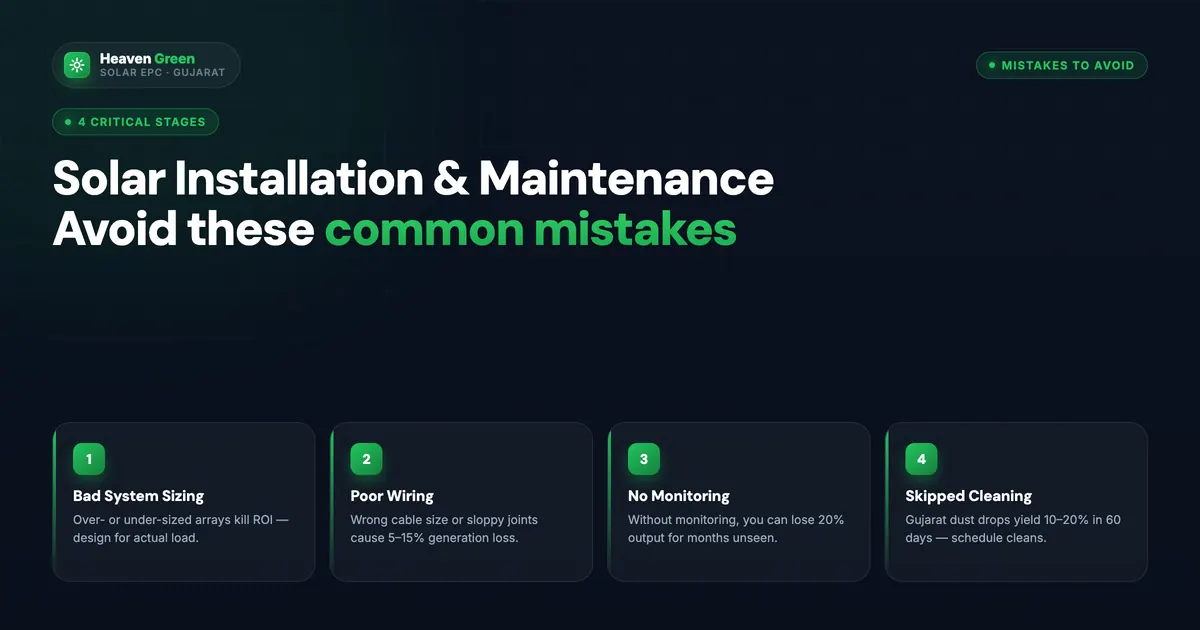
For the connected reading on what to do after handover, see our guides on monitoring solar generation, diagnosing low generation, and the common installation mistakes to avoid.
Frequently Asked Questions
How long does a proper post-installation inspection take?
A complete 12-point inspection for a residential 3 to 5 kW system takes 60 to 90 minutes when the installer is cooperative and all tools are on site. Larger commercial systems (10 to 50 kW) take 3 to 4 hours because of the additional string testing and per-panel IR scanning. If your installer says the inspection can be wrapped up in 15 minutes, they are skipping the measured tests, particularly the earthing resistance and the torque sampling. Insist on the full walk-through before signing the handover certificate; rushed inspections are the single largest source of year-two warranty disputes.
What is the acceptable earthing resistance for a solar installation in India?
IS 3043, the Indian Standard Code of Practice for Earthing, specifies that the earth pit serving a solar PV installation must measure at or below 1 ohm of resistance for safe surge dissipation. Some installers cite 5 ohms as acceptable, but that is the threshold for general electrical earthing, not for surge-protected solar installations. Always demand a live 3-point earth resistance test with a calibrated tester at handover, and insist on a signed earth-test certificate that becomes part of your permanent commissioning file. A reading above 1 ohm requires the installer to add salt-charcoal layers or extend the electrode before sign-off.
How do I verify that the solar panels installed are the same ones I paid for?
Each panel sold in India carries a unique serial number printed on the back-label, and reputable manufacturers like Adani, Waaree, and Tata publish ALMM-registered serial ranges. At handover, photograph every panel’s serial number, request the manufacturer’s packing list from your installer, and cross-check each serial against the list. For Adani panels specifically, our verify genuine Adani panels guide walks through the back-label decode. If a serial does not appear in the packing list or on the ALMM register, you have a counterfeit or grey-market panel, refuse handover until the panels are swapped.
What if my installer refuses to demonstrate the earthing test or the IR scan?
A refusal, or even reluctance, to perform measured tests in your presence is itself the inspection result. Do not sign the handover certificate, do not release the final payment, and request a written explanation for why the test cannot be performed. Reputable installers carry the tools to every commissioning; if yours does not, either they will rent one within 24 hours or they were never planning to test in the first place. Contact our Heaven Green commissioning team for a paid third-party audit if you want an independent measurement before signing off.
Can I run the 12-point inspection myself or do I need an electrician?
The visual and document checks (panel count, serials, MCB labels, conduit sealing, monitoring app, generation against nameplate, commissioning binder) can be done by any careful homeowner with a smartphone. The measured tests, earthing resistance, torque sampling, IR scanning, need either rented instruments or a qualified electrician. Most homeowners we work with run the visual checks themselves and ask the installer to demonstrate the measured tests live; this combination catches roughly 90% of latent defects without any third-party cost. For commercial installations above 10 kW, a qualified third-party commissioning engineer is strongly recommended.
How long after installation should generation match the inverter nameplate?
A properly installed system should deliver instantaneous power within 10% of its rated DC capacity on the very first clear-sky day between 11 a.m. and 2 p.m. A 3 kWp Adani system should show 2.7 to 3.0 kW on the inverter display at solar noon when ambient irradiance exceeds 800 W/m². If you are seeing significantly less on day one, you have a wiring polarity error, a string fault, shading, or a soiled panel set. Generation that improves over weeks is a red flag, it usually means the installer is reporting the gradual fixing of defects as “system stabilising”, which is not a real phenomenon.
What documents do I need to keep for warranty claims later?
Keep the entire commissioning binder for 25 years, the warranty period on the panels. The essential documents are: panel and inverter warranty cards (with photographs of the serials), ALMM and BIS certificates, signed earth-test certificate, single-line diagram, bill of materials, commissioning report from the PM Suryaghar portal, and the DISCOM-sealed bidirectional meter receipt. Store both a hard copy and a cloud-backed PDF set. The most common reason solar warranty claims are denied in India is not that the component failed, but that the customer cannot produce the original warranty card seven years later.
Does PM Suryaghar subsidy depend on the handover inspection passing?
Yes. The PM Suryaghar Direct Benefit Transfer is triggered only after the DISCOM field engineer signs off the net-meter inspection and the installer uploads a complete commissioning report, including earth-test results, panel and inverter serials, and ALMM certificates, to the PM Suryaghar portal. If any of these documents is missing or mismatched, the subsidy is paused until the gap is closed. For the complete subsidy workflow and the documents the DISCOM specifically checks, see our PM Suryaghar complete guide.
How often should I re-inspect the installation after handover?
The full 12-point inspection is a one-time handover check. After commissioning, run a lighter quarterly maintenance checklist: visual check of panel cleanliness, monitoring app generation against expected baseline, and a once-a-year earth-resistance re-test before the monsoon, QBits Energy’s pre-monsoon solar inspection checklist is a useful reference for timing that annual retest. The IR camera scan should be repeated every 2 years or whenever the monitoring app flags string imbalance. Our low solar generation diagnosis guide covers the in-life troubleshooting workflow, and our O&M contracts include a scheduled annual physical audit at no extra cost.