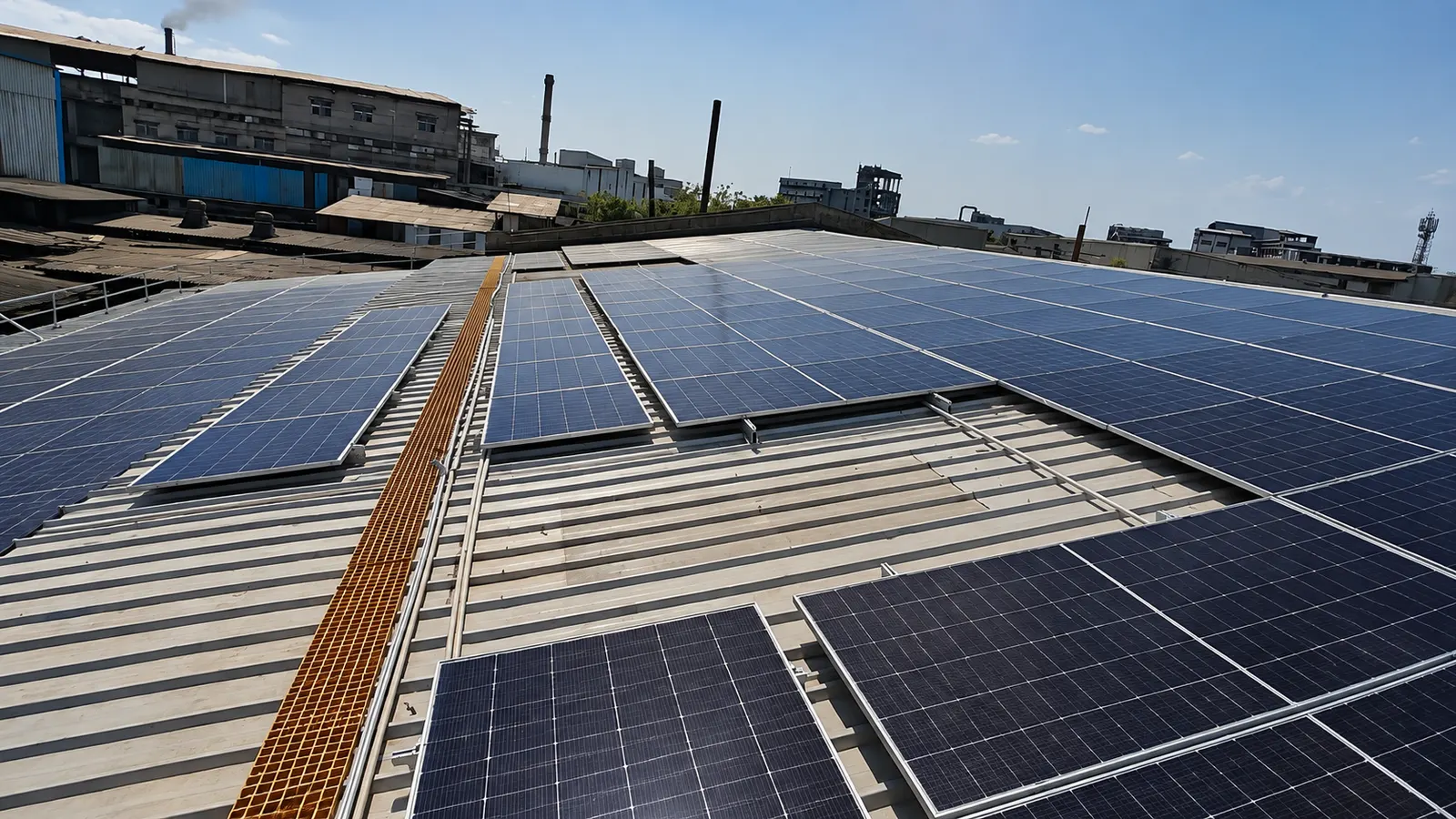
An induction furnace can dominate a foundry’s electricity use, but a rooftop solar array does not become a furnace power supply just because the monthly bill is large. The melt cycle, HT demand charge, roof area and grid connection determine what solar can displace. A Rajkot or Shapar-Veraval owner needs a measured load profile before comparing rooftop and off-site options.
Direct answer. Rooftop solar can reduce grid energy used during daylight melting and by foundry auxiliaries, but it rarely removes the furnace’s maximum-demand requirement or night imports. Record furnace melting and holding loads separately from auxiliaries. Use interval meter data, the PGVCL tariff effective 1 April 2026, roof survey and power-quality measurements to choose a realistic route.
How do melt cycles and auxiliaries shape daytime demand?
For a Gujarat net-metering proposal, also check the DRES instrument signed 30 October 2026. Its published non-residential rule caps exported-energy set-off at 30% of grid imports in the billing cycle, with applicable banking charges and lapse of exports beyond the cap. This can change the value of low-load-day surplus. Gazette commencement and the terms governing the account must be confirmed with the DISCOM; direct on-site use is a separate quantity.
Induction melting occurs in batches. Electrical demand rises while the furnace heats a charge and changes when the melt is poured or the next batch is prepared. Moulding, sand handling, compressors, cooling water, dust extraction and lighting add a smaller but steadier background. A solar system can overlap both, but its output follows sunlight rather than the melt timetable. A high annual electricity bill does not prove that the roof can cover the instantaneous furnace draw.
Record a full melt cycle with the furnace, cooling pumps, extraction, compressors and finishing equipment identified on the same time axis. Note charging, melting, holding, pouring and idle periods. Use the meter data to see which equipment sets the plant peak and which loads continue through a midday pause. A sector average cannot set the solar size for a Rajkot plant; the calculation needs the factory’s actual shift and batch records.
Separate kWh from kW or kVA. The furnace may consume many units over a month while a short high-power period establishes maximum demand. Solar can lower imported kWh during sunny operation but cannot be counted on to be present during the highest recorded demand interval. Clouds, melt timing and evening operation make that assumption especially weak. The maximum-demand guide explains the billing effect.
Use a checklist. Record the furnace cycle and auxiliary load, check the utility meter’s interval demand and power factor, then calculate the usable roof and approved solar connection. If the roof is small relative to the furnace load, rooftop can still offset the continuous auxiliaries and part of daytime melting. The test keeps the sales answer honest: a rooftop array may be useful without claiming to run the whole foundry.
| Foundry load | Typical timing question | Solar design implication |
|---|---|---|
| Induction furnace | Which melt batches occur in solar hours? | Model interval overlap and residual grid peak |
| Cooling and pumps | What runs between batches? | May provide a steady daytime base load |
| Compressors and extraction | Does it cycle or run continuously? | Check direct use and power-quality interaction |
| Lighting and night shift | How much occurs after sunset? | Remains grid or separate backup load |
This table is a checklist. It makes no claim about the load share of a particular Rajkot foundry.
How should the PGVCL HT bill be read before sizing solar?
Read the entire PGVCL bill, including the consumer category, contract demand, recorded demand, energy units, power-factor line, time-of-use line and adjustments. The GERC tariff schedule for DGVCL, MGVCL, PGVCL and UGVCL effective 1 April 2026 contains HTP-I and other HT categories. The GERC PGVCL tariff order, Case 2583/2025 dated 25 March 2026 is the current FY 2026-27 order listed by the regulator. Use the category printed on the plant’s bill, not an assumed “foundry tariff.”
Under the cited HTP-I schedule, billing demand and energy charges are distinct. A foundry can offset some imported energy with solar while still paying for a contract-demand floor and any demand above its contract. A melt batch during a cloud transient can set the month’s recorded maximum. The proposal should show the maximum-demand calculation separately from the energy saving. If a bidder claims solar will reduce demand charges, request interval evidence and a scenario with no solar output at the critical peak.
The same tariff schedule has power-factor adjustment provisions for HT consumers. An induction furnace and its power-electronics equipment can draw reactive power or create harmonics. Solar reduces active grid import and can change the grid-side PF reading. The power-factor penalty guide and kVAh billing guide explain the measurements. Do not install a larger capacitor bank merely because a solar proposal mentions PF; measure the existing system and review APFC and inverter settings.
These dates identify the sources, not a promise that every foundry has the same rate or equipment. If the bill is not PGVCL, use the relevant licensee order. If the meter category or contract demand has changed, model the approved current connection.
Why can rooftop solar cover only part of melting?
The limiting factors are roof area, time overlap and the grid connection. A foundry may have a large furnace in a relatively compact building, leaving little roof per unit of electrical load. Rooflights, stacks, extraction equipment and heat vents can reduce usable space. Solar modules also need safe access and protection from heavy deposits. A gross shed area should not be converted directly to system capacity.
The furnace’s melt cycle may continue through clouds or after sunset. An on-grid array reduces import when it generates and the grid is present, but it does not provide a guaranteed power block to the furnace. Even a solar plant with a high annual yield could miss the interval that sets monthly demand. The Rajkot-related ceramic industry guide covers another energy-intensive Gujarat industry; the foundry’s batch cycle needs its own model.
Illustrative example, not a project forecast: suppose a foundry draws 500 kW during a daytime melt and a rooftop array produces 100 kW at that instant. Grid import is about 400 kW before losses and any other onsite generation. If a cloud reduces solar output to 20 kW while the furnace remains at 500 kW, grid import rises to about 480 kW. A night melt would draw the full load from the grid or another supply source. This arithmetic shows why solar can cut energy without reliably reducing recorded maximum demand.
The right rooftop size should therefore be compared with a minimum daytime load and a typical melt schedule. A smaller array that is used on most operating days can be more predictable than a larger one that exports on holidays or when the furnace is idle. The exact export value depends on the current GERC rooftop connection and settlement arrangement. The solar-capacity versus sanctioned-load guide explains another cap on rooftop design.
Watch out
A large monthly bill does not prove that rooftop solar will reduce the furnace's maximum demand or replace its grid connection.
If the roof is structurally weak or reserved for expansion, the owner may compare another site. The industrial solar page is the factory proposal route, while a separate ground-mount project route has different land and grid approvals.
When should a foundry consider open access or group captive?
Off-site supply deserves study when the roof cannot accommodate enough modules or the foundry wants a larger annual renewable share. Gujarat’s GERC Green Energy Open Access Regulations, Notification 08/2024, set the local route, eligibility and charge framework. The national MoP clarification of 12 February 2024 describes the 100 kW non-captive eligibility threshold and a captive exception. The actual HT meter, contract demand and approved generator path decide what the foundry can use.
Open access is not a way to make a furnace’s power instantaneously solar-only. The grid still carries and balances energy, and the plant retains its electrical connection. An off-site solar project generates in sunlight while a foundry may melt at night. Banking, scheduling or residual grid supply will decide how those periods are settled. The Gujarat open-access landed-cost guide shows the current network charges, losses and conditional surcharges line by line.
A third-party PPA and group captive structure have different ownership, compliance and surcharge consequences. The group-captive glossary and captive versus third-party PPA guide explain those choices. A developer’s use of the word “captive” is not sufficient evidence that the required ownership and consumption tests are satisfied. Ask for the legal structure and annual verification method before modelling an exemption.
| Route | Strongest reason to examine it | Main unresolved check |
|---|---|---|
| Rooftop behind the foundry meter | Direct daytime use without off-site network path | Roof area, structure and export rules |
| Third-party open access | Off-site supply without plant ownership | Delivered-unit cost and contract risk |
| Group captive | Shared asset ownership with potential surcharge treatment | Equity, consumption and compliance proof |
The comparison must use the same delivered kWh and the same melt schedule. It should not compare an injected PPA rate with the whole retail bill. Contract-demand, power factor and other charges can remain.
Compare rooftop and off-site routes. Share the PGVCL bill, melt schedule and roof details through industrial solar so a proposal can separate energy offset from furnace demand.
What harmonics and protection checks are needed?
An induction furnace can create power-quality challenges because its converter changes electrical power for the melting process. The exact harmonic and reactive-power behaviour depends on the equipment, transformer, filters and operating point. Solar inverters add another grid-connected electronic source. The correct response is a baseline measurement and a coordinated design, not a generic claim that solar causes or cures a furnace’s power-quality problem.
The CEA regulations compendium published in 2024 includes grid connectivity standards for bulk consumers and harmonics at the point of common coupling, with reference to IEEE 519. The site should use the applicable current standard and its DISCOM connection conditions. A power-quality consultant can measure voltage, current harmonics, PF and events during a full melt cycle, including start and hold periods. Keep batch electricity, furnace output and operating-condition records together so the engineer can compare like-for-like melt cycles.
The EPC should show the solar point of connection, transformer, relays, anti-islanding protection, earthing, APFC, filters and any generator interface on a single-line diagram. Protection coordination must account for fault levels and operating modes. A rooftop approval or CEI inspection may be required under the actual project route. The CEIG approval guide covers the Gujarat process. The plant should not change inverter reactive-power settings or APFC steps without checking their effect over the furnace’s operating range.
Technical note
Measure the point of common coupling through a full melt cycle before finalising APFC, filtering and inverter settings.
After commissioning, repeat measurements under comparable melt conditions and retain the report. The baseline and follow-up record lets the owner investigate a future penalty or trip without guessing. A bid should assign who performs those tests and what happens if the measured result is outside the agreed limits.
Put the harmonic and power-factor checks into the acceptance schedule, with the measurement point, operating condition and responsible engineer named. A result taken while the furnace is idle may not represent the melt cycle. The commissioning record should say which inverter settings and capacitor-bank steps were active when measurements were taken, so a later tariff or protection complaint can be investigated against a known baseline.
How should a Shapar-Veraval roof and work plan be assessed?
Shapar-Veraval and Rajkot foundries can have old shed roofs, high roof vents, stacks and dust deposits. Those are site-specific possibilities, not properties of every building in the cluster. The engineer should inspect purlins, corrosion, roof sheet type, penetrations and the load path to the main frame. The roof-strength guide provides the general method; the old-roof guide covers fragile cement and aged metal sheets.
The layout should preserve extraction and cooling equipment access. A roof vent cannot be blocked to make a neat solar rectangle. Dust accumulation can affect modules and service access; the cleaning method should be specified without promising a universal frequency. A plant with hot exhaust or abrasive deposits may need different module positioning and cable protection from a clean warehouse. The proposal should name those exposure assumptions and the inspection method.
Construction should be phased around the melt shop. Material lifting, hot work and roof access need exclusion zones below. The electrical tie-in should occur under a planned isolation and permit-to-work process. The factory installation without shutdown guide explains that roof work can often be phased while the final connection still needs a controlled interruption. Do not sell an unconditional “zero shutdown” plan to a foundry before the electrical interface is designed.
The plant should review fire and emergency access around panels and cable runs. Keep a route to roof equipment, isolation points and exits. A future furnace maintenance or building extension can change roof use, so ask for the site master plan before filling every clear bay. The structural design and maintenance plan should work for the long term, not only for the first day of commissioning.
Ask the EPC to return a roof drawing with usable area, exclusions, structure calculations, mounting detail, access routes, cable route and a construction sequence. If reinforcement or replacement is needed, it should appear as a separate scope. An apparently low solar quote may omit the work that makes the roof safe and buildable.
What should the owner demand from an EPC yield and bill model?
The EPC should provide a generation profile, not just an annual kWh estimate. A foundry needs to see the expected output during its melt and auxiliary operating hours, the seasonal variation and the assumptions about roof shade, heat and dust. The model should distinguish generation from self-consumption, export and grid import. Annual generation alone cannot tell the owner whether the plant will use most solar units or send them through a less valuable settlement route.
The bill model should then apply the current PGVCL category and order. Show energy charges separately from demand, PF, time-of-use, fuel adjustment and other relevant lines. If solar is expected to change any non-energy line, the bidder should show the calculation and the operating condition that makes it happen. A maximum-demand reduction should be tested against a cloudy melt interval and an evening melt. A PF change should be tested against measured reactive demand and the proposed inverter settings. The solar bill guide explains why a lower import total does not erase every bill component.
Ask for two operating cases. The first should use the present melt schedule and measured interval profile. The second should use a planned expansion or an alternative shift if management has approved one. Keep the cases separate. If the expansion is uncertain, it should not justify a large array that exports heavily today. If a new furnace is already ordered, the baseline case alone can understate future direct use. The bid should identify each assumption and its source.
- ✓ Interval load and solar output are matched.
- ✓ Demand and PF remain separate bill lines.
- ✗ Annual units are divided by a single retail rate.
- ✗ Furnace demand is assumed to vanish on sunny days.
The owner should be able to reproduce the arithmetic from the bill, interval data and generation assumptions. That is the standard for comparing two EPC bids. If a seller offers only a single savings figure, request the underlying unit and tariff ledger before signing. A transparent model helps the plant team plan the electrical interface as well as the finance case.
How Heaven Green Energy helps scope Foundry Solar
Start with the complete PGVCL bill, interval demand if available, furnace melt schedule, roof plan, electrical single-line diagram and any power-quality report. These are the inputs for an honest split between daytime energy offset, demand charges, PF and roof capacity. Heaven Green Energy files DISCOM paperwork for its customers, but the factory needs to provide accurate connection and site records.
The relevant routes are:
- Industrial solar for an on-site foundry rooftop proposal.
- Commercial solar for a smaller business premise.
- Ground-mount solar park for a separately assessed off-site or land-based project.
Ask each bidder to return the same evidence. The generation model should use interval melt and auxiliary loads. The bill model should retain demand, PF and time-of-use lines where applicable. The electrical design should show protection, harmonics and APFC responsibilities. The roof scope should include safe access and structural calculations. The industrial EPC bid checklist helps compare proposals on a common basis.
The procurement sequence can be simple:
- Measure the melt cycle. Capture demand, energy and power quality across representative batches.
- Check the roof. Verify structure, usable area, vents and maintenance routes.
- Model the bill. Separate energy offset from maximum-demand and PF effects.
- Compare routes. Price rooftop and any eligible open-access option on delivered units.
- Approve the interface. Obtain DISCOM, protection and inspector decisions before commissioning.
Use the industrial solar page for the primary factory proposal enquiry. The first valuable output is a documented feasible scope. It should tell the owner how much of the foundry’s load occurs when solar is available, what the roof can safely hold and which grid charges remain. That gives the finance and plant teams a decision they can check against real records.
Before accepting a quoted plant size, compare at least one normal production week with a maintenance or reduced-output week. Mark furnace starts, auxiliary loads and midday shutdowns on the same interval chart as the proposed solar output. Then ask the EPC to show how each period affects import, export, maximum demand and power factor. An annual units estimate alone can conceal a design that exports heavily on non-melting days. The comparison should also identify who will verify relay settings, harmonic measurements and capacitor-bank behaviour after energisation, because those checks belong to the site’s actual electrical interface rather than to a generic module specification.
Frequently asked questions
Can rooftop solar run an induction furnace?
It can offset some grid energy while sunlight and the grid are present, but output varies and the furnace’s melt demand can be much larger than the rooftop array. A standard on-grid inverter is not a stand-alone furnace supply or outage backup.
Will solar reduce a foundry’s maximum-demand charge?
It may lower a particular sunny interval, but cloud changes, furnace batches and evening operation can leave the recorded maximum unchanged. Use the PGVCL tariff and interval data before putting any demand-charge reduction in a proposal.
What tariff should a Rajkot foundry use in its solar model?
Use the category and licensee on the actual bill. GERC’s PGVCL FY 2026-27 order is dated 25 March 2026, and the common state-DISCOM tariff schedule is effective 1 April 2026. Do not assume every foundry has the same HT category.
Is open access better than rooftop for an induction furnace unit?
It can cover more annual energy when the roof is small, but the delivered cost includes network charges, losses and any applicable surcharges or banking. Compare the same delivered kWh and melt schedule for rooftop, third-party and captive routes.
Do induction furnaces require a harmonic study before solar?
A study is prudent when the site has significant power-electronics loads or existing quality issues. Measure the point of common coupling through a representative melt cycle, then coordinate inverter, filter, APFC and protection settings under the applicable CEA and DISCOM requirements.
What should a foundry send for a solar proposal?
Send the full PGVCL bill, interval demand and production schedule, furnace details, electrical single-line diagram, roof drawings and any existing power-quality report. Those inputs let the EPC distinguish energy offset from demand and power-quality questions.