Direct answer. Start with a year of bills for the society’s common-facilities meter. Record when lifts, pumps and lights use power. Match that use with expected solar output, then check the roof, approved load and export rules. Compare more than one size. Review the GHS/RWA subsidy conditions before the committee approves a quote.
Which electricity bill should the committee use?
Start with the bill for the society’s common facilities. It may include lifts, water pumps, corridor and parking lights, security equipment, a clubhouse and EV charging. Individual flats normally have separate residential accounts. A solar plant connected to the common account should be modelled against that account, not against the sum of every resident’s bill. The housing-society solar guide explains ownership and billing structures; this page focuses on the sizing calculation.
Request twelve consecutive bills, including summer and monsoon periods. Record imported units, billing days, tariff category, sanctioned load, demand or fixed charges, and any existing solar credit. A bill amount in rupees is a poor sizing input because it includes charges that panels cannot necessarily avoid. Units provide a starting energy quantity; the hourly load profile determines how much generation the site can use directly. If the society has several common meters, list them separately and ask the DISCOM which sharing mechanism is approved. Do not add them together and assume one plant can credit all accounts.
Identify the common-facilities meter, record when its loads run, survey the usable roof and check the current approval and scheme rules. Meter identifies the account that will receive solar. Hours shows when lifts, pumps and other loads consume electricity. Roof measures safe unshaded space. Rule checks sanctioned load, interconnection and scheme eligibility. The sanctioned-load glossary explains the utility term. The net-metering glossary explains why exported power is settled under a specific mechanism rather than automatically moving to every flat.
For a hypothetical society, suppose the common meter shows 9,000 units in a month. That is about 300 units per day if the month has 30 billing days. The committee should not divide 300 by a generic generation number and sign a quote. It must first learn whether most units are consumed by daytime pumps and lift trips, or by night lighting and security. Two societies with the same monthly total can need different solar sizes.
| Record from the bill | Why it matters | Committee action |
|---|---|---|
| Common meter units | Energy to compare with generation | Gather 12 months |
| Sanctioned load | Possible interconnection constraint | Verify with DISCOM |
| Tariff and fixed charges | Determines avoided value | Keep separate from units |
| Billing account holder | Application and ownership | Match society records |
The bill file should include any feeder or meter changes during the year. Otherwise an apparent drop in units may be a bookkeeping change rather than lower load.
How much energy do lifts, pumps and lights actually use?
Motor power in kilowatts is not the same as units consumed. A 10 kW lift motor does not run at full rating for every hour the building is open. It starts, travels and stops. Its daily kWh depends on trips, travel, standby draw and drive efficiency. Similarly, a pump’s kWh depends on its actual run time and operating point, not only the nameplate. Ask the maintenance team for run-hour logs or short interval meter data before turning equipment ratings into a solar estimate.
Break the common load into at least four groups: daylight, evening, overnight and intermittent peaks. Pumps often can be scheduled partly in daylight if the water system and resident demand permit. Corridor and parking lights usually remain mostly after sunset. Lifts run across the day but have sharp short peaks. Security and network equipment may run continuously. A solar system can offset the daytime energy, but it should not be credited with eliminating every evening unit or every motor peak. The solar-and-power-cuts guide explains why ordinary grid-tied solar does not provide backup during an outage.
Here is an illustrative load audit, not a measured society or a performance promise. Assume pumps consume 80 units daily, with 60 during daylight. Lifts consume 65, with 35 during daylight. Common lighting consumes 75, with 10 during daylight. Security, ventilation and other uses consume 80, with 40 during daylight. The total is 300 units daily; the daytime part is 145. A proposal that assumes all 300 units can be self-used during solar hours would overstate direct consumption. Exports may have a different value and settlement.
| Illustrative load | Daily units | Daylight units | Main question |
|---|---|---|---|
| Pumps | 80 | 60 | Can some runs move to daylight? |
| Lifts | 65 | 35 | What are actual trips and standby use? |
| Lighting | 75 | 10 | Which circuits run by day? |
| Other common loads | 80 | 40 | Are loads steady or occasional? |
| Total | 300 | 145 | Size from the profile, not the total alone |
The numbers are deliberately hypothetical. A real load logger or utility interval data can reveal different peaks and seasonal changes. The committee should ask the EPC to show the data source behind each load assumption.
How do you turn those units into a solar size?
Use a named model and stated inputs to estimate monthly solar units per kW. For this example, assume 120 kWh per kW per month after losses. This is a hypothetical input, not a Gujarat benchmark or Heaven Green performance claim. For a target of roughly 4,500 daytime units a month, 4,500 ÷ 120 = 37.5 kW. A designer can test sizes around that figure. The final choice needs checks for orientation, shade, export rules and seasonal output.
The arithmetic is only the first pass. Solar produces most of its energy near midday, while lifts and pumps may consume unevenly. A 37.5 kW plant could export at noon even if the society’s total daylight use across the day is 4,500 units. Ask for an hourly simulation that shows direct use and exports. The solar generation by state explains how location, monsoon, tilt, temperature and system loss change output. Do not simply multiply a sunny-day figure by every day of the year.
Model at least three cases: a size that prioritizes direct daytime use, a larger size that relies partly on export credit, and a roof-limited size. For each case show annual generation, self-used units, exported units, remaining imports and charges that remain payable. A fixed monthly charge or minimum demand charge may remain even if energy imports fall. The bill-slabs guide explains why an electricity bill is more than one unit rate.
Use this sequence with the EPC:
- Obtain a year of bills and an hourly or representative load profile.
- Separate common-facility loads from individual flat consumption.
- Model monthly generation using the actual location and roof geometry.
- Calculate direct use and exports under the proposed meter arrangement.
- Check state capacity rules, sanctioned load and scheme limits.
- Compare designs on annual units and remaining bill components.
A claim that “one kW produces X units everywhere” skips the key difference between a shaded lift-room roof and an open terrace. Ask to see the assumptions and sensitivity to lower generation before the committee votes.
Sizing caution
The 120 kWh per kW monthly figure above is an illustrative calculation input. Replace it with a site model and compare sunny, monsoon and low-output periods before approving capacity.
What roof and electrical limits can stop a larger design?
The apparent roof area includes places that cannot host modules safely. Lift machine rooms, water tanks, plumbing vents, fire exits, parapet shadows, maintenance paths and future repair zones all reduce usable area. A panel layout should show these exclusions. The roof inspection guide explains what a survey checks. A structural engineer should review roof capacity, waterproofing and mounting before the society treats a drawing as buildable.
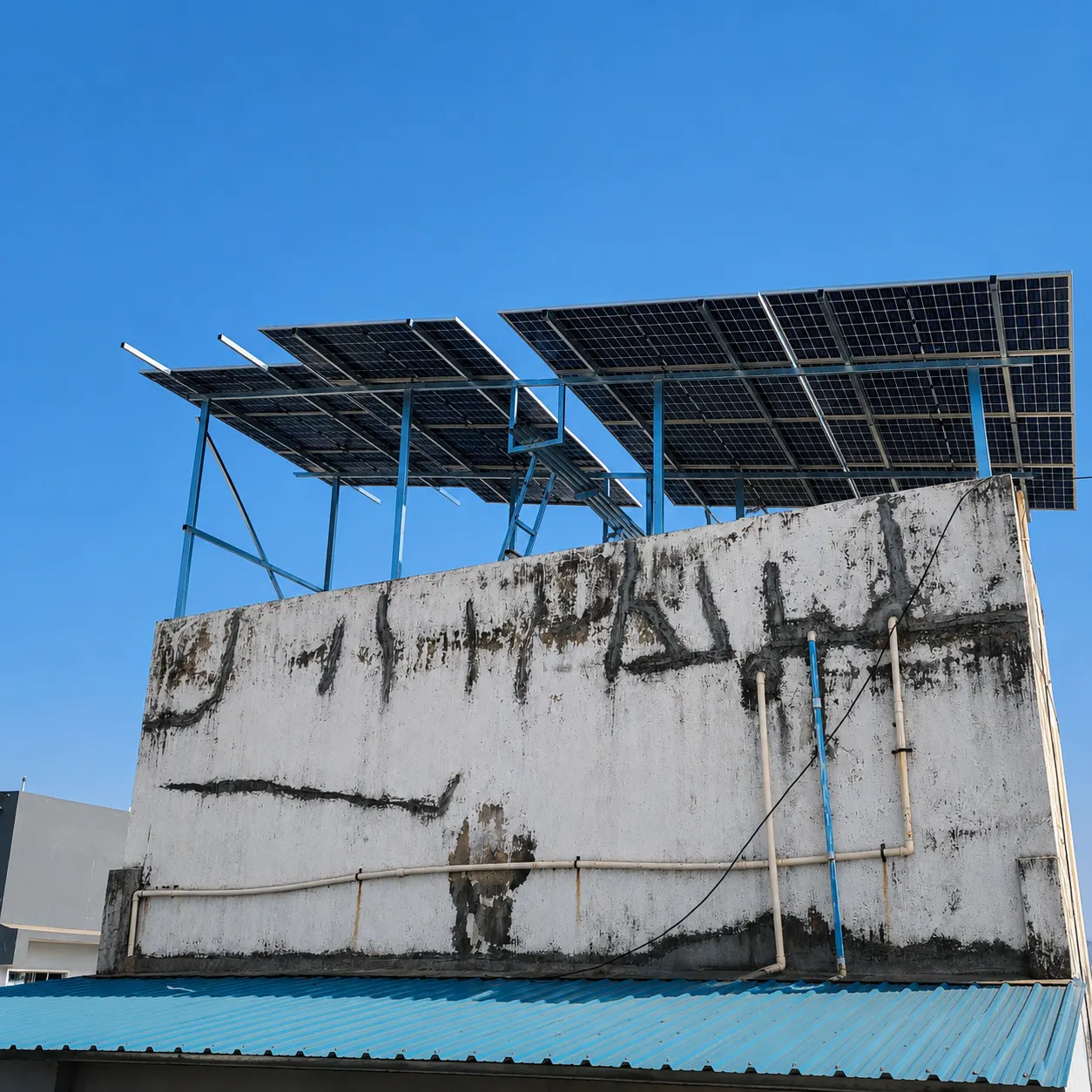
Keep access to lift equipment and water tanks. A technician must be able to reach valves, motors and electrical panels without moving modules. If an elevated structure is considered to preserve terrace use, check wind loading, anchors and drainage with the elevated structure guide. A visually open terrace can still be unsuitable because of shade or weak slabs. Do not use a fixed square-metres-per-kW rule as the final design.
Roof space does not settle the electrical limit. Check the common account’s approved load, voltage, network and connection. DRES instrument signed 30 October 2026 publishes group and virtual net-metering routes. It sets conditions for consumers, tariffs, licensees, capacity and allocation. Clause 1.2 ties commencement to Gazette notification. Confirm which instrument is in force and how the utility applies it to these accounts. A published route alone does not approve a sharing design.
Fire access and emergency isolation should be shown on the roof plan. A society is occupied throughout installation, so material movement and work zones need coordination with residents. The solar fire-safety guide covers protective equipment and isolation. The maintenance committee should know who can shut down the plant and who holds the final single-line drawing.
If the roof is small, the committee can prioritize the most productive unshaded zones and size the plant for direct common load. Extra modules on a heavily shaded area may add less useful generation than the quote implies. Ask for a shade study and a roof plan with measured dimensions before approving any capacity.
Size from the common-area meter. Share a full year of society bills, lift and pump schedules and available roof plans through society solar. Ask for the export and subsidy assumptions beside the proposed system size.
What is the PM Surya Ghar rule for GHS and RWA systems?
The ordinary-category rate is ₹18,000 per kWp. It covers eligible GHS/RWA common facilities, including EV charging. PIB stated this rate on 7 August 2024. The cap is 500 kWp, subject to 3 kWp per house. The scheme notice, checked on 30 October 2026, adds two rules. Count residents’ own rooftop systems within the supported capacity limit. The society meter must serve common facilities, not homes. Check eligibility before putting a subsidy in the budget.
The MNRE operational guidelines page dated 7 June 2024 is the main starting point for applications and compliance. Use the current portal and DISCOM instructions before budgeting a subsidy. Check the bill category, applicant, design and records. If the common meter is classed as a commercial tenant account, resolve that first. Do not assume it qualifies as GHS/RWA.
Here is an illustrative cap test. For 100 houses, 3 kWp per house gives 300 kWp. The overall 500 kWp cap and other scheme rules still apply. Qualifying residents’ rooftop systems count toward the limit. These can leave less supported capacity for the common plant. This example does not approve a 300 kWp plant or calculate its subsidy. The roof, common load and utility approval may justify a much smaller size.
Do not confuse the common-facilities rate with the individual household rate. A flat owner’s private meter and a society’s shared account are different applicants and loads. The flat-owner guide explains the individual route, while the society NOC guide covers consent to use a shared roof. The committee should maintain a register of resident systems and common projects if it intends to claim scheme support.
First model the plant without CFA. Then add a separate CFA case if written portal and DISCOM confirmation supports eligibility. This keeps an unconfirmed subsidy out of the base budget if the society’s facts differ from a brochure example.
Scheme check
For the common account, verify the consumer category, house count, existing resident plants and approved capacity before counting any GHS/RWA CFA in the budget.
How should the committee compare the proposed sizes?
Compare more than installed kW. Ask bidders to use the same roof area, weather source, orientation, shade method and system losses. Give them the same hourly load profile. Then compare generation, direct use, exports and remaining imports. The how-to-read-solar-quote guide helps find missing inputs. Two plants of the same size can make very different claims about self-use and export.
Use three alternatives with the same inputs. The direct-use case limits capacity to a level that the common meter is likely to use during solar hours. The export case allows a larger array, but states the current licensee settlement value and any limits. The roof case uses only the practical unshaded area. For each alternative, ask what happens in monsoon months and on days when pumps are off. The committee should see the sensitivity, not a single annual total.
| Comparison item | Direct-use case | Export case | Roof-limited case |
|---|---|---|---|
| Capacity | EPC to model | EPC to model | EPC to model |
| Directly used units | Highest share expected | Lower share possible | Depends on roof |
| Export assumption | Limited | Must cite settlement rule | Site-specific |
| Scheme eligibility | Verify | Verify | Verify |
| Main risk | Too little headroom | Export value overstated | Shade or access |
The table is a decision template, not a forecast. Fill it with measured bills and a dated regulatory basis. The solar calculator can help frame the first discussion, but the committee should require a site-specific proposal for a multi-building system.
Request a written equipment and maintenance plan. Society arrays can be difficult to clean if lifts, tanks and water pipes split the roof. The O&M scope should name access procedures, monitoring, fault response and responsibility for waterproofing. Ask who owns the plant after a change in committee, who keeps portal credentials and who approves an inverter replacement. The warranty guide explains why the handover file should be stored with society records.
The proposal should also show the remaining bill. Solar may reduce energy imports, but fixed, demand, tax or other tariff components can remain. A savings percentage promise is less useful than a transparent model of monthly units and bill line items. Give residents a comparison they can audit with future meter readings.
A reviewable proposal
- Uses the common meter's 12 bills
- Shows daylight load and exports
- Includes measured roof and shade
- Names the current utility rule
Questions to resolve
- Combined flat and common bills
- Unverified subsidy cap
- Blocked roof maintenance paths
- No remaining-bill model
What approvals should the society complete first?
The committee needs authority to use a shared roof and spend common funds. Check the society’s governing documents, meeting and voting requirements, and any roof rights already granted to flat owners. The society NOC guide explains how consent can be documented. A committee vote should approve a defined plant location, budget, ownership model and maintenance duty. A vague approval for “solar” can leave later disputes over tanks, terraces or residents’ individual systems.
Confirm who holds the common meter and its tariff category. The application must match the society’s legal name and records. Ask the DISCOM about feasibility, maximum size, meter work, export settlement and any electrical inspection. Review the GERC rooftop regulation index, checked on 30 October 2026, with the Gujarat licensee. For Maharashtra or MP, use that state’s current regulator and utility process. Gujarat limits and credit terms do not transfer automatically.
Approve a measured roof survey. Record shade, structural checks, roof seals, cable routes, emergency isolation and work access. Lifts and pumps must remain safe while the work proceeds. The contractor should mark lifting routes, barriers around occupied areas and the planned electrical tie-in window. The industrial installation guide explains similar work in occupied buildings. A society also needs a resident-safety plan.
Before signing for GHS/RWA CFA, check the house count and residents’ rooftop plants against the scheme cap. The PIB 7 August 2024 answer gives the published rate and limit. Confirm the live application steps with the national portal and local DISCOM. Save the written eligibility decision in the society file.
Name one committee officer and one facility manager to keep the records. Give them as-built drawings, commissioning records, meter details, warranties and monitoring access. The next committee may need these to trace a fault or support an insurance claim. Review the maintenance policy when actual output data is available.
How Heaven Green Energy helps with a society proposal
A society proposal should begin with the common-facilities bill and the roof, not a standard capacity package. Send twelve months of the shared meter’s bills, the society’s house count, a list of existing resident solar systems and a rough roof plan. Mark lift rooms, tanks and places residents must continue to access. This information lets an EPC prepare a measured site review and identify the approvals that need a utility answer.
Request a size comparison with clear output assumptions. Separate direct use from exports. If the society has several common meters, show how each is treated. Any subsidy assumption needs a source and a written application path. The housing-society service page is for committee-led projects. The residential-solar page is for an individual home’s separate connection.
Heaven Green Energy can help customers with PM Surya Ghar and DISCOM paperwork. The society should still review and authorize its own application details, roof rights and financial assumptions. A committee member should retain the portal login and approval records rather than leaving the history with a single office bearer. The housing-society solar guide provides the broader governance context.
- Solar for housing societies for a committee-led common-facilities proposal.
- Residential solar for an individual household connection.
Include the required records in the proposal request. Ask for bill data, a measured layout, structural checks and a load profile. Add the current rule, generation and export models, equipment list, work plan and maintenance scope. Bidders should mark exclusions clearly. Residents can then compare the work included, rather than just two final prices.
The committee can then decide whether to install a smaller plant now or preserve some roof for future resident systems. That choice should be made with the scheme’s combined-capacity condition and actual roof access in view. There is no single right size for all societies, even those with the same number of flats.
Committee verdict. Approve a capacity only after the bill, load profile, usable roof and current rule tell the same story. The cheapest or largest quote can be the wrong fit if it assumes every lift unit is consumed at noon or every export earns the retail tariff.
For a committee review, send the common-area bills and roof plan through solar for housing societies. Ask for a site-specific sizing comparison and a documented GHS/RWA eligibility check.
Frequently asked questions
Can a society size solar from the common bill amount alone?
No. The amount includes tariff components that solar may not remove. Start with the common meter’s units, then separate daytime and night use. The final design needs a site generation model, roof plan and the applicable export rule. A rupee-to-kW shortcut can oversize the plant.
Should the lift motor rating be added to pump and lighting ratings?
Only as part of an electrical-load and inverter check. Motor ratings are not daily energy use. Record lift trips, standby draw and pump run hours to estimate kWh. Solar sizing should use those energy figures and their time of day, while the electrical design handles short peaks separately.
Can the common plant reduce every flat owner’s bill?
Do not assume so. An ordinary plant on the common connection serves and settles against that account. Credit sharing across flat accounts requires a specifically approved mechanism in the relevant state and licensee area. Ask the DISCOM for the current rule before promising residents individual bill credits.
What is the GHS/RWA PM Surya Ghar subsidy rule?
PIB’s 7 August 2024 answer gives ₹18,000 per kWp for ordinary-category common facilities, including EV charging. The 500 kWp and 3 kWp-per-house limits apply. Under the scheme notice, residents’ systems count toward the cap. The connection must serve common facilities. Portal and DISCOM review still determine eligibility.
Does a larger roof mean a larger system is better?
No. Roof area is one limit, but the common meter’s daytime use, export value, shade, structure and utility capacity also matter. A large array can export heavily at noon while lighting consumes power at night. Compare a direct-use design and a larger export design using the same assumptions.
What should the committee ask an EPC to deliver?
Ask for a measured layout, structural review and common-load profile. Get annual and monthly output estimates, with direct use and export shown apart. Include a bill model, wiring drawing, approval plan and maintenance scope. Each regulatory or subsidy assumption should name its source and date.
Can an individual resident also apply for solar on the shared roof?
Settle roof rights and society consent first. The resident’s connection and plant are separate from the common project. For GHS/RWA CFA, the scheme notice counts residents’ plants within the supported-capacity ceiling. Keep a register so the committee can check that total.